Unit 8 · Topic 8.5 · about 30 minutes · 7 parts · 9 scored checks, 2 of them multiple choice, plus 2 from earlier lessons
AP World History: Modern 8.5: Decolonization After 1900
Unit 8: 8 to 10% of the multiple-choice section
What you'll be able to do
- Compare the processes by which various peoples pursued independence after 1900.
Key vocabulary
| Term | What it means | The exam trap |
|---|---|---|
| Autonomy | Self-rule over a people's own affairs while staying inside a larger empire or state. | Autonomy is not independence. Read whether a speaker wants to leave the empire or to govern more inside it, and keep the two apart. |
| Negotiated independence | Independence reached through talks and agreement with the ruling empire. | Negotiated names the route, not the goal. Read a case for both before you name either. |
| Armed struggle | Fighting to end imperial rule. | Not all fighting in these years was a route to independence. Read whom a source's fighters oppose before you use the term. |
| Inherited imperial boundaries | Borders an empire drew that a state kept when the empire left. | A border challenge can come at more than one time. Read the date and who governs before you name it. |
| Nationalist party | A party that seeks self-rule for a people it sees as a nation; College Board's examples include the Indian National Congress. | Nationalist parties sought varying degrees of autonomy or independence. A choice that gives every one the same goal has dropped varying. |
 Tap to open the picture full size
Part 1 Think first Talks or war?
Make a guess before you read. A wrong guess still helps the right idea stick.
Predict first
After World War II, many colonies left the empires that ruled them. Do you expect they mostly got out the same way, or in different ways?
In short. Peoples under imperial rule pursued independence after 1900 in more than one way, and the routes they took are this topic's comparison.
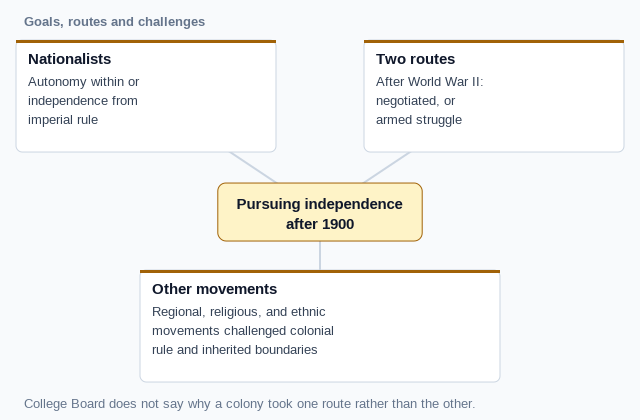
- Nationalist leaders and parties in Asia and Africa sought varying degrees of autonomy within or independence from imperial rule.
- After the end of World War II, some colonies negotiated their independence, while others achieved independence through armed struggle.
- Regional, religious, and ethnic movements challenged colonial rule and inherited imperial boundaries, and some advocated for autonomy.
Part 2 Learn it Routes out of empire
8.5a. What nationalists sought
The first statement is about leaders and parties:
Nationalist leaders and parties in Asia and Africa sought varying degrees of autonomy within or independence from imperial rule.
It gives two goals. Autonomy within imperial rule means more self-rule while staying inside the empire. Independence from it means leaving the empire. Varying degrees says the goals were not all alike: how much self-rule a party sought could differ from one to the next.
College Board's examples are the Indian National Congress, Ho Chi Minh in French Indochina (Vietnam), Kwame Nkrumah in British Gold Coast (Ghana), and Gamal Abdel Nasser in Egypt. The names in brackets are the states those colonies became.
Quick check · Select all
According to this topic, what did nationalist leaders and parties in Asia and Africa seek? Pick two.
Select 2 answers, then check.
8.5b. Two routes to independence
The second statement is this topic's comparison, and comparison is its reasoning process:
After the end of World War II, some colonies negotiated their independence, while others achieved independence through armed struggle.
While sets the two routes against each other. Both end in independence; they differ in how it was reached. Some and others say neither route was the only one.
College Board lists examples under each. Negotiated independence: India from the British Empire, the Gold Coast from the British Empire, and French West Africa. Independence through armed struggle: Algeria from the French empire, Angola from the Portuguese empire, and Vietnam from the French empire.
A good comparison names a likeness and a difference. Here the likeness is the outcome, independence, and the difference is the route.
Quick check · Multiple choice
Which comparison does this topic's statement on the years after World War II make?
8.5c. Movements that challenged borders
The third statement widens the picture:
Regional, religious, and ethnic movements challenged colonial rule and inherited imperial boundaries. Some of these movements advocated for autonomy.
These movements challenged two things. One was colonial rule. The other was inherited imperial boundaries: borders an empire had drawn, which a state could inherit when the empire left. So a movement could challenge a border inside a state that was already independent. Some advocated for autonomy, not all.
College Board's examples are the Muslim League in British India, the Québécois separatist movement in Canada, and the Biafra secessionist movement in Nigeria. Unlike the nationalist statement, this one names no region, and one of its examples is in North America.
Quick check · Select all
Compare this topic's nationalist leaders and parties with its regional, religious, and ethnic movements. Which two comparisons are accurate? Pick two.
Select 2 answers, then check.
Part 3 Watch it done Comparing two colonies
Watch the first steps, then take the last one yourself.
Compare the processes by which the Gold Coast and Angola pursued independence, using this topic's examples.
Predict first
Before the steps: what will a good comparison of the two need?
Step 1 · Name what is compared
Two processes: the route the Gold Coast took out of the British Empire, and the route Angola took out of the Portuguese empire.
Step 2 · Find each case in the lesson
Both colonies appear in the examples under the second chunk's statement, one under each of its two headings. Look up which heading holds which before you write.
Why this step?
Why name a likeness as well as a difference?
Comparing means saying what is alike and what differs. That the two colonies reached the same outcome is what makes the difference in how they got there worth noticing.
Your step · Decide and justify
Finish it. Which sentence compares the two processes?
What makes that sentence a comparison?
Part 4 Try it Two speeches, two developments
Two short speeches written for this page (they are not real sources):
> Speech A, the leader of a party in a colony in Asia, to a crowd in the colony's capital, 1946: "We do not ask the governor to leave tomorrow. We ask for a parliament of our own, inside the empire, to make our own laws."
> Speech B, the leader of a movement in a state in Africa a few years after independence, 1967: "The empire drew the lines that bound our region to this state. We did not choose them, and we ask to govern our own affairs."
Relate each speech to a development in this topic.
Try it · Fill the statement
Complete the note on the two speeches.
Speech A seeks for its colony, and Speech B challenges .
Part 5 Explain it Two roads to independence
This is a self-check. Nothing you type leaves this page. Set your answer beside the model and each scoring point.
Free-response practice · Question 1 style
A short practice in the shape of the document-based question: a thesis, one sentence of context and one paragraph that uses both documents and explains the purpose or audience of one, instead of a full essay. Both documents are written for this page and are not real.
Document 1: a nationalist leader in a colony in Africa, speaking on the radio to the colony's people, 1956: "We have won our freedom at the conference table, without a shot fired. Next year our flag will fly over our own parliament."
Document 2: a leaflet passed among villagers in a colony in Asia, 1954: "For years the empire answered our petitions with prisons. Now we answer it with arms. Join the fighters in the hills."
Using both documents, compare the processes by which various peoples pursued independence after 1900.
Model answer
Thesis: Peoples under imperial rule pursued the same goal, independence, by different routes after World War II: some negotiated it, as in Document 1, while others turned to armed struggle, as in Document 2.
Context: Long before World War II, increasing questions about political authority and growing nationalism had contributed to anticolonial movements, so both documents belong to a longer history of anticolonial movements.
The documents share an aim but not a method. In Document 1 a nationalist leader says freedom was won "at the conference table, without a shot fired," which is negotiated independence. In Document 2 the leaflet says that petitions brought "prisons" and calls people to "answer it with arms," which is armed struggle. Both seek independence rather than autonomy: Document 1 looks to the day "our flag will fly," and Document 2 to driving the empire out. Document 2's purpose shapes what it says. Written to recruit villagers to "join the fighters," it presents petitions as having failed, so it explains why its movement chose arms, from the fighters' side only.
Score your own answer. This is a self-check, not a grade. Tick each point your answer makes.
Part 6 Check yourself Four cases from the end of empire
The table drives the first two questions. The last two come from the rest of the lesson.
Four short cases. All four were written for this lesson and are not real places.
| Row | When and where | What happened |
|---|---|---|
| 1 | 1950s, a colony in Africa | The nationalist party wins an election held under the empire's rules, and talks in the imperial capital set a date for independence. |
| 2 | 1950s, a colony in Asia | After years of fighting in the countryside, the imperial army withdraws and the fighters' leaders form a government. |
| 3 | 1960s, a state in Africa a few years after independence | A region with its own language declares that it will leave the state and rule itself. |
| 4 | 1940s, a colony in Asia | A party asks for an elected council to run the colony's schools and roads, under the empire's governor. |
Case question 1 · Match
Match each row to the process it shows.
Case question 2 · Spot the error
A student compared the rows. Which line misreads the table?
The rest stand on their own and do not use the case.
Check yourself · Multiple choice
This topic's illustrative examples include India's independence from the British Empire and Algeria's from the French empire. Which comparison of the two do the examples support?
Check yourself · Select all
Which two statements from this unit could best support an argument that the end of empires did not settle where borders lay? Some choices are true but do not bear on the argument. Pick two.
Select 2 answers, then check.
Part 7 Keep it Bring back earlier ideas
One question from the lesson just before this one, and one from the Cold War's ideological struggle three lessons back.
A newspaper column written for this page (it is not a real source), printed by the Chinese communists just after they seized power, for readers in China:
> The people, worn out by quarrels at home and by the invaders' war, have turned to the Communist Party. The old rulers fought each other while the enemy burned our villages. We alone fought for the people, and the people have chosen us.
Sort each question by whether the column can answer it.
From 8.4 Spread of Communism After 1900 · Sort it
Sort each question a historian might ask of the column.
The column can show this
The column cannot show this
From 8.2 The Cold War · Select all
A speech written for this page (it is not a real source) opens a 1955 meeting of leaders from states that had recently become independent: "We are told the world must choose between two camps. We say there is another road, and we will build it ourselves." Which two choices best explain the speech's point of view and purpose? Pick two.
Select 2 answers, then check.
In three lines
- Nationalist leaders and parties in Asia and Africa sought varying degrees of autonomy within or independence from imperial rule.
- After World War II, some colonies negotiated their independence, while others achieved it through armed struggle.
- Regional, religious, and ethnic movements challenged colonial rule and inherited imperial boundaries.
Exam strategy for this topic
- Section I Part A, Multiple Choice: 55 questions in 55 minutes.
- Section I Part B, Short Answer: 3 questions in 40 minutes.
- Section II, Document-Based Question and Long Essay: 2 questions in 100 minutes.
- This lesson's Explain it is shaped like free-response question 1, Document-based.
When a prompt asks you to compare processes, write one sentence with a likeness and a difference, such as the same outcome reached by different routes, and name a case for each side.
Questions students ask
What is the difference between autonomy and independence?
Autonomy is more self-rule within imperial rule; independence is leaving it. The statement says nationalist leaders and parties in Asia and Africa sought varying degrees of either.
Which colonies negotiated, and which fought?
College Board's examples of negotiated independence are India and the Gold Coast from the British Empire, and French West Africa. Its examples of armed struggle are Algeria and Vietnam from the French empire and Angola from the Portuguese empire.
Why did some colonies fight while others negotiated?
The statement does not say. It sets the two routes side by side and gives examples. A source can show one movement's reasons, as the leaflet in Explain it does for its own side.
Why is a movement in Canada in a lesson on decolonization?
The statement on regional, religious, and ethnic movements names no region. The Québécois separatist movement in Canada is one of College Board's examples, beside the Muslim League in British India and the Biafra secessionist movement in Nigeria.
How does this topic connect to 8.1?
8.1 Setting the Stage for the Cold War and Decolonization says increasing anti-imperialist sentiment after World War II contributed to the dissolution of empires. This topic compares the ways peoples pursued independence as those empires came apart.
Course alignment, for teachers
AP World History: Modern topic 8.5, Unit 8: Cold War and Decolonization.
- Skill 5.B: Explain how a historical development or process relates to another historical development or process.
This lesson maps all 3 essential knowledge statements of the topic, and the one learning objective with none of its own, to the part that teaches each one: 4 are checked by a scored question. The map is in the lesson file.