Unit 5 · Topic 5.7 · about 30 minutes · 7 parts · 9 scored checks, 2 of them multiple choice, plus 2 from earlier lessons
AP World History: Modern 5.7: Economic Developments and Innovations in the Industrial Age
Unit 5: 12 to 15% of the multiple-choice section
What you'll be able to do
- Explain the development of economic systems, ideologies, and institutions and how they contributed to change in the period from 1750 to 1900.
Key vocabulary
| Term | What it means | The exam trap |
|---|---|---|
| Mercantilism | In the word's general meaning, a set of policies by which a state manages trade for its own gain. | Mercantilism is a state policy, not a business, so it never belongs on a list of transnational businesses or financial instruments. |
| Free trade | Trade between countries with few government limits on it. | The statement pairs free trade with policies, decisions by countries, and laissez-faire with theories, so keep the policy and the idea apart. |
| Laissez-faire capitalism | An economy run by private owners with as little government control as possible. | Growing acceptance describes how widely the theories were held, not that every government followed them. |
| Transnational business | A business that operates in more than one country. | Unilever's entry names four places, two where it was based and two where it operated, so read which kind a stem asks for. |
| Standard of living | How well people live, measured by things like income, goods and comfort. | It measures how people live, not a country's share of manufacturing, which is the different measure in 5.4 Industrialization Spreads in the Period from 1750 to 1900. |
 Tap to open the picture full size
Part 1 Think first Which way did trade policy turn?
Guess first. Checking a guess against the reading makes the reading stick.
Predict first
In the period before this one, European rulers used mercantilist policies and practices to expand and control their economies (4.5 Maritime Empires Maintained and Developed). By the 1800s, which way do you think some European countries had begun to move?
In short. Western European countries began moving from mercantilism to free trade, transnational businesses multiplied on new banking and finance, and industrial capitalism raised living standards for some.
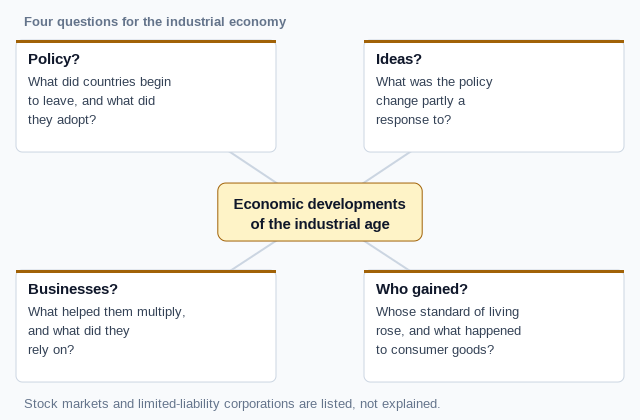
- Western European countries began abandoning mercantilism and adopting free trade policies, partly in response to the growing acceptance of Adam Smith's theories of laissez-faire capitalism and free markets.
- The global nature of trade and production contributed to the proliferation of large-scale transnational businesses that relied on new practices in banking and finance.
- Industrial capitalism led to increased standards of living for some, and to continued improvement in manufacturing methods that made consumer goods more available, affordable and varied.
Part 2 Learn it Policies, businesses, and their results
2a. From mercantilism toward free trade
Trade policy first. This topic's statement: Western European countries began abandoning mercantilism and adopting free trade policies, partly in response to the growing acceptance of Adam Smith's theories of laissez-faire capitalism and free markets.
The statement relates an idea to a policy. As Smith's theories won growing acceptance, Western European countries started to change how they handled trade.
Two small words set the limits. Began makes this a shift getting under way, not one finished. Partly makes the theories one reason among others, and the statement does not name the others.
The statement is also about Western European countries only. It says nothing about trade policy elsewhere.
Quick check · Multiple choice
How does this topic relate the growing acceptance of Adam Smith's theories to trade policy?
2b. Transnational businesses and new finance
The second statement links trade to business. The global nature of trade and production contributed to the proliferation of large-scale transnational businesses that relied on new practices in banking and finance.
Proliferation is a rapid increase in number. A transnational business operates in more than one country. Contributed to makes the global nature of trade one cause of their spread, not the only one.
College Board's examples of transnational businesses are the Hong Kong and Shanghai Banking Corporation (HSBC) and Unilever, based in England and the Netherlands and operating in British West Africa and the Belgian Congo.
It also lists two financial instruments: stock markets and limited-liability corporations. It does not say how either one worked, or which business used them.
Quick check · Select all
Which two links does this topic make about large-scale transnational businesses? Pick two.
Select 2 answers, then check.
2c. What industrial capitalism brought, and to whom
The last statement gives results. The development of industrial capitalism led to increased standards of living for some, and to continued improvement in manufacturing methods that increased the availability, affordability, and variety of consumer goods.
There are two results, and the second has a chain of its own: better manufacturing methods made consumer goods easier to find, cheaper and more varied.
For some is the limit to hold on to. The statement does not say whose standard of living rose, and it does not say everyone's did.
Continued matters too. Improvement in manufacturing kept going across the period, so it is a change that went on rather than one that happened once.
Quick check · Select all
Which two does this topic give as results of the development of industrial capitalism? Pick two.
Select 2 answers, then check.
Part 3 Watch it done Fit a policy change into a pattern
Watch two steps, then decide the third yourself.
One of the questions College Board gives for this topic's skill: "How or why does the development or process fit into a pattern of continuity or change over time?"
Apply it to Western European trade policy, using the earlier period in 4.5 Maritime Empires Maintained and Developed and this lesson.
Predict first
Before the steps: set beside the mercantilism of the period before, what did this period's Western European trade policy do?
Step 1 · The earlier pattern
From 4.5 Maritime Empires Maintained and Developed: mercantilist policies and practices were used by European rulers to expand and control their economies and claim overseas territories.
Step 2 · What this lesson adds
Western European countries began abandoning mercantilism and adopting free trade policies, partly in response to the growing acceptance of Adam Smith's theories. Set beside the earlier pattern, that is a change in policy, and the statement gives one reason for it.
Why this step?
Why does the word began matter for continuity and change?
It marks a change in motion. The statement does not claim mercantilism was gone, so an answer that calls the change complete says more than the statement does.
Your step · Decide and justify
Finish it. A student writes: "In this period, Western European countries began moving from mercantilism toward free trade, partly because Adam Smith's theories were winning growing acceptance." Does the sentence give the change as the statement does?
Why?
Part 4 Try it A shopkeeper's account
An account written for this page in the voice of a shopkeeper in an industrial town in the late 1800s. It draws on this topic's statement about industrial capitalism and is not a real document.
"My shelves hold more kinds of cloth, soap and tinware than my father's ever did, and at lower prices, since the factories keep finding better ways to make them. Some of my customers buy more each year. Many of the families on our street still cannot afford them."
Try it · Fill the statement
Relate the account to this topic's statement on industrial capitalism.
In the shopkeeper's telling, the fuller, cheaper shelves come from , and the account's sign that the rise in living standards reached only some is .
Part 5 Explain it Economic ideas and institutions, in writing
This is a self-check. Nothing you type leaves this page. Compare your work with the model and each scoring point.
Free-response practice · Question 2 style
A short practice in the shape of the long essay question: a thesis, one sentence of context and one paragraph of evidence instead of a full essay.
Explain how new economic ideas and institutions contributed to change in the period from 1750 to 1900.
Model answer
Thesis: New economic ideas and institutions contributed to change: the growing acceptance of Adam Smith's theories was part of why Western European countries began moving toward free trade, and large transnational businesses that relied on new practices in banking and finance multiplied as trade and production became global.
Context: From 1450 to 1750, European rulers had used mercantilist policies and practices to expand and control their economies and claim overseas territories, so the move toward free trade that began in this period was a turn away from a long practice of rulers using trade policy to control their economies.
Western European countries began abandoning mercantilism and adopting free trade policies, partly in response to the growing acceptance of Adam Smith's theories of laissez-faire capitalism and free markets. Alongside that shift in policy, the global nature of trade and production contributed to the proliferation of large-scale transnational businesses, such as HSBC and Unilever, that relied on new practices in banking and finance. The development of industrial capitalism led to increased standards of living for some and to continued improvement in manufacturing methods, which made consumer goods more available and affordable. An idea helped start a shift in policy, and global trade helped large businesses multiply, which is how these ideas and institutions contributed to change.
Score your own answer. This is a self-check, not a grade. Tick each point your answer makes.
Part 6 Check yourself Developments and what they relate to
The first two questions use the table. The other two cover the rest of the lesson.
A student's table of this lesson's developments.
| Row | Development | Examples College Board gives | What this topic relates it to |
|---|---|---|---|
| 1 | Large-scale transnational businesses | HSBC; Unilever, based in England and the Netherlands and operating in British West Africa and the Belgian Congo | the global nature of trade and production contributed to their proliferation; they relied on new practices in banking and finance |
| 2 | Financial instruments | stock markets; limited-liability corporations | listed as examples, with nothing on how they worked or which business used them |
| 3 | Free trade policies | none given | Western European countries began adopting them and abandoning mercantilism, partly in response to the growing acceptance of Adam Smith's theories |
| 4 | Industrial capitalism | none given | led to increased standards of living for some, and to continued improvement in manufacturing methods that increased the availability, affordability, and variety of consumer goods |
Case question 1 · Sort it
Sort each claim by what the table does with it.
The table supports it
The table contradicts it
The table does not say
Case question 2 · Spot the error
A student wrote this paragraph from the table. Which line is the first to go wrong?
The rest stand on their own and do not use the case.
Check yourself · Multiple choice
Which countries does this topic say began abandoning mercantilism?
Check yourself · Select all
Which two of these does this unit describe as changes rather than continuities? Pick two.
Select 2 answers, then check.
Part 7 Keep it Bring back earlier ideas
One question from the lesson on government's role and one from the lesson on technology.
From 5.6 Industrialization: Government’s Role from 1750 to 1900 · Multiple choice
Which description matches what this topic says about governments and industrialization?
From 5.5 Technology of the Industrial Age · Select all
This topic says railroads, steamships, and the telegraph made three things possible in interior regions globally. Which two of these are among them? Pick two.
Select 2 answers, then check.
In three lines
- Western European countries began abandoning mercantilism for free trade, partly in response to the growing acceptance of Adam Smith's theories.
- The global nature of trade and production contributed to the proliferation of transnational businesses, such as HSBC and Unilever, that relied on new practices in banking and finance.
- Industrial capitalism raised standards of living for some, and continued improvement in manufacturing made consumer goods more available, affordable and varied.
Exam strategy for this topic
- Section I Part A, Multiple Choice: 55 questions in 55 minutes.
- Section I Part B, Short Answer: 3 questions in 40 minutes.
- Section II, Document-Based Question and Long Essay: 2 questions in 100 minutes.
- This lesson's Explain it is shaped like free-response question 2, Long essay.
When a question asks how one development relates to another, name both developments and the link between them, and keep the link's strength as the source gives it. Partly in response to and contributed to mark one cause among others, not the whole story.
Questions students ask
Did free trade replace mercantilism everywhere?
This topic says Western European countries began abandoning mercantilism and adopting free trade policies. It says nothing about trade policy in other regions, and began means the shift was under way.
What were the other reasons for the move to free trade?
The statement says the countries acted partly in response to the growing acceptance of Adam Smith's theories. It does not name the other reasons.
What did stock markets and limited-liability corporations do?
College Board lists them as examples of financial instruments and does not explain them. An answer can name them as examples without describing how they worked.
Whose standard of living increased?
The statement says increased standards of living for some. It names no group, so an answer should not add one from this lesson.
Is the improvement in manufacturing a change or a continuity?
Both readings have a part. The statement calls it continued improvement, so the improving went on across the period, and what it brought, more available, affordable and varied goods, was a change.
Course alignment, for teachers
AP World History: Modern topic 5.7, Unit 5: Revolutions.
- Skill 5.B: Explain how a historical development or process relates to another historical development or process.
This lesson maps all 3 essential knowledge statements of the topic, and the one learning objective with none of its own, to the part that teaches each one: 4 are checked by a scored question. The map is in the lesson file.