Unit 5 · Topic 5.1 · about 30 minutes · 7 parts · 10 scored checks, 2 of them multiple choice, plus 2 from earlier lessons
AP World History: Modern 5.1: The Enlightenment
Unit 5: 12 to 15% of the multiple-choice section
What you'll be able to do
- Explain the ideas and beliefs that formed the setting in which revolutions swept the Atlantic world from 1750 to 1900.
- Explain how the Enlightenment affected societies over time.
Key vocabulary
| Term | What it means | The exam trap |
|---|---|---|
| Enlightenment | A movement of thought that put reason and new ways of understanding at the center of how people studied nature and society. | It is a body of thought, not an event or a government, so a choice that treats it as a rebellion misreads the term. |
| Empiricist | In the word's general meaning, relying on observation and experience to understand something. | These approaches were applied to human relationships as well as to the natural world, so the word is not about science alone. |
| Natural rights | In the general meaning, rights a person is thought to have simply by being a person. | Natural here does not mean the natural world that empiricist approaches studied; it names where the rights are said to come from. |
| Social contract | In the general meaning, an agreement, spoken or understood, about how people are to be governed. | A contract here is about how people are governed, so a stem about government resting on agreement points to it even without the word. |
| Suffrage | The right to vote. | Two statements in this topic use the word, one about reform and one about women's demands, so read which one a stem is quoting. |
| Emergent feminism | Feminism, the case for women's rights and standing, at the stage when it was taking shape. | Emergent marks a beginning, so read it as a movement forming, not as a change already settled in law. |
 Tap to open the picture full size
Part 1 Think first A declaration for women
Commit to a guess before you read. A wrong guess now still helps the right idea stick.
Predict first
During the French Revolution came the "Declaration of the Rights of Man and of the Citizen." Olympe de Gouges wrote a Declaration of the Rights of Woman and of the Female Citizen, a title that closely tracks the first one. What do you think she was doing?
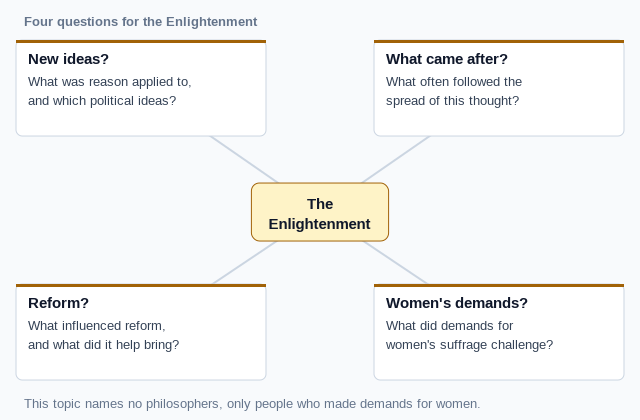
In short. The Enlightenment applied reason and empiricist approaches to the natural world and to human relationships, gave philosophers new political ideas, often spread before revolutions against existing governments, and, with religious ideals, influenced reform movements that contributed to the expansion of rights.
- Philosophers developed new political ideas about the individual, natural rights and the social contract, and they reexamined the role religion played in public life.
- Enlightenment thought questioned established traditions in all areas of life, and its rise and spread often came before revolutions and rebellions; nationalism also became a major force shaping states and empires.
- Reform movements contributed to expanded suffrage, the abolition of slavery and the end of serfdom, and demands for women's suffrage challenged political and gender hierarchies.
Part 2 Learn it Ideas, revolutions and reform
2a. Reason applied to everything
Enlightenment philosophies took new ways of understanding to two subjects at once: the natural world and human relationships. They used empiricist approaches, which rest on observation and experience, and they emphasized the importance of reason.
Religion was not left out. These philosophies reexamined the role that religion played in public life. Reexamined means looked at again, so read it as a question asked, not as an answer about where religion ended up.
Out of this came new political ideas. Philosophers developed ideas about:
- the individual
- natural rights
- the social contract
This topic names no philosopher for any of them, so a page that attaches a name is going past this topic.
Quick check · Multiple choice
This topic says philosophers developed new political ideas. Which ideas does it name?
2b. Before the revolutions
This is the context half of the topic. Enlightenment thought questioned established traditions in all areas of life, not in government alone. Its rise and diffusion often preceded revolutions and rebellions against existing governments.
Two words in that sentence carry its meaning. Preceded means came before. Often means in many cases, so it is a pattern, not a law with no exceptions.
A second force grew up beside it: nationalism also became a major force shaping the historical development of states and empires. This topic says only that much. Where the new sense of a shared nation came from is the start of 5.2 Nationalism and Revolutions in the Period from 1750 to 1900.
Quick check · Select all
Which two statements match what this topic says about the context in which revolutions swept the Atlantic world? Pick two.
Select 2 answers, then check.
2c. Ideas that fed reform
The ideas did not stay in books. Enlightenment ideas and religious ideals influenced various reform movements. Two sources, then, and the second is religious: religion, the very subject the philosophers reexamined, still fed reform.
Those reform movements contributed to the expansion of rights, and the statement shows it in three results:
- expanded suffrage, the right to vote reaching more people
- the abolition of slavery
- the end of serfdom
Contributed to means helped bring about. It does not make reform the whole cause.
The next checks are passages written for this page. In each, find the claim, the point the writer is trying to prove, and the support, the sentences that back it. The claim can sit anywhere in a passage.
Quick check · Select all
A passage written for this page reads: "Reform had more than one root. Enlightenment ideas and religious ideals both influenced reform movements, and those movements contributed to expanded suffrage and the end of serfdom." Which two statements describe the passage accurately? Pick two.
Select 2 answers, then check.
2d. Women's demands
One more effect. Demands for women's suffrage and an emergent feminism challenged political and gender hierarchies. Emergent means taking shape. Two kinds of rank were under challenge: rank in political life, and rank between men and women.
College Board's examples of these demands:
- Mary Wollstonecraft's A Vindication of the Rights of Woman
- Olympe de Gouges's Declaration of the Rights of Woman and of the Female Citizen, the writer from Think first
- the Seneca Falls Conference, organized by Elizabeth Cady Stanton and Lucretia Mott
College Board lists these by title and organizer only. It does not quote them or say what each one won.
Quick check · Select all
A passage written for this page reads: "Demands for women's suffrage, together with an emergent feminism, challenged political hierarchies and gender hierarchies alike. More than the vote was at stake." Which two statements describe the passage accurately? Pick two.
Select 2 answers, then check.
Part 3 Watch it done Find the claim, then describe it
Watch the first steps, then take the last one yourself.
A short passage written for this page from this topic's statements:
"(1) Enlightenment writers put old customs to the test of reason. (2) They studied the natural world and human relationships through observation and experience. (3) They also reexamined the role religion played in public life. (4) Where their thought spread, revolutions and rebellions against existing governments often followed."
Identify the passage's claim, then describe exactly what sentence 4, a further point, claims.
Predict first
Before the steps: which sentence is the passage's claim?
Step 1 · Ask what each sentence is for
Sentences 2 and 3 give things the writers did: they studied by observation and experience, and they reexamined religion's role. Both are cases of testing old customs by reason, so they back up sentence 1. Sentence 1 is the claim.
Step 2 · Describe the claim in your own words
To describe a claim is to say what it holds, not just to point at it: the passage holds that these writers judged inherited customs by reason rather than accepting them.
Why this step?
Why is sentence 4 not the claim, even though it is the most striking?
Nothing else in the passage backs it up. Sentences 2 and 3 are about how the writers thought, not about revolutions. Sentence 4 adds what often came next. It is a further point the passage sets down without support, so sentence 1 stays the claim.
Your step · Decide and justify
Finish it. Sentence 4 reads: "Where their thought spread, revolutions and rebellions against existing governments often followed." Does sentence 4 claim that the writers' thought caused those revolutions?
Why?
Part 4 Try it A reformer's speech
A speech written for this page in the voice of a reformer of the period, from this topic's statements and examples. It is not a real document.
"Some say that the rights of the individual belong to men alone. Custom, they insist, should keep women out of political life. I answer that these rights belong to women as fully as to men. I take my ground on the philosophers: they wrote of natural rights as the rights of the individual, and a woman is an individual. Mary Wollstonecraft's A Vindication of the Rights of Woman was one of the demands made for women. Olympe de Gouges's Declaration of the Rights of Woman and of the Female Citizen was another."
Try it · Sort it
Sort each sentence of the speech by the part it plays in the speaker's argument.
The speaker's claim
Support for the claim
A view the speaker argues against
Part 5 Explain it How the Enlightenment affected societies, in writing
This is a self-check. Nothing you type leaves this page. Compare your answer with the model and each scoring point.
Free-response practice · Question 2 style
A short practice in the shape of the long essay question: a thesis, one sentence of context and one paragraph of evidence instead of a full essay.
Explain how the Enlightenment affected societies in the period from 1750 to 1900.
Model answer
Thesis: The Enlightenment affected societies by questioning established traditions, and its ideas, joined with religious ideals, influenced reform movements that helped expand rights and that challenged political and gender hierarchies.
Context: The 18th century began an intense period of revolution and rebellion against existing governments, leading to new nation-states around the world, so the question of how people should be governed was open in many places.
Enlightenment philosophers applied reason and empiricist approaches to human relationships as well as to the natural world, and they developed new political ideas about the individual, natural rights and the social contract. Those ideas, together with religious ideals, influenced reform movements, and the movements contributed to expanded suffrage, the abolition of slavery and the end of serfdom. Demands for women's suffrage, such as Mary Wollstonecraft's A Vindication of the Rights of Woman and the Seneca Falls Conference organized by Elizabeth Cady Stanton and Lucretia Mott, challenged rank in political life and rank between men and women. The effect ran through reform: ideas that questioned established traditions in all areas of life influenced movements, and those movements contributed to changes in who could vote and in slavery and serfdom.
Score your own answer. This is a self-check, not a grade. Tick each point your answer makes.
Part 6 Check yourself A historian's claim
Use the passage for the first two questions. The last two cover the whole lesson.
A passage in the style of a historian, written for this page from this topic's statements. It is not a real source. Its four sentences are set out in the table.
| Sentence | Text |
|---|---|
| 1 | Studies of the revolutions of the Atlantic world often begin with ideas, and two points about those ideas are widely accepted. |
| 2 | Enlightenment thought questioned established traditions in all areas of life, and its rise and spread often came before revolutions and rebellions against existing governments. |
| 3 | The same ideas, together with religious ideals, influenced reform movements that contributed to expanded suffrage, the abolition of slavery and the end of serfdom. |
| 4 | This essay argues that the Enlightenment's effects reached well past the revolutions themselves. |
Case question 1 · Fill the statement
Complete a student's description of the historian's argument.
The historian's claim is in , and the reform movements, which contributed to the expansion of rights, are offered as .
Case question 2 · Spot the error
Another student described the passage line by line. Which line is the first to go wrong?
The rest stand on their own and do not use the case.
Check yourself · Multiple choice
A passage written for this page reads: "A government should answer to reason, not to habit. Philosophers reexamined the role religion played in public life, and they wrote about natural rights and the social contract." What is the author trying to prove?
Check yourself · Match
Match each item to what this topic says it was.
Part 7 Keep it Bring back earlier ideas
One question from the review of Unit 4 and one from the lesson on maritime empires maintained and developed, so both come round again.
From 4.8 Continuity and Change from 1450 to 1750 · Select all
Which two pieces of evidence from this unit show something that continued, rather than something new, from 1450 to 1750? Pick two.
Select 2 answers, then check.
From 4.5 Maritime Empires Maintained and Developed · Multiple choice
A passage written for this page reads: "Silver helped create a new global circulation of goods. Flowing especially from Spanish colonies in the Americas, it bought Asian goods for Atlantic markets and met Chinese demand for silver." What is the passage's claim?
In three lines
- Philosophers applied reason and empiricist approaches, reexamined religion's role in public life, and developed ideas about the individual, natural rights and the social contract.
- Enlightenment thought questioned established traditions and often spread before revolutions; nationalism also became a major force.
- Enlightenment ideas and religious ideals influenced reform movements that expanded rights, and women's demands challenged political and gender hierarchies.
Exam strategy for this topic
- Section I Part A, Multiple Choice: 55 questions in 55 minutes.
- Section I Part B, Short Answer: 3 questions in 40 minutes.
- Section II, Document-Based Question and Long Essay: 2 questions in 100 minutes.
- This lesson's Explain it is shaped like free-response question 2, Long essay.
When a question asks for a source's claim, find the sentence the other sentences back up; it can come first, last or in the middle. Then describe it with its limiting words, such as often, still attached.
Questions students ask
Which philosophers does this topic name?
None. It describes what Enlightenment philosophies did and which political ideas philosophers developed, without naming any of them. Its named people are the examples of demands for women: Wollstonecraft, de Gouges, Stanton and Mott.
Did the Enlightenment reject religion?
The statement says its philosophies reexamined the role religion played in public life. Another statement names religious ideals beside Enlightenment ideas as an influence on reform movements, so religion stayed part of the story.
What does this topic say about nationalism?
Only that it also became a major force shaping the historical development of states and empires. Where the sense of a shared nation came from, and what nationalists did with it, is in 5.2 Nationalism and Revolutions in the Period from 1750 to 1900.
What did the Seneca Falls Conference do?
College Board lists it, organized by Elizabeth Cady Stanton and Lucretia Mott, as an example of demands for women's suffrage and an emergent feminism. It does not describe what the conference said or achieved.
Why does a topic about ideas sit in a unit called Revolutions?
Because this topic's ideas are the context for the unit's revolutions: the rise and spread of Enlightenment thought often came before revolutions and rebellions against existing governments, which 5.2 Nationalism and Revolutions in the Period from 1750 to 1900 takes up.
Course alignment, for teachers
AP World History: Modern topic 5.1, Unit 5: Revolutions.
- Skill 3.A: Identify and describe a claim and/or argument in a text-based or non-text-based source.
This lesson maps all 5 essential knowledge statements of the topic, and the 2 learning objectives with none of their own, to the part that teaches each one: 7 are checked by a scored question. The map is in the lesson file.