Unit 1 · Topic 1.7 · about 30 minutes · 7 parts · 9 scored checks, 2 of them multiple choice, plus 2 from earlier lessons
AP World History: Modern 1.7: Comparison in the Period from c. 1200 to c. 1450
Unit 1: 8 to 10% of the multiple-choice section
What you'll be able to do
- Explain the similarities and differences in how states formed across regions from c. 1200 to c. 1450, and make a historically defensible claim about them.
Key vocabulary
| Term | What it means | The exam trap |
|---|---|---|
| State formation | How states come into being and take shape. | A state and a religion can share a label. Read whether a claim is about a government or a belief. |
| Continuity | What carries on from earlier times. | Continuity and change can sit inside one development. Name which one your claim is about. |
| Innovation | Something new, done or made for the first time. | New does not mean better. The word says only that something had not been done before. |
| Diversity | Variety; differences among things of one kind. | The word on its own does not say what differed. Say whether you mean rulers, beliefs or forms of government. |
| Scope and reach | How much a state governs, and how far its rule extends. | Two measures share one phrase. A claim may be about only one of them, so say which. |
 Tap to open the picture full size
Part 1 Think first Which claim is strongest?
Commit to a guess before you read. A wrong guess now still helps the right idea stick.
Predict first
Three students each write one sentence comparing Song China and Europe in this period. Which do you expect a history teacher would rate as the strongest claim?
In short. From c. 1200 to c. 1450, state formation showed continuity, innovation and diversity in many regions, and the forms it took differed from Song China's bureaucracy to the Hindu and Buddhist states of South and Southeast Asia.
- The shared pattern: state formation and development showed continuity, innovation and diversity in various regions.
- The differences: Song China kept traditional Confucian methods and an imperial bureaucracy, Dar al-Islam fragmented into new Islamic states mostly dominated by Turkic peoples, and South and Southeast Asia saw new Hindu and Buddhist states.
- In the Americas and in Africa, state systems also expanded in scope and reach, and a defensible claim about any of this is one the evidence can support.
Part 2 Learn it Comparing state formation
2a. The pattern the unit keeps finding
This topic adds no new region. It asks you to use the unit's key ideas to argue.
Start with the sentence that sums the unit up: state formation and development demonstrated continuity, innovation and diversity in various regions.
You met those three words in every lesson:
- Afro-Eurasia in the 13th century, including Song China;
- the new Islamic states as the Abbasid Caliphate fragmented;
- the new Hindu and Buddhist states of South and Southeast Asia;
- the state systems of the Americas and of Africa, which also expanded in scope and reach.
That repeated description is the main similarity across regions. It is a similarity of pattern: in each place, older ways carried on, new ones appeared, and states took more than one form.
Quick check · Multiple choice
Which claim best states the similarity the course draws in state formation across regions from c. 1200 to c. 1450?
2b. Where the regions part ways
The same pattern took different forms, and those forms are your differences. They are easiest to see in pairs:
- Song China kept power through traditional methods of Confucianism and an imperial bureaucracy, while Europe was politically fragmented, with decentralized monarchies and feudalism.
- Dar al-Islam saw new Islamic political entities, most dominated by Turkic peoples, while South and Southeast Asia saw new Hindu and Buddhist states.
- The Americas and Africa were described alike, but with different states: the Maya city-states and the Inca in one, Great Zimbabwe and Ethiopia in the other.
A good comparison names both regions and the feature that differs, in one sentence.
Quick check · Select all
Which two claims about differences in state formation in this period are historically defensible? Pick two.
Select 2 answers, then check.
2c. Making a defensible claim
This topic's skill is to make a historically defensible claim.
A claim takes a position someone could argue with. A historically defensible claim is one the historical evidence can support. The long essay rubric adds that a thesis must respond to the prompt rather than restate it, and that it establishes a line of reasoning.
Test the three sentences from Think first:
- "Song China and Europe were different" is true but too vague to argue; it does not say how.
- "Song China was better governed" is an opinion. Nothing in the unit's evidence can settle it.
- "Song China ruled through an imperial bureaucracy, while Europe was politically fragmented" names a difference and can be backed with evidence from both lessons.
A comparative claim gets stronger when it says how the regions differ or match, and when every part of it can be traced to a statement you could cite.
Quick check · Multiple choice
Which of these is a historically defensible comparative claim, rather than a bare fact or a personal opinion?
Part 3 Watch it done From a Venn diagram to a claim
Watch the first steps, then take the last one yourself.
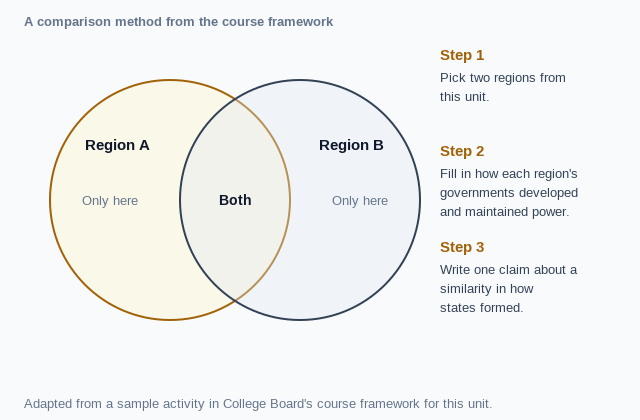
Using a Venn diagram, make a historically defensible claim about a similarity in state formation in Dar al-Islam and in South and Southeast Asia in the period c. 1200 to c. 1450.
Step 1 · Fill each circle
Dar al-Islam: as the Abbasid Caliphate fragmented, new Islamic political entities emerged, most dominated by Turkic peoples. South and Southeast Asia: new Hindu and Buddhist states emerged.
Step 2 · Find the overlap
In both regions, new states emerged in this period. Both regions' statements also describe state formation with continuity, innovation and diversity. Those go in the middle. Islamic and Turkic-dominated stays on one side; Hindu and Buddhist on the other.
Why this step?
Why build the claim from the middle of the diagram?
The prompt asks for a similarity, and the middle holds only what is true of both regions. Anything from one side alone would make the claim false for the other region.
Your step · Decide and justify
Finish it. Which claim about a similarity is historically defensible?
Which evidence supports your claim?
Part 4 Try it Defensible or not?
Five claims about state formation, written for this page by imaginary students. Judge each one the way chunk 3 taught: can the unit's evidence support it?
Try it · Sort it
Sort each claim about state formation, c. 1200 to c. 1450, by whether it is historically defensible.
Historically defensible
Not defensible
Part 5 Explain it A comparative thesis
This is a self-check. Nothing you type leaves this page. Compare your answer with the model and each scoring point.
Free-response practice · Question 2 style
A short practice in the shape of the long essay question: a thesis, one sentence of context and one paragraph of evidence instead of a full essay. Use what this unit taught.
In the period c. 1200 to c. 1450, both Song China and Dar al-Islam saw important political developments.
Compare the processes of state formation in Song China and in Dar al-Islam in the period c. 1200 to c. 1450.
Model answer
Thesis: State formation in Song China and Dar al-Islam was similar in showing continuity, innovation and diversity, but it differed in form: Song government carried traditional methods forward, while in Dar al-Islam a fragmenting caliphate gave way to new states.
Context: State building reached well beyond these two regions. In the same period, state systems in the Americas and in Africa expanded in scope and reach, so Song China and Dar al-Islam are two cases in a world where states were growing on several continents.
The Song Dynasty used traditional methods of Confucianism and an imperial bureaucracy to maintain and justify its rule, so Song government is a case of continuity. In Dar al-Islam, by contrast, the Abbasid Caliphate fragmented and new Islamic political entities emerged, such as the Seljuk Empire and the Mamluk sultanate of Egypt, most dominated by Turkic peoples. Both regions fit the shared pattern, yet one shows a state carrying older methods forward and the other shows new states forming, which is why the comparison is about different forms of the same process.
Score your own answer. This is a self-check, not a grade. Tick each point your answer makes.
Part 6 Check yourself A student's Venn diagram
The written-out diagram is for the first two questions. The last two draw on the whole unit.
A student compared state systems in Africa and in the Americas with a Venn diagram, written out here as a table. One entry is in the wrong place.
| Part of the diagram | Entry |
|---|---|
| Only Africa | Great Zimbabwe |
| Only Africa | The Hausa kingdoms |
| Both | Continuity, innovation and diversity |
| Both | Expanded in scope and reach |
| Only the Americas | Ethiopia |
| Only the Americas | The Maya city-states |
Case question 1 · Fill the statement
Complete the claim the student builds from the diagram.
State systems in Africa and the Americas were alike, since both demonstrated continuity, innovation and diversity and in scope and reach, but they were different states, such as in Africa and the Inca in the Americas.
Case question 2 · Spot the error
Which entry in the student's diagram is in the wrong place?
The rest stand on their own and do not use the case.
Check yourself · Select all
A student's Venn diagram compares Dar al-Islam with Europe in this period. Which two statements belong in the shared middle, true of both? Pick two.
Select 2 answers, then check.
Check yourself · Select all
A student claims: "State formation from c. 1200 to c. 1450 took many different forms." Which two pieces of evidence best support that claim? Pick two.
Select 2 answers, then check.
Part 7 Keep it Bring back earlier ideas
One question from the Europe lesson and one from the Americas lesson, so both come round again before the unit ends.
From 1.6 Developments in Europe from c. 1200 to c. 1450 · Select all
Which two statements about religion in Europe in this period are accurate? Pick two.
Select 2 answers, then check.
From 1.4 State Building in the Americas · Select all
Which two of these were state systems in the Americas in this period? Pick two.
Select 2 answers, then check.
In three lines
- State formation showed continuity, innovation and diversity in various regions from c. 1200 to c. 1450.
- Its forms differed: Song China's bureaucracy, Dar al-Islam's new Islamic states, South and Southeast Asia's Hindu and Buddhist states, and the state systems of the Americas and Africa.
- A historically defensible claim names how regions match or differ and can be supported by evidence.
Exam strategy for this topic
- Section I Part A, Multiple Choice: 55 questions in 55 minutes.
- Section I Part B, Short Answer: 3 questions in 40 minutes.
- Section II, Document-Based Question and Long Essay: 2 questions in 100 minutes.
- This lesson's Explain it is shaped like free-response question 2, Long essay.
Before you write a comparative thesis, check that every part of it is true of the region you give it to, and that it says how the regions match or differ rather than only that they do.
Questions students ask
Why does this topic teach no new region?
College Board's framework says the final topic in the unit focuses on argumentation, so students draw on the key concepts and developments of the whole unit.
What makes a claim historically defensible?
Evidence can support it. The long essay rubric also asks that a thesis respond to the prompt rather than restate it, and that it establish a line of reasoning.
Where does the Venn diagram method come from?
One of College Board's sample activities for this unit has students compare how governments in two regions developed and maintained power on a Venn diagram, then write a claim about similarities.
Does a comparison need both a similarity and a difference?
College Board defines compare as providing a description or explanation of similarities and/or differences. A strong answer often uses both, but read what the prompt asks for.
Course alignment, for teachers
AP World History: Modern topic 1.7, Unit 1: The Global Tapestry.
- Skill 6.A: Make a historically defensible claim.
This lesson maps all 6 essential knowledge statements of the topic, and the one learning objective with none of its own, to the part that teaches each one: 7 are checked by a scored question. The map is in the lesson file.