Unit 7 · Topic 7.9 · about 30 minutes · 7 parts · 9 scored checks, 2 of them multiple choice, plus 2 from earlier lessons
AP World History: Modern 7.9: Causation in Global Conflict
Unit 7: 8 to 10% of the multiple-choice section
What you'll be able to do
- Explain the relative significance of the causes of global conflict in the period 1900 to the present.
Key vocabulary
| Term | What it means | The exam trap |
|---|---|---|
| Corroborate | To back an argument with further evidence that agrees with it. This is the lesson's working meaning. | Corroborating adds support but does not prove the argument, so a corroborated claim can still need qualifying. |
| Qualify | To limit how far an argument holds, in place, time or degree. This is the lesson's working meaning. | A qualified argument still stands within its limits, so qualifying is not the same as refuting. |
| Modify | To change an argument's claim in light of new evidence. This is the lesson's working meaning. | Modifying changes the claim itself, while qualifying keeps the claim and narrows where it holds. |
| Relative significance | How much one cause mattered compared with others. | Relative means compared, so calling a cause important is not yet a claim about its significance until it is set against others. |
| Complex argument | An argument that, in the skill's words, might "explain nuance of an issue by analyzing multiple variables" or "explain relevant and insightful connections within and across periods." | A complex argument still makes one claim, so evidence against it is a way to sharpen the thesis, not a reason to drop it. |
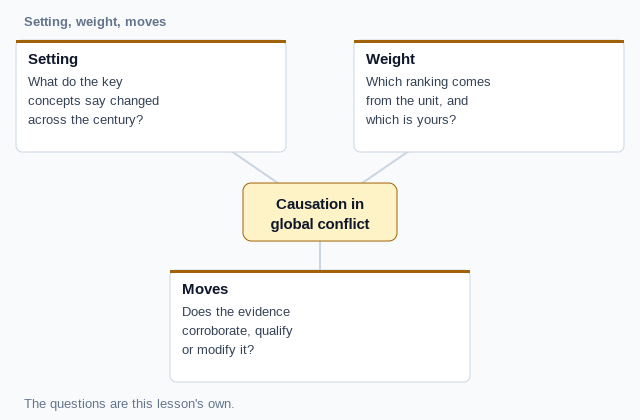 Tap to open the picture full size
Part 1 Think first One cause for a whole century
Commit to a guess before you read. A wrong guess now still helps the right idea stick.
Predict first
A classmate says one cause explains every major conflict from 1900 on. If you had to put one forward, which would you pick?
In short. This review topic asks you to argue about the relative significance of the causes of global conflict, using the unit's key concepts, which say that peoples and states around the world challenged the existing political and social order in varying ways, leading to unprecedented worldwide conflicts.
- The West dominated the global political order at the beginning of the 20th century, but both land-based and maritime empires gave way to new states by the century's end.
- The unit names causes for each world war, and a ranking of them beyond the unit's own words is the writer's argument.
- To corroborate, qualify or modify an argument, use evidence that agrees with it and evidence that cuts against it.
Part 2 Learn it Arguing about the causes of global conflict
2a. Challenges to the existing order
This topic adds no new statements. Its page says the final topic in the unit focuses on the skill of argumentation, and it repeats the unit's key concepts as evidence to argue from. Two of them frame the century.
Peoples and states around the world challenged the existing political and social order in varying ways, leading to unprecedented worldwide conflicts. Varying ways means the challenges took different forms. Unprecedented means the conflicts had no earlier example.
States around the world challenged the existing political and social order, including the Mexican Revolution that arose as a result of political crisis. The Mexican Revolution is the one example named, and its cause is political crisis.
Read together, the first gives a direction, challenges leading to conflict, and the second gives one case of a challenge with a cause of its own. Neither ranks one cause of conflict above another.
Quick check · Multiple choice
According to the review, peoples and states around the world challenged the existing political and social order in varying ways. What did those challenges lead to?
2b. Empires, and the advances of the century
Three more key concepts give the setting.
The West dominated the global political order at the beginning of the 20th century, but both land-based and maritime empires gave way to new states by the century's end. But turns the sentence from a start to an end, and both takes in empires on land and empires by sea.
The older, land-based Ottoman, Russian, and Qing empires collapsed due to a combination of internal and external factors. These changes in Russia eventually led to communist revolution. Combination means neither kind of factor worked alone.
Rapid advances in science and technology altered the understanding of the universe and the natural world and led to advances in communication, transportation, industry, agriculture, and medicine. This one names no conflict at all, so using it in an argument about conflict takes a link of your own.
Quick check · Select all
Which two does the review's statement on science and technology say that rapid advances did? Pick two.
Select 2 answers, then check.
2c. Weighing causes, and three moves
The objective asks for the relative significance of the causes of global conflict: how much each mattered compared with the others. The unit names causes for each world war and for mass atrocities, and it weighs one of them with a word of its own, in 7.6 Causes of World War II. Every other ranking is the writer's argument.
The skill names three moves. This lesson uses working meanings of its own, not College Board's:
- corroborate: add evidence that agrees with the argument;
- qualify: add evidence that limits how far the argument holds, in place, time or degree;
- modify: add evidence that changes the claim itself.
A complex argument uses diverse and alternative evidence, so it looks for evidence that cuts against it as well as evidence that agrees. An argument about the whole century, for instance, can be tested against each world war in turn.
Quick check · Select all
A student argues: "The rise to power of fascist and totalitarian regimes was the most significant cause of World War II." Which two pieces of evidence from this unit could best corroborate the argument? Pick two.
Select 2 answers, then check.
Part 3 Watch it done One claim about the century, tested
Watch the first steps, then take the last one yourself.
An argument written for this page by an imagined student: "Nationalism was the most significant cause of global conflict in the twentieth century."
Explain how evidence from this unit corroborates, qualifies, or modifies the argument.
Step 1 · Name the claim and its scope
The claim ranks one cause above the rest, and its scope is the whole century's global conflict, not one war.
Step 2 · Find evidence that corroborates
7.2 Causes of World War I names intense nationalism among the factors that combined to escalate the tensions into global conflict. For World War I, that is evidence for the claim.
Why this step?
Why test the claim against the other world war as well?
The claim covers the whole century. Evidence from one war can back it there, and a complex argument also checks the other war, where a different cause may weigh more.
Your step · Decide and justify
Finish it. The student now adds what Topic 7.6 says about the causes of World War II. Does that evidence corroborate the argument or qualify it?
Why?
Part 4 Try it An imagined historian's one-cause claim
A claim written for this page by an imagined historian: "The global conflicts of the twentieth century had one main cause: states competing for empire." The historian is not real. The evidence below is from this unit.
Try it · Sort it
Sort each piece of evidence by what it does to the historian's claim.
Corroborates the claim
Qualifies the claim
Part 5 Explain it The causes of global conflict, from documents
This is a self-check. Nothing you type leaves this page. Compare your answer with the model, line by line, and with each scoring point.
Free-response practice · Question 1 style
A short practice in the shape of the document-based question: a thesis, one sentence of context and one paragraph that uses both documents and explains the sourcing of one, instead of a full essay. Both documents are written for this page and are not real sources.
Document 1: an editorial in a newspaper of an imagined great power, in the years before a world war: "Our rivals have taken the best colonies. We must have our share, or fight for it."
Document 2: a speech by the leader of an imagined regime that has just taken power, years later, to a rally of supporters: "Our party alone will make the nation strong, and our army will make it great."
Using both documents and what you know from this unit, explain the relative significance of the causes of global conflict in the period 1900 to the present.
Model answer
Thesis: Competition for empire was a cause of both world wars, but it was not the most significant cause of the second, where the rise to power of fascist and totalitarian regimes, which resulted in the aggressive militarism of Nazi Germany under Adolf Hitler, weighed most.
Context: Beginning in the 18th century, revolutions and rebellions against existing governments had already founded new nation-states in many parts of the world, so the twentieth century's challenges to existing governments continued a pattern that began long before 1900.
Document 1 shows competition for empire before a world war: an editorial says its country must have its share of colonies or fight for it, like the imperialist expansion and competition for resources among the causes of World War I. Because the editorial was written to stir its readers, it shows how rivalry for colonies was presented to the public, not how the government decided on war. Document 2 shows a regime that has just taken power promising that its army will make the nation great, the kind of rise to power that led to aggressive militarism before World War II. Beyond the documents, territorial and regional conflicts, a flawed alliance system and intense nationalism combined to escalate the tensions into World War I, and the global economic crisis engendered by the Great Depression was among the causes of World War II. Competition for empire runs through both wars, while the rise of these regimes weighs most for the second.
Score your own answer. This is a self-check, not a grade. Tick each point your answer makes.
Part 6 Check yourself An imagined empire across the century
Use the table for the first two questions. The last two cover the whole lesson.
An imagined land-based empire across the twentieth century, written for this page. It is not a real state, and its record comes from an imagined history of the country.
| Row | When | What the history records |
|---|---|---|
| 1 | At the century's start | Warships from Europe and North America guard the ports they hold on the empire's coast. |
| 2 | Some years later | Officials and soldiers rebel as foreign loans fall due, and the old dynasty falls. |
| 3 | A decade on | Rival leaders cannot agree on who should govern; the quarrel ends the government, and a new order is fought for in the streets. |
| 4 | Near the century's end | The land's own people govern it, with its own flag and its own seat at world councils. |
Case question 1 · Match
Match each row of the imagined empire's record to the key concept it most resembles.
Case question 2 · Spot the error
A student uses the table to test the argument "Outside pressure was the most significant cause of this empire's fall." Which line is the first to go wrong?
The rest stand on their own and do not use the case.
Check yourself · Multiple choice
A claim written for this page: "The Ottoman, Russian, and Qing empires collapsed because of pressure from outside." Which statement from the review could best be used to modify the claim?
Check yourself · Select all
A student argues: "World War I and World War II shared at least one kind of cause." Which two pieces of evidence, one about each war, could best support the argument together? Pick two.
Select 2 answers, then check.
Part 7 Keep it Bring back earlier ideas
One question from mass atrocities and one from the causes of World War II, so both come round again.
From 7.8 Mass Atrocities After 1900 · Select all
Which two does this topic's statement say about the Holocaust? Pick two.
Select 2 answers, then check.
From 7.6 Causes of World War II · Select all
Which two statements from other topics in this unit describe what happened during World War II, rather than before it? Pick two.
Select 2 answers, then check.
In three lines
- Peoples and states around the world challenged the existing political and social order in varying ways, leading to unprecedented worldwide conflicts.
- The West dominated the global political order at the beginning of the 20th century, but both land-based and maritime empires gave way to new states by the century's end.
- An argument about the relative significance of causes is the writer's own, tested with evidence that corroborates, qualifies or modifies it.
Exam strategy for this topic
- Section I Part A, Multiple Choice: 55 questions in 55 minutes.
- Section I Part B, Short Answer: 3 questions in 40 minutes.
- Section II, Document-Based Question and Long Essay: 2 questions in 100 minutes.
- This lesson's Explain it is shaped like free-response question 1, Document-based.
A strong argument uses evidence that pulls against its thesis as well as evidence that backs it. For the causes of global conflict, test any ranking against both world wars, and say where it holds and where it needs qualifying.
Questions students ask
Does College Board rank the causes of global conflict?
In one place: 7.6 Causes of World War II marks the rise to power of fascist and totalitarian regimes with especially among the causes of World War II. Any other ranking is your argument.
What does this topic add that is new?
No new statements. It repeats the unit's key concepts and asks you to argue with them, corroborating, qualifying or modifying an argument.
Why do the key concepts mention science and technology?
Rapid advances in science and technology are one of the unit's key concepts: they altered the understanding of the universe and the natural world and led to advances in communication, transportation, industry, agriculture, and medicine. The key concepts do not tie them to conflict.
What is the difference between qualifying and modifying an argument?
In this lesson's working meanings, qualifying keeps the claim and limits how far it holds, while modifying changes the claim itself. Those meanings are the lesson's own.
What caused the Mexican Revolution?
The key concepts say it arose as a result of political crisis, and they give no more detail.
Course alignment, for teachers
AP World History: Modern topic 7.9, Unit 7: Global Conflict.
- Skill 6.D: Corroborate, qualify, or modify an argument using diverse and alternative evidence in order to develop a complex argument.
This lesson maps all 5 essential knowledge statements of the topic, and the one learning objective with none of its own, to the part that teaches each one: 6 are checked by a scored question. The map is in the lesson file.