Unit 7 · Topic 7.8 · about 30 minutes · 7 parts · 9 scored checks, 2 of them multiple choice, plus 2 from earlier lessons
AP World History: Modern 7.8: Mass Atrocities After 1900
Unit 7: 8 to 10% of the multiple-choice section
What you'll be able to do
- Explain the various causes and consequences of mass atrocities in the period from 1900 to the present.
Key vocabulary
| Term | What it means | The exam trap |
|---|---|---|
| Extremist group | A group with extreme aims that is ready to act on them. This is the lesson's working meaning. | The statement does not define the word or name the groups behind its examples, so name a group only where you have evidence. |
| Atrocity | An act of great cruelty, especially against people who cannot defend themselves. | The statement joins atrocities, acts of genocide and ethnic violence with or, as kinds side by side, so do not read one as a heading over the others. |
| Genocide | The deliberate killing of a people, or the attempt to destroy them, as a group. | College Board's examples sit under one heading of three kinds, so do not label a listed case genocide on this page's authority. |
| Specific populations | Particular groups of people, singled out. | The statement says such populations were targeted, not what marked each one out, so do not supply a reason it does not give. |
| Notably | Especially; as the case most worth naming. | Notably marks the case the statement singles out, and it does not rank the other cases below it in any order. |
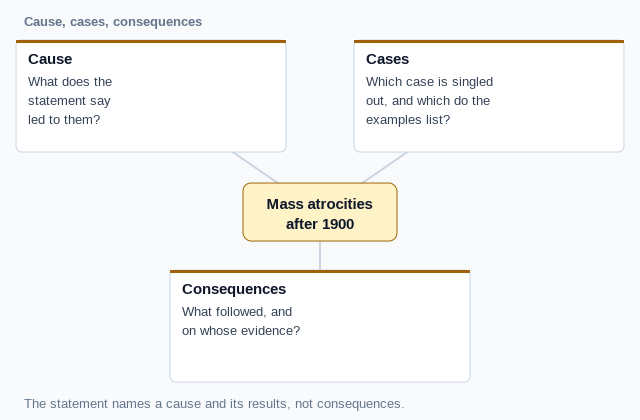 Tap to open the picture full size
Part 1 Think first What lies behind an atrocity
Commit to a guess before you read. A wrong guess now still helps the right idea stick.
Predict first
Armenians in the Ottoman Empire during and after World War I are one of College Board's examples of genocide, ethnic violence, or attempted destruction of specific populations. Across the century that followed, what would you guess most often lay behind cases like this?
In short. The rise of extremist groups in power led to the attempted destruction of specific populations, notably the Nazi killing of the Jews in the Holocaust during World War II, and to other atrocities, acts of genocide, or ethnic violence.
- The statement gives one cause, the rise of extremist groups in power, and two kinds of result.
- College Board's examples run from Armenians in the Ottoman Empire during and after World War I to the Tutsi in Rwanda in the 1990s.
- The statement names no consequences of the atrocities themselves, so any a writer gives is the writer's own claim and needs evidence.
Part 2 Learn it Mass atrocities, their cause and their cases
2a. One cause, two kinds of result
The statement is one sentence: The rise of extremist groups in power led to the attempted destruction of specific populations, notably the Nazi killing of the Jews in the Holocaust during World War II, and to other atrocities, acts of genocide, or ethnic violence.
Read it as one cause and two results.
Cause: the rise of extremist groups in power. The cause is such groups holding power, not only holding views. The statement does not define extremist; this lesson uses it for groups with extreme aims that are ready to act on them, a working meaning of its own.
First result: the attempted destruction of specific populations. Attempted names the aim, whether or not it was carried through, and specific means particular groups were singled out.
Second result: other atrocities, acts of genocide, or ethnic violence. Or joins three kinds, so a case need not be all three.
The verb joining them is led to, so the statement gives this as cause and result.
Quick check · Multiple choice
According to this topic's statement, what led to the attempted destruction of specific populations?
2b. The Holocaust, and the cases the examples list
Notably singles out one case: the Nazi killing of the Jews in the Holocaust during World War II. The statement names who killed (the Nazis), who was killed (the Jews) and when (during World War II).
College Board then lists four examples under one heading, genocide, ethnic violence, or attempted destruction of specific populations:
- Armenians in the Ottoman Empire during and after World War I
- Cambodia during the late 1970s
- Tutsi in Rwanda in the 1990s
- Ukraine in the Soviet Union in the 1920s and 1930s
The list does not say which of the three kinds each case was, or who carried each one out, and this page does not either.
What the list does show is reach in time. The cases run from World War I to the 1990s, before and long after the Holocaust.
Quick check · Select all
Which two does this topic's statement say about the Holocaust? Pick two.
Select 2 answers, then check.
2c. Linking developments, and what the statement leaves out
This topic's skill asks how one development relates to another. The statement makes one link itself: the rise of extremist groups in power led to attempted destruction and other atrocities.
Other topics in this unit describe developments a writer may set beside it: 7.6 Causes of World War II gives the causes of World War II, and 7.7 Conducting World War II says what totalitarian states did to basic freedoms and daily life. None of those statements mentions atrocities, so joining one to this topic is an argument, not a quotation. A sound link names what the two developments share, such as the same kind of actor or the same kind of action, and says the link is the writer's own.
The objective also asks for consequences. The statement's results are the atrocities themselves; it names no consequence that followed from them. A consequence on this page, such as refugees in an imagined record, is this lesson's own example and stands on that record's evidence.
Quick check · Multiple choice
A student wants to connect this topic's cause of mass atrocities to a cause of World War II in Topic 7.6. Which 7.6 cause could best support a connection based on a similar development?
Part 3 Watch it done One imagined record, and a causal reading
Watch the first steps, then take the last one yourself.
A record written for this page (it is not a real source), from an imagined country: "In the first year, a party that calls one minority an enemy of the nation wins control of the government. Within two years, members of that minority are driven from their homes, and thousands are killed."
Explain how the two developments in the record relate to each other.
Step 1 · Name the two developments
First, a party that calls one minority an enemy wins control of the government. Second, that minority is driven from its homes and thousands of its members are killed.
Step 2 · Put them in order
The party comes to power first, and the killings follow within two years.
Why this step?
Why is the order in time not enough on its own?
One development coming before another does not show that it caused it. A causal claim needs a link between the two, not only a sequence.
Your step · Decide and justify
Finish it. A student writes: "The party's rise to power is a cause of the killings that follow." Does this topic support that reading?
Why?
Part 4 Try it An imagined historian's six sentences
Six sentences from an imagined historian's essay on atrocities after 1900, written for this page. The historian and the essay are not real.
Try it · Sort it
Sort each of the historian's sentences by how it relates to this topic.
This topic says it
A link the writer adds
This topic contradicts it
Part 5 Explain it Mass atrocities, from documents
This is a self-check. Nothing you type leaves this page. Compare your answer with the model, line by line, and with each scoring point.
Free-response practice · Question 1 style
A short practice in the shape of the document-based question: a thesis, one sentence of context and one paragraph that uses both documents and explains the sourcing of one, instead of a full essay. Both documents are written for this page and are not real sources.
Document 1: a speech by the leader of an imagined party that has just taken power, to a rally of supporters: "This nation will be whole only when the enemy within is gone."
Document 2: a letter by a refugee from the same imagined country: "They took the village school first, then the farms. We left at night; my brother did not."
Using both documents and what you know from this topic, explain a cause and a consequence of mass atrocities in the period from 1900 to the present.
Model answer
Thesis: One cause of mass atrocities after 1900 was the rise of extremist groups in power, which led to the attempted destruction of specific populations, notably the Nazi killing of the Jews in the Holocaust during World War II, and to other atrocities, acts of genocide, or ethnic violence; for those who survived, one consequence was flight from home.
Context: In World War II, totalitarian states used ideologies to repress basic freedoms and dominate many aspects of daily life during the course of the conflicts and beyond, and this argument reads the Holocaust, carried out by one such state, as that control at its most violent, a link the writer makes.
Document 1 shows a party that has just taken power naming one group as the enemy within, the kind of extremist group in power whose rise leads to the attempted destruction of a population. Because the leader is speaking to a rally of supporters to win them over, the speech shows what he wanted them to believe, not what his government then did. Document 2 shows what followed for one family: the school and the farms taken, a flight at night, and a brother who did not survive. The flight is a consequence for the survivors, and it rests on one letter, so it is evidence about one family. Beyond the documents, the Holocaust was the Nazi killing of the Jews during World War II, and other cases in the period include Armenians in the Ottoman Empire during and after World War I, Cambodia during the late 1970s, and the Tutsi in Rwanda in the 1990s.
Score your own answer. This is a self-check, not a grade. Tick each point your answer makes.
Part 6 Check yourself An imagined country across nine years
Use the table for the first two questions. The last two cover the whole lesson.
An imagined country over nine years, written for this page. It is not a real state, and its record comes from an imagined association of survivors.
| Year | What the association's record says |
|---|---|
| Year 1 | A border war with a neighboring state ends in defeat, and crowds blame the minority. |
| Year 3 | An extremist party wins power and calls the minority the nation's enemy. |
| Year 4 | New laws push the minority out of schools and government jobs. |
| Year 6 | Soldiers and party members kill thousands of the minority, and others flee across the border. |
| Year 9 | The party falls; refugees come home to empty villages, and courts try party leaders. |
Case question 1 · Match
Match each year of the record to where it sits against this topic's statement.
Case question 2 · Spot the error
A student wrote this paragraph about the table. Which line is the first to go wrong?
The rest stand on their own and do not use the case.
Check yourself · Select all
Which two does this topic's statement give as results of the development it describes? Pick two.
Select 2 answers, then check.
Check yourself · Select all
Which two statements from this unit describe states or groups in power acting against people under their rule? Pick two.
Select 2 answers, then check.
Part 7 Keep it Bring back earlier ideas
One question from conducting World War II and one from empires between the wars, so both come round again.
From 7.7 Conducting World War II · Select all
Which two appear in this topic's statement on World War II but not in Topic 7.3's statement on World War I? Pick two.
Select 2 answers, then check.
From 7.5 Unresolved Tensions After World War I · Select all
A pamphlet written for this page (it is not a real source) is handed out by an anti-imperial group in a colony between the wars: "Workers, put down your tools on Monday. Show the governor that this land is ours." Which two could a historian use the pamphlet to show? Pick two.
Select 2 answers, then check.
In three lines
- The rise of extremist groups in power led to the attempted destruction of specific populations and to other atrocities, acts of genocide, or ethnic violence.
- The statement singles out the Nazi killing of the Jews in the Holocaust during World War II, and the examples run from World War I to the 1990s.
- The statement names no consequences of the atrocities, so a consequence is the writer's own claim and needs evidence.
Exam strategy for this topic
- Section I Part A, Multiple Choice: 55 questions in 55 minutes.
- Section I Part B, Short Answer: 3 questions in 40 minutes.
- Section II, Document-Based Question and Long Essay: 2 questions in 100 minutes.
- This lesson's Explain it is shaped like free-response question 1, Document-based.
For a causation prompt on mass atrocities, start from the cause the statement gives, the rise of extremist groups in power, and name a case. A consequence of the atrocities is your own claim, so give the evidence it rests on.
Questions students ask
What caused mass atrocities after 1900?
The statement gives the rise of extremist groups in power, which led to the attempted destruction of specific populations and to other atrocities, acts of genocide, or ethnic violence.
Is the Holocaust the only case this topic covers?
No. The statement singles it out with notably, as the Nazi killing of the Jews during World War II, and goes on to other atrocities, acts of genocide, or ethnic violence.
Which cases does College Board list?
Armenians in the Ottoman Empire during and after World War I, Cambodia during the late 1970s, Tutsi in Rwanda in the 1990s, and Ukraine in the Soviet Union in the 1920s and 1930s, as examples of genocide, ethnic violence, or attempted destruction of specific populations, without saying which is which.
Does this topic give the consequences of mass atrocities?
No. The objective asks for them, but the statement's results are the atrocities themselves. A consequence you give needs your own evidence.
How does this topic connect to the rest of the unit?
Its statement does not link to any other topic. A writer may set its cause beside developments in 7.6 Causes of World War II or 7.7 Conducting World War II, and the link is then the writer's own argument, to be supported with evidence.
Course alignment, for teachers
AP World History: Modern topic 7.8, Unit 7: Global Conflict.
- Skill 5.B: Explain how a historical development or process relates to another historical development or process.
This lesson maps the one essential knowledge statement of the topic, and the one learning objective with none of its own, to the part that teaches each one: 2 are checked by a scored question. The map is in the lesson file.