Unit 8 · Topic 8.9 · about 25 minutes · 7 parts · 10 scored checks, 2 of them multiple choice, plus 2 from earlier lessons
AP World History: Modern 8.9: Causation in the Age of the Cold War and Decolonization
Unit 8: 8 to 10% of the multiple-choice section
What you'll be able to do
- Explain the extent to which the effects of the Cold War were similar in the Eastern and Western Hemispheres.
Key vocabulary
| Term | What it means | The exam trap |
|---|---|---|
| Hemisphere | Half of the globe. This lesson follows the usual world-history convention: the Western Hemisphere is the Americas, and the Eastern Hemisphere is Africa, Asia and Europe. | The split is this lesson's convention, not a line of the review, and a hemisphere is half of the map, not a side in the Cold War. |
| Extent | How far something is true. | An extent question wants a degree weighed from evidence, not a yes or no. |
| Corroborate | In this lesson's working meaning, to add support to a claim as it stands. | Corroborating supports a claim; it does not prove the claim for every case. |
| Qualify | In this lesson's working meaning, to keep a claim but limit it, so it says less and holds up better. | Qualifying is not rejecting a claim. |
| Modify | In this lesson's working meaning, to change part of a claim because evidence shows that part is wrong. | A modified claim keeps what the evidence leaves standing; it is not thrown out whole. |
| Institutions of global association | Organizations through which states around the world work together. | This unit's topics name none of these organizations, so an example has to come from your class, not from this lesson. |
 Tap to open the picture full size
Part 1 Think first A claim to argue
Make a guess before you read. A wrong guess still helps the right idea stick.
Predict first
College Board's sample activity for this topic gives a claim: "The Cold War increased the influence of the United States in the world but ultimately weakened the influence of Russia." What would make an argument about this claim complex?
In short. This topic reviews Unit 8 through five statements and asks how similar the Cold War's effects were in the Eastern and Western Hemispheres.
- Peoples and states challenged the existing order in varying ways, and after World War II anti-imperialist sentiment contributed to the dissolution of empires.
- The Cold War extended beyond its ideological origins to have profound effects on economic, political, social, and cultural aspects of global events.
- The role of the state in the domestic economy varied, and an extent answer weighs likeness against difference with evidence.
Part 2 Learn it The unit in five statements
8.9a. Challenge and the end of empires
This last topic reviews Unit 8 through five statements. Two are about challenge and empire.
Peoples and states around the world challenged the existing political and social order in varying ways, leading to unprecedented worldwide conflicts.
In varying ways is the phrase to hold: there was no single way to challenge the order. 8.5 Decolonization After 1900 shows more than one route to independence, and 8.7 Global Resistance to Established Power Structures After 1900 more than one way of pursuing political change. Unprecedented says conflicts like these had not happened before, and worldwide says they reached around the world.
Hopes for greater self-government were largely unfulfilled following World War I; however, in the years following World War II, increasing anti-imperialist sentiment contributed to the dissolution of empires and the restructuring of states.
8.1 Setting the Stage for the Cold War and Decolonization opened the unit with this statement. However turns it between the two wars: hopes unmet after the first, empires dissolving after the second. Largely leaves room for some hopes that were met. Contributed to makes anti-imperialist sentiment one cause of the end of empires, not the only one.
Quick check · Select all
The review says peoples and states challenged the existing political and social order "in varying ways." Which two pieces of evidence from this unit could best corroborate that? Pick two.
Select 2 answers, then check.
8.9b. The Cold War's reach
One statement is about the Cold War itself. The Cold War conflict extended beyond its basic ideological origins to have profound effects on economic, political, social, and cultural aspects of global events.
Its origins were ideological: 8.2 The Cold War names the ideological conflict and power struggle between capitalism and communism. Extended beyond says the conflict did not stay a contest of ideas. Profound says the effects ran deep, and the four aspects say how wide they ran.
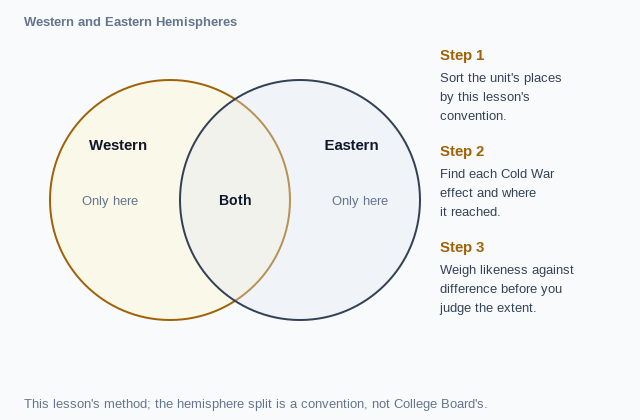
This topic's objective asks how far those effects were similar in the Eastern and Western Hemispheres. College Board does not define the two. This lesson uses the usual world-history convention, which is its own choice and not a line of the review: the Western Hemisphere is the Americas, so Latin America, and the Eastern Hemisphere holds Africa, Asia and Europe.
The review says global, which takes in both hemispheres, but it does not compare them. 8.3 Effects of the Cold War names one effect it places on both sides: proxy wars between and within postcolonial states in Latin America, Africa, and Asia.
Quick check · Multiple choice
According to the review, how far did the Cold War's effects reach?
8.9c. States and economies
The last two statements turn to states and economies. The role of the state in the domestic economy varied, and new institutions of global association emerged and continued to develop throughout the century. States responded in a variety of ways to the economic challenges of the 20th century.
Varied and a variety of ways make the same kind of claim: there was no single pattern. The unit gives two cases. 8.4 Spread of Communism After 1900 says that in communist China the government controlled the national economy through the Great Leap Forward. 8.6 Newly Independent States says that in newly independent states after World War II, governments often took on a strong role in guiding economic life to promote development. Read as this lesson reads them, controlling an economy and guiding one are two different roles, and often leaves room for states that took neither.
The first statement's second half names institutions of global association, organizations through which states work together. This unit's topics name none of them, so this lesson does not either.
Quick check · Multiple choice
According to the review, what happened to institutions of global association during the century?
8.9d. Building a complex argument
College Board's sample activity for this topic gives a claim: The Cold War increased the influence of the United States in the world but ultimately weakened the influence of Russia. The class discusses how to develop a complex argument that supports a claim like this and also acknowledges and discusses evidence that contradicts it.
This topic's skill names three moves with evidence. This lesson uses these working meanings, which are its own: to corroborate is to add support to the claim as it stands; to qualify is to keep the claim but limit it; to modify is to change part of it, because evidence shows that part is wrong. Before you use a piece of evidence, ask which of the three it does, or whether it bears on the claim at all.
Read the claim's own words, too. It has two halves joined by but, so evidence can bear on one half and leave the other alone. And it says Russia, while this unit's statements speak of the Soviet Union. An argument that notices the difference is more precise than one that does not.
Quick check · Sort it
College Board's sample activity gives this claim: "The Cold War increased the influence of the United States in the world but ultimately weakened the influence of Russia." Suppose you found each of these while arguing about it. Sort each by what it does to the claim, using this lesson's working meanings.
Corroborates: the claim stands as written
Qualifies: keep the claim, add a limit
Modifies: part of the claim must change
Part 3 Watch it done How similar were the effects?
Watch the first steps, then take the last one yourself.
Explain the extent to which the effects of the Cold War were similar in the Eastern and Western Hemispheres, using this unit's statements and the examples College Board gives for them.
Step 1 · Sort the places, by this lesson's convention
This lesson puts Latin America in the Western Hemisphere and Africa and Asia in the Eastern, the usual world-history convention and not a line of the review. 8.3 Effects of the Cold War's examples of proxy wars then fall on both sides: the Sandinista-Contras conflict in Nicaragua in the Western, and the Korean War and the Angolan Civil War in the Eastern.
Step 2 · Find an effect in both
8.3 Effects of the Cold War says the Cold War led to proxy wars between and within postcolonial states in Latin America, Africa, and Asia, so proxy wars are one effect found in both hemispheres. The review adds that the Cold War had profound effects on economic, political, social, and cultural aspects of global events, and global takes in both.
Why this step?
Why keep looking once you have found a shared effect?
The objective asks for an extent, and an extent weighs likeness against difference. This unit's statements do not compare the hemispheres directly, and silence is not evidence either way, so a judgment of how far the effects were alike needs evidence of how they differed, if they did.
Your step · Decide and justify
Finish it. Which sentence is the stronger start to an extent answer built on this unit's statements?
What makes that sentence the stronger start?
Part 4 Try it Can it compare the hemispheres?
Five notes a student might find while working on the objective. All five are written for this page and are not real sources.
> A. In 1984, in a Central American country and in a southern African country, a government and rebels each received weapons from a different superpower. > > B. In the 1960s, radio stations in a South American city and in a West African city both played programs sent by the two superpowers, each praising its own system. > > C. In the 1970s, a superpower's loans paid for new dams in an Asian country, while a Caribbean island received no aid from either superpower. > > D. In 1960, two West African colonies became independent states, one by negotiation and the other after an armed struggle. > > E. In the 1950s, a European country and an Asian country both joined new military alliances.
Sort the hemispheres by this lesson's convention: the Americas in the Western, and Africa, Asia and Europe in the Eastern.
Try it · Sort it
Sort each piece of evidence by what it can do for the question of how similar the Cold War's effects were in the two hemispheres.
Shows a similar effect in both hemispheres
Shows a difference between the hemispheres
Cannot compare the hemispheres
Part 5 Explain it Two countries, two hemispheres
This is a self-check. Nothing you type leaves this page. Set your answer beside the model and each scoring point.
Free-response practice · Question 1 style
A short practice in the shape of the document-based question: a thesis, one sentence of context and one paragraph that uses both documents and explains the point of view or audience of one, instead of a full essay. Both documents are written for this page and are not real.
Document 1: a newspaper editor in a Central American country, writing for his readers, 1984: "Our government buys its rifles from one superpower, and the rebels in the hills get theirs from the other. Neither side could fight a month without them."
Document 2: a teacher in a southern African country, in a private letter to a friend abroad, 1984: "Since independence two armies have fought over our country, each supplied by a different superpower. At night my students hear one superpower's radio praising its system, and in the morning the other's."
Using both documents, explain the extent to which the effects of the Cold War were similar in the Eastern and Western Hemispheres.
Model answer
Thesis: The Cold War's effects were alike in the two hemispheres in at least one clear way, proxy wars fought within postcolonial states with each side armed by a rival superpower, but these documents speak for one country each, so how far the likeness went needs more evidence than they give.
Context: Conflict dominated much of the 20th century, and both documents describe one more such conflict, here fought with rival superpowers' weapons.
Document 1, from Central America, in the Western Hemisphere by the usual convention, shows a proxy war: the government's rifles come from "one superpower" and the rebels' from "the other." Document 2, from southern Africa, in the Eastern Hemisphere, shows the same pattern, "two armies" each "supplied by a different superpower," so the political effect matches. Document 2 also shows a cultural effect, radio from both superpowers "praising its system," while Document 1 says nothing about culture, so the documents show a likeness in war but cannot show whether the cultural effect reached both sides. Document 1's editor writes for his own readers and may stress that "neither side could fight a month" without foreign rifles to make a point about his country's dependence, so his words show how he saw the war as well as what happened.
Score your own answer. This is a self-check, not a grade. Tick each point your answer makes.
Part 6 Check yourself One colony across the century
The table drives the first two questions. The last two come from the rest of the lesson.
Four rows a student put together for a review of the unit. The table was written for this lesson, and every row is invented.
| Row | Year | What happened |
|---|---|---|
| 1 | 1919 | A colony's delegates travel to the peace conference after World War I to ask for a parliament of their own. They are not heard, and the colony stays as it was. |
| 2 | 1947 | After years of crowds calling for an end to foreign rule, the same colony becomes an independent state. |
| 3 | 1960 | The new state's government draws up a five-year plan for roads, dams and factories. |
| 4 | 1981 | In a Central American country, a government and rebels each receive weapons from a rival superpower. |
Case question 1 · Fill the statement
Complete the note on rows 1 and 3.
Row 1 shows , and row 3 shows .
Case question 2 · Spot the error
A student wrote on the table. Which line misreads it?
The rest stand on their own and do not use the case.
Check yourself · Select all
A claim written for this page: "In the 20th century, states everywhere took the same role in their economies." Which two pieces of evidence from this unit could best be used to refute the claim? Some choices are true but do not bear on the claim. Pick two.
Select 2 answers, then check.
Check yourself · Select all
This topic's sample activity gives the claim: "The Cold War increased the influence of the United States in the world but ultimately weakened the influence of Russia." Which two pieces of evidence from this unit could best support the claim's second part? Pick two.
Select 2 answers, then check.
Part 7 Keep it Bring back earlier ideas
One question from the end of the Cold War, the lesson just before this one, and one from newly independent states three lessons back.
A diary written for this page (it is not a real source), kept by a teacher in a communist country, 1989:
> Line 1. Three hours in line for bread again, and the shelves were empty when I reached the front. > > Line 2. My neighbor's son came home from Afghanistan with one arm. He says the fighting there never ends, and no one will say what it costs. > > Line 3. Tonight half the town went to the square to shout that we have had enough.
Match each line to the cause it best shows.
From 8.8 End of the Cold War · Match
Match each line of the diary to a cause this topic names.
Four short scenes from former colonies and their old rulers. All four were written for this lesson and are not real places.
| Row | Where | What happened |
|---|---|---|
| 1 | A former colony in Asia | As the colonial officials leave, a commission draws a new border, and a state that did not exist before holds its first election. |
| 2 | The same state, the following year | Fighting breaks out along the new border, and families on both sides leave their homes to cross it. |
| 3 | A newly independent state in Africa | The government's five-year plan pays for dams and steel mills, and its ministers set the price of grain. |
| 4 | The capital of a former colonizing country | A street of shops run by people from a former colony sells its goods, and its banks send money back there. |
From 8.6 Newly Independent States · Spot the error
A student wrote on change and continuity in the table. Which line misreads it?
In three lines
- Peoples and states challenged the existing order in varying ways, and after World War II anti-imperialist sentiment contributed to the dissolution of empires.
- The Cold War had profound effects on economic, political, social, and cultural aspects of global events, and proxy wars reached both hemispheres, by this lesson's convention.
- An extent answer weighs a shared effect against a difference; evidence corroborates, qualifies or modifies a claim.
Exam strategy for this topic
- Section I Part A, Multiple Choice: 55 questions in 55 minutes.
- Section I Part B, Short Answer: 3 questions in 40 minutes.
- Section II, Document-Based Question and Long Essay: 2 questions in 100 minutes.
- This lesson's Explain it is shaped like free-response question 1, Document-based.
On an extent question, let the thesis weigh likeness against difference and say how far the claim holds, on evidence for both; a thesis that says only alike, or only different, is a yes or no.
Questions students ask
Does College Board say how similar the Cold War's effects were in the two hemispheres?
No. The objective asks you to explain the extent, and this unit's statements do not compare the hemispheres directly. They show one effect in both, proxy wars between and within postcolonial states in Latin America, Africa, and Asia, and a judgment of how far the effects were alike needs evidence of how they differed.
Which places are in which hemisphere?
College Board does not say. This lesson uses the usual world-history convention: the Americas, so Latin America, in the Western Hemisphere, and Africa, Asia and Europe in the Eastern. An essay that uses another split should say so.
What is the difference between qualifying and modifying an argument?
In this lesson's working meanings, qualifying keeps the claim and limits it to some places, people or times, and modifying changes part of the claim because evidence shows that part is wrong.
Why does the sample activity's claim say Russia?
The claim is College Board's, from this topic's sample activity, and it names Russia. This unit's statements speak of the Soviet Union, and an argument that notices the difference is more precise than one that does not.
Will multiple-choice questions test this topic's skill?
College Board says no multiple-choice questions explicitly assess the argumentation skill; the document-based question and the long essay question do. The questions here practice the reasoning those essays ask for.
Course alignment, for teachers
AP World History: Modern topic 8.9, Unit 8: Cold War and Decolonization.
- Skill 6.D: Corroborate, qualify, or modify an argument using diverse and alternative evidence in order to develop a complex argument.
This lesson maps all 5 essential knowledge statements of the topic, and the one learning objective with none of its own, to the part that teaches each one: 6 are checked by a scored question. The map is in the lesson file.