Unit 1 · Topic 1.5 · about 30 minutes · 7 parts · 10 scored checks, 2 of them multiple choice, plus 2 from earlier lessons
AP World History: Modern 1.5: State Building in Africa
Unit 1: 8 to 10% of the multiple-choice section
What you'll be able to do
- Explain how and why state systems in Africa developed and changed from c. 1200 to c. 1450, including how they expanded in scope and reach.
Key vocabulary
| Term | What it means | The exam trap |
|---|---|---|
| Eurasia | Europe and Asia, taken together. | Eurasia leaves Africa out and Afro-Eurasia includes it. Check which one a statement uses before comparing. |
| State system | A state together with the way it is organized to govern. | A state system can be one kingdom or a group of them. Read a name for whether it is singular or plural. |
| Scope and reach | How much a state governs, and how far its rule extends. | Two measures share one phrase. A choice may describe only one of them, so read it closely. |
| Expand | To grow larger or wider. | Growth over time and variety at one time are different ideas. Read which one a choice is describing. |
 Tap to open the picture full size
Part 1 Think first One sentence for three states
Commit to a guess before you read. A wrong guess now still helps the right idea stick.
Predict first
Great Zimbabwe, Ethiopia and the Hausa kingdoms were all states in Africa from c. 1200 to c. 1450. If you had to write one sentence about African states in that period, which would you expect to be closest?
In short. In Africa from c. 1200 to c. 1450, as in Eurasia and the Americas, state systems showed continuity, innovation and diversity, and they expanded in scope and reach.
- Great Zimbabwe, Ethiopia and the Hausa kingdoms are examples of state systems in Africa in this period.
- They carried older ways forward, did new things, and differed from one another.
- They expanded in scope and reach, the same description the framework gives the Americas.
Part 2 Learn it State systems in Africa
2a. The same pattern, a new region
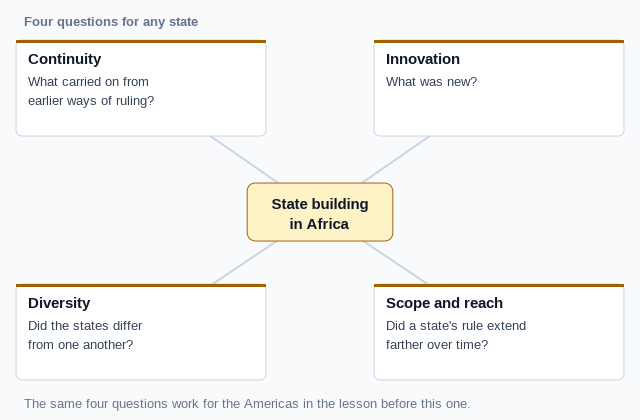
In Africa, as in Eurasia and the Americas, state systems demonstrated continuity, innovation and diversity, and expanded in scope and reach.
Compare it with the Americas statement from the last lesson. The wording is almost the same. Only the comparison changes: the Americas were compared with Afro-Eurasia, and Africa is compared with Eurasia and the Americas, because Africa is now the region being described.
The framework's examples for Africa are Great Zimbabwe, Ethiopia and the Hausa kingdoms. Notice the plural again: the Hausa kingdoms were more than one kingdom.
When two regions get the same description, that is a similarity you can use. It says state building in Africa was part of the same worldwide pattern, not an exception to it.
Quick check · Select all
Which two of these were state systems in Africa in this period? Pick two.
Select 2 answers, then check.
2b. Four features in one statement
Pull the statement apart and it gives four features:
- continuity: older ways carried on;
- innovation: new things were done;
- diversity: the states differed from one another;
- expansion in scope and reach: states came to govern more, and their rule extended farther.
The first is continuity. The second and fourth are change. The third is about difference at one time rather than over time.
A common slip is to quote one feature and stop. "African state systems showed continuity" is true, but it leaves out three quarters of what the framework says. In a written answer, try to hold both continuity and change, because that matches the whole statement.
Quick check · Select all
A student writes: "African state systems in this period showed continuity." Which two additions would complete the course's description? Pick two.
Select 2 answers, then check.
2c. Identify, or explain?
This topic's skill is to explain a historical development. College Board defines its task verbs, and two are easy to mix up:
- Identify: "Indicate or provide information about a specified topic, without elaboration or explanation."
- Explain: "Provide information about how or why a relationship, process, pattern, position, situation, or outcome occurs, using evidence and/or reasoning."
"Great Zimbabwe was a state in Africa" identifies. It points at a fact and stops.
An explanation links a pattern to the evidence or reasoning that shows it holds. For Africa, the framework supplies two such links:
- Evidence to pattern: African state systems were diverse, since Great Zimbabwe, Ethiopia and the Hausa kingdoms were different states.
- Comparison: state building in Africa fit a wider pattern, since the same description holds for Eurasia and the Americas.
What it does not supply is how any state grew. Saying that expanding in scope and reach means governing more only restates the words. For how a state grew, you need what your class studies about it.
Quick check · Select all
A prompt asks students to explain a development in African state building. Which two responses explain, rather than only identify? Pick two.
Select 2 answers, then check.
Part 3 Watch it done Explain a development
Watch the first steps, then take the last one yourself.
Explain why state building in Africa in the period c. 1200 to c. 1450 can be called part of a wider pattern.
Step 1 · Name the pattern
The pattern is the framework's description: state systems that showed continuity, innovation and diversity and expanded in scope and reach.
Step 2 · Find the link the framework supplies
The Africa statement opens "In Africa, as in Eurasia and the Americas". The same description holds for those regions too. That is evidence the pattern was shared, so Africa's state building was one case of it, not a thing apart.
Why this step?
Why not explain it by saying what scope and reach mean?
That defines the words. It does not show how or why the pattern holds, and College Board's explain asks for how or why, using evidence or reasoning.
Your step · Decide and justify
Finish it. Which sentence explains why state building in Africa can be called part of a wider pattern?
Why does that sentence count as an explanation?
Part 4 Try it Explain, or not?
Six student sentences, written for this page, each answering the prompt "Explain one pattern in state building in Africa from c. 1200 to c. 1450." Decide which ones explain. Then match the task verbs to College Board's meanings.
Try it · Sort it
Sort each student sentence by whether it explains a pattern in African state building.
Explains with evidence
Does not explain
Try it · Match
Match each task verb to the meaning College Board gives it.
Part 5 Explain it A similarity, in writing
This is a self-check. Nothing you type leaves this page. Compare your answer with the model and each scoring point.
Free-response practice · Question 2 style
A short practice in the shape of the long essay question: a thesis, one sentence of context and one paragraph of evidence instead of a full essay. Use what this lesson and the Americas lesson taught.
In the period c. 1200 to c. 1450, state systems took shape on several continents.
Explain one similarity between state building in Africa and state building in the Americas in the period c. 1200 to c. 1450.
Model answer
Thesis: State building in Africa and in the Americas was similar because in both, state systems showed continuity, innovation and diversity and expanded in scope and reach, even though the states themselves were different.
Context: State building in Africa went on in years when Islam, Judaism and Christianity continued to shape African societies and Muslim rule continued to expand to many parts of Afro-Eurasia. The writer reads Africa's growing states as part of a continent whose societies those faiths continued to shape.
In Africa, the evidence of diversity is Great Zimbabwe, Ethiopia and the Hausa kingdoms, different states, the Hausa kingdoms themselves several kingdoms. In the Americas it is the Maya city-states, many separate states, beside the Mexica and the Inca. Since the framework gives both regions the same four features, the similarity lies in the pattern of development, not in the particular states.
Score your own answer. This is a self-check, not a grade. Tick each point your answer makes.
Part 6 Check yourself Africa and the Americas side by side
Both case questions need the side-by-side table. The others revisit chunks 1 and 2.
A student set the framework's descriptions of state systems in the Americas and in Africa side by side.
| Feature | The Americas | Africa |
|---|---|---|
| Continuity, innovation and diversity | Yes | Yes |
| Expanded in scope and reach | Yes | Yes |
| Compared with | Afro-Eurasia | Eurasia and the Americas |
| Examples | Maya city-states, Mexica, Inca, Chaco, Mesa Verde, Cahokia | Great Zimbabwe, Ethiopia, Hausa kingdoms |
Case question 1 · Decide and justify
Another student claims the framework treats state building in Africa as a different process from state building in the Americas. Does the table support that claim?
Which evidence in the table decides it?
Case question 2 · Spot the error
The student then wrote this paragraph from the table. Which line is the first to go wrong?
The rest stand on their own and do not use the case.
Check yourself · Multiple choice
Which statement best describes state systems in Africa from c. 1200 to c. 1450?
Check yourself · Multiple choice
How does the course's description of state systems in Africa compare with its description of state systems in the Americas?
Part 7 Keep it Bring back earlier ideas
One question from the Americas lesson and one from the Dar al-Islam lesson, so both come round again.
From 1.4 State Building in the Americas · Select all
Which two statements match the course's description of state systems in the Americas? Pick two.
Select 2 answers, then check.
From 1.2 Developments in Dar al-Islam from c. 1200 to c. 1450 · Select all
Muslim states encouraged intellectual innovations and transfers. Which two of these are transfers, learning passed along from another people or time? Pick two.
Select 2 answers, then check.
In three lines
- In Africa, as in Eurasia and the Americas, state systems showed continuity, innovation and diversity, and expanded in scope and reach.
- Great Zimbabwe, Ethiopia and the Hausa kingdoms are examples of those state systems.
- Identify names a fact; explain says how or why it happened, using evidence or reasoning.
Exam strategy for this topic
- Section I Part A, Multiple Choice: 55 questions in 55 minutes.
- Section I Part B, Short Answer: 3 questions in 40 minutes.
- Section II, Document-Based Question and Long Essay: 2 questions in 100 minutes.
- This lesson's Explain it is shaped like free-response question 2, Long essay.
Read the task verb before anything else. If a prompt says explain, link each claim to the evidence that shows how or why it holds. A definition of the words is not that link.
Questions students ask
Why does the Africa statement say Eurasia instead of Afro-Eurasia?
Africa is the region being described, so the statement compares it with the other two: Eurasia and the Americas. The Americas statement compares with Afro-Eurasia for the same reason.
Where do the task verb meanings come from?
College Board's course framework prints them in a list of task verbs used in free-response questions. This lesson quotes them word for word.
Why doesn't the lesson say how African states grew?
The framework says African state systems expanded in scope and reach and names three examples, but it does not say how any of them grew. This lesson does not invent a how; your class can add one from what it studies about one of these states.
What skill does this topic practice?
Explaining a historical concept, development or process. Chunk 3 and Watch it done show the difference between explaining and identifying.
Course alignment, for teachers
AP World History: Modern topic 1.5, Unit 1: The Global Tapestry.
- Skill 1.B: Explain a historical concept, development, or process.
This lesson maps the one essential knowledge statement of the topic, and the one learning objective with none of its own, to the part that teaches each one: 2 are checked by a scored question. The map is in the lesson file.