Unit 4 · Topic 4.3 · about 30 minutes · 7 parts · 9 scored checks, 2 of them multiple choice, plus 2 from earlier lessons
AP World History: Modern 4.3: Columbian Exchange
Unit 4: 12 to 15% of the multiple-choice section
What you'll be able to do
- Explain what caused the Columbian Exchange and what it did to the Eastern and Western Hemispheres.
Key vocabulary
| Term | What it means | The exam trap |
|---|---|---|
| Endemic | Regularly found among the people of a particular region. | Endemic says where a disease was common before it spread. Read which hemisphere a choice places it in. |
| Disease vector | A living thing, such as an insect or a rat, that carries a disease from one host to another. | The vector carries the disease; it is not the disease. A choice may swap the two. |
| Staple crop | A food crop that people rely on as a main part of their diet. | Read whether a choice is about food people ate or a crop grown to be sold. The topic has a sentence for each. |
| Coerced labor | Work people are forced to do. | Coerced is the opposite of free. Read what kind of labor a choice says was used. |
| Indigenous | Belonging to a place by origin, as the first known peoples of a region. | Read which hemisphere's peoples a choice describes. The disease statement is about the Americas. |
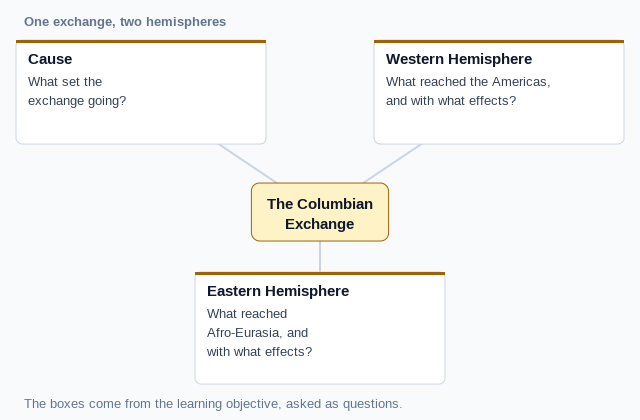 Tap to open the picture full size
Part 1 Think first Crossing in both directions
Commit to a guess before you read. A wrong guess now still helps the right idea stick.
Predict first
Ships begin to cross regularly between two hemispheres that had been out of contact. Besides people and trade goods, what do you expect would cross with them?
In short. New connections between the Eastern and Western Hemispheres set off an exchange of plants, animals and diseases, the Columbian Exchange, with very different effects on each side.
- European colonization of the Americas led to the unintentional transfer of disease vectors and the spread of diseases endemic in the Eastern Hemisphere, and some of these diseases substantially reduced the indigenous populations, with catastrophic effects in many areas.
- American foods became staple crops in parts of Europe, Asia and Africa, and populations in Afro-Eurasia benefitted nutritionally from the increased diversity of crops.
- Europeans brought Afro-Eurasian fruit trees, grains, sugar and domesticated animals to the Americas, while other foods were brought by African enslaved persons.
Part 2 Learn it What crossed, and what it did
4.3a. New connections, and disease
The topic opens with a cause and its result: the new connections between the Eastern and Western Hemispheres resulted in the exchange of new plants, animals, and diseases, known as the Columbian Exchange. The connections themselves came from the voyages of 4.2 Exploration: Causes and Events from 1450 to 1750.
The first thing College Board follows is disease. European colonization of the Americas led to the unintentional transfer of disease vectors, including mosquitoes and rats, and the spread of diseases that were endemic in the Eastern Hemisphere, including smallpox, measles, and malaria.
Three words carry that sentence. Unintentional: the sentence calls the transfer of the vectors unplanned, not something anyone set out to do. Vectors: the mosquitoes and rats that carry disease moved too. Endemic: the diseases were already common in the Eastern Hemisphere before they spread.
Then the effect, with its qualifier: some of these diseases substantially reduced the indigenous populations, with catastrophic effects in many areas. Keep some and many. College Board does not say every disease did this, or that every area suffered the same way, and it does not say which of the diseases did.
Quick check · Multiple choice
In this topic's statement on disease, what led to the transfer of disease vectors and the spread of diseases such as smallpox, measles and malaria?
4.3b. Foods and animals
Food moved both ways.
From the Americas: American foods became staple crops in various parts of Europe, Asia, and Africa. A staple is a food people rely on. And populations in Afro-Eurasia benefitted nutritionally from the increased diversity of American food crops. College Board names no particular American food, so neither does this lesson.
To the Americas: Afro-Eurasian fruit trees, grains, sugar, and domesticated animals were brought by Europeans to the Americas, while other foods were brought by African enslaved persons. College Board's examples of domesticated animals are horses, pigs and cattle; its examples of foods brought by African enslaved persons are okra and rice. Notice the two carriers in one sentence.
One more sentence is about trade rather than diet. Cash crops were grown primarily on plantations with coerced labor and were exported mostly to Europe and the Middle East. A cash crop is grown to be sold. Keep primarily and mostly: they leave room for exceptions College Board does not describe.
Quick check · Select all
Which three of these does this topic say Europeans brought to the Americas? Pick three.
Select 3 answers, then check.
4.3c. Finding a source's evidence
This topic's skill is identifying the evidence a source uses to support its argument. Two steps. First find the argument: the point the source wants you to accept. Then find the evidence: what the source offers to back that point up.
An example, written for this page: "Animals changed the Americas. Europeans brought horses, pigs and cattle across the ocean." The argument is the first sentence. The evidence is the second: domesticated animals brought by Europeans.
Two traps. The argument is not its own evidence, however confidently it is stated. And evidence used in a source has to be in the source. A fact you know from this lesson, such as the spread of disease, may be true and relevant, but if the passage does not mention it, it is not the passage's evidence.
Read for the point first, then the support.
Quick check · Multiple choice
A passage written for this page reads: "Contact between the hemispheres did not help everyone. Diseases endemic in the Eastern Hemisphere, among them smallpox and measles, spread with colonization, and some of them substantially reduced indigenous populations, with catastrophic effects in many areas." Which evidence does the passage use to support its argument?
Part 3 Watch it done Point first, then support
Watch the first steps, then take the last one yourself.
A passage written for this page reads: "The exchange ran in both directions. Europeans brought fruit trees, grains, sugar and domesticated animals to the Americas, while American foods became staple crops in parts of Europe, Asia and Africa." Identify the evidence the passage uses to support its argument.
Step 1 · Find the argument
The first sentence is the point the passage wants accepted: the exchange ran in both directions.
Step 2 · Find what backs it up
The second sentence gives one movement each way: Afro-Eurasian crops and animals to the Americas, and American foods to Europe, Asia and Africa. Two directions, one example of each.
Why this step?
Why is "populations in Afro-Eurasia benefitted nutritionally" not part of this passage's evidence?
It is true, but the passage never says it. Evidence used in a source has to be in the source, so only what the passage itself offers counts.
Your step · Decide and justify
Finish it. Which identifies the evidence this passage uses?
Why is that the evidence?
Part 4 Try it Argument, evidence, or neither
A passage written for this page from College Board's statements:
> "The exchange tied the Americas to distant markets and to forced labor. Cash crops were grown primarily on plantations with coerced labor. They were exported mostly to Europe and the Middle East."
Sort each statement by the part it plays in this passage.
Try it · Sort it
Sort each statement: the passage's argument, evidence the passage uses, or not in the passage.
The passage's argument
Evidence the passage uses
Not in the passage
Part 5 Explain it Two hemispheres, two outcomes
This is a self-check. Nothing you type leaves this page. Compare your answer with the model and each scoring point.
Free-response practice · Question 2 style
This is a partial long essay. Write a thesis, one sentence of context and one paragraph of evidence, not a full essay.
In the period c. 1450 to c. 1750, new connections joined the Eastern and Western Hemispheres.
Explain the effects of the Columbian Exchange on the Eastern and Western Hemispheres in the period c. 1450 to c. 1750.
Model answer
Thesis: The Columbian Exchange affected the two hemispheres differently: some diseases from the Eastern Hemisphere substantially reduced the indigenous populations of the Americas, while American food crops benefitted populations in Afro-Eurasia nutritionally.
Context: Spanish sponsorship of the voyages of Columbus and subsequent voyages dramatically increased European interest in transoceanic travel and trade, so the connections that carried the exchange grew in this period.
In the Western Hemisphere, European colonization of the Americas led to the unintentional transfer of disease vectors, including mosquitoes and rats, and the spread of diseases endemic in the Eastern Hemisphere, including smallpox, measles and malaria. Some of these diseases substantially reduced the indigenous populations, with catastrophic effects in many areas. In the Eastern Hemisphere, American foods became staple crops in parts of Europe, Asia and Africa, and populations there benefitted nutritionally from the increased diversity of crops. So the same connections carried a nutritional benefit to Afro-Eurasia and, in many areas of the Americas, catastrophic population loss.
Score your own answer. This is a self-check, not a grade. Tick each point your answer makes.
Part 6 Check yourself What moved, and which way
The table drives the first two questions. The last two come from the rest of the lesson.
A student set out the exchange's movements in a table. It was written for this lesson from College Board's statements, and it shows only what moved and who or what carried it, not the effects.
| What moved | To | How, as College Board says |
|---|---|---|
| Disease vectors, including mosquitoes and rats, and diseases endemic in the Eastern Hemisphere | The Americas | With European colonization; the transfer of the vectors was unintentional |
| American foods | Various parts of Europe, Asia and Africa | Became staple crops |
| Afro-Eurasian fruit trees, grains, sugar and domesticated animals | The Americas | Brought by Europeans |
| Other foods | The Americas | Brought by African enslaved persons |
Case question 1 · Fill the statement
A classmate reads the table and says the exchange must have affected both hemispheres in the same way, since things moved in both directions. Complete the reply, using the first two rows and what the lesson says each movement did.
Movement both ways did not mean the same effects: American foods populations in Afro-Eurasia nutritionally, while some of the diseases that reached the Americas the indigenous populations.
Case question 2 · Match
Each scene was written for this question. Match it to the row of the table it shows.
The rest stand on their own and do not use the case.
Check yourself · Select all
Which two statements about cash crops match this topic? Pick two.
Select 2 answers, then check.
Check yourself · Select all
A passage written for this page reads: "The Columbian Exchange changed diets in Afro-Eurasia. American foods became staple crops in parts of Europe, Asia and Africa, and populations there benefitted nutritionally from the wider range of crops." Which two pieces of evidence does the passage use? Pick two.
Select 2 answers, then check.
Part 7 Keep it Bring back earlier ideas
One question from the exploration lesson just before this one, and one from the last lesson of Unit 3.
From 4.2 Exploration: Causes and Events from 1450 to 1750 · Multiple choice
According to this topic, what did Spanish sponsorship of the voyages of Columbus and later voyages across the Atlantic and Pacific bring about?
From 3.4 Comparison in Land-Based Empires · Multiple choice
A student uses Mughal mausolea and mosques and the Incan sun temple of Cuzco as evidence that rulers in different regions used similar methods to legitimize their rule. Which sentence best explains how the evidence supports the claim?
In three lines
- New connections between the hemispheres resulted in the exchange of plants, animals and diseases known as the Columbian Exchange.
- Diseases endemic in the Eastern Hemisphere spread with colonization, and some of them substantially reduced indigenous populations, with catastrophic effects in many areas.
- American foods became staples in Afro-Eurasia, while Europeans and African enslaved persons brought crops and animals to the Americas.
Exam strategy for this topic
- Section I Part A, Multiple Choice: 55 questions in 55 minutes.
- Section I Part B, Short Answer: 3 questions in 40 minutes.
- Section II, Document-Based Question and Long Essay: 2 questions in 100 minutes.
- This lesson's Explain it is shaped like free-response question 2, Long essay.
When a source question asks for evidence, underline the source's main point first. Then look only inside the source for what supports it; a true fact from class that the source never mentions does not count.
Questions students ask
Why is it called the Columbian Exchange?
College Board uses the name for the exchange of plants, animals and diseases that resulted from the new connections between the hemispheres. The topic before this one, on exploration, covers the voyages of Columbus.
Did the diseases spread on purpose?
College Board calls the transfer of disease vectors, including mosquitoes and rats, unintentional, and it gives no purpose for the spread of the diseases.
Which disease reduced indigenous populations the most?
College Board does not say. It names smallpox, measles and malaria among the diseases that spread, and says some of these diseases substantially reduced the indigenous populations.
Which American foods became staples in Afro-Eurasia?
College Board names none. It says American foods became staple crops in various parts of Europe, Asia and Africa.
What are okra and rice doing in this topic?
They are College Board's examples of foods brought to the Americas by African enslaved persons, a second carrier beside the Europeans who brought fruit trees, grains, sugar and domesticated animals.
Course alignment, for teachers
AP World History: Modern topic 4.3, Unit 4: Transoceanic Interconnections.
- Skill 3.B: Identify the evidence used in a source to support an argument.
This lesson maps all 5 essential knowledge statements of the topic, and the one learning objective with none of its own, to the part that teaches each one: 6 are checked by a scored question. The map is in the lesson file.