Unit 4 · Topic 4.6 · about 25 minutes · 7 parts · 9 scored checks, 2 of them multiple choice, plus 2 from earlier lessons
AP World History: Modern 4.6: Internal and External Challenges to State Power from 1450 to 1750
Unit 4: 12 to 15% of the multiple-choice section
What you'll be able to do
- Explain the effects of the development of state power from 1450 to 1750.
Key vocabulary
| Term | What it means | The exam trap |
|---|---|---|
| Centralization | Gathering power toward one central authority. | Centralization is about where power sits, and expansion is about how far a state reaches. The statement names both; a choice may give only one. |
| On a local level | In particular places, rather than across a whole state or the world. | Local does not mean small or unimportant. A revolt across a large province can still be resistance on a local level. |
| Array | A wide range of different things. | An array is more than one kind. A choice that narrows the resisters to peasants alone has shrunk the statement. |
| Existing authorities | The people or governments already in power. | The statement on enslaved resistance does not name the authorities. Do not pick a choice because it names who they were. |
| Maroon society | A community founded by people who escaped enslavement. College Board names them for the Caribbean and Brazil. | A choice may move the Maroon societies to another region. The topic's own example names the Caribbean and Brazil. |
 Tap to open the picture full size
Part 1 Think first A capital reaches farther
Commit to a guess before you read. A wrong guess now still helps the right idea stick.
Predict first
A government gathers more power into its own hands and pushes its rule into regions it once left alone. How do you expect people in those regions to react?
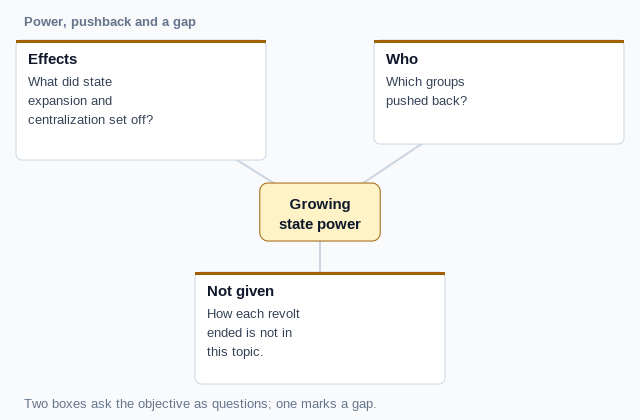
In short. As states expanded and centralized their power, groups on a local level pushed back, and in the Americas enslaved persons challenged existing authorities through organized resistance.
- State expansion and centralization led to resistance from an array of social, political and economic groups on a local level.
- College Board's examples of local resistance include the Pueblo Revolts, the Fronde, Cossack revolts, the Maratha conflict with the Mughals, Ana Nzinga's resistance and Metacom's War.
- Enslaved persons challenged existing authorities in the Americas through organized resistance, including the establishment of Maroon societies in the Caribbean and Brazil.
Part 2 Learn it Power and pushback
4.6a. Growing states, local resistance
This topic gives one effect of rising state power. State expansion and centralization led to resistance from an array of social, political, and economic groups on a local level. Expansion is a state reaching farther; centralization is power gathered toward its center. Array means a wide range of groups, and on a local level means in particular places.
College Board lists six examples: the Pueblo Revolts, the Fronde, Cossack revolts, the Maratha conflict with the Mughals, Ana Nzinga's resistance (as ruler of Ndongo and Matamba), and Metacom's War, also called King Philip's War.
The statement is short. It gives the cause of the resistance and who resisted, by kind of group. It does not say how any of these revolts ended or what they changed, so this lesson does not either.
Quick check · Multiple choice
Which sentence gives the cause and the effect in this topic's statement on local resistance in the right order?
4.6b. Resistance by enslaved persons
A second statement sits in this topic. Enslaved persons challenged existing authorities in the Americas through organized resistance. Organized matters: this is resistance that was planned and carried out together.
The examples are the establishment of Maroon societies in the Caribbean and Brazil, and the resistance of enslaved persons in North America.
The statement does not link this resistance to state expansion; it stands on its own. When you need a wider setting for it, the unit offers one in 4.4 Maritime Empires Established, where the growth of the plantation economy increased the demand for enslaved labor in the Americas.
Quick check · Multiple choice
College Board lists the establishment of Maroon societies in the Caribbean and Brazil as an example for this topic. Which broader development is it best situated within?
4.6c. Setting a development in context
This topic's skill is explaining how a specific development is situated within a broader historical context. It takes three moves.
First, say what the specific development is: who acted, and against what. Second, name the broader development of the period it belongs to. Third, say how the two connect: the specific case is one instance of the wider pattern, or happened within it.
The topic's title echoes the Governance theme printed on its page: a variety of internal and external factors contribute to state formation, expansion, and decline. The statements themselves do not sort the resistance into internal and external, so a context you write should rest on the statement, not on the title.
Quick check · Select all
A student writes: "The Pueblo Revolts were part of a wider pattern in this period." Which two sentences describe that wider pattern, using this topic's statement on local resistance? Pick two.
Select 2 answers, then check.
Part 3 Watch it done Placing a ruler's resistance
Watch the first steps, then take the last one yourself.
Ana Nzinga's resistance, as ruler of Ndongo and Matamba, is one of College Board's examples for this topic. Explain how it is situated within a broader historical context.
Step 1 · Say what it is
A ruler, of Ndongo and Matamba, resisting. The topic gives no more detail than that, so the context has to come from the statement it is listed under.
Step 2 · Find the broader development
It is listed among the examples of local resistance, so its broader development is the statement on state expansion and centralization meeting resistance from groups on a local level.
Why this step?
Why is the statement on resistance by enslaved persons the wrong context, though it is also about resistance?
That statement is about enslaved persons challenging authorities in the Americas. Ana Nzinga resisted as a ruler, and her example is listed with local resistance to growing states, not with the resistance of enslaved persons.
Your step · Decide and justify
Finish it. Which broader context best situates Ana Nzinga's resistance?
Why does that context fit?
Part 4 Try it Which pattern does it belong to?
Each scene below was written for this page. None is a real event or names a place. Decide which broader development of the period would situate it, or whether neither of this topic's statements does.
Try it · Sort it
Sort each scene by the broader development that situates it.
Local resistance to a growing state
Organized resistance by enslaved persons
Neither statement in this topic
Part 5 Explain it What growing power set off
This is a self-check. Nothing you type leaves this page. Compare your answer with the model and each scoring point.
Free-response practice · Question 2 style
This is a partial long essay. Write a thesis, one sentence of context and one paragraph of evidence, not a full essay.
In the period c. 1450 to c. 1750, many states expanded and centralized their power.
Explain the effects of the development of state power in the period c. 1450 to c. 1750.
Model answer
Thesis: As states expanded and centralized their power in this period, they met resistance from an array of social, political and economic groups on a local level.
Context: European states, driven largely by political, religious and economic rivalries, were establishing new maritime empires in this period, so state power was growing by sea as well as on land.
The main effect was resistance in particular places. The Maratha conflict with the Mughals pushed back against a growing empire. Ana Nzinga resisted as ruler of Ndongo and Matamba. The Pueblo Revolts and Metacom's War were local resistance, and so were the Fronde and Cossack revolts. The statement says the resisters were an array of social, political and economic groups, and the examples range from a ruler's resistance to revolts and wars, so growing state power drew opposition from more than one quarter.
Score your own answer. This is a self-check, not a grade. Tick each point your answer makes.
Part 6 Check yourself Placing the examples
The table drives the first two questions. The last two come from the rest of the lesson.
A student copied College Board's examples for this topic into a table, mixed together. It was written for this lesson and does not say which statement each example belongs to.
| Row | Example |
|---|---|
| 1 | The Pueblo Revolts |
| 2 | The Fronde |
| 3 | The Maratha conflict with the Mughals |
| 4 | Metacom's War (King Philip's War) |
| 5 | The establishment of Maroon societies in the Caribbean and Brazil |
Case question 1 · Fill the statement
A classmate says rows 2 and 3 have nothing in common, since they happened in different parts of the world. Complete the reply, using the topic's two statements.
Rows 2 and 3 share a context: like rows 1 and 4, they are examples of resistance to growing state power, while row 5 is organized resistance by persons.
Case question 2 · Spot the error
A student wrote five lines placing the table's examples. Which line is the first that is wrong about the table's examples?
The rest stand on their own and do not use the case.
Check yourself · Select all
Which two of these does College Board list as examples of local resistance to state expansion and centralization? Pick two.
Select 2 answers, then check.
Check yourself · Select all
Resistance of enslaved persons in North America is one of College Board's examples for this topic. Which two developments from this unit help situate it in a broader context? Pick two.
Select 2 answers, then check.
Part 7 Keep it Bring back earlier ideas
One question from the lesson on maintaining the maritime empires just before this one, and one from the maritime empires lesson before that.
From 4.5 Maritime Empires Maintained and Developed · Multiple choice
According to this topic's statement on rivalries, what led to rivalries and conflict between states from 1450 to 1750?
From 4.4 Maritime Empires Established · Multiple choice
A historian reads a report written by a European merchant at a new trading post in Asia, addressed to the rulers who backed the post. Which development from this topic best places the report in its historical situation?
In three lines
- State expansion and centralization led to resistance from an array of social, political and economic groups on a local level.
- The examples run from the Pueblo Revolts and Metacom's War to the Fronde, Cossack revolts, the Maratha conflict with the Mughals and Ana Nzinga's resistance.
- Enslaved persons challenged existing authorities in the Americas through organized resistance, such as the Maroon societies of the Caribbean and Brazil.
Exam strategy for this topic
- Section I Part A, Multiple Choice: 55 questions in 55 minutes.
- Section I Part B, Short Answer: 3 questions in 40 minutes.
- Section II, Document-Based Question and Long Essay: 2 questions in 100 minutes.
- This lesson's Explain it is shaped like free-response question 2, Long essay.
To contextualize, name the broader development in a full sentence and then say how your case fits within it. A list of other events from the same years does not situate anything.
Questions students ask
What caused the Pueblo Revolts?
The topic lists the Pueblo Revolts as an example of local resistance to state expansion and centralization and gives no more. College Board's sample activity has students read an excerpt from the Declaration of Pedro Naranjo, about the Pueblo Revolt, and mark its social, economic and political reasons for rebellion.
Did any of these revolts succeed?
The topic does not say. It gives resistance as an effect of growing state power and lists examples, but not how they ended.
What are the internal and external challenges in the title?
The title echoes the Governance theme: a variety of internal and external factors contribute to state formation, expansion, and decline. The topic's two statements do not sort the resistance into internal and external.
Who was Ana Nzinga, in this topic?
Her resistance, as ruler of Ndongo and Matamba, is one of the examples of local resistance. The topic says nothing more about her.
Is the resistance of enslaved persons part of the statement on growing states?
No. It has its own statement: enslaved persons challenged existing authorities in the Americas through organized resistance. The topic does not say state expansion caused it.
Course alignment, for teachers
AP World History: Modern topic 4.6, Unit 4: Transoceanic Interconnections.
- Skill 4.B: Explain how a specific historical development or process is situated within a broader historical context.
This lesson maps all 2 essential knowledge statements of the topic, and the one learning objective with none of its own, to the part that teaches each one: 3 are checked by a scored question. The map is in the lesson file.