Unit 5 · Topic 5.6 · about 30 minutes · 7 parts · 9 scored checks, 2 of them multiple choice, plus 2 from earlier lessons
AP World History: Modern 5.6: Industrialization: Government’s Role from 1750 to 1900
Unit 5: 12 to 15% of the multiple-choice section
What you'll be able to do
- Explain the causes and effects of economic strategies of different states and empires.
Key vocabulary
| Term | What it means | The exam trap |
|---|---|---|
| State-sponsored | Backed or paid for by a government. | The word says who backed a vision, not whether it worked, and the statement says nothing about how any vision turned out. |
| Internal reform | Change made inside a country to its own laws, government or institutions. | The statement does not say who carried out Japan's reform, so a stem that names the reformers is adding to it. |
| Meiji Era | A period in Japan's history, the one the statement names. | The statement gives the era's name but no dates, so do not attach years to it from this lesson. |
| Regional power | Strength and influence over a region and its neighbors. | Regional power is a country's standing among its neighbors, not its share of global manufacturing, which 5.4 Industrialization Spreads in the Period from 1750 to 1900 covers. |
 Tap to open the picture full size
Part 1 Think first A government that wants factories
Make a guess before you read. A wrong guess still gives the right idea something to push against.
Predict first
Picture a government in the 1800s that wants factories in its own country. What do you expect it to do?
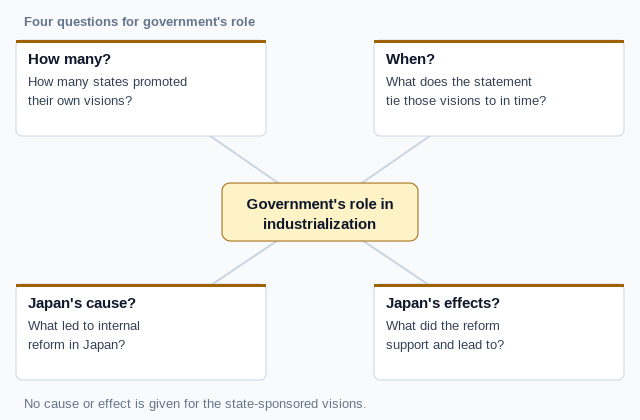
In short. As the Industrial Revolution's influence grew, a few states promoted their own visions of industrialization, and in Japan, reform answered the expansion of U.S. and European influence in Asia.
- As the influence of the Industrial Revolution grew, a small number of states and governments promoted their own state-sponsored visions of industrialization, such as Muhammad Ali's development of a cotton textile industry in Egypt.
- The expansion of U.S. and European influence in Asia led to internal reform in Japan.
- That reform supported industrialization and led to the growing regional power of Japan in the Meiji Era.
Part 2 Learn it States, visions, and reform in Japan
2a. A few states, each with its own vision
Industrialization was not only a story of private mills. The statement: as the influence of the Industrial Revolution grew, a small number of states and governments promoted their own state-sponsored visions of industrialization.
Each phrase limits the claim. A small number means few, not most. Their own means each vision belonged to the state that promoted it, not one shared plan. State-sponsored means a government backed it.
College Board gives one example: Muhammad Ali's development of a cotton textile industry in Egypt.
That is all it says about the example. It names no result of the Egyptian industry, and it names no other state that promoted a vision of its own.
Quick check · Multiple choice
Which description matches what this topic says about governments and industrialization?
2b. Japan: a cause from outside, a reform inside
The second statement is about Japan, and it is a full chain. The expansion of U.S. and European influence in Asia led to internal reform in Japan that supported industrialization and led to the growing regional power of Japan in the Meiji Era.
Take it apart. The cause lies outside Japan: U.S. and European influence expanding in Asia. The development lies inside: internal reform. Then the reform has two effects, one on industry and one on Japan's place among its neighbors.
Two silences are worth knowing. The statement does not say what the reforms were, and it does not say who carried them out. 5.4 Industrialization Spreads in the Period from 1750 to 1900 also lists Japan among the places new methods of industrial production spread to.
Quick check · Select all
Which two does this topic give as effects of internal reform in Japan? Pick two.
Select 2 answers, then check.
2c. Two statements, two amounts of cause and effect
Set the two statements side by side and a difference shows.
The Japan statement names a cause, led to, and two effects. The statement on state-sponsored visions names neither. Its opening, as the influence of the Industrial Revolution grew, says when the visions came. The statement does not say the growing influence made states act, and it gives no effect of any vision.
That difference matters for the objective, which asks for the causes and effects of states' economic strategies. For Japan you can quote both. For the state-sponsored visions you can give the timing and the example, and any cause or effect beyond that is an argument you would have to support from other evidence.
Quick check · Select all
Which two pair a development in this topic with what this topic says it came with or from? Pick two.
Select 2 answers, then check.
Part 3 Watch it done Ask cause and effect of an example
See the first steps worked, then take the last one.
Two of the questions College Board gives for this topic's skill: "What are the causes of this development or process?" and "What are the effects of this development or process?"
Ask them of College Board's example: Muhammad Ali's development of a cotton textile industry in Egypt.
Predict first
Before the steps: how much of an answer do you expect the statement to supply?
Step 1 · Place the example
College Board gives the Egyptian industry as an example of a state-sponsored vision of industrialization. So it belongs to the pattern of a small number of states and governments promoting visions of their own.
Step 2 · Look for a cause and an effect
The statement's opening, as the influence of the Industrial Revolution grew, places the visions in time. It does not call that influence a cause, and it names no effect of the Egyptian industry.
Why this step?
Why not call the growing influence the cause anyway?
As marks when the visions were promoted. Calling the influence a cause may be a fair argument, but it is a claim the statement does not make, so an answer that makes it has to support it rather than quote it.
Your step · Decide and justify
Finish it. A student writes: "Muhammad Ali's cotton textile industry in Egypt was one of a few government-backed plans for industry, promoted while the Industrial Revolution's influence was growing." Does the sentence stay within what the statement supports?
Why?
Part 4 Try it A teacher's notes on several states
Notes written for this page in the voice of a teacher comparing several states in this period, from this topic's statements and one from 5.8 Reactions to the Industrial Economy from 1750 to 1900. They are not a real document.
"Egypt's cotton mills, backed by Muhammad Ali, rose while the Industrial Revolution's reach was growing. Ottoman and Qing governments set out to modernize their armies and economies once industrializing states pressed on them. Some officials at court and old elite families fought those plans. In the Meiji Era, Japan counted for more among its neighbors than it had, after its own reforms."
Try it · Match
Match each sentence of the notes to the link it shows.
Part 5 Explain it Causes and effects of reform, in writing
This is a self-check. Nothing you type leaves this page. Hold your answer up to the model and each scoring point.
Free-response practice · Question 2 style
A short practice in the shape of the long essay question: a thesis, one sentence of context and one paragraph of evidence instead of a full essay.
Explain the causes and effects of internal reform in Japan in the period from 1750 to 1900.
Model answer
Thesis: The expansion of U.S. and European influence in Asia led to internal reform in Japan, and that reform both supported industrialization and led to Japan's growing regional power in the Meiji Era.
Context: Japan's reform took place as industrialization was spreading beyond the places it began. New methods of industrial production that had become more common in parts of northwestern Europe spread to other parts of Europe, the United States, Russia and Japan, so the reform came inside a wider spread of industry that reached Japan itself.
As U.S. and European influence expanded in Asia, change came inside Japan in the form of internal reform. That reform supported industrialization in Japan. The same reform led to the growing regional power of Japan in the Meiji Era. So the reform answered pressure from beyond Japan, and its effects ran two ways: toward industry at home and toward standing among Japan's neighbors. Japan's case shows a cause from outside producing a response inside, with effects on both production and power.
Score your own answer. This is a self-check, not a grade. Tick each point your answer makes.
Part 6 Check yourself A cause and effect organizer
Answer the first two from the organizer. The other two reach back over the lesson.
A student's organizer of this lesson's two statements.
| Development | What the statement ties it to | Effects the statement gives |
|---|---|---|
| Internal reform in Japan | the expansion of U.S. and European influence in Asia, which led to it | supported industrialization; led to the growing regional power of Japan in the Meiji Era |
| State-sponsored visions of industrialization, promoted by a small number of states and governments (example: Muhammad Ali's development of a cotton textile industry in Egypt) | as the influence of the Industrial Revolution grew | none given |
Case question 1 · Fill the statement
Finish the student's reading of the organizer.
Japan's reform answers a change that came from , while for Muhammad Ali's cotton textile industry the organizer gives a time and .
Case question 2 · Spot the error
A student wrote this paragraph from the organizer. Which line is the first to go wrong?
The rest stand on their own and do not use the case.
Check yourself · Multiple choice
This topic gives Muhammad Ali's development of a cotton textile industry in Egypt as an example. What is it an example of here?
Check yourself · Select all
These developments come from several topics in this unit. Which two could best support an argument that states took a role in industrialization? Pick two.
Select 2 answers, then check.
Part 7 Keep it Bring back earlier ideas
One question from the lesson on technology and one from the lesson on the spread of industry, so both come round again.
From 5.5 Technology of the Industrial Age · Multiple choice
Which fossil fuels does this topic name specifically?
From 5.4 Industrialization Spreads in the Period from 1750 to 1900 · Select all
Which three does this topic name as places new methods of industrial production spread to? Pick three.
Select 3 answers, then check.
In three lines
- As the influence of the Industrial Revolution grew, a small number of states and governments promoted their own state-sponsored visions of industrialization, such as Muhammad Ali's cotton textile industry in Egypt.
- The expansion of U.S. and European influence in Asia led to internal reform in Japan, which supported industrialization and led to Japan's growing regional power in the Meiji Era.
- The statements give a cause and effects for Japan's reform, but only a time and an example for the state-sponsored visions.
Exam strategy for this topic
- Section I Part A, Multiple Choice: 55 questions in 55 minutes.
- Section I Part B, Short Answer: 3 questions in 40 minutes.
- Section II, Document-Based Question and Long Essay: 2 questions in 100 minutes.
- This lesson's Explain it is shaped like free-response question 2, Long essay.
When a question asks for causes and effects, check what the evidence actually gives. Some statements give a cause and its effects; others give only a time or an example. Fill such a gap with an argument you support, never with an effect borrowed from another case.
Questions students ask
Who carried out Japan's internal reform?
The statement says internal reform in Japan and does not say who carried it out. An answer that names an actor is arguing from other evidence, and should say so.
What did Muhammad Ali's cotton textile industry lead to?
College Board gives it only as an example of a state-sponsored vision of industrialization. It names no result of the industry.
Did the growing influence of the Industrial Revolution cause the state-sponsored visions?
The statement says the visions came as that influence grew, which places them in time. It does not say the influence caused them.
How many states promoted their own visions of industrialization?
The statement says a small number of states and governments and gives one example, in Egypt. It does not list the others.
How does Japan here fit with Japan in the lesson on the spread of industry?
5.4 Industrialization Spreads in the Period from 1750 to 1900 lists Japan among the places new methods of industrial production spread to. This lesson adds that internal reform in Japan, which the expansion of U.S. and European influence in Asia led to, supported industrialization.
Course alignment, for teachers
AP World History: Modern topic 5.6, Unit 5: Revolutions.
- Skill 5.A: Identify patterns among or connections between historical developments and processes.
This lesson maps all 2 essential knowledge statements of the topic, and the one learning objective with none of its own, to the part that teaches each one: 3 are checked by a scored question. The map is in the lesson file.