Unit 3 · Topic 3.2 · about 30 minutes · 7 parts · 9 scored checks, 2 of them multiple choice, plus 2 from earlier lessons
AP World History: Modern 3.2: Empires: Administration
Unit 3: 12 to 15% of the multiple-choice section
What you'll be able to do
- Explain how rulers used a variety of methods to legitimize and consolidate their power in land-based empires from 1450 to 1750.
Key vocabulary
| Term | What it means | The exam trap |
|---|---|---|
| Legitimize | To make people accept a ruler's power as rightful. | The objective names two goals, legitimize and consolidate, and an answer that covers only one leaves half the prompt unanswered. |
| Consolidate | To make power firmer and more centralized. | Consolidating is a goal, and officials and soldiers are means to it. An essay that names the goal without the means has no evidence. |
| Bureaucratic elite | Trained officials who run a government's business for the ruler. | The framework names bureaucratic elites and military professionals in one statement, but they are two different groups, one civil and one military. |
| Tribute | Payments a ruler takes from people or states under that ruler's power. | Mexica tribute lists are records of tribute, so a question may give you the record and ask what it is evidence of. |
| Monumental architecture | Large, lasting buildings such as temples, tombs and palaces. | A building can be religious and still sit in the framework's art and architecture group, as Mughal mosques do. |
 Tap to open the picture full size
Part 1 Think first Why build a palace?
Commit to a guess before you read. A wrong guess now still helps the right idea stick.
Predict first
Rulers in this period built on a grand scale: the palace of Versailles in Europe, mausolea and mosques in the Mughal Empire. What do you think a ruler most wanted a building like that to do?
In short. From 1450 to 1750, rulers legitimized their power with religious ideas, art and monumental architecture, and consolidated it with officials, professional soldiers and new ways of raising revenue.
- Rulers continued to use religious ideas, art and monumental architecture to legitimize their rule.
- Rulers who wanted centralized control made more use of bureaucratic elites and military professionals.
- Tribute collection, tax farming and new tax-collection systems raised revenue to forward state power and expansion.
Part 2 Learn it Methods of rule
2a. Making rule look rightful
To legitimize rule is to make people accept it as rightful. The framework says rulers in this period continued to use religious ideas, art, and monumental architecture to do it.
Continued is a continuity word. Rulers had done this before: Song China used traditional methods of Confucianism and an imperial bureaucracy to maintain and justify its rule, in 1.1 Developments in East Asia from c. 1200 to c. 1450. What the framework adds for this period is a list of possible examples.
The framework's possible examples fall into two groups:
- Religious ideas: the Mexica practice of human sacrifice, European notions of divine right, and the Songhai promotion of Islam.
- Art and monumental architecture: Qing imperial portraits, the Incan sun temple of Cuzco, Mughal mausolea and mosques, and European palaces such as Versailles.
The examples come from Europe, Asia, Africa and the Americas, though the framework does not compare how well the method worked in any one place.
Quick check · Select all
Which two statements about how rulers legitimized their rule from 1450 to 1750 are accurate, as the course describes it? Pick two.
Select 2 answers, then check.
2b. Officials and soldiers
The objective pairs legitimizing with a second goal: to consolidate power, making it firmer and more centralized.
The framework says the recruitment and use of bureaucratic elites, trained officials who run a government's business, and the development of military professionals became more common among rulers who wanted to maintain centralized control over their populations and resources.
Became more common is change language: more rulers did it than before. The possible examples are the Ottoman devshirme and salaried samurai, listed without saying how either worked.
Quick check · Multiple choice
A student is describing the historical context for two of the course's examples, the Ottoman devshirme and salaried samurai. Which development from the course gives that context?
2c. Paying for power
The third statement turns to money. It says rulers used tribute collection, tax farming and innovative tax-collection systems to generate revenue in order to forward state power and expansion.
Read it as a chain. The methods raised revenue, and the revenue had a purpose: state power and expansion. That links this topic back to 3.1 Empires Expand, where large empires were built.
The framework's possible examples are Mughal zamindar tax collection, Ottoman tax farming, Mexica tribute lists, and the Ming practice of collecting taxes in hard currency. The word innovative says some of these systems were new, though the framework does not say which.
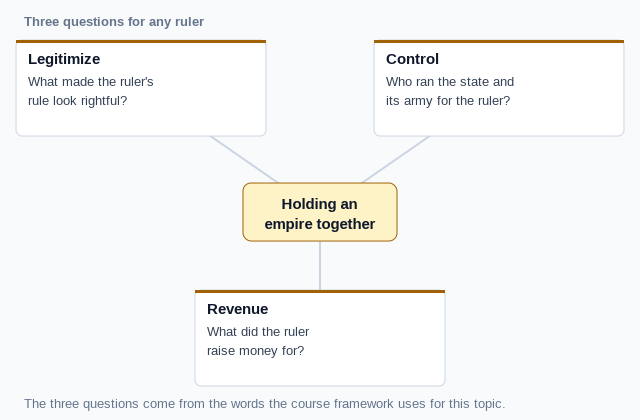
So the topic holds three kinds of method: religion and display to legitimize, officials and soldiers to keep central control, and revenue to forward state power and expansion.
Quick check · Multiple choice
According to the course, rulers in this period used tribute collection, tax farming and innovative tax-collection systems in order to do what?
Part 3 Watch it done Describe a context for one example
Watch the first steps, then take the last one yourself.
Identify and describe a historical context for Mexica tribute lists, one of the framework's examples.
The framework's task list for this skill asks two questions: What events led up to the one we are studying? What else is happening in the world at this time?
Predict first
Before the steps: which do you expect to make a better context for Mexica tribute lists?
Step 1 · Place the example
The framework lists Mexica tribute lists under tax-collection systems. The statement they illustrate is that rulers used tribute collection, tax farming and innovative tax-collection systems to generate revenue in order to forward state power and expansion.
Step 2 · Widen to what else was happening
Ask the task list's second question. In the same period, imperial expansion relied on the increased use of gunpowder, cannons and armed trade to establish large empires in both hemispheres, from 3.1 Empires Expand. Rulers were also continuing to use religious ideas to legitimize their rule, and the framework's examples include the Mexica practice of human sacrifice.
Why this step?
Why is "the Mexica lived in the Americas" not a historical context?
It is a place, not a development. A context describes something else going on at the time, such as empires expanding through gunpowder and cannons, and says how it bears on the example.
Your step · Decide and justify
Finish it. A student writes: "Mexica tribute lists come from a period when imperial expansion relied on the increased use of gunpowder, cannons and armed trade, and rulers raised revenue to forward state power and expansion." Does the sentence describe a historical context for the example?
Why?
Part 4 Try it One ruler, three methods
A list of actions by an imagined ruler, written for this page from the framework's three statements. None of them is one of the framework's named examples, so place each one by what it does.
Try it · Sort it
Sort each action by the method of rule it belongs to.
Legitimizing rule
Keeping central control
Raising revenue
Part 5 Explain it Methods of rule, in writing
This is a self-check. Nothing you type leaves this page. Compare your answer with the model and each scoring point.
Free-response practice · Question 2 style
A short practice in the shape of the long essay question: a thesis, one sentence of context and one paragraph of evidence instead of a full essay.
In the period from 1450 to 1750, rulers of land-based empires used a variety of methods to hold power.
Explain how rulers used different methods to legitimize and consolidate their power in land-based empires from 1450 to 1750.
Model answer
Thesis: Rulers legitimized their power by continuing to use religious ideas, art and monumental architecture, and they consolidated it by making more use of bureaucratic elites and military professionals and by raising revenue to forward state power.
Context: Imperial expansion in this period relied on the increased use of gunpowder, cannons and armed trade to establish large empires, so rulers were holding power over large empires that spread over several regions.
Religious ideas such as European notions of divine right and the Songhai promotion of Islam, and buildings such as Mughal mausolea and mosques and the palace of Versailles, presented rule as rightful. Because rulers continued these practices, they show continuity. To maintain centralized control over their populations and resources, rulers made more use of bureaucratic elites and military professionals, as the Ottoman devshirme and salaried samurai show, and that growing use was a change. Revenue from systems such as Ottoman tax farming and Mughal zamindar tax collection went to forward state power and expansion.
Score your own answer. This is a self-check, not a grade. Tick each point your answer makes.
Part 6 Check yourself Two empires side by side
Use the chart for the first two questions. The last two cover the whole lesson.
A student built this chart from the framework's examples, to compare the methods rulers used in the Ottoman and Mughal empires.
| Method | Ottoman example | Mughal example |
|---|---|---|
| Raising revenue | Ottoman tax farming | Mughal zamindar tax collection |
| Art and monumental architecture | no example in the framework's list | Mughal mausolea and mosques |
| Bureaucratic elites or military professionals | Ottoman devshirme | no example in the framework's list |
Case question 1 · Decide and justify
Does the chart show that Ottoman rulers did not use art or monumental architecture to legitimize their rule?
Which reading of the chart decides it?
Case question 2 · Spot the error
The student then wrote this paragraph from the chart. Which line is the first to go wrong?
The rest stand on their own and do not use the case.
Check yourself · Select all
A student is describing the historical context for Mughal zamindar tax collection, one of the course's examples. Which two statements from the course belong in that context? Pick two.
Select 2 answers, then check.
Check yourself · Select all
One of College Board's sample activities for this topic uses excerpts about the rulers of the Ottoman and Songhay empires from Leo Africanus's Description of Timbuktu (1526) and Ogier Ghiselin de Busbecq's The Turkish Letters (1555 to 1562). Which two developments from the course were under way in the period when these sources were written? Pick two.
Select 2 answers, then check.
Part 7 Keep it Bring back earlier ideas
One question from the lesson on expanding empires and one from the lesson on the environmental effects of exchange, so both come round again.
From 3.1 Empires Expand · Select all
Which three of these match an empire with the regions the course gives for it? Pick three.
Select 3 answers, then check.
From 2.6 Environmental Consequences of Connectivity · Select all
Which two statements about disease in Afro-Eurasia from c. 1200 to c. 1450 are accurate? Pick two.
Select 2 answers, then check.
In three lines
- Rulers continued to use religious ideas, art and monumental architecture to legitimize their rule.
- Rulers who wanted centralized control made more use of bureaucratic elites and military professionals.
- Tribute collection, tax farming and new tax-collection systems generated revenue to forward state power and expansion.
Exam strategy for this topic
- Section I Part A, Multiple Choice: 55 questions in 55 minutes.
- Section I Part B, Short Answer: 3 questions in 40 minutes.
- Section II, Document-Based Question and Long Essay: 2 questions in 100 minutes.
- This lesson's Explain it is shaped like free-response question 2, Long essay.
A historical context is a development under way at the time, not a place or a date. Describe what else was happening, then say in a clause how it bears on the example.
Questions students ask
Is it Songhai or Songhay?
Both spellings name the same empire. The framework's examples spell it Songhai, and its sample activity for this topic spells it Songhay.
What was the devshirme?
The framework lists the Ottoman devshirme as an example of bureaucratic elites or military professionals, beside salaried samurai, and does not describe how it worked. What your class studies about it can fill that in.
What was tax farming?
The framework lists Ottoman tax farming as an example of how rulers raised revenue to forward state power and expansion, and does not describe how it worked. What your class studies about it can fill that in.
Why does the framework say rulers continued to use religion?
Because the practice was older than this period. Song China used traditional methods of Confucianism and an imperial bureaucracy to maintain and justify its rule, in 1.1 Developments in East Asia from c. 1200 to c. 1450, and in this period rulers continued to use religious ideas, art and monumental architecture to legitimize their rule.
What does the sample activity for this topic ask?
It has students read short excerpts about the rulers of the Ottoman and Songhay empires by Leo Africanus and Ogier Ghiselin de Busbecq, identify and describe the historical context, and highlight similarities in the methods rulers used to legitimize and consolidate power.
Are the European examples about land-based empires?
The statements say rulers in general, and the framework's examples include European notions of divine right and European palaces such as Versailles beside Ottoman, Mughal and Qing examples.
Course alignment, for teachers
AP World History: Modern topic 3.2, Unit 3: Land-Based Empires.
- Skill 4.A: Identify and describe a historical context for a specific historical development or process.
This lesson maps all 3 essential knowledge statements of the topic, and the one learning objective with none of its own, to the part that teaches each one: 4 are checked by a scored question. The map is in the lesson file.