Unit 5 · Topic 5.5 · about 30 minutes · 7 parts · 9 scored checks, 2 of them multiple choice, plus 2 from earlier lessons
AP World History: Modern 5.5: Technology of the Industrial Age
Unit 5: 12 to 15% of the multiple-choice section
What you'll be able to do
- Explain how technology shaped economic production over time.
Key vocabulary
| Term | What it means | The exam trap |
|---|---|---|
| Fossil fuels | Fuels formed in the earth long ago from the remains of living things. | The statement says both existing and vast newly discovered resources, so an answer that has the machines using only old supplies drops half of it. |
| Internal combustion engine | An engine that burns fuel inside itself to make power. | It sits beside the steam engine as one of the machines, so do not file it with the second industrial revolution's list of products. |
| Second industrial revolution | A later stage of industrialization than the first Industrial Revolution of 5.4 Industrialization Spreads in the Period from 1750 to 1900. | A stem that names steam-powered production and a rising European share is pointing at the first Industrial Revolution, not this one. |
| Interior regions | Lands away from the coasts. | The statement says globally, so an answer that confines it to one continent's interior narrows what it claims. |
 Tap to open the picture full size
Part 1 Think first Five technologies, one ranking
Commit to a pick before you read. You will test it against what each technology made possible.
Predict first
A magazine article will rank five technologies by how much they changed the world. Which would you put first?
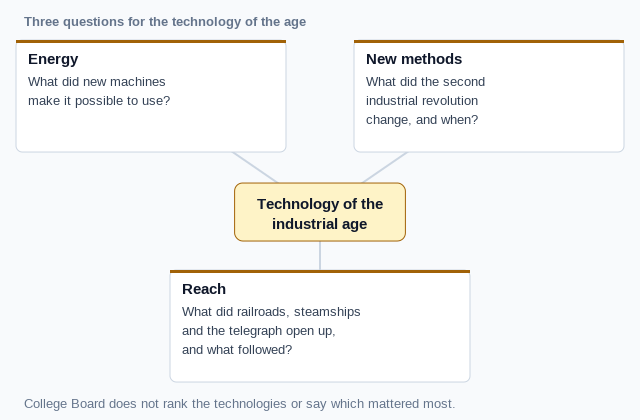
In short. New machines let societies draw on the energy stored in coal and oil, a second industrial revolution brought new production methods, and railroads, steamships and the telegraph opened interior regions to trade and migration.
- Machines, including steam engines and the internal combustion engine, made it possible to take advantage of energy stored in fossil fuels, and the fossil fuels revolution greatly increased the energy available to human societies.
- The second industrial revolution led to new methods in the production of steel, chemicals, electricity, and precision machinery during the second half of the 19th century.
- Railroads, steamships, and the telegraph made exploration, development, and communication possible in interior regions globally, which led to increased trade and migration.
Part 2 Learn it Energy, new methods, and reach
2a. Machines and stored energy
Start with energy. The statement: the development of machines, including steam engines and the internal combustion engine, made it possible to take advantage of both existing and vast newly discovered resources of energy stored in fossil fuels, specifically coal and oil.
Read it as a chain. The energy was already there, stored in the fuels. The machines are the middle link: they made it possible to take advantage of that energy. Including marks the two engines as examples of the machines, not the whole set.
Then the result: the fossil fuels revolution greatly increased the energy available to human societies.
Two details slip out of answers. The resources were both existing ones and vast newly discovered ones. And the statement never says how an engine works, so an explanation needs only what the engines made possible.
Quick check · Multiple choice
A student explains: "Steam engines and the internal combustion engine changed how much energy societies had." Which statement from this topic best explains how?
2b. A second industrial revolution
The next statement gives a time and a list. The "second industrial revolution" led to new methods in the production of steel, chemicals, electricity, and precision machinery during the second half of the 19th century.
The quotation marks are College Board's own. In 5.4 Industrialization Spreads in the Period from 1750 to 1900, the rising European and U.S. share of global manufacturing came during the first Industrial Revolution; this second one is later, in the second half of the 1800s.
What changed here is the method. The statement does not say steel or chemicals were new, only that new ways of producing them came.
It also gives no cause. Nothing College Board gives says why the second industrial revolution began, so an answer can say what it led to and when, and stop there.
Quick check · Select all
Which three does this topic give as things whose production the second industrial revolution brought new methods to? Pick three.
Select 3 answers, then check.
2c. Reaching the interior
The last statement is about distance. Railroads, steamships, and the telegraph made exploration, development, and communication possible in interior regions globally, which led to increased trade and migration.
Interior regions are lands away from the coasts, and globally means around the world. The statement names no place.
Like the energy statement, this one has a middle link:
- the technologies: railroads, steamships, the telegraph
- what they made possible in interior regions
- what that led to: increased trade and migration
An explanation that skips the second link goes straight from a rail line to trade, with nothing to show how one brought the other.
Quick check · Select all
This topic says railroads, steamships, and the telegraph made three things possible in interior regions globally. Which two of these are among them? Pick two.
Select 2 answers, then check.
Part 3 Watch it done Show technology shaping production over time
Follow the first steps, then take the last one yourself.
The objective ends with two words: over time. One way to show technology shaping production over time is to set two stages of production in order.
Use the stage in 5.4 Industrialization Spreads in the Period from 1750 to 1900 and the one in this lesson.
Predict first
Before the steps: which came first, steam-powered production or new methods for producing steel and chemicals?
Step 1 · The earlier stage
From 5.4 Industrialization Spreads in the Period from 1750 to 1900: the rapid development of steam-powered industrial production in European countries and the U.S. contributed to a rise in their share of global manufacturing during the first Industrial Revolution.
Step 2 · The later stage
From this lesson: during the second half of the 19th century, the second industrial revolution led to new methods in producing steel, chemicals, electricity and precision machinery.
Why this step?
Why put the stages in order instead of describing each one alone?
Over time asks for change across a period, and two stages in order show it: steam-powered production first, then new methods for other products. Neither statement gives a cause joining the two stages, so the order is all an answer should claim about them.
Your step · Decide and justify
Finish it. A student writes: "Technology changed production in stages: steam-powered production developed rapidly during the first Industrial Revolution, and that steam power then caused the second industrial revolution, which led to new methods for producing steel, chemicals, electricity and precision machinery in the second half of the 19th century." Does the sentence stay within what the two statements support?
Why?
Part 4 Try it A paragraph for the article
A paragraph written for this page, for a debate group's article on technologies that changed the world. It is set in an imagined inland region and uses only the links the statement on interior regions gives. The region and its details are not real.
"Steamships began calling at river towns far inland. A telegraph line was strung across the plains to the mining camps. Survey parties pushed into hills that no outsider had mapped, and merchants on the coast could send word to agents in the camps and hear back. Each year more grain and ore went out to distant buyers, and families from far away moved in to settle and work."
Try it · Sort it
Sort each piece of the paragraph by the link it fills in the statement's chain.
The technology
What it made possible inland
What that led to
Part 5 Explain it Technology and production, in writing
This is a self-check. Nothing you type leaves this page. Set your answer beside the model and each scoring point.
Free-response practice · Question 2 style
A short practice in the shape of the long essay question: a thesis, one sentence of context and one paragraph of evidence instead of a full essay.
Explain how technology shaped economic production in the period from 1750 to 1900.
Model answer
Thesis: Technology shaped economic production by making far more energy available, by bringing new ways of producing steel, chemicals, electricity and precision machinery, and by opening interior regions to development and trade.
Context: These technologies were part of the development of industrial capitalism, which led to continued improvement in manufacturing methods that increased the availability, affordability and variety of consumer goods, so each new technology fed a wider, ongoing change in what economies produced.
Machines, including steam engines and the internal combustion engine, made it possible to take advantage of existing and vast newly discovered resources of energy stored in coal and oil, and the fossil fuels revolution greatly increased the energy available to human societies. In the second half of the 19th century, the second industrial revolution led to new methods in the production of steel, chemicals, electricity and precision machinery. Railroads, steamships and the telegraph made exploration, development and communication possible in interior regions globally, which led to increased trade and migration. So technology shaped production in three ways: more energy available, new methods for making steel, chemicals, electricity and precision machinery, and interior regions opened to development and increased trade.
Score your own answer. This is a self-check, not a grade. Tick each point your answer makes.
Part 6 Check yourself A debate group's ranking
The first two questions use the group's table; the other two range over the whole lesson.
A debate group's draft ranking for its article, written for this page. The reasons are in the group's own words.
| Rank | Technology | The group's reason |
|---|---|---|
| 1 | Railroad | It opened lands far from the coast to newcomers and to goods bound for distant markets. |
| 2 | Steam engine | It let factories draw on the energy stored in coal. |
| 3 | Telegraph | It carried messages to places deep inland. |
| 4 | Internal combustion engine | It put the energy stored in oil to work. |
| 5 | Steamship | It reached river towns far from the coast. |
Case question 1 · Fill the statement
Complete a student's reading of the group's reasons.
Only the group's reason for the carries its technology all the way to the trade and migration that followed, and its reason for the internal combustion engine rests on the same statement as its reason for the .
Case question 2 · Spot the error
A student wrote this review of the group's table. Which line is the first to go wrong?
The rest stand on their own and do not use the case.
Check yourself · Multiple choice
Which fossil fuels does this topic name specifically?
Check yourself · Select all
Which two cause-and-effect links does this topic give? Pick two.
Select 2 answers, then check.
Part 7 Keep it Bring back earlier ideas
One question from the lesson on how industrialization spread and one from the lesson on how it began.
From 5.4 Industrialization Spreads in the Period from 1750 to 1900 · Multiple choice
In this topic's statement, where did new methods of industrial production become more common before they spread to other places?
From 5.3 Industrial Revolution Begins · Select all
Which two describe how this topic links its factors to the Industrial Revolution? Pick two.
Select 2 answers, then check.
In three lines
- Machines, including steam engines and the internal combustion engine, let societies take advantage of energy stored in coal and oil, and the energy available to them greatly increased.
- In the second half of the 19th century, the second industrial revolution led to new methods of producing steel, chemicals, electricity and precision machinery.
- Railroads, steamships and the telegraph made exploration, development and communication possible in interior regions, which led to increased trade and migration.
Exam strategy for this topic
- Section I Part A, Multiple Choice: 55 questions in 55 minutes.
- Section I Part B, Short Answer: 3 questions in 40 minutes.
- Section II, Document-Based Question and Long Essay: 2 questions in 100 minutes.
- This lesson's Explain it is shaped like free-response question 2, Long essay.
An explanation that names a technology and stops has only identified it. Say what the technology made possible, then what that led to, so the reader can follow the cause to its effect.
Questions students ask
Which of the five technologies changed the world most?
College Board does not rank them. Its sample debate asks a group to rank the steam engine, railroad, internal combustion engine, steamship and telegraph and justify the order, so a ranking is an argument built from what each one made possible.
Did the machines create new energy?
No. The energy was stored in fossil fuels. The machines made it possible to take advantage of it, and the fossil fuels revolution greatly increased the energy available to human societies.
How is the second industrial revolution different from the first?
5.4 Industrialization Spreads in the Period from 1750 to 1900 ties the first Industrial Revolution to the rapid development of steam-powered production. The second came in the second half of the 19th century and led to new methods of production. College Board does not say what caused it.
Where were the railroads and telegraph lines built?
The statement says interior regions globally and names no place, and College Board gives no examples for this topic. An explanation of the link does not need a place.
Is the fossil fuels revolution the same thing as the Industrial Revolution?
College Board does not equate them. It uses the phrase in the energy statement, for what greatly increased the energy available to human societies, and gives it no dates of its own.
Course alignment, for teachers
AP World History: Modern topic 5.5, Unit 5: Revolutions.
- Skill 1.B: Explain a historical concept, development, or process.
This lesson maps all 3 essential knowledge statements of the topic, and the one learning objective with none of its own, to the part that teaches each one: 4 are checked by a scored question. The map is in the lesson file.