Unit 3 · Topic 3.1 · about 30 minutes · 7 parts · 9 scored checks, 2 of them multiple choice, plus 2 from earlier lessons
AP World History: Modern 3.1: Empires Expand
Unit 3: 12 to 15% of the multiple-choice section
What you'll be able to do
- Explain how and why various land-based empires developed and expanded from 1450 to 1750.
Key vocabulary
| Term | What it means | The exam trap |
|---|---|---|
| Land empire | An empire whose rule spread over land, such as the four the framework lists for this topic. | The framework says land empires included four, and a list that opens with included is not a full count. |
| Armed trade | Trade carried on with force behind it, one of the three things imperial expansion relied on. | Armed trade is still trade, so it can appear in a question about commerce as well as in one about war. Read the whole phrase. |
| Hemisphere | Half of the globe. The framework speaks of the Eastern and Western Hemispheres. | The statement on expansion says large empires in both hemispheres, so it reaches past the four land empires in this topic's list. |
| Rivalry | Competition between states, which can lead to conflict. | A rivalry here is between states. A split inside one faith is a different development, taken up in 3.3 Empires: Belief Systems. |
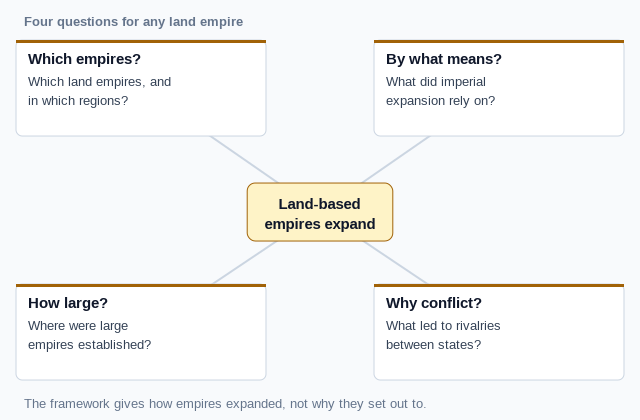 Tap to open the picture full size
Part 1 Think first Drawing a battle
Commit to a guess before you read. A wrong guess now still helps the right idea stick.
Predict first
One of College Board's sample activities gives students the description of the Battle of Panipat in the Baburnama, a primary source on the Mughal conquest of India. Students draw a diagram of the battle, then explain the technological factors that helped the Mughal Empire grow. What do you expect the diagram to need most?
In short. From 1450 to 1750, land-based empires expanded by relying on the increased use of gunpowder, cannons and armed trade, and political and religious disputes led to rivalries and conflict between states.
- Imperial expansion relied on more use of gunpowder, cannons and armed trade, and it established large empires in both hemispheres.
- Land empires included the Manchu, the Mughal, the Ottoman and the Safavids, each in regions the framework names.
- Political and religious disputes led to rivalries between states, such as the Safavid-Mughal conflict.
Part 2 Learn it How land empires grew
2a. What expansion relied on
The framework names three things that imperial expansion relied on in this period: gunpowder, cannons and armed trade, meaning trade carried on with force behind it.
Read the words in front of the list closely: the increased use of gunpowder, cannons and armed trade. Increased use means more use than before. It does not say the weapons were new. Gunpowder from China is one of the framework's examples of innovations that diffused before 1450, in 2.5 Cultural Consequences of Connectivity.
The statement also says what this expansion produced: large empires in both hemispheres, the Eastern and the Western. So it covers more empires than the four land empires in the next chunk.
That gives you the how of this topic. When a question asks how empires grew from 1450 to 1750, the framework's answer is the means: more and more gunpowder, cannons and armed trade.
Quick check · Multiple choice
Which statement best explains how land empires expanded from 1450 to 1750, as the course describes it?
2b. Four land empires
The framework says land empires included four, each with the regions it gives:
- the Manchu in Central and East Asia
- the Mughal in South and Central Asia
- the Ottoman in Southern Europe, the Middle East and North Africa
- the Safavids in the Middle East
Included marks examples, not a full count.
Two regions repeat. Tell the Manchu and the Mughal apart by East Asia and South Asia, since both have Central Asia. The Middle East is in both the Ottoman and the Safavid entries.
Quick check · Select all
Which three of these match an empire with the regions the course gives for it? Pick three.
Select 3 answers, then check.
2c. Rivals
These states also had rivals. The framework's statement is that political and religious disputes led to rivalries and conflict between states.
This is a cause and an effect: disputes over politics and religion came first, and rivalry and conflict followed. It answers why states clashed, which is a different question from how empires grew.
The framework gives two possible examples of state rivalries: the Safavid-Mughal conflict and the Songhai Empire's conflict with Morocco. Two of the land empires from the last chunk are in the first one. The framework does not say whether a political or a religious dispute lay behind either example.
Now the objective's how and why. The how is in the first chunk. The framework gives no reason why empires set out to expand; the why it does give is for conflict between states. An answer can say so plainly and build on what the framework does supply.
Quick check · Select all
Which two of these does the course give as examples of rivalries and conflict between states from 1450 to 1750? Pick two.
Select 2 answers, then check.
Part 3 Watch it done Explain a factor in an empire's growth
Watch the first steps, then take the last one yourself.
The sample activity's prompt: "Explain the technological factors that contributed to the growth of the Mughal Empire."
A student has written one sentence so far:
"The Mughal Empire, in South and Central Asia, grew by relying more and more on gunpowder and cannons."
Decide whether the sentence explains a technological factor, or only names one.
Predict first
Before the steps: does the student's sentence explain, or does it only name?
Step 1 · Take the prompt apart
The prompt asks for two things joined together: technological factors, the tools and weapons, and the growth of the Mughal Empire, the outcome. An explanation has to connect the first to the second.
Step 2 · Gather what the framework gives
The Mughal was one of the land empires, in South and Central Asia. Imperial expansion in this period relied on the increased use of gunpowder, cannons and armed trade. Gunpowder and cannons are the technological factors in that list.
Why this step?
Why is "the Mughal Empire had gunpowder" not yet an explanation?
It names a factor but says nothing about growth. An explanation says how the factor led to the outcome, so the sentence needs a link such as "grew by relying on".
Your step · Decide and justify
Finish it. Does the student's sentence, "The Mughal Empire, in South and Central Asia, grew by relying more and more on gunpowder and cannons," explain a technological factor in the empire's growth?
Why?
Part 4 Try it Which sentences explain growth?
A practice paragraph, written for this page from the framework's statements:
"Land empires such as the Ottoman grew from 1450 to 1750. Their expansion relied on the increased use of gunpowder and cannons. Armed trade also helped establish large empires in both hemispheres. Gunpowder from China had spread before 1450. The Safavids and the Mughal were rivals. The Ottoman ruled in Southern Europe, the Middle East and North Africa."
Try it · Sort it
Sort each sentence from the paragraph by whether it explains how the empires grew.
Explains how they grew
Does not explain how they grew
Part 5 Explain it How empires expanded, in writing
This is a self-check. Nothing you type leaves this page. Compare your answer with the model and each scoring point.
Free-response practice · Question 2 style
A short practice in the shape of the long essay question: a thesis, one sentence of context and one paragraph of evidence instead of a full essay.
From 1450 to 1750, several land-based empires grew large.
Explain how land-based empires expanded in the period from 1450 to 1750.
Model answer
Thesis: Land-based empires such as the Ottoman and the Mughal expanded by relying on the increased use of gunpowder, cannons and armed trade, and that reliance let them establish empires that spread over several regions.
Context: In the same centuries, transoceanic voyaging connected the Eastern and Western Hemispheres and transformed trade, so armed trade was one means of expansion in a world whose trade was being remade.
Land empires included the Ottoman, which ruled in Southern Europe, the Middle East and North Africa, the Mughal in South and Central Asia, the Manchu in Central and East Asia, and the Safavids in the Middle East. Their expansion relied on the increased use of gunpowder and cannons, weapons that were used more than before, and on armed trade. Those means are how large empires were established in both hemispheres. An empire that used gunpowder and cannons more and more could hold land across several regions, as the Ottoman did.
Score your own answer. This is a self-check, not a grade. Tick each point your answer makes.
Part 6 Check yourself From notes to an explanation
Use the notes for the first two questions. The last two cover the whole lesson.
A student made these notes from the framework to answer the sample activity's prompt: "Explain the technological factors that contributed to the growth of the Mughal Empire."
| Note | What the framework gives |
|---|---|
| Where the Mughal ruled | South and Central Asia |
| What imperial expansion relied on | the increased use of gunpowder, cannons and armed trade |
| What that expansion established | large empires in both hemispheres |
| A state rivalry the framework lists | the Safavid-Mughal conflict |
Case question 1 · Fill the statement
Complete the student's explanation from the notes.
Gunpowder and cannons were factors in the Mughal Empire's growth, and the word in the notes shows they were already in use before this period.
Case question 2 · Spot the error
The student then wrote this paragraph from the notes. Which line is the first to go wrong?
The rest stand on their own and do not use the case.
Check yourself · Multiple choice
According to this topic's statement on rivalries, what led to rivalries and conflict between states from 1450 to 1750?
Check yourself · Select all
One of College Board's sample activities for this topic asks students to explain the technological factors that contributed to the growth of the Mughal Empire. Which two of these does the course's statement on imperial expansion name? Pick two.
Select 2 answers, then check.
Part 7 Keep it Bring back earlier ideas
One question from the review of networks of exchange and one from the lesson on cultural effects of connectivity, so both come round again.
From 2.7 Comparison of Economic Exchange · Select all
A student claims: "The networks of exchange in this period grew with the help of different technologies." Which two pieces of evidence support that claim? Pick two.
Select 2 answers, then check.
From 2.5 Cultural Consequences of Connectivity · Select all
Which two of these are examples of diffusion in this period as the course describes it? Pick two.
Select 2 answers, then check.
In three lines
- Imperial expansion relied on the increased use of gunpowder, cannons and armed trade, and it established large empires in both hemispheres.
- Land empires included the Manchu, Mughal, Ottoman and Safavids, each in the regions the framework gives.
- Political and religious disputes led to rivalries and conflict between states, such as the Safavid-Mughal conflict.
Exam strategy for this topic
- Section I Part A, Multiple Choice: 55 questions in 55 minutes.
- Section I Part B, Short Answer: 3 questions in 40 minutes.
- Section II, Document-Based Question and Long Essay: 2 questions in 100 minutes.
- This lesson's Explain it is shaped like free-response question 2, Long essay.
When a prompt asks you to explain, link each factor to the outcome in the same sentence, with words such as "grew by relying on". A list of factors with no link only identifies them.
Questions students ask
What is the Baburnama?
The sample activity for this topic describes it as a primary source on the Mughal conquest of India, and has students draw the Battle of Panipat from its description. The framework says nothing more about the battle itself.
Was gunpowder new in this period?
The statement speaks of the increased use of gunpowder, and 2.5 Cultural Consequences of Connectivity names gunpowder from China among innovations that diffused before 1450. What changed here was how much empires used it.
Are these the only land empires of the period?
The framework says land empires included the Manchu, Mughal, Ottoman and Safavids. Included marks a list of examples, so it does not claim to name them all.
Was the Songhai Empire's conflict with Morocco political or religious?
In this topic the framework lists it as a state rivalry under the statement on political and religious disputes, without saying which kind of dispute lay behind it. In 4.5 Maritime Empires Maintained and Developed it lists the Moroccan conflict with the Songhai Empire again, under competition over trade routes, beside a statement that economic disputes also led to rivalries.
Does the framework say why empires set out to expand?
No. It says what expansion relied on and what it established, which is how. The cause it gives in this topic is for conflict between states: political and religious disputes.
Course alignment, for teachers
AP World History: Modern topic 3.1, Unit 3: Land-Based Empires.
- Skill 1.B: Explain a historical concept, development, or process.
This lesson maps all 3 essential knowledge statements of the topic, and the one learning objective with none of its own, to the part that teaches each one: 4 are checked by a scored question. The map is in the lesson file.