Unit 3 · Topic 3.3 · about 30 minutes · 7 parts · 9 scored checks, 2 of them multiple choice, plus 2 from earlier lessons
AP World History: Modern 3.3: Empires: Belief Systems
Unit 3: 12 to 15% of the multiple-choice section
What you'll be able to do
- Explain continuity and change within the various belief systems during the period from 1450 to 1750.
Key vocabulary
| Term | What it means | The exam trap |
|---|---|---|
| Reformation | A movement to reform a church. The framework speaks of a Protestant one and a Catholic one. | The Protestant Reformation and the Catholic reformation are two movements, so read which one a choice names before you judge it. |
| Sunni and Shi'a | The two branches of Islam named in the framework's statement on the split. | The statement speaks of a split within Islam, so it is about one faith dividing, not about two separate religions. |
| Sikhism | A belief system that the framework says developed in South Asia in this period. | Where Sikhism developed and amid which faiths are two separate details, and a question may ask for either one. |
| Historical situation | The circumstances in which a source was produced: what was going on at that time and place. | Situation is one of four sourcing elements, beside point of view, purpose and audience, and a question names the one it wants. |
 Tap to open the picture full size
Part 1 Think first Same faiths, or new ones?
Commit to a guess before you read. A wrong guess now still helps the right idea stick.
Predict first
Picture a traveler in this period who passes through Europe, the Ottoman and Safavid lands, and South Asia. Compared with two centuries earlier, what would the traveler most likely find in the belief systems of those places?
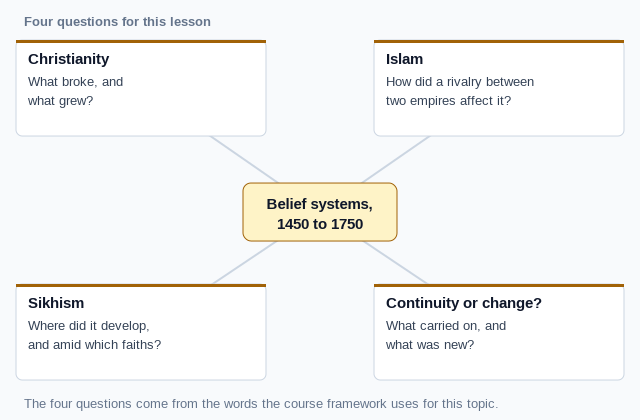
In short. From 1450 to 1750, belief systems both changed and carried on: Christianity broke and grew, an older split within Islam deepened, and Sikhism developed in South Asia.
- The Protestant Reformation marked a break with existing Christian traditions, and both reformations contributed to the growth of Christianity.
- Political rivalries between the Ottoman and Safavid empires intensified the split within Islam between Sunni and Shi'a.
- Sikhism developed in South Asia in a context of interactions between Hinduism and Islam.
Part 2 Learn it Three belief systems in this period
2a. Break and growth in Christianity
The framework's statement on Christianity has two halves, and they point in different directions.
First: the Protestant Reformation marked a break with existing Christian traditions. A break is change, and a sharp one.
Second: both the Protestant and Catholic reformations contributed to the growth of Christianity. Note the plural. There were two reformations, and the framework credits the growth to both of them.
Put the halves together and the pattern is not what a student might first expect. A break inside a faith might sound like a loss, yet the framework pairs it with growth.
One of College Board's sample activities for this topic has students read an excerpt from Martin Luther's 95 Theses after a lesson on the Protestant Reformation, then work on one element of sourcing, such as the source's historical situation. To name a situation, ask when and where a source was produced, then find the development under way there at that time.
Quick check · Multiple choice
In one of College Board's sample activities, students read an excerpt from Martin Luther's 95 Theses after a lesson on the Protestant Reformation. Which development from the course best describes the historical situation of that source?
2b. A split within Islam
The statement on Islam ties politics to belief: political rivalries between the Ottoman and Safavid empires intensified the split within Islam between Sunni and Shi'a.
Read the verb. To intensify is to make something stronger. The split was there to be made stronger, so the statement holds a continuity, the split itself, and a change, its deepening.
The cause is political. Two empires were rivals, and their rivalry worked on a religious division. Both empires appear in 3.1 Empires Expand's list of land empires, and the Middle East is in both of their entries.
The statement does not say which empire held to which branch of Islam, or how the rivalry deepened the split. It gives the link and its direction: political rivalry, then a sharper religious split.
Quick check · Multiple choice
A historian reads a letter written at the Ottoman court about the Safavid empire. Which development from the course best explains the historical situation in which the letter was written?
2c. A new faith in South Asia
The third statement: Sikhism developed in South Asia in a context of interactions between Hinduism and Islam. It gives a place, South Asia, and a setting, two faiths that were already there. The framework does not describe what Sikhs believed.
Sikhism developed in this period, so it is change. Hinduism and Islam formed its context, so the faiths around it carried on.
One test now works on every development in this lesson: ask what carried on, then what was new. Christianity carried on as a faith, and grew, while the Protestant Reformation broke with its existing traditions. Islam's older split deepened. Sikhism was new, amid older faiths that carried on.
Quick check · Select all
A historian is explaining the historical situation of a source about the development of Sikhism. Which two details from the course help? Pick two.
Select 2 answers, then check.
Part 3 Watch it done Describe continuity and change in one statement
Watch the first steps, then take the last one yourself.
Describe the continuity and the change in the framework's statement on Islam: "Political rivalries between the Ottoman and Safavid empires intensified the split within Islam between Sunni and Shi'a."
Then judge a student's sentence about it.
Predict first
Before the steps: how many developments of continuity or change do you expect to find in that one sentence?
Step 1 · Find what was already there
"The split within Islam between Sunni and Shi'a" is the thing being acted on. A split that can be intensified already exists, so the split carries on. That is the continuity.
Step 2 · Find what changed, and why
"Intensified" is the change: the split grew sharper. "Political rivalries between the Ottoman and Safavid empires" is what the statement says drove it.
Why this step?
Why not call the whole statement a change?
Because the split itself was older. Calling it all change would erase the continuity the verb assumes, and a strong answer gives both.
Your step · Decide and justify
Finish it. A student writes: "The split between Sunni and Shi'a carried on from before, and rivalry between the Ottoman and Safavid empires deepened it." Does the sentence describe the continuity and change in the statement correctly?
Why?
Part 4 Try it Situate four new sources
Four sources, described for this page. Each is the kind of source a historian might read for this period, but none is a real document the framework names. For each, find the development that gives its historical situation.
Try it · Match
Match each source to the development that best describes its historical situation.
Part 5 Explain it Continuity and change, in writing
This is a self-check. Nothing you type leaves this page. Compare your answer with the model and each scoring point.
Free-response practice · Question 2 style
A short practice in the shape of the long essay question: a thesis, one sentence of context and one paragraph of evidence instead of a full essay.
In the period from 1450 to 1750, belief systems in several regions saw important developments.
Explain continuity and change within belief systems in the period from 1450 to 1750.
Model answer
Thesis: Belief systems in this period changed through breaks, deepening divisions and a new faith, yet each change grew from something that carried on, so the period shows change built on continuity.
Context: Empires achieved increased scope and influence in these centuries, shaping and being shaped by the diverse populations they incorporated, so belief systems were developing in a world where large empires ruled many peoples.
In Christianity, the Protestant Reformation marked a break with existing Christian traditions, a change, yet Christianity carried on and grew, since both the Protestant and Catholic reformations contributed to its growth. Within Islam, the split between Sunni and Shi'a was already there, which is continuity, and political rivalries between the Ottoman and Safavid empires intensified it, which is change. In South Asia, Sikhism developed in a context of interactions between Hinduism and Islam: a new belief system, so a change, that took shape amid two faiths that carried on.
Score your own answer. This is a self-check, not a grade. Tick each point your answer makes.
Part 6 Check yourself Three belief systems in one table
Use the table for the first two questions. The last two cover the whole lesson.
A student built this table from the framework's statements, to answer the question: what carried on and what changed in belief systems from 1450 to 1750?
| Belief system | What the framework says |
|---|---|
| Christianity | the Protestant Reformation marked a break with existing Christian traditions; both the Protestant and Catholic reformations contributed to the growth of Christianity |
| Islam | political rivalries between the Ottoman and Safavid empires intensified the split within Islam between Sunni and Shi'a |
| Sikhism | developed in South Asia in a context of interactions between Hinduism and Islam |
Case question 1 · Fill the statement
Complete the student's reading of the Christianity row.
In the Christianity row, Christianity carrying on as a faith is a , while the Protestant Reformation's break with existing traditions is a .
Case question 2 · Spot the error
The student then wrote this paragraph from the table. Which line is the first to go wrong?
The rest stand on their own and do not use the case.
Check yourself · Select all
A historian is explaining the historical situation of a source written by a Catholic reformer in this period. Which two statements from the course describe that situation? Pick two.
Select 2 answers, then check.
Check yourself · Select all
Which two of these describe a change in belief systems from 1450 to 1750, as the course gives it? Pick two.
Select 2 answers, then check.
Part 7 Keep it Bring back earlier ideas
One question from the lesson on methods of rule and one from the review of networks of exchange, so both come round again.
From 3.2 Empires: Administration · Multiple choice
According to the course, rulers in this period used tribute collection, tax farming and innovative tax-collection systems in order to do what?
From 2.7 Comparison of Economic Exchange · Select all
The course's review statement says a deepening and widening of networks of human interaction contributed to cultural, technological and biological diffusion. Which two pieces of evidence from this unit support that statement? Pick two.
Select 2 answers, then check.
In three lines
- The Protestant Reformation marked a break with existing Christian traditions, and both reformations contributed to the growth of Christianity.
- Political rivalries between the Ottoman and Safavid empires intensified an existing split within Islam between Sunni and Shi'a.
- Sikhism developed in South Asia in a context of interactions between Hinduism and Islam: new, and built amid faiths that carried on.
Exam strategy for this topic
- Section I Part A, Multiple Choice: 55 questions in 55 minutes.
- Section I Part B, Short Answer: 3 questions in 40 minutes.
- Section II, Document-Based Question and Long Essay: 2 questions in 100 minutes.
- This lesson's Explain it is shaped like free-response question 2, Long essay.
When a question asks for a source's historical situation, name the development under way when and where the source was produced, not what the source itself says.
Questions students ask
What does the sample activity on Luther ask students to do?
After a lesson on the Protestant Reformation, students read a short excerpt from Martin Luther's 95 Theses and paraphrase it to a partner. Each pair is given one element of sourcing, point of view, purpose, situation or audience, and the students explain how it might affect Luther's interpretation of the Catholic Church.
Which empire was Sunni and which was Shi'a?
The framework's statement does not say. It says political rivalries between the Ottoman and Safavid empires intensified the split. What your class studies about the two empires can fill that in.
Did the Catholic reformation break with tradition too?
The framework says the Protestant Reformation marked a break with existing Christian traditions, and says both reformations contributed to Christianity's growth. It makes no statement about a break for the Catholic reformation.
Why is a split within a faith explained by politics?
Because that is the link the statement draws: political rivalries between two empires intensified a split within Islam. It is one place where this unit's two themes, governance and cultural developments, meet.
Is Sikhism a change or a continuity?
Both parts are there. A belief system that developed in this period is a change, and the faiths that formed its context, Hinduism and Islam, carried on beside it.
Course alignment, for teachers
AP World History: Modern topic 3.3, Unit 3: Land-Based Empires.
- Skill 2.B: Explain the point of view, purpose, historical situation, and/or audience of a source.
This lesson maps all 3 essential knowledge statements of the topic, and the one learning objective with none of its own, to the part that teaches each one: 4 are checked by a scored question. The map is in the lesson file.