Unit 1 · Topic 1.6 · about 30 minutes · 7 parts · 9 scored checks, 2 of them multiple choice, plus 2 from earlier lessons
AP World History: Modern 1.6: Developments in Europe from c. 1200 to c. 1450
Unit 1: 8 to 10% of the multiple-choice section
What you'll be able to do
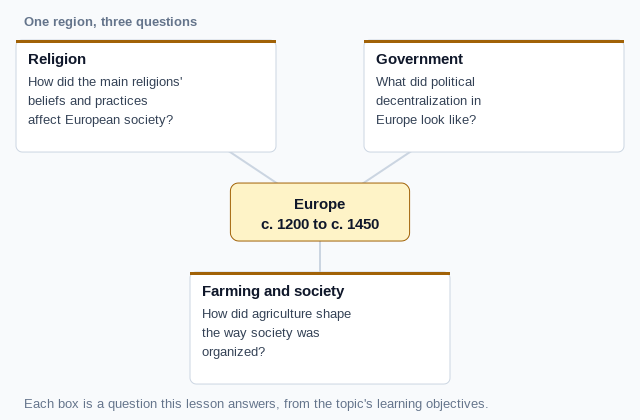
- Explain how the beliefs and practices of Christianity, Judaism and Islam affected European society from c. 1200 to c. 1450.
- Explain the causes and consequences of political decentralization in Europe from c. 1200 to c. 1450, starting from what decentralized Europe looked like.
- Explain how agriculture shaped the way European society was organized from c. 1200 to c. 1450.
Key vocabulary
| Term | What it means | The exam trap |
|---|---|---|
| Politically fragmented | Broken into many separate centers of power. | Fragmented describes where power sat, not how many people lived there. Read it as a statement about government. |
| Decentralized monarchy | A monarchy in which power is not held at the center. | Read decentralized as a statement about where power sat, not about whether a monarch existed. |
| Feudalism | A system of holding land in return for loyalty and service. | Feudalism is a way of organizing land and loyalty, not a religion or a trade network. |
| Manorial system | Farming and village life organized around a lord's estate, called a manor. | The manorial system works at the level of the estate. Keep it apart from the monarchy above it. |
| Agricultural society | A society in which most people make their living from farming. | A farming society can still have towns and trade. The word names the main way people lived. |
| Coerced labor | Work that people are forced to do. | The word describes the terms of the work, not the job itself. Read what kind of work a choice describes as well. |
| Serfdom | A condition in which a peasant is bound to work a lord's land. | Serfdom is one kind of coerced labor. A choice may speak of coerced labor without naming serfdom. |
 Tap to open the picture full size
Part 1 Think first A working day in Europe
Commit to a guess before you read. A wrong guess now still helps the right idea stick.
Predict first
Picture an ordinary person living in Europe around the year 1300. How do you expect they most likely spent their working days?
In short. From c. 1200 to c. 1450, Christianity, Judaism and Islam shaped European societies, Europe was politically fragmented, and it was largely an agricultural society that depended on both free and coerced labor.
- Christianity, Judaism and Islam, with their core beliefs and practices, continued to shape societies in Europe.
- Europe was politically fragmented, with decentralized monarchies, feudalism and the manorial system.
- Europe was largely an agricultural society dependent on free and coerced labor, including serfdom.
Part 2 Learn it Faith, power and farming in Europe
2a. Three faiths in Europe
Christianity, Judaism and Islam, and the core beliefs and practices of these religions, continued to shape societies in Europe.
Read the list again. It names three religions, not one, and says all three continued to shape European societies. A choice that keeps Christianity and drops the other two has shortened the statement.
You have seen the same three faiths before. In the Dar al-Islam lesson, Islam, Judaism and Christianity shaped societies in Africa and Asia. The same three appear in both statements; what differs is the region.
Quick check · Select all
Which two statements about religion in Europe in this period are accurate? Pick two.
Select 2 answers, then check.
2b. A fragmented Europe
Europe was politically fragmented and characterized by decentralized monarchies, feudalism and the manorial system.
- Fragmented means broken into many pieces: many separate centers of power.
- A decentralized monarchy has a monarch, but power is not held at the center.
- Feudalism is a system of holding land in return for loyalty and service.
- The manorial system organized farming and village life around a lord's estate, called a manor.
Set this beside Song China, which used traditional Confucian methods and an imperial bureaucracy to maintain and justify its rule. The two are described in very different terms, and that contrast is a ready-made comparison.
One honest note. The learning objective asks for the causes and consequences of decentralization, but the framework's statement for this topic describes what decentralized Europe looked like. It lists no causes, so this lesson does not invent any.
Quick check · Multiple choice
Which statement best describes the political organization of Europe from c. 1200 to c. 1450?
2c. A farming society
Europe was largely an agricultural society dependent on free and coerced labor, including serfdom.
Largely agricultural means most people made their living from the land. Free and coerced means both kinds of labor existed side by side: some workers chose their work, and others were forced to do it. Serfdom, in which a peasant is bound to work a lord's land, is the form of coerced labor the framework names.
This is where agriculture shapes social organization. A society that lives by farming has to settle who works the land and on what terms, and in Europe the answer was a mix: free workers alongside serfs.
Compare Song China's economy, which depended on free peasant and artisanal labor. Be careful with that comparison: it tells you what each region's economy depended on, not everything about either one.
Quick check · Multiple choice
Which statement best explains how agriculture shaped social organization in Europe in this period?
Part 3 Watch it done Identify how one thing shaped another
Watch the first steps, then take the last one yourself.
Identify one way agriculture shaped social organization in Europe in the period c. 1200 to c. 1450.
Step 1 · Name the cause
The cause is agriculture: Europe was largely an agricultural society, so most people made their living from the land.
Step 2 · Find the effect on how society was organized
Social organization is about how people are grouped and on what terms. A farming society has to decide who works the land. In Europe that work fell to free workers and to people in coerced labor, including serfs.
Why this step?
Why does the answer need both free and coerced labor?
The statement names both. An answer with only serfs, or only free workers, keeps half of the effect and loses the other half.
Your step · Decide and justify
Finish it. Which sentence identifies how agriculture shaped social organization in Europe?
Which evidence supports your choice?
Part 4 Try it Free or coerced?
Each card describes a worker in Europe's farming society. The cards were written for this page from the framework's statement and the plain meanings of its words, not taken from a source. Decide on what terms each one works.
Try it · Sort it
Sort each worker in Europe, c. 1200 to c. 1450, by the kind of labor described.
Free labor
Coerced labor
Part 5 Explain it Cause and effect, in writing
This is a self-check. Nothing you type leaves this page. Compare your answer with the model and each scoring point.
Free-response practice · Question 2 style
A short practice in the shape of the long essay question: a thesis, one sentence of context and one paragraph of evidence instead of a full essay. Use what this lesson taught.
In the period c. 1200 to c. 1450, most societies depended on farming.
Explain how agriculture shaped social organization in Europe in the period c. 1200 to c. 1450.
Model answer
Thesis: Because Europe was largely an agricultural society, the way it organized its people rested on who worked the land and on what terms: it depended on free labor and on coerced labor, including serfdom.
Context: Europe was politically fragmented in this period, with decentralized monarchies, feudalism and the manorial system, a sharp contrast with Song China's imperial bureaucracy.
Farming was how most Europeans lived, so labor on the land was the base of society. Some of that labor was free. Some was coerced, including serfdom, in which peasants were bound to work a lord's land, and the manorial system organized farming around such estates. So agriculture shaped social organization by dividing working people into free workers and those bound to the land, side by side in the same society.
Score your own answer. This is a self-check, not a grade. Tick each point your answer makes.
Part 6 Check yourself Europe beside Song China
Read the table for the first two questions. The last two reach across the lesson.
A student set the framework's descriptions of Europe and of Song China side by side.
| Theme | Europe | Song China |
|---|---|---|
| Government | politically fragmented; decentralized monarchies, feudalism, the manorial system | traditional methods of Confucianism and an imperial bureaucracy |
| Economy and labor | largely agricultural; free and coerced labor, including serfdom | increasingly commercialized; free peasant and artisanal labor |
| Religion and culture | Christianity, Judaism and Islam | Chinese cultural traditions and Buddhism in East Asia |
Case question 1 · Fill the statement
Complete the student's comparison using the table.
In Europe, political power was , with decentralized monarchies and feudalism, while the Song held its rule through traditional Confucian methods and an imperial .
Case question 2 · Spot the error
The student wrote this paragraph about Europe from the table. Which line is the first to state something the framework does not support?
The rest stand on their own and do not use the case.
Check yourself · Select all
Which two statements describe European society and its labor in this period? Pick two.
Select 2 answers, then check.
Check yourself · Select all
Which two statements accurately contrast Europe with Song China in this period? Pick two.
Select 2 answers, then check.
Part 7 Keep it Bring back earlier ideas
One question from the Africa lesson and one from the South and Southeast Asia lesson, so both come round again.
From 1.5 State Building in Africa · Select all
A student writes: "African state systems in this period showed continuity." Which two additions would complete the course's description? Pick two.
Select 2 answers, then check.
From 1.3 Developments in South and Southeast Asia from c. 1200 to c. 1450 · Select all
Which two of these are beliefs or practices that shaped societies in South and Southeast Asia in this period? Pick two.
Select 2 answers, then check.
In three lines
- Christianity, Judaism and Islam all continued to shape societies in Europe.
- Europe was politically fragmented, with decentralized monarchies, feudalism and the manorial system.
- Europe was largely agricultural and depended on free and coerced labor, including serfdom.
Exam strategy for this topic
- Section I Part A, Multiple Choice: 55 questions in 55 minutes.
- Section I Part B, Short Answer: 3 questions in 40 minutes.
- Section II, Document-Based Question and Long Essay: 2 questions in 100 minutes.
- This lesson's Explain it is shaped like free-response question 2, Long essay.
When a question sets Europe beside Song China, check every feature in a choice against the right region: fragmented politics and serfdom for Europe, an imperial bureaucracy and a commercializing economy for the Song.
Questions students ask
Why doesn't this lesson list the causes of decentralization?
The learning objective asks for causes and consequences, but College Board's statement for this topic describes what decentralized Europe looked like and names no causes. The lesson teaches what the statement says; your class may study causes beyond it.
What is the difference between feudalism and the manorial system?
In their general sense, feudalism is about holding land in return for loyalty and service, and the manorial system is about how farming and village life were organized on a lord's estate.
Why are there no named examples in this topic?
The framework prints no illustrative examples for this topic, so this lesson works from its three statements and compares Europe with regions you have already studied.
Did Song China have no coerced labor?
The framework does not say that. It says the Song economy depended on free peasant and artisanal labor. Compare what each region's economy depended on, and do not stretch either statement further.
Was everyone in Europe's farming society a serf?
No. The framework says Europe depended on free and coerced labor, including serfdom. Serfs worked alongside free workers.
Course alignment, for teachers
AP World History: Modern topic 1.6, Unit 1: The Global Tapestry.
- Skill 1.A: Identify a historical concept, development, or process.
This lesson maps all 3 essential knowledge statements of the topic, and the 3 learning objectives with none of their own, to the part that teaches each one: 6 are checked by a scored question. The map is in the lesson file.