Unit 2 · Topic 2.5 · about 30 minutes · 7 parts · 9 scored checks, 2 of them multiple choice, plus 2 from earlier lessons
AP World History: Modern 2.5: Cultural Consequences of Connectivity
Unit 2: 8 to 10% of the multiple-choice section
What you'll be able to do
- Explain the intellectual and cultural effects of the networks of exchange in Afro-Eurasia from c. 1200 to c. 1450.
Key vocabulary
| Term | What it means | The exam trap |
|---|---|---|
| Diffusion | The spread of something from one people or place to others. | Every spread has a starting point and a place it reached. Read both before you accept a choice. |
| Cross-cultural interaction | Contact between people of different cultures. | A question may ask about the contact itself or about what came of it. Read which one. |
| Urbanization | The growth of cities. | Read the time span a choice covers before you accept what it says about cities. |
| Point of view | The perspective of the person who made a source. | Point of view is the author's perspective, not the views of the people the author describes. |
| Purpose | What the author of a source was trying to do. | Purpose is what the author meant the source to do, which can differ from what it actually did. |
| Audience | The people a source was made for. | A source can mention many people. Read the question for which group it means. |
| Historical situation | The time and circumstances in which a source was made. | Read whether a choice describes the source's world or something inside the source itself. |
 Tap to open the picture full size
Part 1 Think first Far from home
Commit to a guess before you read. A wrong guess now still helps the right idea stick.
Predict first
A traveler reaches a city far from home and finds a temple of a faith from another land, and paper for sale in the market. What do you expect best accounts for finding both so far from where they came from?
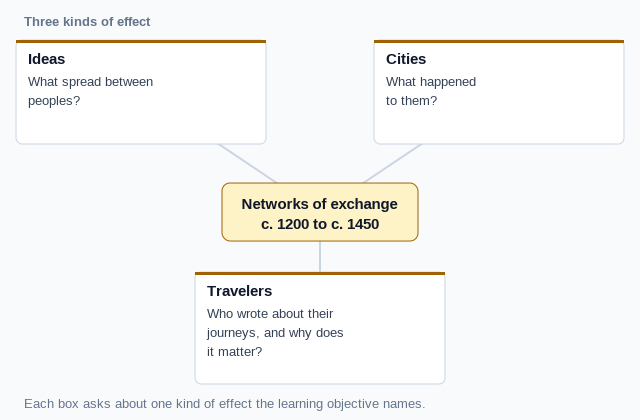
In short. From c. 1200 to c. 1450, increased cross-cultural interactions spread traditions and innovations between societies, the fate of cities varied greatly, and more travelers within Afro-Eurasia wrote about their travels.
- Increased cross-cultural interactions resulted in the diffusion of literary, artistic and cultural traditions, as well as scientific and technological innovations, such as paper from China.
- The fate of cities varied greatly, with periods of significant decline and periods of increased urbanization, buoyed by rising productivity and expanding trade networks.
- As exchange networks intensified, an increasing number of travelers within Afro-Eurasia, such as Ibn Battuta, Margery Kempe and Marco Polo, wrote about their travels.
Part 2 Learn it What connection carried
2a. Traditions and innovations on the move
More trade meant more meetings between peoples. Increased cross-cultural interactions resulted in the diffusion of literary, artistic, and cultural traditions, as well as scientific and technological innovations. Diffusion is spreading from one people or place to others.
The statement has two halves, and an answer that keeps only one has lost half of it.
- Traditions: the framework's possible examples are the influence of Buddhism in East Asia, the spread of Hinduism and Buddhism into Southeast Asia, and the spread of Islam in sub-Saharan Africa and Asia.
- Innovations: its possible examples are gunpowder from China and paper from China.
Notice the direction in the second pair. Each example names where the innovation spread from, China. When you use one, keep its direction.
Quick check · Select all
Which two of these are examples of diffusion in this period as the course describes it? Pick two.
Select 2 answers, then check.
2b. Travelers who wrote, and how to source them
As exchange networks intensified, an increasing number of travelers within Afro-Eurasia wrote about their travels. Ibn Battuta, Margery Kempe and Marco Polo are the framework's possible examples. Their writing is a cultural effect of exchange in its own right.
A travel account is also a primary source, and College Board's sourcing skill asks you to identify four things about one:
- Point of view: the author's perspective.
- Purpose: what the author was trying to do.
- Audience: who it was meant for.
- Historical situation: the time and circumstances it came from.
Each element answers a different question. "Did the author admire the people described?" asks about point of view. "What did the author want the account to achieve?" asks about purpose. "Whom was it written for?" asks about audience. College Board's sample activity for this lesson asks questions like these of an excerpt from On the Tatars by the Arab historian Ibn al-Athir (1220 to 1221 CE).
Quick check · Select all
A College Board sample activity has students source an excerpt from On the Tatars by the Arab historian Ibn al-Athir (1220 to 1221 CE). Which two of these questions are about the author's purpose? Pick two.
Select 2 answers, then check.
2c. Cities that rose and fell
Cities did not share one story. The fate of cities varied greatly, with periods of significant decline and periods of increased urbanization, buoyed by rising productivity and expanding trade networks.
Urbanization is the growth of cities. Buoyed by means held up by: in the periods when cities grew, rising productivity and expanding trade networks supported that growth. The framework gives no cause for the periods of decline, so an answer should not invent one.
This statement also helps with sourcing. A traveler who describes a city growing crowded is writing in one of the periods of increased urbanization. That is part of the account's historical situation. It does not prove that every city was growing, because the same statement says the fate of cities varied greatly.
Quick check · Select all
A traveler's account from this period describes a city growing crowded and busy with merchants. Which two statements from the course help place that account within its historical situation? Pick two.
Select 2 answers, then check.
Part 3 Watch it done Place an account in its situation
Watch the first steps, then take the last one yourself.
A student is sourcing a travel account by Marco Polo, one of the framework's possible examples of travelers. Identify the account's historical situation.
Predict first
Before the steps: where do you expect to find an account's historical situation?
Step 1 · Know what the element asks
Historical situation is the time and circumstances a source came from. It is about the world around the author, not the author's opinions, aims or readers.
Step 2 · Find a statement that describes those circumstances
One statement fits a travel account directly: as exchange networks intensified, an increasing number of travelers within Afro-Eurasia wrote about their travels. Marco Polo is one of the possible examples of those travelers.
Why this step?
Why is "the author wanted readers to admire distant lands" not the historical situation?
It is a guess at what the author was trying to do, which is purpose. Historical situation places the account in its time, among a growing number of travelers writing about their travels.
Your step · Decide and justify
Finish it. Which sentence places Marco Polo's account in its historical situation?
Why does your sentence describe the historical situation?
Part 4 Try it Source an imagined letter
The letter below is imagined. It was written for this page and is not a real source.
"I write this for the merchants of my home city, so that they may know which markets are worth the long journey. As a merchant myself, I judge every city first by its markets." The traveler wrote it in a century when more and more travelers within Afro-Eurasia were writing about their travels.
Try it · Match
Match each part of the imagined letter to the element of sourcing it shows.
Part 5 Explain it What contact spread
This is a self-check. Nothing you type leaves this page. Compare your answer with the model and each scoring point.
Free-response practice · Question 2 style
In the shape of the long essay question, but shorter: a thesis, a sentence of context and a paragraph of evidence.
In the period c. 1200 to c. 1450, people across Afro-Eurasia came into contact with other cultures more often.
Explain one intellectual or cultural effect of the networks of exchange in Afro-Eurasia in the period c. 1200 to c. 1450.
Model answer
Thesis: The networks of exchange spread cultural traditions and technological innovations between societies, such as the spread of Islam in sub-Saharan Africa and Asia and paper from China, because they brought people of different cultures into contact.
Context: Trade itself was growing. Improved commercial practices and transportation technologies increased the volume of trade on existing routes such as the Silk Roads and the Indian Ocean and expanded their range, so more exchange reached more places in these years.
Increased cross-cultural interactions resulted in the diffusion of literary, artistic and cultural traditions, such as the spread of Hinduism and Buddhism into Southeast Asia, as well as technological innovations, such as gunpowder from China. As those networks intensified, an increasing number of travelers, such as Ibn Battuta, also wrote about their travels. The link runs from contact to spread: where interactions between cultures increased, traditions and innovations diffused between them.
Score your own answer. This is a self-check, not a grade. Tick each point your answer makes.
Part 6 Check yourself An imagined traveler's account
The account drives the first two questions. The last two come from the rest of the lesson.
This account is imagined. It was written for this lesson from the framework's statements and is not a real source.
"I write for the merchants of my home city. This city grows larger every year; new houses rise outside its walls, and its streets are crowded with traders from many lands. Its people buy paper from China, and the guards at the gate carry weapons that use gunpowder from China. Near the market stands a temple of a faith that came here from another region, and in the evenings musicians play songs from a distant land."
| Part of the account | What it says |
|---|---|
| Readers | The merchants of the traveler's home city |
| The city | Grows larger every year, with new houses outside its walls and streets crowded with traders |
| The market | Paper from China for sale |
| The gate | Guards with weapons that use gunpowder from China |
| Near the market | A temple of a faith that came from another region |
| Evenings | Musicians playing songs from a distant land |
Case question 1 · Sort it
Sort each detail from the account by what it shows.
A tradition spreading
An innovation spreading
A city growing
Case question 2 · Spot the error
A student sourced the account and used it as evidence. Which line is the first to go wrong?
The rest stand on their own and do not use the case.
Check yourself · Multiple choice
Which statement best describes a cultural effect of increased cross-cultural interactions in Afro-Eurasia from c. 1200 to c. 1450?
Check yourself · Multiple choice
Margery Kempe wrote an account of her travels. Which of these places her account within its historical situation?
Part 7 Keep it Bring back earlier ideas
One question from the trans-Saharan lesson just before this one, and one on transfers from the Mongol lesson three back.
From 2.4 Trans-Saharan Trade Routes · Select all
Which two are transportation technologies whose innovation encouraged the growth of trans-Saharan trade? Pick two.
Select 2 answers, then check.
From 2.2 The Mongol Empire and the Making of the Modern World · Select all
Which two statements about technological and cultural transfers in this period are accurate? Pick two.
Select 2 answers, then check.
In three lines
- Increased cross-cultural interactions spread literary, artistic and cultural traditions and scientific and technological innovations, such as paper from China.
- The fate of cities varied greatly; periods of increased urbanization were buoyed by rising productivity and expanding trade networks.
- More travelers wrote about their travels, and sourcing an account means naming its point of view, purpose, audience and historical situation.
Exam strategy for this topic
- Section I Part A, Multiple Choice: 55 questions in 55 minutes.
- Section I Part B, Short Answer: 3 questions in 40 minutes.
- Section II, Document-Based Question and Long Essay: 2 questions in 100 minutes.
- This lesson's Explain it is shaped like free-response question 2, Long essay.
When a question asks you to source a document, decide first which element it asks about: point of view, purpose, audience or historical situation. Then read the choices for that element only, and set aside true statements about the others.
Questions students ask
Did gunpowder and paper begin in China?
College Board's framework gives gunpowder from China and paper from China as possible examples of innovations that diffused. It says they spread from China; this lesson does not claim more about where either one first appeared.
Who were Ibn Battuta, Margery Kempe and Marco Polo?
The framework names them as possible examples of the increasing number of travelers within Afro-Eurasia who wrote about their travels. It says nothing more about them, and its examples are not required information.
Did cities grow throughout this period?
No single answer fits. The framework says the fate of cities varied greatly, with periods of significant decline and periods of increased urbanization, buoyed by rising productivity and expanding trade networks.
Where does the Ibn al-Athir activity come from?
It is one of College Board's sample activities for this lesson. Students read an excerpt from On the Tatars by the Arab historian Ibn al-Athir (1220 to 1221 CE) and answer questions on its historical situation, point of view, purpose and audience.
Course alignment, for teachers
AP World History: Modern topic 2.5, Unit 2: Networks of Exchange.
- Skill 2.A: Identify a source’s point of view, purpose, historical situation, and/or audience.
This lesson maps all 3 essential knowledge statements of the topic, and the one learning objective with none of its own, to the part that teaches each one: 4 are checked by a scored question. The map is in the lesson file.