Unit 7 · Topic 7.7 · about 30 minutes · 7 parts · 9 scored checks, 2 of them multiple choice, plus 2 from earlier lessons
AP World History: Modern 7.7: Conducting World War II
Unit 7: 8 to 10% of the multiple-choice section
What you'll be able to do
- Explain similarities and differences in how governments used a variety of methods to conduct war.
Key vocabulary
| Term | What it means | The exam trap |
|---|---|---|
| Ideology | A set of ideas about how society and government should work. | Fascism and communism come after including, so they are examples, not the only ideologies the statement allows. |
| Totalitarian state | A state whose government seeks control over nearly every part of public and private life. | Totalitarian describes how far a government's control reaches, not which side of the war it fought on. |
| Basic freedoms | Rights such as speaking, meeting and worshipping freely. | To repress a freedom is to hold it down by force or law, which can happen without the freedom being abolished on paper. |
| Tactics | The methods used to fight a battle or a war. | Tactics are ways of fighting, not weapons, so a list of what raised casualties can hold both. |
| Refute | To show that an argument cannot stand. This is the lesson's working meaning. | Evidence that leaves part of an argument standing modifies it, so check what survives before you write refute. |
 Tap to open the picture full size
Part 1 Think first Two governments, one war
Commit to a guess before you read. A wrong guess now still helps the right idea stick.
Predict first
Two governments are fighting the same world war. One is elected by its citizens; the other is run by a single party that tolerates no rival. Where would you expect the two to differ most?
In short. World War II was a total war, in which governments used a variety of strategies to mobilize populations, used ideologies to mobilize all of their state's resources and, in the case of totalitarian states, to repress basic freedoms, while new military technology and new tactics led to increased levels of wartime casualties.
- Governments used political propaganda, art, media, and intensified forms of nationalism to mobilize populations, both in the home countries and the colonies or former colonies.
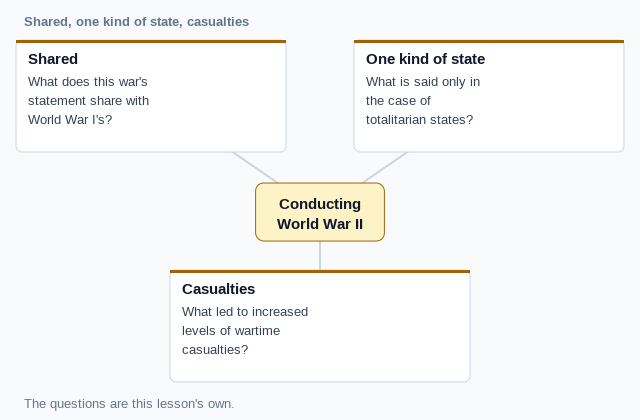
- The clause on repressing basic freedoms and dominating many aspects of daily life, during the course of the conflicts and beyond, is said in the case of totalitarian states.
- New military technology and new tactics, including the atomic bomb, fire-bombing, and the waging of "total war", led to increased levels of wartime casualties.
Part 2 Learn it How governments waged World War II
2a. A second total war, set beside the first
The statement opens: World War II was a total war. 7.3 Conducting World War I called World War I the first total war, so this war, too, drew on whole societies and not only their armies.
Set the two topics' statements side by side and much of the wording is the same.
In both: governments used a variety of strategies, including political propaganda, art, media, and intensified forms of nationalism, to mobilize populations for the purpose of waging war. New military technology led to increased levels of wartime casualties.
Only in this topic's statements:
- the populations are in the home countries and the colonies or former colonies;
- governments used ideologies, including fascism and communism, to mobilize all of their state's resources for war;
- a clause is added for totalitarian states, the subject of the next chunk;
- new tactics stand beside the new technology.
This is a comparison of two statements. Where one names something the other does not, say that. It is not evidence that the earlier war lacked it.
Quick check · Select all
Which two appear in this topic's statement on World War II but not in Topic 7.3's statement on World War I? Pick two.
Select 2 answers, then check.
2b. Ideologies, and a clause for one kind of state
The ideology sentence has two parts.
Governments used ideologies, including fascism and communism to mobilize all of their state's resources for war. An ideology is a set of ideas about how society and government should work. Including makes fascism and communism examples, and the statement does not say which state held which.
And, in the case of totalitarian states, to repress basic freedoms and dominate many aspects of daily life during the course of the conflicts and beyond. This part is said of one kind of state. The first half is said of governments; the clause on totalitarian states begins only at in the case of. Two words set its reach: many aspects, not every one, and beyond, so the control did not end when the fighting did.
The topic's examples sort governments into two groups. Western democracies mobilizing for war: Great Britain under Winston Churchill and the United States under Franklin Roosevelt. Totalitarian states mobilizing for war: Germany under Adolf Hitler and the USSR under Joseph Stalin.
Both groups are mobilizing for war, which is a similarity. The repression clause names only the second kind of state, which gives a difference.
Quick check · Multiple choice
Which of these does the statement say only in the case of totalitarian states?
2c. Technology, tactics, and what evidence does
The topic's second statement: New military technology and new tactics, including the atomic bomb, fire-bombing, and the waging of "total war" led to increased levels of wartime casualties. Casualties are the people killed or wounded.
Three examples follow including: the atomic bomb, fire-bombing, and the waging of total war itself. The statement gives them as one list and does not say which is technology and which is a tactic.
This topic's skill asks what evidence does to an argument. This lesson uses three working meanings, its own and not College Board's:
- evidence supports an argument when the argument stands as it is;
- evidence modifies it when part of the argument stands and part must change;
- evidence refutes it when the argument cannot stand in any form.
So a claim that the casualties came from new weapons alone keeps its weapons and loses its alone: the statement modifies it, because tactics stand beside technology.
Quick check · Select all
Which two does this topic name among the new technology and tactics that led to increased levels of wartime casualties? Pick two.
Select 2 answers, then check.
Part 3 Watch it done One memoir, and what the statement does to it
Watch the first steps, then take the last one yourself.
A memoir written for this page (it is not a real source), by a person who lived in an imagined totalitarian state during and after a world war: "In the war the party told us what to read, what to say and where to work. When the guns stopped, nothing changed: the posters stayed, and so did the police."
Explain how evidence from this topic supports, modifies, or refutes the memoir's argument.
Step 1 · Name the argument
The writer argues that the party's control over daily life did not end with the war. The claim is about time: during the fighting and after it.
Step 2 · Name the evidence the memoir gives
The writer offers one life: what the party decided about reading, speech and work, and the posters and police that stayed after the guns stopped. It is a memory, written after the events.
Why this step?
Why look for evidence beyond the memoir?
One person's memory shows how one life went. To say whether such control ran on in states of this kind, the argument needs evidence that reaches further than one writer.
Your step · Decide and justify
Finish it. A student writes: "This topic's statement refutes the memoir, because the statement is about how governments conducted the war." Is that a sound reading?
Why?
Part 4 Try it Six imagined scenes from a world war
Six scenes from imagined states fighting a world war, written for this page. None is real.
Try it · Sort it
Sort each imagined scene by what this topic's statement says it is: something governments in general did, or something said in the case of totalitarian states.
Said of governments in general
Said in the case of totalitarian states
Part 5 Explain it How governments conducted World War II, from documents
This is a self-check. Nothing you type leaves this page. Compare your answer with the model, line by line, and with each scoring point.
Free-response practice · Question 1 style
A short practice in the shape of the document-based question: a thesis, one sentence of context and one paragraph that uses both documents and explains the sourcing of one, instead of a full essay. Both documents are written for this page and are not real sources.
Document 1: the memoir from Watch it done, by a person who lived in an imagined totalitarian state: "In the war the party told us what to read, what to say and where to work. When the guns stopped, nothing changed: the posters stayed, and so did the police."
Document 2: a poster from an imagined state with an elected parliament, during a world war: "Your savings build our planes. Lend to the nation, and bring our soldiers home."
Using both documents and what you know from this topic, explain one similarity and one difference in how governments conducted World War II.
Model answer
Thesis: In World War II, governments of both kinds mobilized their populations for the purpose of waging war through strategies such as political propaganda and art, but in totalitarian states governments also used ideologies to repress basic freedoms and dominate many aspects of daily life during the course of the conflicts and beyond.
Context: World War I was the first total war, in which governments used political propaganda, art, media and intensified forms of nationalism to mobilize populations in the home countries and the colonies, so the governments of this second total war were using methods of mobilizing that had been used before.
Document 2, a poster from a state with an elected parliament, asks citizens to lend their savings to build planes, which is propaganda and art used to mobilize a population. Document 1 shows mobilizing in a totalitarian state too, where the party decided what people read and where they worked. The two differ on what came after: in Document 1 the posters and the police stayed when the guns stopped. As a memoir written after the events, Document 1 gives one person's memory, so it shows how one life went, not how far control reached across a state. Beyond the documents, Western democracies such as Great Britain under Winston Churchill and the United States under Franklin Roosevelt mobilized for war, as did totalitarian states such as Germany under Adolf Hitler and the USSR under Joseph Stalin. Mobilizing was shared, while the repression of basic freedoms belongs to the case of the totalitarian states.
Score your own answer. This is a self-check, not a grade. Tick each point your answer makes.
Part 6 Check yourself Two imagined states in one war
Use the table for the first two questions. The last two cover the whole lesson.
Two imagined states fighting the same world war, written for this page. Neither is real. State A has an elected parliament; State B is ruled by one party. The record comes from a report by an imagined international commission after the war.
| Row | State A | State B |
|---|---|---|
| 1 | Posters and radio talks ask for volunteers and savings; recruiting offices open in its former colonies. | Films, posters and mass rallies call the nation to arms. |
| 2 | Car factories switch to building tanks and planes. | Every factory and farm works to the ruling party's war plan. |
| 3 | Newspapers argue over how the war is run, and an election is held in its middle year. | Critics of the war are jailed, and the police watch homes and workplaces during the war and for years after it. |
| 4 | Its bombers fire-bomb enemy cities. | Its bombers fire-bomb enemy cities. |
Case question 1 · Match
Match each row of the table to what it shows when the two states are compared against this topic's statements.
Case question 2 · Spot the error
A student wrote this paragraph about the table. Which line is the first to go wrong?
The rest stand on their own and do not use the case.
Check yourself · Multiple choice
A claim written for this page: "New weapons played no part in the rise of casualties in World War II." Which statement from this topic most directly refutes the claim?
Check yourself · Select all
An argument written for this page: "In World War II only the totalitarian states mobilized for war; the Western democracies did not." Which two pieces of evidence from this topic's examples could best be used to refute the argument? Pick two.
Select 2 answers, then check.
Part 7 Keep it Bring back earlier ideas
One question from the causes of World War II and one from the economy between the wars, so both come round again.
From 7.6 Causes of World War II · Select all
A speech written for this page (it is not a real source) is given by the leader of a regime to a rally of supporters in the years before World War II: "Our nation needs room to grow, and our army will win it." Given the speech's purpose and audience, which two could a historian use it to show? Pick two.
Select 2 answers, then check.
From 7.4 Economy in the Interwar Period · Select all
Compare this topic's general statement about governments with its statement about the Soviet Union. Which two comparisons are accurate? Pick two.
Select 2 answers, then check.
In three lines
- World War II was a total war, and governments used propaganda, art, media and intensified nationalism to mobilize populations in the home countries and the colonies or former colonies.
- Governments used ideologies to mobilize all of their state's resources and, in the case of totalitarian states, to repress basic freedoms during the course of the conflicts and beyond.
- New military technology and new tactics, including the atomic bomb and fire-bombing, led to increased levels of wartime casualties.
Exam strategy for this topic
- Section I Part A, Multiple Choice: 55 questions in 55 minutes.
- Section I Part B, Short Answer: 3 questions in 40 minutes.
- Section II, Document-Based Question and Long Essay: 2 questions in 100 minutes.
- This lesson's Explain it is shaped like free-response question 1, Document-based.
A comparison prompt wants at least one similarity and one difference. For World War II, the strategies governments used to mobilize populations give a similarity, and the clause on totalitarian states gives a difference. When you say what evidence does to an argument, say whether the argument survives whole, survives changed, or cannot stand.
Questions students ask
Was World War II a total war?
Yes. The statement opens with World War II was a total war, and 7.3 Conducting World War I calls World War I the first total war.
How was conducting World War II different from conducting World War I?
Set the two topics' statements side by side. Only this topic's names former colonies among the populations mobilized, ideologies used to mobilize all of a state's resources, repression in the case of totalitarian states, and new tactics beside new technology. That compares the statements; it does not show the earlier war lacked any of these.
Did the democracies mobilize for war too?
Yes. College Board's examples of Western democracies mobilizing for war are Great Britain under Winston Churchill and the United States under Franklin Roosevelt.
Which state used which ideology?
The statement names fascism and communism among the ideologies governments used, and it pairs neither with a state. Its examples of totalitarian states are Germany under Adolf Hitler and the USSR under Joseph Stalin.
What led to the high casualties of World War II?
The statement says new military technology and new tactics, including the atomic bomb, fire-bombing, and the waging of total war, led to increased levels of wartime casualties. It gives no figures.
Course alignment, for teachers
AP World History: Modern topic 7.7, Unit 7: Global Conflict.
- Skill 3.D: Explain how claims or evidence support, modify, or refute a source’s argument.
This lesson maps all 2 essential knowledge statements of the topic, and the one learning objective with none of its own, to the part that teaches each one: 3 are checked by a scored question. The map is in the lesson file.