Unit 9 · Topic 9.5 · about 30 minutes · 7 parts · 9 scored checks, 2 of them multiple choice, plus 2 from earlier lessons
AP World History: Modern 9.5: Calls for Reform and Responses After 1900
Unit 9: 8 to 10% of the multiple-choice section
What you'll be able to do
- Explain how social categories, roles, and practices have been maintained and challenged over time.
Key vocabulary
| Term | What it means | The exam trap |
|---|---|---|
| Rights-based discourse | A way of talking and arguing that starts from what people are owed as people; a plain meaning, since the topic does not define it. | A discourse is talk and argument, not a law. A choice that treats a discourse as a law a government passed misreads it. |
| Old assumptions | Beliefs long taken for granted without being questioned. | An assumption is a belief, not a written rule. Challenging one is not the same as abolishing a law. |
| Inclusive | Open to more kinds of people. | Inclusive is about who could take part. A rising count, such as more women at university, is evidence of it; a count alone does not show that access became equal. |
| Global integration | The world's economies and societies becoming more closely tied together; a plain meaning. | Integration here is between countries and economies, not the integration of schools or neighborhoods. |
| Liberation theology | A movement in Latin America that the topic lists among challenges to old assumptions; the topic does not describe its teachings. | Theology is religious thought, so this is a religious movement, not a government or an army. |
 Tap to open the picture full size
Part 1 Think first The vote and the classroom
Make a guess before you read. A wrong guess still helps the right idea stick.
Predict first
In 1900, in many countries, a woman could not vote, and a child from a poor family rarely stayed long in school. Across the world, which do you guess had changed more by 2000?
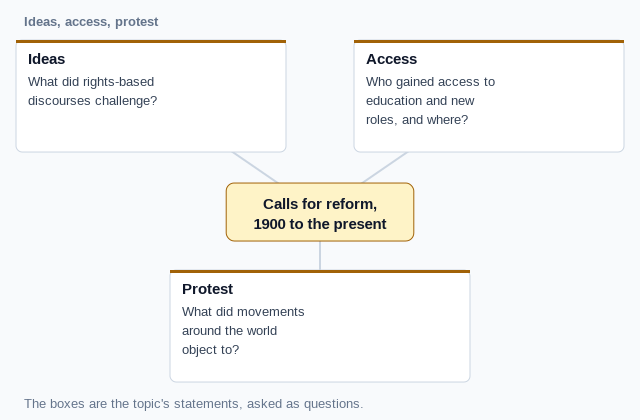
In short. This topic is about how ideas about rights challenged old assumptions after 1900, how access to education and new roles widened in much of the world, and what movements protested about global integration.
- Rights-based discourses challenged old assumptions about race, class, gender, and religion.
- In much of the world, access to education as well as participation in new political and professional roles became more inclusive in terms of race, class, gender, and religion.
- Movements throughout the world protested the inequality of the environmental and economic consequences of global integration.
Part 2 Learn it Rights, access and protest
9.5a. Challenging old assumptions
The first statement is about ideas: Rights-based discourses challenged old assumptions about race, class, gender, and religion.
A discourse is a way of talking and arguing about something. A rights-based discourse argues from what people are owed as people. What it challenged were assumptions, beliefs long taken for granted, about four categories at once.
The topic's examples are the U.N. Universal Declaration of Human Rights, especially as it sought to protect the rights of children, women, and refugees; global feminism movements; the Negritude movement; and liberation theology in Latin America. The topic lists them by name and does not describe what each one taught.
Challenged is the verb. It says the old assumptions were put in question, not that they vanished.
Quick check · Multiple choice
According to this topic, what did rights-based discourses challenge?
9.5b. Who could learn, vote and work
The second statement turns from ideas to access: In much of the world, access to education as well as participation in new political and professional roles became more inclusive in terms of race, class, gender, and religion.
Two limits matter. In much of the world, not all of it. More inclusive, a comparison: access widened. The statement does not say it became equal.
The examples are concrete. The right to vote and/or to hold public office was granted to women in the United States (1920), Brazil (1932), Turkey (1934), Japan (1945), India (1947), and Morocco (1963). The rate of female literacy rose, and the numbers of women in higher education increased, in most parts of the world. The list also names the end of apartheid and caste reservation in India.
The same four categories run through both statements, which is why the two are easy to read together.
Quick check · Select all
Which two does this topic say about access to education and new political and professional roles? Pick two.
Select 2 answers, then check.
9.5c. Protesting unequal consequences
The third statement is about protest: Movements throughout the world protested the inequality of the environmental and economic consequences of global integration.
Read what the movements objected to. Not global integration as such, but the inequality of its consequences, both environmental and economic. Some peoples bore more of the costs than others.
The examples come in two groups. Environmental movements: Greenpeace, and Professor Wangari Maathai's Green Belt Movement in Kenya. Economic movements: World Fair Trade.
This topic's skill is to explain how a specific development is situated within a broader historical context. A movement like the Green Belt Movement is the specific development; the unequal consequences of global integration are part of what it sits inside.
Quick check · Multiple choice
According to this topic, what did movements throughout the world protest?
Part 3 Watch it done Placing one classroom in its context
Watch the first steps, then take the last one yourself.
In 1975 a university in an imagined country admits its first class in which half the students are women. Explain how this development is situated within a broader historical context.
Step 1 · Name the specific development
One university, one year, one class in which half the students are women.
Step 2 · Find a broader development it sits inside
Look in the topic's statements on access and on old assumptions for a development wider than one university and one country. Then tie the class to it in the same sentence.
Why this step?
Why is a single university's class not its own context?
A context has to be wider than what it explains. The class is one case; the context is the change across many places that the case belongs to.
Your step · Decide and justify
Finish it. Which sentence situates the class within that context?
What makes it situate the class?
Part 4 Try it A councilwoman's letter
A letter written for this page (it is not a real source), from a woman elected to her town council in an imagined country in 1963, to her daughter at a university abroad:
> When I was your age, no woman in this town could vote, and the priest told us that was how things were meant to be. Now I sit on the council, and you write to me from a university where half your classmates are women. Your brother says the new factories by the river are poisoning the fish the fishermen sell, while the money goes to owners far away. He marches with the others every Sunday.
A class was asked to situate the letter within a broader context. Six students each wrote one sentence.
Try it · Sort it
Sort each student sentence by whether it situates something in the letter within a broader development.
Gives a context
Does not
Part 5 Explain it Social categories challenged and kept
This is a self-check. Nothing you type leaves this page. Compare your answer with the model and each scoring point.
Free-response practice · Question 2 style
This is a partial long essay. Write a thesis, one sentence of context and one paragraph of evidence, not a full essay.
In the period from 1900 to the present, rights-based discourses challenged old assumptions about race, class, gender, and religion.
Explain how social categories, roles, and practices were maintained and challenged in the period from 1900 to the present.
Model answer
Thesis: After 1900, old assumptions about race, class, gender, and religion were challenged, and access to education and to political and professional roles became more inclusive, but the change reached much of the world rather than all of it, which leaves room for places where older categories were kept.
Context: Demands for women's suffrage and an emergent feminism had already challenged political and gender hierarchies before 1900, which I would argue means the grants of the vote after 1900 carried forward a challenge raised before the period began.
The challenge came first in ideas. Rights-based discourses, such as the U.N. Universal Declaration of Human Rights with its protection of the rights of children, women, and refugees, and liberation theology in Latin America, challenged old assumptions. Access widened in much of the world: women gained the right to vote and/or to hold public office in Brazil in 1932 and India in 1947, apartheid ended, and caste reservation opened roles in India. Yet that widening came in much of the world, not all of it, which leaves room for places where the older categories held. Movements such as Greenpeace and World Fair Trade also protested the inequality of the environmental and economic consequences of global integration.
Score your own answer. This is a self-check, not a grade. Tick each point your answer makes.
Part 6 Check yourself Public life in one country, 1930 to 1990
The table drives the first two questions. The last two come from the rest of the lesson.
Four rows from a record of public life in an imagined country. The record was written for this lesson and is not real.
| Row | What is recorded | 1930 | 1960 | 1990 |
|---|---|---|---|---|
| 1 | Women may vote | No | Yes, since 1947 | Yes |
| 2 | Women in the national assembly | 0 | 4 | 61 |
| 3 | Women among university students | 1 in 20 | 1 in 5 | 1 in 2 |
| 4 | Posts in the civil service set aside for families of the poorest class | None | 1 in 10 | 1 in 5 |
Case question 1 · Fill the statement
Complete the note on the record.
Row shows a professional role becoming more inclusive in terms of class, and row shows access to education becoming more inclusive in terms of gender.
Case question 2 · Spot the error
A student wrote this summary of the record. Which line goes wrong?
The rest stand on their own and do not use the case.
Check yourself · Select all
This topic lists the right to vote and/or to hold public office granted to women in the United States (1920), Brazil (1932), Turkey (1934), Japan (1945), India (1947), and Morocco (1963). Based on this topic, which two developments best situate these examples in a broader context? Pick two.
Select 2 answers, then check.
Check yourself · Select all
This topic lists Greenpeace and Professor Wangari Maathai's Green Belt Movement in Kenya as environmental movements. Based on this unit, which two pieces of evidence could best situate them in a broader context? Pick two.
Select 2 answers, then check.
Part 7 Keep it Bring back earlier ideas
One question from the global economy, the lesson just before this one, and one from disease after 1900 three lessons back.
From 9.4 Economics in the Global Age · Select all
Which two does this topic say about free-market economic policies in the late 20th century? Pick two.
Select 2 answers, then check.
From 9.2 Technological Advances and Limitations After 1900: Disease · Select all
Which two does this topic say about the diseases that emerged as new epidemics after 1900, and their outbreaks? Pick two.
Select 2 answers, then check.
In three lines
- Rights-based discourses challenged old assumptions about race, class, gender, and religion.
- In much of the world, access to education and to new political and professional roles became more inclusive.
- Movements throughout the world protested the inequality of the environmental and economic consequences of global integration.
Exam strategy for this topic
- Section I Part A, Multiple Choice: 55 questions in 55 minutes.
- Section I Part B, Short Answer: 3 questions in 40 minutes.
- Section II, Document-Based Question and Long Essay: 2 questions in 100 minutes.
- This lesson's Explain it is shaped like free-response question 2, Long essay.
When a long essay asks how social categories were challenged after 1900, pair an idea, such as the Universal Declaration of Human Rights, with a change in access, such as women gaining the vote, and keep in much of the world.
Questions students ask
What does the topic give as examples of rights-based discourses?
The U.N. Universal Declaration of Human Rights, especially as it sought to protect the rights of children, women, and refugees; global feminism movements; the Negritude movement; and liberation theology in Latin America.
Did every country grant women the vote after 1900?
The topic lists six countries with years, from the United States in 1920 to Morocco in 1963, and says access became more inclusive in much of the world. It does not say every country did.
Were the protest movements against global integration?
The statement says they protested the inequality of its environmental and economic consequences. That is an objection to who bore the costs, which the topic keeps separate from global integration itself.
Which categories does the topic name?
Race, class, gender, and religion, in both the statement on rights-based discourses and the statement on access.
Where does this topic show categories being maintained?
The topic's words are about challenge and widening access. In much of the world leaves room for places where access did not widen, but the topic names none, so a claim about a particular place needs its own evidence.
Course alignment, for teachers
AP World History: Modern topic 9.5, Unit 9: Globalization.
- Skill 4.B: Explain how a specific historical development or process is situated within a broader historical context.
This lesson maps all 3 essential knowledge statements of the topic, and the one learning objective with none of its own, to the part that teaches each one: 4 are checked by a scored question. The map is in the lesson file.