Unit 7 · Topic 7.3 · about 30 minutes · 7 parts · 10 scored checks, 2 of them multiple choice, plus 2 from earlier lessons
AP World History: Modern 7.3: Conducting World War I
Unit 7: 8 to 10% of the multiple-choice section
What you'll be able to do
- Explain how governments used a variety of methods to conduct war.
Key vocabulary
| Term | What it means | The exam trap |
|---|---|---|
| Total war | A war that draws on a whole society, not only its armies. | Total describes how much of a society the war draws on, not how many countries fight in it, so do not read it as world war. |
| Mobilize | To organize people and resources for a purpose, here for waging war. | Mobilizing a population is wider than calling up soldiers, so read who is being organized before you answer. |
| Political propaganda | Messages spread to shape what people think about a political cause. | Propaganda is a strategy a government uses, so naming it does not by itself show what a particular source argues. |
| Media | Ways of carrying news and messages to many people, such as newspapers. | Media are the channels a message travels by, and the message itself, such as a poster's claim, is a separate thing. |
| Casualties | People killed or wounded in war. | The word counts the wounded as well as the dead, so do not read it as deaths alone. |
 Tap to open the picture full size
Part 1 Think first A war in the village square
Commit to a guess before you read. A wrong guess now still helps the right idea stick.
Predict first
A village is hundreds of miles from any battle. During the war, posters cover its walls, its newspaper prints songs about the army, and its painters design flags for the troops. Who is the war asking something of here?
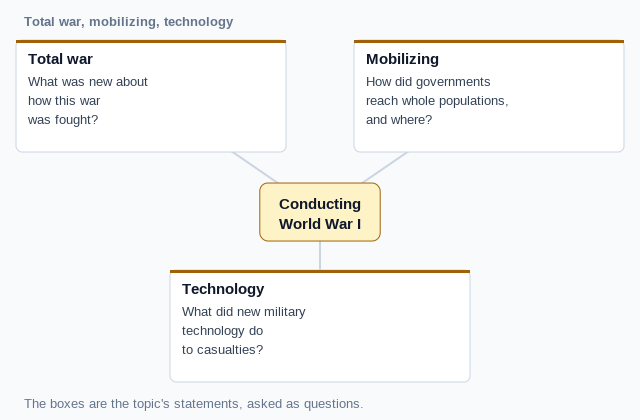
In short. World War I was the first total war: governments used a variety of strategies, including political propaganda, art, media, and intensified forms of nationalism, to mobilize populations at home and in the colonies for the purpose of waging war.
- Total war drew on whole populations, both in the home countries and the colonies, not only on armies.
- The strategies are introduced with including, so the four named are examples.
- New military technology led to increased levels of wartime casualties.
Part 2 Learn it Waging a total war
2a. Something new in war
The statement opens with a claim about change: World War I was the first total war.
First marks it as new. A total war draws on a whole society, not only on its armies, so the people who never went near a battle were part of the war too.
That is why the rest of the statement is about whole populations. A government waging total war needs farmers, factory workers, writers and families behind it, as well as soldiers.
The statement does not say what earlier wars were like, so the comparison stops at the word first.
Quick check · Multiple choice
Which words in this topic's statement mark World War I as something new?
2b. Strategies to mobilize populations
To mobilize is to organize people and resources for a purpose. The statement says governments used a variety of strategies, including political propaganda, art, media, and intensified forms of nationalism, to mobilize populations (both in the home countries and the colonies) for the purpose of waging war.
Read it in three parts.
What: four strategies, after including, so they are examples of a wider variety.
Whom: populations, in two places at once. The colonies are named beside the home countries, so empires reached past their own borders for support.
Why: for the purpose of waging war. Each strategy served that one aim.
Notice intensified. Nationalism existed before the war; the governments made it stronger.
Quick check · Select all
Which two does this topic name among the strategies governments used to mobilize populations for World War I? Pick two.
Select 2 answers, then check.
2c. Technology and casualties
The second statement is short: new military technology led to increased levels of wartime casualties. Casualties are the people killed or wounded.
The statement names no weapon for World War I, and this page names none either. 7.7 Conducting World War II names some for World War II.
The topic's theme, technology and innovation, sets this inside a wider idea: technological advances have shaped human development and interactions with both intended and unintended consequences. The theme gives that idea in general terms. It does not sort higher casualties into one kind of consequence or the other, so an answer that does so should say it is the writer's reading.
Quick check · Decide and justify
A student writes: "Because the armies of World War I had new machines to fight with, fewer soldiers were killed or wounded than before." Does the sentence agree with this topic?
Why?
Part 3 Watch it done Find the evidence in a source
Watch the first steps, then take the last one yourself.
A letter written for this page (it is not a real source), from a painter in a home country during World War I: "The war has taken my brushes. I paint posters for the ministry now, and the cinema shows our films of the front before every play. No one in this city can forget we are at war."
Identify the letter's argument and the evidence it uses to support it.
Step 1 · Find the argument
Ask what the writer is trying to show. The last sentence carries the claim: no one in this city can forget we are at war. The war reaches everyone, not only soldiers.
Step 2 · Find the specific examples
Ask what the writer offers for that claim. The posters painted for the ministry and the films of the front shown before every play are specific examples. Each is a way the war reaches people in the city: art and media, two of the strategies this topic names.
Why this step?
Why is the last sentence not evidence too?
It is what the other sentences are offered to support. A claim cannot be its own evidence, so the evidence is the posters and the films, not the sentence they back up.
Your step · Decide and justify
Finish it. A classmate marks "the cinema shows our films of the front before every play" as evidence. Is that line evidence the letter uses to support its argument?
Why?
Part 4 Try it An imagined pamphlet
A pamphlet written for this page (it is not a real source), handed out in a colony during a war its ruling empire is fighting. Six of its lines are below.
Try it · Sort it
Sort each line of the imagined pamphlet: is it the pamphlet's claim, evidence offered for the claim, or neither?
The claim
Evidence for the claim
Neither
Part 5 Explain it Methods of waging war, from documents
This is a self-check. Nothing you type leaves this page. Compare your answer with the model, line by line, and with each scoring point.
Free-response practice · Question 1 style
A short practice in the shape of the document-based question: a thesis, one sentence of context and one paragraph that uses both documents and explains the sourcing of one, instead of a full essay. Both documents are written for this page and are not real sources.
Document 1: a poster put up by a war ministry in a home country: "Mothers, your sons fight for the nation. Your work in the fields feeds them. Every harvest is a victory."
Document 2: the pamphlet from Try it, printed by a colonial government's office: "The empire's war has become this colony's war as well. Our schools now teach children the songs of the empire's army."
Using both documents and what you know from this topic, explain how governments used a variety of methods to conduct World War I.
Model answer
Thesis: Governments conducted World War I as the first total war, using strategies such as political propaganda, art, media and intensified nationalism to mobilize populations in the home countries and the colonies, while new military technology raised the war's casualties.
Context: Before 1900, nationalism was among the ideologies used to justify imperialism, and in this war governments used intensified forms of that same nationalism to mobilize the populations of the empires it had helped justify.
Document 1 shows propaganda aimed at a home country: the ministry tells mothers that their work in the fields feeds their sons, so a government reached people far from any battle and gave their labor a part in the war. Document 2 shows the same reach into a colony, where the colonial government's own office claims the empire's war as the colony's war. Its source matters to how far it can be trusted: a government office printed it to win support, so it shows what that government wanted colonists to believe, not how they felt. Both documents mobilize whole populations for the purpose of waging war, which is what made the war total. The cost of that war rose too, since new military technology led to increased levels of wartime casualties.
Score your own answer. This is a self-check, not a grade. Tick each point your answer makes.
Part 6 Check yourself An imagined front page
Use the table for the first two questions. The last three cover the whole lesson.
The front page of an imagined newspaper in a home country during a war, written for this page. It is not a real source.
| Part of the page | What it shows |
|---|---|
| Headline | The whole nation marches together. |
| Cartoon | A drawing of farmers, factory hands and soldiers holding up one flag. |
| Column | A writer urges readers to hate every one of the enemy's people. |
| Ministry notice | The war ministry asks every family to grow food for the army. |
| Back page | A list of the district's men killed or wounded this month, longer than any list before it. |
Case question 1 · Fill the statement
Complete a student's reading of the front page.
Of the strategies this topic names, the is an example of art, and the is an example of intensified nationalism.
Case question 2 · Spot the error
A student wrote this paragraph about the front page. Which line is the first to go wrong?
The rest stand on their own and do not use the case.
Check yourself · Multiple choice
A speech written for this page (it is not a real source) is given by an official in a colony during World War I: "The empire's war is our war too. Our newspapers carry its posters, and in our markets people sing songs for its victory." Which choice gives the evidence the speech uses to support its argument?
Check yourself · Select all
Which two of these does this topic state about World War I? Pick two.
Select 2 answers, then check.
Check yourself · Select all
A government notice written for this page (it is not a real source) is posted in a home country during World War I: "Every family has given something. Our factories run through the night. Will you be the one who stands aside?" The notice argues that the whole nation is already taking part in the war. Which two specific examples does it use to support that argument? Pick two.
Select 2 answers, then check.
Part 7 Keep it Bring back earlier ideas
One question from the causes of World War I and one from the review of Unit 6, so both come round again.
From 7.2 Causes of World War I · Select all
Besides intense nationalism, which two does this topic name among the factors that combined to escalate the tensions into global conflict? Pick two.
Select 2 answers, then check.
From 6.8 Causation in the Imperial Age · Select all
A student claims that empire and expansion in this period changed where people lived. Which two statements from this unit could best corroborate the claim? Pick two.
Select 2 answers, then check.
In three lines
- World War I was the first total war, drawing on whole populations as well as armies.
- Governments used strategies including political propaganda, art, media and intensified nationalism to mobilize populations at home and in the colonies for the purpose of waging war.
- New military technology led to increased levels of wartime casualties.
Exam strategy for this topic
- Section I Part A, Multiple Choice: 55 questions in 55 minutes.
- Section I Part B, Short Answer: 3 questions in 40 minutes.
- Section II, Document-Based Question and Long Essay: 2 questions in 100 minutes.
- This lesson's Explain it is shaped like free-response question 1, Document-based.
On a source question, find the source's claim first, then the specific examples it offers for that claim. More than one choice can be true about the war, but only one is evidence the source itself uses.
Questions students ask
What makes World War I a total war?
The statement calls it the first total war and says governments used a variety of strategies to mobilize populations for the purpose of waging war. A total war draws on a whole society, not only its armies.
Did governments mobilize people outside their home countries?
Yes. The statement says they mobilized populations both in the home countries and the colonies.
Which weapons does this topic name?
None. It says new military technology led to increased levels of wartime casualties without naming a weapon. 7.7 Conducting World War II names some for World War II.
Is a question to the reader evidence in a source?
No. A question such as "Will you join us?" asks for action and gives no example, so it does not support the argument the way a specific example does.
Are the four strategies the only ones governments used?
The statement introduces them with including, so political propaganda, art, media and intensified forms of nationalism are examples of a variety of strategies.
Course alignment, for teachers
AP World History: Modern topic 7.3, Unit 7: Global Conflict.
- Skill 3.B: Identify the evidence used in a source to support an argument.
This lesson maps all 2 essential knowledge statements of the topic, and the one learning objective with none of its own, to the part that teaches each one: 3 are checked by a scored question. The map is in the lesson file.