Unit 5 · Topic 5.9 · about 35 minutes · 7 parts · 9 scored checks, 2 of them multiple choice, plus 2 from earlier lessons
AP World History: Modern 5.9: Society and the Industrial Age
Unit 5: 12 to 15% of the multiple-choice section
What you'll be able to do
- Explain how industrialization caused change in existing social hierarchies and standards of living.
Key vocabulary
| Term | What it means | The exam trap |
|---|---|---|
| Social class | A group of people who share a similar place in society, often by work or wealth. | A new class can form beside older groups, so a statement that new classes developed does not say the old ones vanished. |
| Middle class | The group between the wealthiest and the poorest in a society. | This topic gives no income line for the middle class, so do not attach a figure to it. |
| Wage-earning job | Work paid for in wages, usually by the hour, day or week. | Running a house is work but not wage-earning, so keep the word wage when you compare what the two classes did. |
| Infrastructure | The basic systems a place needs, such as roads, bridges, water and sewers. | The statement's challenge is insufficient infrastructure, too little for the growth, so do not write that a city had none. |
| Public health crisis | A danger to the health of many people in a place at once. | The statement lists it among challenges that came at times, so do not write that every growing city had one. |
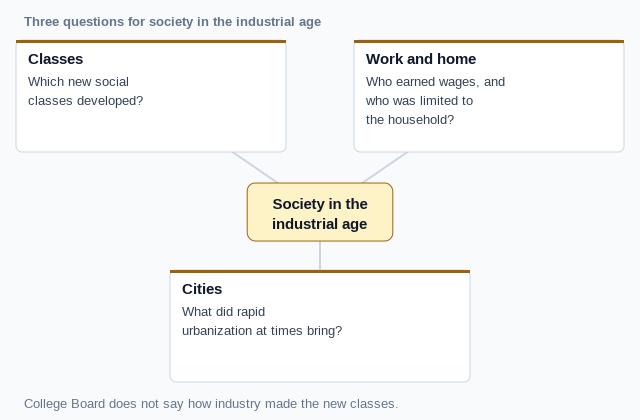 Tap to open the picture full size
Part 1 Think first Who earned the wages?
Commit to an answer first, then see how the lesson treats it.
Predict first
Picture a family in an industrial city that lives on wages from the mills. Who in that family do you expect earned them?
In short. Industrialization brought new social classes, split the work of women by class, and left fast-growing cities facing a variety of challenges.
- New social classes, including the middle class and the industrial working class, developed.
- Women and often children in working-class families typically held wage-earning jobs to supplement their families' income, while middle-class women who did not have the same economic demands to satisfy were increasingly limited to roles in the household or roles focused on child development.
- The rapid urbanization that accompanied global capitalism at times led to challenges, among them pollution, poverty, increased crime, public health crises, housing shortages, and insufficient infrastructure.
Part 2 Learn it Classes, families and cities
2a. Two new classes, and wages at home
The objective asks how industrialization changed existing social hierarchies and standards of living. This topic's first answer is short: new social classes, including the middle class and the industrial working class, developed. Including names two of them; it does not make them the only ones.
The statement does not say how industry brought either class about, or which older groups they rose above or below. College Board files these statements under its larger point that the development of industrial capitalism led to increased standards of living for some (5.7 Economic Developments and Innovations in the Industrial Age), so a gain for one class says nothing about another.
The next statement looks inside working-class homes. Women and often children in working class families typically held wage-earning jobs to supplement their families' income. Read the qualifiers. Often children, not always. Typically, not in every family. And the wages added to an income the family already had, so they were not meant to carry it alone.
Quick check · Select all
A diary entry written for this page, by a girl in a working-class family: "My mother and I both work for wages now, so that the family has enough." Which two parts of this topic's context best explain the entry? Pick two.
Select 2 answers, then check.
2b. Middle-class women, and the reason given
The same statement turns to the other class. Middle-class women who did not have the same economic demands to satisfy were increasingly limited to roles in the household or roles focused on child development.
Three parts carry the meaning. The reason is economic: these families did not face the demands that working-class families did. The result is a limit, to the household or to child development. And increasingly makes it a direction across the period, not a fixed state at its start.
So one sentence divides women's lives by class, with money as the hinge. The statement does not say how many families fit the pattern or what any woman thought of it.
Quick check · Multiple choice
According to this topic, why did middle-class women's roles differ from those of women in working-class families?
2c. Cities that grew too fast
The last statement moves from the home to the city. The rapid urbanization that accompanied global capitalism at times led to a variety of challenges, including pollution, poverty, increased crime, public health crises, housing shortages, and insufficient infrastructure to accommodate urban growth.
Accompanied sets urbanization beside global capitalism in time; it does not say which drove which. At times means in some places and periods, not everywhere and always. Including marks the six as the named ones.
Urbanization has come up before. In 5.3 Industrial Revolution Begins it is one of the factors that contributed to the growth of industrial production. Here it brings trouble. One development can play both parts, so say which part it plays in the argument you are making.
College Board names no city and gives no figures for any of the six.
Quick check · Select all
Which three does this topic list among the challenges rapid urbanization at times led to? Pick three.
Select 3 answers, then check.
Part 3 Watch it done Place one household in a broader pattern
Two steps are worked; the third is yours.
A letter written for this page, from a woman to her sister. It is not a real document.
"Since Thomas rose to a post in the mill office, we live as the town's middle-class families do. His salary keeps us all, I no longer take in sewing, and my days go to the house and the children's lessons."
Explain how the life the letter describes is situated within a broader historical context.
Predict first
Before the steps: which would place this letter in a broader context?
Step 1 · The specific development
The letter shows one woman's paid sewing ending once her husband's salary keeps the family, and her days turning to the house and her children's lessons.
Step 2 · The broader context
This topic gives the process it belongs to. New social classes, including the middle class, developed, and middle-class women who did not have the same economic demands to satisfy were increasingly limited to roles in the household or roles focused on child development.
Why this step?
Why is that context broader than the letter, and not just another fact about it?
It describes a pattern across a whole class and across the period, which the word increasingly marks, while the letter is one family at one moment. That lets the letter stand as an example of the pattern rather than a one-off.
Your step · Decide and justify
Finish it. A student writes: "The letter fits its context because the writer's neighbor, another office clerk's wife, also spends her days on her house and her children." Does the sentence situate the letter within a broader historical context?
Why?
Part 4 Try it An inspector's report
A report written for this page by an inspector in a fast-growing industrial city. It is not a real document.
"In the new districts by the mills, eight people share a single cellar room, and late arrivals sleep in doorways through the night. The paved road ends where the new houses begin, and the one bridge over the river can no longer carry the carts. This winter a fever passed from house to house down whole streets, until half the children of one lane were sick at once."
Try it · Sort it
Each detail is a specific condition in one city. Sort it under the broader challenge of rapid urbanization that it is an instance of.
Housing shortages
Insufficient infrastructure
Public health crises
Part 5 Explain it How industry changed society
This is a self-check. Nothing you type leaves this page. Compare your answer with the model, line by line, and with each scoring point.
Free-response practice · Question 2 style
A short practice in the shape of the long essay: a thesis, one sentence of context and one paragraph of evidence and reasoning, instead of a full essay.
Explain how industrialization caused change in existing social hierarchies and standards of living in the period from 1750 to 1900.
Model answer
Thesis: Industrialization changed social hierarchies by bringing new classes, the middle class and the industrial working class, whose economic demands differed, and that difference came to shape whether the women in a family typically earned wages.
Context: These changes sat within the development of industrial capitalism, which led to increased standards of living for some, so a gain for one group of families could leave another behind, and the new classes are where that unevenness showed.
New social classes, including the middle class and the industrial working class, developed. In working-class families, women and often children typically held wage-earning jobs to supplement their families' income, a sign of households that needed more than one wage. Middle-class women, who did not have the same economic demands to satisfy, were increasingly limited to roles in the household or roles focused on child development. Because the difference turned on economic demands, the new hierarchy reached inside the family: a family's class shaped whether its women typically earned wages. Middle-class women's roles narrowed further across the period, so the split widened over time, a change rather than an older order carried on.
Score your own answer. This is a self-check, not a grade. Tick each point your answer makes.
Part 6 Check yourself Three households, placed in context
The first two questions use the table. The other two range across the lesson.
Three households in one industrial city, written for this page. None of them is a real family.
| Household | Who earns wages | Who keeps the house and the children | Where they live |
|---|---|---|---|
| A | The father and the mother, both in a cotton mill, and their eldest son beside them | A neighbor, while the parents are at the mill | Two rooms near the mill |
| B | The father, a manager in the mill office | The mother, who also teaches the children their lessons | A house on a new street at the city's edge |
| C | The father when work can be found, and the mother by taking in washing | The mother, between loads of washing | A cellar room shared with another family |
Case question 1 · Fill the statement
Finish the student's sentence about Household B.
Household B's mother keeps to the house and the children's lessons, the pattern this topic gives for women, and the reason it gives is that such families did not have the same to satisfy as Household A.
Case question 2 · Spot the error
A student wrote this paragraph about the three households. Which line is the first to go wrong?
The rest stand on their own and do not use the case.
Check yourself · Select all
Which two statements describe how this topic says industrialization changed social hierarchies or roles? Pick two.
Select 2 answers, then check.
Check yourself · Multiple choice
A report written for this page describes a fast-growing city: "The poor crowd into the newest districts, and the air is thick with factory smoke." Which broader development in this unit best situates the report?
Part 7 Keep it Bring back earlier ideas
One question from the lesson on reactions to the industrial economy and one from the lesson on economic developments.
From 5.8 Reactions to the Industrial Economy from 1750 to 1900 · Select all
In response to the social and economic changes brought about by industrial capitalism, some governments, organizations, and individuals promoted reforms. Which three of these are kinds of reform this topic names? Pick three.
Select 3 answers, then check.
From 5.7 Economic Developments and Innovations in the Industrial Age · Select all
Which two links does this topic make about large-scale transnational businesses? Pick two.
Select 2 answers, then check.
In three lines
- New social classes, including the middle class and the industrial working class, developed, and the statement does not say how industry brought them about.
- Women and often children in working-class families typically held wage-earning jobs, while middle-class women were increasingly limited to roles in the household or focused on child development.
- The rapid urbanization that accompanied global capitalism at times led to challenges such as housing shortages and public health crises.
Exam strategy for this topic
- Section I Part A, Multiple Choice: 55 questions in 55 minutes.
- Section I Part B, Short Answer: 3 questions in 40 minutes.
- Section II, Document-Based Question and Long Essay: 2 questions in 100 minutes.
- This lesson's Explain it is shaped like free-response question 2, Long essay.
Context has to be broader than the thing it explains: a process, such as rapid urbanization or a class taking shape, not another detail from the same street. Name the process, then say how it helps explain the source.
Questions students ask
Were the middle class and the industrial working class the only new classes?
This topic says new social classes developed, including those two. Including marks them as named examples, so it leaves room for others, though it names no other.
Does this topic say how industrialization created these classes?
No. It says the classes developed and places the statement under its point that industrial capitalism raised standards of living for some, but it gives no mechanism. An answer that explains how has to argue it from evidence.
Did middle-class women do no work at all?
The statement says they were increasingly limited to roles in the household or roles focused on child development. It describes their roles narrowing toward the home, not an end to all work.
Did every industrial city face pollution, crime and housing shortages?
The statement says the rapid urbanization that accompanied global capitalism at times led to these challenges, so not every city at every moment. It names no city.
Does College Board give examples for this topic?
No. The topic has no illustrative examples, so it names no city, country or family. The letter, report and households on this page are written for it.
Course alignment, for teachers
AP World History: Modern topic 5.9, Unit 5: Revolutions.
- Skill 4.B: Explain how a specific historical development or process is situated within a broader historical context.
This lesson maps all 3 essential knowledge statements of the topic, and the one learning objective with none of its own, to the part that teaches each one: 4 are checked by a scored question. The map is in the lesson file.