Unit 8 · Topic 8.3 · about 30 minutes · 7 parts · 9 scored checks, 2 of them multiple choice, plus 2 from earlier lessons
AP World History: Modern 8.3: Effects of the Cold War
Unit 8: 8 to 10% of the multiple-choice section
What you'll be able to do
- Compare the ways in which the United States and the Soviet Union sought to maintain influence over the course of the Cold War.
Key vocabulary
| Term | What it means | The exam trap |
|---|---|---|
| Military alliance | An agreement between states to help one another in war. | Treaties come in many kinds. Read what the member states pledge one another before you name the kind. |
| Nuclear proliferation | The spread of nuclear weapons, as more of them are built or more states come to hold them. | Proliferation is about numbers. Read what a source says is spreading before you use the word. |
| Proxy war | In the general meaning of the term, a war fought by others on behalf of rival powers. | Not every war of the Cold War years was a proxy war. Look for the outside backing a source describes before you use the term. |
| Postcolonial state | A state that was once a colony. | Postcolonial names a state's past, not its region or its date of independence. Latin America's states and those in Africa and Asia became independent in different periods. |
| Influence | The power to shape what others do without ruling them directly. | Influence can be held through allies and through others' wars, not only through a state's own army. A comparison of influence can rest on who backed whom. |
 Tap to open the picture full size
Part 1 Think first Rivals without a battlefield
Make a guess before you read. A wrong guess still helps the right idea stick.
Predict first
Two superpowers are rivals, but neither wants a war fought on its own soil. Where would you expect most of the fighting between their sides to happen?
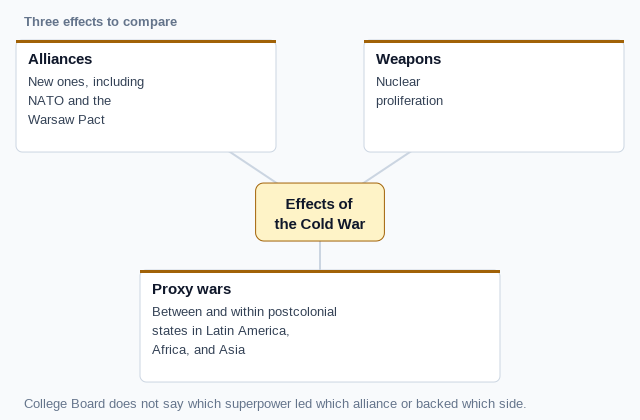
In short. The Cold War produced new military alliances and led to nuclear proliferation and to proxy wars between and within postcolonial states, not between the two superpowers directly.
- The new military alliances included NATO and the Warsaw Pact.
- The Cold War led to nuclear proliferation.
- It led to proxy wars between and within postcolonial states in Latin America, Africa, and Asia.
Part 2 Learn it Alliances, weapons and proxy wars
8.3a. Two verbs, three effects
One statement carries this topic:
The Cold War produced new military alliances, including NATO and the Warsaw Pact, and led to nuclear proliferation and proxy wars between and within postcolonial states in Latin America, Africa, and Asia.
The Cold War is the subject of two verbs. It produced new military alliances. It led to nuclear proliferation and proxy wars.
Including matters. NATO and the Warsaw Pact are two of the new alliances, not the whole list. New matters too: these alliances came out of the Cold War itself.
Proliferation means spreading or growing in number, so nuclear proliferation is the spread of nuclear weapons. The word is about how many there were, not about whether they were used.
Quick check · Select all
Which two does this topic say the Cold War led to? Pick two.
Select 2 answers, then check.
8.3b. Where the proxy wars were fought
Read the end of the statement slowly. The proxy wars were fought between and within postcolonial states. Some were wars of one state against another; others were fought inside a single state. They were in three regions: Latin America, Africa, and Asia.
A proxy war, in the general meaning of the term, is a war fought by others on behalf of rival powers. That is why the wars could be part of the Cold War without the two superpowers fighting each other directly.
College Board's examples are the Korean War, the Angolan Civil War, and the Sandinista-Contras conflict in Nicaragua. A teacher may use these or others.
Postcolonial ties this topic to the rest of the unit: these states had once been colonies. They did not all become independent at once. For Africa and Asia, 8.5 Decolonization After 1900 describes the years after World War II. Latin America's states had become independent much earlier, in the period from c. 1750 to c. 1900 (5.2 Nationalism and Revolutions in the Period from 1750 to 1900).
Quick check · Select all
Where does this topic place the Cold War's proxy wars? Pick two.
Select 2 answers, then check.
8.3c. Comparing the two superpowers
The objective asks you to compare how the United States and the Soviet Union sought to maintain influence. Comparison is this topic's reasoning process: say what is similar, what is different, or both.
The unit gives you this much. The two superpowers differed in what they stood for: 8.2 The Cold War calls the United States a democracy and the Soviet Union authoritarian and communist, in a struggle between capitalism and communism. This topic names the means of the struggle, alliances, nuclear proliferation and proxy wars, as effects of the Cold War as a whole. It does not divide them between the two, or say which alliance each led, so this lesson does not either. Anything beyond that needs evidence from your class or from a source.
The skill asks how one development relates to another. A connection is more than two facts side by side: name the link, such as a cause, a similarity or a difference. NATO and the Warsaw Pact are the cleanest comparison here, because the statement treats both the same way.
Quick check · Multiple choice
Based on this topic's statement alone, which comparison of NATO and the Warsaw Pact is accurate?
Part 3 Watch it done Relating the proxy wars to the end of empire
Watch the first steps, then take the last one yourself.
Explain how the Cold War's proxy wars in Africa and Asia relate to the end of colonial rule there, using this topic and 8.5 Decolonization After 1900.
Predict first
Before the steps: which came first in Africa and Asia, the states or the proxy wars fought in them?
Step 1 · Name the first development
Proxy wars between and within postcolonial states. This topic places them in Latin America, Africa, and Asia; this example takes Africa and Asia only.
Step 2 · Name the second development
In Asia and Africa, nationalist leaders and parties sought autonomy or independence. After the end of World War II, some colonies negotiated their independence, while others achieved it through armed struggle (8.5 Decolonization After 1900).
Step 3 · Find the word that joins them
Look at how this topic describes the states the proxy wars were fought in, and set that description beside the second development.
Why this step?
Why is it not enough to list the two developments one after the other?
The skill asks how one development relates to another, so the answer has to name the link. Two true facts placed side by side leave the reader to find it.
Your step · Decide and justify
Finish it. Which sentence relates the two developments?
What makes that sentence relate them?
Part 4 Try it Sorting a newspaper column
A newspaper column written for this page (it is not a real source), from a capital in Africa, 1966:
> This week's news is a map of the great powers' quarrel. In the hills to our north, rebels fight our neighbor's government with rifles one great power sends them, while the other great power arms the government. On the coast, two neighboring states that were colonies ten years ago trade shots across their border, each army trained by a different great power. And over the radio comes word that one more state has tested a nuclear bomb.
A class was asked to relate the column's news to the developments of this unit. Five students each wrote one sentence.
Try it · Sort it
Sort each student sentence by whether it explains how one development relates to another or only sets facts side by side.
Relates one development to another
Only sets facts side by side
Part 5 Explain it Two ways of keeping influence
This is a self-check. Nothing you type leaves this page. Set your answer beside the model and each scoring point.
Free-response practice · Question 1 style
A short practice in the shape of the document-based question: a thesis, one sentence of context and one paragraph that uses both documents and explains the purpose or audience of one, instead of a full essay. Both documents are written for this page and are not real.
Document 1: a United States official, speaking to the country's lawmakers, 1965: "We cannot let one more government fall to communism. We ask you to fund the rifles, the trainers and the advisers that our friends overseas need to hold their ground."
Document 2: a Soviet newspaper, 1976: "The Soviet people stand with every nation fighting the capitalist powers and the governments they prop up. Our help to these brave fighters will not stop."
Using both documents, compare the ways in which the United States and the Soviet Union sought to maintain influence over the course of the Cold War.
Model answer
Thesis: The two documents show the superpowers seeking influence in a similar way, by backing others' fights overseas, while differing in the side each backed, since each supported those who fought for its own system.
Context: After the end of World War II, some colonies negotiated their independence while others won it through armed struggle, so many of the states the superpowers backed sides in were new.
The similarity is the method. In Document 1 the United States pays for "rifles," "trainers" and "advisers" for "friends overseas," and in Document 2 the Soviet Union promises "help" to "brave fighters" abroad; neither describes its own army fighting, which fits the proxy wars the Cold War led to. The difference is whom each backed. The official wants to stop governments falling "to communism," while the newspaper sides with those fighting "the capitalist powers," so each superpower backed the side of its own system in the struggle between capitalism and communism. Document 1's audience matters: the official speaks to lawmakers who must vote the money, so he presents the aid as defense against a threat.
Score your own answer. This is a self-check, not a grade. Tick each point your answer makes.
Part 6 Check yourself Four reports from the Cold War
The table drives the first two questions. The last two come from the rest of the lesson.
Four short reports from the Cold War. All four were written for this lesson and are not real.
| Row | Year and place | The report |
|---|---|---|
| 1 | 1952, Europe | "Seven governments have signed a treaty, each pledged to come to the others' aid if one is attacked." |
| 2 | 1960, Asia | "A third state has now tested an atomic bomb, and two more are said to be close behind." |
| 3 | 1977, Africa | "Two armed movements fight for control of a country that left colonial rule two years ago. Each is armed by a different great power." |
| 4 | 1984, Latin America | "Troops of two neighboring states clash at the border again. One army is trained by one superpower, the other by its rival." |
Case question 1 · Fill the statement
Complete the note on rows 1 and 2.
Row 1 reports , and row 2 reports .
Case question 2 · Spot the error
A student compared rows 3 and 4. Which line misreads the table?
The rest stand on their own and do not use the case.
Check yourself · Multiple choice
Based on this unit's statements alone, which comparison of the United States and the Soviet Union in the Cold War is accurate?
Check yourself · Select all
Which two statements from this unit could best support an argument that the Cold War reached far beyond the two superpowers? Some choices are true but do not bear on the argument. Pick two.
Select 2 answers, then check.
Part 7 Keep it Bring back earlier ideas
One question from the lesson just before this one, and one from the Unit 7 review three lessons back.
From 8.2 The Cold War · Select all
According to this topic, what did groups and individuals, including the Non-Aligned Movement, do? Pick two.
Select 2 answers, then check.
From 7.9 Causation in Global Conflict · Select all
Which two does the review's statement on science and technology say that rapid advances did? Pick two.
Select 2 answers, then check.
In three lines
- The Cold War produced new military alliances, including NATO and the Warsaw Pact.
- It led to nuclear proliferation, the spread of nuclear weapons.
- It led to proxy wars between and within postcolonial states in Latin America, Africa, and Asia.
Exam strategy for this topic
- Section I Part A, Multiple Choice: 55 questions in 55 minutes.
- Section I Part B, Short Answer: 3 questions in 40 minutes.
- Section II, Document-Based Question and Long Essay: 2 questions in 100 minutes.
- This lesson's Explain it is shaped like free-response question 1, Document-based.
When you relate two developments, write the link as a word in your sentence, such as because, so, or in the states that, instead of setting two facts side by side.
Questions students ask
What makes a war a proxy war?
In the general meaning of the term, it is a war fought by others on behalf of rival powers. This topic places the Cold War's proxy wars between and within postcolonial states in Latin America, Africa, and Asia.
Which alliance did each superpower lead?
This topic does not say. It names NATO and the Warsaw Pact as new military alliances the Cold War produced and does not divide them between the United States and the Soviet Union. Bring that from a source or your class evidence.
Were NATO and the Warsaw Pact the only Cold War alliances?
No. The statement says new military alliances, including NATO and the Warsaw Pact, so these two are examples rather than the whole list.
Why does the statement say postcolonial states?
The proxy wars were fought in states that had once been colonies. That ties this topic to 8.5 Decolonization After 1900, on how colonies in Asia and Africa won their independence, and to 5.2 Nationalism and Revolutions in the Period from 1750 to 1900 for Latin America.
How can I compare the two superpowers with so little in the statement?
Start with what the unit gives: 8.2 The Cold War sets their systems, capitalism and communism, against each other, and this topic gives the means of the struggle. A source can then show how one side sought influence, and you compare from its evidence.
Course alignment, for teachers
AP World History: Modern topic 8.3, Unit 8: Cold War and Decolonization.
- Skill 5.B: Explain how a historical development or process relates to another historical development or process.
This lesson maps the one essential knowledge statement of the topic, and the one learning objective with none of its own, to the part that teaches each one: 2 are checked by a scored question. The map is in the lesson file.