Unit 4 · Topic 4.7 · about 25 minutes · 7 parts · 9 scored checks, 2 of them multiple choice, plus 2 from earlier lessons
AP World History: Modern 4.7: Changing Social Hierarchies from 1450 to 1750
Unit 4: 12 to 15% of the multiple-choice section
What you'll be able to do
- Explain how social categories, roles, and practices have been maintained or have changed over time.
Key vocabulary
| Term | What it means | The exam trap |
|---|---|---|
| Accommodate | To make room for or adjust to. | Accommodating is something a state does toward its subjects. Read whether a choice has the state or the subjects doing the acting. |
| Suppress | To hold down or put a stop to. | Suppress is a stronger word than restrict. A source may show a restriction on a group without showing suppression, so read the verb it uses. |
| Ethnic | Having to do with a group that shares a culture, ancestry or language. | Ethnic diversity is about peoples and religious diversity is about faiths. The statement names both, so read which one a source is about. |
| Elite | A small group with more power, wealth or status than the rest of a society. | An elite can be political, economic or both. A choice that treats elites as one kind of group has narrowed the statement. |
| Casta system | A social system in the Americas, named in this topic. | A choice may describe how the Casta system ranked people. The topic gives no such detail, so do not pick a choice for it. |
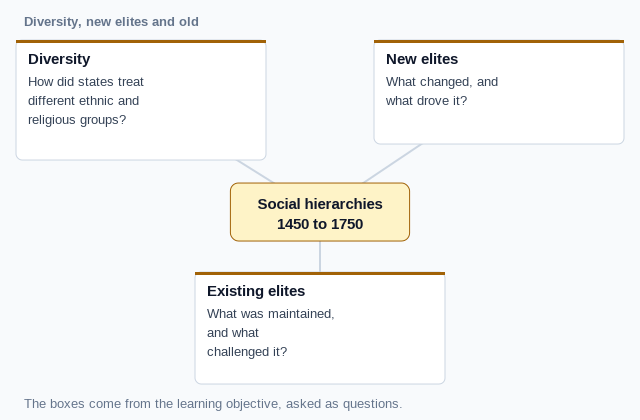 Tap to open the picture full size
Part 1 Think first Ruling many peoples
Commit to a guess before you read. A wrong guess now still helps the right idea stick.
Predict first
An empire rules peoples of many faiths and many ethnic groups. Which approach do you expect states of this period took toward that diversity?
In short. States handled diverse subjects in more than one way, new elites formed in places such as Qing China and the Americas, and the power of existing elites rose and fell against stronger monarchs.
- Many states, such as the Mughal and Ottoman empires, adopted practices to accommodate ethnic and religious diversity or to use the contributions of different groups; in other cases states suppressed diversity or limited certain groups' roles.
- Imperial conquests and widening global economic opportunities contributed to the formation of new political and economic elites, including in China with the transition to the Qing Dynasty and in the Americas with the rise of the Casta system.
- The power of existing elites fluctuated as they confronted new challenges to their ability to affect the policies of increasingly powerful monarchs and leaders.
Part 2 Learn it Who held what place
4.7a. Diverse subjects
Empires ruled many peoples, and the topic gives two kinds of response.
Many states, such as the Mughal and Ottoman empires, adopted practices to accommodate the ethnic and religious diversity of their subjects or to utilize the economic, political, and military contributions of different ethnic or religious groups. In other cases, states suppressed diversity or limited certain groups' roles in society, politics, or the economy.
Read many and in other cases as a pair: neither response was the rule everywhere.
College Board's examples of different treatment: the expulsion of Jews from Spain and Portugal set beside the acceptance of Jews in the Ottoman Empire; restrictive policies against Han Chinese in Qing China; and the varying status of different classes of women within the Ottoman Empire. That last example is a reminder that one empire could treat groups within it differently.
Quick check · Select all
Which two does this topic give as ways states dealt with the diversity of their subjects? Pick two.
Select 2 answers, then check.
4.7b. New elites and old
Some elites were new. Imperial conquests and widening global economic opportunities contributed to the formation of new political and economic elites, including in China with the transition to the Qing Dynasty and in the Americas with the rise of the Casta system. Two causes, two places. Contributed means these were among the causes, not the only ones. The topic names the Casta system without describing it.
Others were already there. The power of existing political and economic elites fluctuated as the elites confronted new challenges to their ability to affect the policies of the increasingly powerful monarchs and leaders. The examples of existing elites are Ottoman timars, Russian boyars and European nobility.
Notice what gained and what moved. Monarchs and leaders grew increasingly powerful; the older elites' power fluctuated, rising and falling, as their hold on policy was challenged. The statement gives no dates for the rises and falls.
Quick check · Multiple choice
According to this topic, what contributed to the formation of new political and economic elites?
4.7c. Support, modify, refute
This topic's skill is explaining how evidence supports, modifies or refutes an argument. Start by stating the claim exactly, including how far it reaches. Then test each piece of evidence against it.
Evidence supports a claim when it is a case of what the claim says. It refutes a claim when it shows the claim is wrong. It modifies a claim when the claim survives only with a limit: true in some cases, or in part, but not as stated.
Mixed evidence is the usual case. When some evidence fits a claim and some does not, the claim is modified: it survives as a claim about some cases, or with a condition. Before you sort evidence, mark the claim's own words of scope, such as all, many or some, since they tell you how far it reaches. A claim about all cases is refuted by one case against it. A claim with no scope word, or with generally, is read as a general pattern, and mixed evidence modifies it.
Quick check · Select all
A claim written for this page: "The power of existing elites grew steadily from 1450 to 1750." Which two choices explain how this topic's statements modify or refute the claim? Pick two.
Select 2 answers, then check.
Part 3 Watch it done Two pieces, one claim
Watch the first steps, then take the last one yourself.
A claim written for this page: "States in this period generally dealt with diverse subjects by suppressing diversity or limiting certain groups' roles." Two pieces of evidence from this topic: the Mughal Empire adopted practices to accommodate the diversity of its subjects, and Qing China adopted restrictive policies against Han Chinese. Explain how the evidence bears on the claim.
Step 1 · State the claim exactly
It names one way of dealing with diverse subjects, suppressing diversity or limiting groups' roles. Generally makes it a claim about the usual pattern among states, not about every state.
Step 2 · Test each piece
Restrictive policies against Han Chinese are a case of a state limiting a group, so that piece fits the claim. Mughal accommodation is a state making room for diversity, so that piece cuts against it.
Why this step?
Why not stop at the Mughal evidence and call the claim refuted?
Check how far the claim reaches before you let one piece decide it, and check what the other piece does to it.
Your step · Decide and justify
Finish it. What do the two pieces of evidence do to the claim, taken together?
Why is that the right verdict?
Part 4 Try it Weighing a claim about toleration
College Board's sample activity for this topic asks students to gather evidence that supports and refutes a historian's claim about toleration. Here is a claim written for this page in the same spirit:
> "Rulers in this period accepted or accommodated religious minorities."
The claim has no scope word, so read it as a general pattern. Sort each piece of evidence from this topic by what it does to the claim on its own.
Try it · Sort it
Sort each piece of evidence, weighed on its own: supports the claim, cuts against it, or does not bear on it.
Supports the claim
Cuts against the claim
Does not bear on it
Part 5 Explain it Hierarchies kept and changed
This is a self-check. Nothing you type leaves this page. Compare your answer with the model and each scoring point.
Free-response practice · Question 2 style
This is a partial long essay. Write a thesis, one sentence of context and one paragraph of evidence, not a full essay.
In the period c. 1450 to c. 1750, empires and states grew in power and reach.
Explain how social hierarchies were maintained or changed in the period c. 1450 to c. 1750.
Model answer
Thesis: Social hierarchies both changed and held on in this period: imperial conquests and widening global economic opportunities helped form new political and economic elites, while the power of existing elites fluctuated under increasingly powerful monarchs.
Context: As states expanded and centralized their power in this period, they met resistance from an array of groups on a local level, so rulers were pressing their authority on many parts of society at once.
The change shows in the new elites. In China, new political and economic elites formed with the transition to the Qing Dynasty, and in the Americas they formed with the rise of the Casta system. The continuity is in the existing elites, such as Ottoman timars, Russian boyars and European nobility, whose power fluctuated as they confronted new challenges to their ability to affect the policies of the increasingly powerful monarchs and leaders. So the period formed new elites in some societies while the power of existing elites fluctuated.
Score your own answer. This is a self-check, not a grade. Tick each point your answer makes.
Part 6 Check yourself Elites, new and old
The table drives the first two questions. The last two come from the rest of the lesson.
A student listed the elites this topic names, with their places. The table was written for this lesson and does not say which elites were new or how their power changed.
| Row | Elite | Place |
|---|---|---|
| 1 | Timars | The Ottoman Empire |
| 2 | Boyars | Russia |
| 3 | Nobility | Europe |
| 4 | Elites under the transition to the Qing Dynasty | China |
| 5 | Elites with the rise of the Casta system | The Americas |
Case question 1 · Fill the statement
A classmate says every row shows the same thing happening to elites. Complete the reply, using what the lesson says about each group of rows.
The rows split in two: rows 1 to 3 are elites, whose power rose and fell as monarchs grew more powerful, while rows 4 and 5 are elites, formed through imperial conquests and widening global economic opportunities.
Case question 2 · Spot the error
A student wrote five lines about the table. Which line is the first that the lesson contradicts?
The rest stand on their own and do not use the case.
Check yourself · Multiple choice
A claim written for this page: "States in this period treated all religious and ethnic groups alike." Which example from this topic best refutes the claim?
Check yourself · Select all
Which two does this topic give as places where new political and economic elites formed? Pick two.
Select 2 answers, then check.
Part 7 Keep it Bring back earlier ideas
One question from the lesson on challenges to state power just before this one, and one from the lesson on maintaining the maritime empires.
From 4.6 Internal and External Challenges to State Power from 1450 to 1750 · Select all
Which two of these does College Board list as examples of local resistance to state expansion and centralization? Pick two.
Select 2 answers, then check.
From 4.5 Maritime Empires Maintained and Developed · Select all
Which two statements about labor match this topic? Pick two.
Select 2 answers, then check.
In three lines
- Many states, such as the Mughal and Ottoman empires, accommodated diverse subjects, while in other cases states suppressed diversity or limited certain groups' roles.
- Imperial conquests and widening global economic opportunities contributed to new elites, in China with the Qing transition and in the Americas with the Casta system.
- Existing elites, such as timars, boyars and European nobility, saw their power fluctuate as monarchs and leaders grew increasingly powerful.
Exam strategy for this topic
- Section I Part A, Multiple Choice: 55 questions in 55 minutes.
- Section I Part B, Short Answer: 3 questions in 40 minutes.
- Section II, Document-Based Question and Long Essay: 2 questions in 100 minutes.
- This lesson's Explain it is shaped like free-response question 2, Long essay.
Before you say a piece of evidence supports, modifies or refutes a claim, underline the claim's words of scope. A claim about all states and a claim about many states can take the same evidence in different ways.
Questions students ask
What was the Casta system?
The topic names the rise of the Casta system in the Americas as one place new political and economic elites formed. It does not describe how the system worked.
Why did Qing China restrict Han Chinese?
The topic does not say. Restrictive policies against Han Chinese in Qing China are one of College Board's examples of the differential treatment of groups.
Did any state in this period accept Jewish subjects?
Yes. The examples set the acceptance of Jews in the Ottoman Empire beside the expulsion of Jews from Spain and Portugal.
Who were the timars and the boyars?
In this topic, Ottoman timars and Russian boyars are, with European nobility, the examples of existing elites. The topic says nothing more about who they were.
Did existing elites lose their power?
The statement says their power fluctuated, rising and falling, as they confronted new challenges to their ability to affect the policies of increasingly powerful monarchs and leaders. It does not say they lost it.
Course alignment, for teachers
AP World History: Modern topic 4.7, Unit 4: Transoceanic Interconnections.
- Skill 3.D: Explain how claims or evidence support, modify, or refute a source’s argument.
This lesson maps all 3 essential knowledge statements of the topic, and the one learning objective with none of its own, to the part that teaches each one: 4 are checked by a scored question. The map is in the lesson file.