Unit 6 · Topic 6.3 · about 30 minutes · 7 parts · 9 scored checks, 2 of them multiple choice, plus 2 from earlier lessons
AP World History: Modern 6.3: Indigenous Responses to State Expansion from 1750 to 1900
Unit 6: 12 to 15% of the multiple-choice section
What you'll be able to do
- Explain how and why internal and external factors have influenced the process of state building from 1750 to 1900.
Key vocabulary
| Term | What it means | The exam trap |
|---|---|---|
| Anticolonial | Opposed to colonial rule. | Anticolonial describes a movement's aim, not its method. Read what a choice says the movement did. |
| Political authority | The right to rule and to be obeyed. | Authority is about who may rule, not who is stronger. Read whether a choice speaks of a right or of force. |
| Periphery | The outer edge of a region or an empire. | Periphery names a location, not a kind of people. Read where a choice places a state, not who lived there. |
| Rebellion | An open rising against those in power. | A rebellion is a rising against rulers, not a new government. Read whether a choice describes a rising or a state. |
| Point of view | The position from which a source's author sees events. | Point of view belongs to the author, and audience to the reader. Keep the two apart when you explain a limit. |
 Tap to open the picture full size
Part 1 Think first When an empire arrives
Pick an answer before you read on. A guess, right or wrong, gives the lesson something to hook onto.
Predict first
In the 1800s, an empire comes to rule a land whose people did not choose it. What do you expect the people there to do?
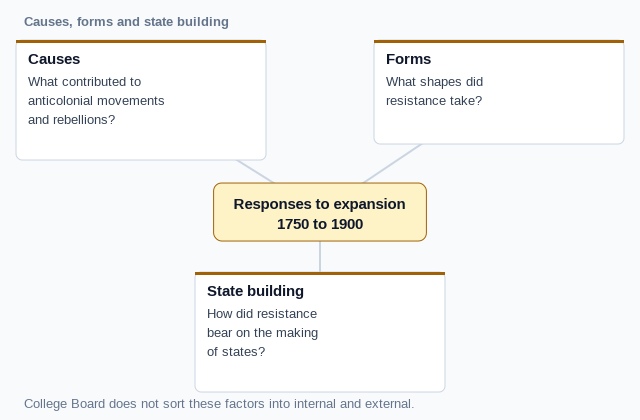
In short. From 1750 to 1900, peoples facing state expansion resisted it: questions about authority and growing nationalism fed anticolonial movements, and discontent with imperial rule led to rebellions.
- Increasing questions about political authority and growing nationalism contributed to anticolonial movements.
- Anti-imperial resistance took various forms, including direct resistance within empires and the creation of new states on the peripheries.
- Increasing discontent with imperial rule led to rebellions, some of which were influenced by religious ideas.
Part 2 Learn it Resistance and its sources
6.3a. What contributed to resistance
Expansion did not go unanswered. The first statement names two developments behind one kind of answer: Increasing questions about political authority and growing nationalism contributed to anticolonial movements.
Both halves are about change over time. Increasing and growing say these were rising, not fixed. Questions about political authority ask who has the right to rule. Nationalism you met in Unit 5, as a new sense of commonality based on language, religion, social customs and territory.
The verb is contributed. The statement gives two contributors to anticolonial movements; it does not call either the only cause or rank one above the other.
Quick check · Multiple choice
According to this topic, which developments contributed to anticolonial movements?
6.3b. Forms of resistance, and rebellions
Anti-imperial resistance took various forms, including direct resistance within empires and the creation of new states on the peripheries. College Board's examples of direct resistance are Túpac Amaru II's rebellion in Peru, Samory Touré's military battles in West Africa, the Yaa Asantewaa War in West Africa and the 1857 rebellion in India. Its examples of new states are the establishment of independent states in the Balkans, the Sokoto Caliphate in modern-day Nigeria, the Cherokee Nation and the Zulu Kingdom.
That second form is where resistance meets the learning objective: creating a state is state building.
A third statement adds a cause and a qualifier. Increasing discontent with imperial rule led to rebellions, some of which were influenced by religious ideas. The examples listed are the Ghost Dance in the U.S., the Xhosa Cattle-Killing Movement in Southern Africa and the Mahdist wars in Sudan. College Board does not say which of them religious ideas influenced.
Quick check · Select all
Which two statements describe the rebellions as this topic presents them? Pick two.
Select 2 answers, then check.
6.3c. Who wrote it, and for whom
This topic's skill is explaining the significance of a source's point of view, purpose, historical situation or audience, including how these might limit its use.
- Point of view: where the author stands.
- Purpose: what the source was made to do.
- Historical situation: the circumstances it came from.
- Audience: who it was made for.
Significance means saying what difference that makes to what the source can show. A soldier's diary, kept only for himself, can show what he feared on the eve of a battle; it cannot show what his commanders planned. Both halves matter: what a source is good evidence for, and where its use stops.
On resistance, the people who wrote down events often stood on one side. An account from an empire's officials and one from those resisting can describe the same rising very differently, and each is shaped by who wrote it and why.
Quick check · Multiple choice
A petition written for this page is sent by leaders of a colony to the parliament of the empire that rules it: "We are loyal subjects, and we ask only that our people have a voice in the laws that govern us." Which choice best explains how the petition's audience limits its use as a source?
Part 3 Watch it done Weighing a call to rise
Watch the first steps, then take the last one yourself.
A proclamation written for this page is issued by the leaders of a rebellion against imperial rule to the villages of their region: "The foreign rulers tax our harvests and scorn our faith. Rise with us, and God will drive them out." Explain how its purpose limits its use as evidence about the rebellion.
Step 1 · Identify the purpose
Rebel leaders write to villages and end with "Rise with us." The proclamation was made to win followers.
Step 2 · Say what it is good evidence for
It shows the case the leaders made: discontent with imperial rule over taxes, and a religious appeal. That fits the statement that discontent led to rebellions, some influenced by religious ideas.
Why this step?
The proclamation appeals to God. Why does that not make the rebellion only a matter of faith?
The same text complains of taxes on harvests. The statement says some rebellions were influenced by religious ideas, and one source can carry more than one grievance.
Your step · Decide and justify
Finish it. Which sentence better explains how the proclamation's purpose limits its use?
Why is that the better explanation?
Part 4 Try it Reading an editorial's purpose
An editorial written for this page, from a newspaper printed in a colony and run by colonists:
> Who gave a parliament across the sea the right to rule us? We are a nation, and a nation should govern itself.
A student wrote four sentences about it.
Try it · Spot the error
Which sentence of the student's reading goes wrong?
Part 5 Explain it Resistance and state building, from documents
This is a self-check. Nothing you type leaves this page. Compare your answer with the model and each scoring point in turn.
Free-response practice · Question 1 style
A short practice in the shape of the document-based question: a thesis, one sentence of context and one paragraph that uses both documents and explains the significance of one document's audience or purpose, instead of a full essay. Both documents are written for this page and are not real.
Document 1: the colonial editorial from Try it.
Document 2: a proclamation from the leaders of a new state formed beyond an empire's border, read aloud to its people: "Here we keep our own laws and our own faith, and no governor of the empire sets foot among us."
Using both documents, explain how and why internal and external factors influenced the process of state building in the period from 1750 to 1900.
Model answer
Thesis: State building in this period was shaped from outside by expanding empires that peoples resisted, and from inside by increasing questions about political authority and growing nationalism, which in some places led peoples to create new states of their own.
Context: The 18th century marked the beginning of an intense period of revolution and rebellion against existing governments, leading to the establishment of new nation-states around the world, and the colonists' editorial and the new state beyond the border are both part of that wave of challenges to existing rule.
Document 1 shows factors at work inside a colony: its writers ask who gave a distant parliament "the right to rule us" and call themselves "a nation," the questions about political authority and the growing nationalism that contributed to anticolonial movements. Because it is printed in the colony for colonists, its purpose is to win readers to that cause, so it shows the argument some colonists made rather than how widely it was held. Document 2 shows a form of resistance that is itself state building: a new state created on the peripheries of an empire, keeping "our own laws." The empire is the outside pressure here, the rule this state defines itself against. Together the documents show resistance to expanding empires driving the making of states, within an empire through new movements and at its edge through new states.
Score your own answer. This is a self-check, not a grade. Tick each point your answer makes.
Part 6 Check yourself Four sources on resistance
The table drives the first two questions. The last two come from the rest of the lesson.
A historian gathered four sources on resistance to empire from 1750 to 1900. All four were written for this lesson and are not real.
| Row | Author and audience | Its words |
|---|---|---|
| 1 | A commander in West Africa, to his soldiers before a battle with an imperial army | "Hold the river crossing. The invaders must not pass." |
| 2 | Leaders of a people who now govern themselves beyond an empire's reach, in a treaty with a neighboring ruler | "We will trade with you as one free people with another." |
| 3 | A prophet, to villagers living under imperial rule | "Keep faith, and our ancestors will return and sweep the foreigners away." |
| 4 | A colonial official, to his own government, about the prophet's movement | "The prophet's followers are few, and the movement will soon die out." |
Case question 1 · Match
Match rows 1 to 3 to the form of response each shows.
Case question 2 · Fill the statement
Rows 3 and 4 describe the same movement. Complete the sentence about what limits row 4.
Row 4 is weak evidence of the movement's , because an official reporting to his own government has reason to it.
The rest stand on their own and do not use the case.
Check yourself · Select all
A report written for this page is sent by a colonial governor to his government after a rising: "The trouble was the work of a few men who stirred up the villages with talk of prophecy. Our rule is welcome everywhere else." Which two statements could best explain how the report's point of view limits its use as evidence about the rising? Pick two.
Select 2 answers, then check.
Check yourself · Select all
A pamphlet written for this page is issued by the leaders of a new state founded on the edge of an empire: "We have made our own state, and the empire's officials no longer rule here." A historian wants to use it as evidence of anti-imperial resistance. Which two statements best explain the pamphlet's value and a limit on that use? Pick two.
Select 2 answers, then check.
Part 7 Keep it Bring back earlier ideas
One question from the state expansion lesson just before this one, and one from the Unit 5 review.
From 6.2 State Expansion from 1750 to 1900 · Select all
Which two states does this topic name both among those that acquired territories throughout Asia and the Pacific and among those that expanded their land holdings by conquering and settling neighboring territories? Pick two.
Select 2 answers, then check.
From 5.10 Continuity and Change in the Industrial Age · Select all
Which two pieces of evidence from this review could best support an argument that industrialization brought great change? Pick two.
Select 2 answers, then check.
In three lines
- Increasing questions about political authority and growing nationalism contributed to anticolonial movements.
- Resistance took various forms, including direct resistance within empires and new states on the peripheries; discontent with imperial rule led to rebellions, some influenced by religious ideas.
- A source's point of view, purpose, situation and audience shape what it can show, and where its use stops.
Exam strategy for this topic
- Section I Part A, Multiple Choice: 55 questions in 55 minutes.
- Section I Part B, Short Answer: 3 questions in 40 minutes.
- Section II, Document-Based Question and Long Essay: 2 questions in 100 minutes.
- This lesson's Explain it is shaped like free-response question 1, Document-based.
When you explain a source's point of view, purpose, situation or audience, finish the thought: say what that makes the source good evidence for, then where its use stops. Naming the author alone earns nothing.
Questions students ask
Which rebellions were influenced by religious ideas?
The statement says some were. College Board lists the Ghost Dance in the U.S., the Xhosa Cattle-Killing Movement in Southern Africa and the Mahdist wars in Sudan as examples of rebellions, without saying which ones religious ideas influenced.
How does resistance connect to state building?
One form the topic names, the creation of new states on the peripheries, is state building itself. College Board's examples are independent states in the Balkans, the Sokoto Caliphate, the Cherokee Nation and the Zulu Kingdom.
Which factors here are internal and which external?
College Board's theme for this topic says a variety of internal and external factors contribute to state formation, expansion and decline, but it does not label the factors in these statements. Sorting them is an argument you make and support.
Is a one-sided source useless?
No. A source written from one side is good evidence of that side's view and aims. Its point of view limits other uses, such as judging how widely its view was shared.
Did nationalism alone cause anticolonial movements?
The statement says growing nationalism and increasing questions about political authority contributed to them. It names two contributors and ranks neither.
Course alignment, for teachers
AP World History: Modern topic 6.3, Unit 6: Consequences of Industrialization.
- Skill 2.C: Explain the significance of a source’s point of view, purpose, historical situation, and/or audience, including how these might limit the use(s) of a source.
This lesson maps all 3 essential knowledge statements of the topic, and the one learning objective with none of its own, to the part that teaches each one: 3 are checked by a scored question and 1 by the written response. The map is in the lesson file.