Unit 8 · Topic 8.8 · about 25 minutes · 7 parts · 9 scored checks, 2 of them multiple choice, plus 2 from earlier lessons
AP World History: Modern 8.8: End of the Cold War
Unit 8: 8 to 10% of the multiple-choice section
What you'll be able to do
- Explain the causes of the end of the Cold War.
Key vocabulary
| Term | What it means | The exam trap |
|---|---|---|
| Collapse | The end of a state or system as it falls apart. | A collapse can be read as a cause or as a result. Check the statement's own order before you place one. |
| Invasion of Afghanistan | In this topic, the Soviet Union's war in Afghanistan, which the statement calls costly and ultimately failed. | Ask whose invasion a choice describes, and how the statement sums it up, before you judge the choice. |
| Public discontent | Widespread unhappiness among a country's people with how they are governed or how they live. | Discontent can be found almost anywhere. Read whose public a choice names and check it against the statement. |
| Economic weakness | An economy that fails to grow or to supply what its people need. | A choice may name an economy's weakness or its growth. Check which one the statement gives, and where. |
| Technological development | New tools, machines and methods, here in the military of the United States. | Advances can belong to either side of a rivalry. Read whose advances a choice names before you accept it. |
 Tap to open the picture full size
Part 1 Think first How does a rivalry end?
Make a guess before you read. A wrong guess still helps the right idea stick.
Predict first
A long rivalry between two superpowers comes to an end without a war between them. Where would you look first for its causes?
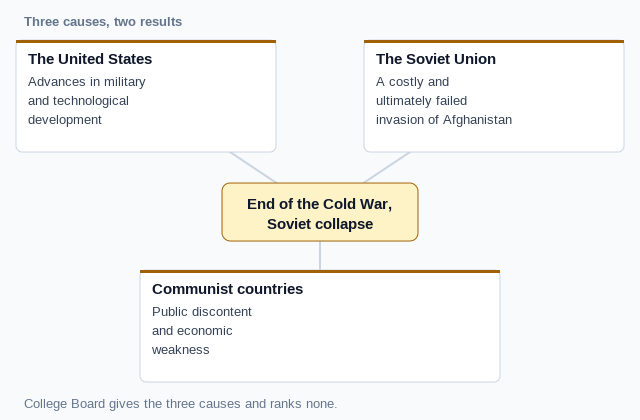
In short. Three causes, one from the United States and two from the Soviet side, led to the end of the Cold War and the collapse of the Soviet Union.
- Advances in U.S. military and technological development were one cause.
- The Soviet Union's costly and ultimately failed invasion of Afghanistan was another.
- Public discontent and economic weakness in communist countries were the third.
Part 2 Learn it Why the Cold War ended
8.8a. Three causes
One statement carries this topic, and causation is its reasoning process:
Advances in U.S. military and technological development, the Soviet Union's costly and ultimately failed invasion of Afghanistan, and public discontent and economic weakness in communist countries led to the end of the Cold War and the collapse of the Soviet Union.
Everything before led to is a cause. There are three, and each belongs to someone:
- The United States: advances in its military and technological development.
- The Soviet Union: its invasion of Afghanistan, which the statement calls costly and ultimately failed. Keep both words: it cost a great deal, and in the end it failed.
- Communist countries: public discontent and economic weakness. The plural reaches past the Soviet Union itself.
Quick check · Multiple choice
How does this topic describe the Soviet Union's invasion of Afghanistan?
8.8b. Two results
After led to come two results, joined by and: the end of the Cold War and the collapse of the Soviet Union.
They are not the same thing. The Cold War was a rivalry; its end is the end of that struggle. The Soviet Union was a state; its collapse is the state itself falling apart. The statement gives both as results of the same three causes.
Watch the direction of the arrow. The collapse of the Soviet Union is a result here, never a cause. A choice that says the collapse led to the invasion of Afghanistan, or to economic weakness, has turned the statement around.
The statement gives no dates, and it does not rank the causes. It names three and joins them to two results.
Quick check · Select all
What does this topic say its causes led to? Pick two.
Select 2 answers, then check.
8.8c. Explaining a process
This topic's skill is explaining a historical concept, development, or process. A list of causes is a start; an explanation says how they fit.
One way to make them fit is to sort them by where they came from. One cause came from outside the communist countries, from the United States. Two came from inside: a war the Soviet Union began and lost, and discontent and weakness at home. Put that way, the end of the Cold War was not one side's push alone. Pressure from outside met strain from inside. That sorting is this lesson's own way of grouping the causes, not a line of the statement.
This topic's sample activity has students read a historian's account of the social movements of 1989 to 1992 and draw a political cartoon that summarizes and explains them.
Quick check · Select all
Which two causes in this topic's statement were actions or conditions of the Soviet Union or other communist countries, rather than of the United States? Pick two.
Select 2 answers, then check.
Part 3 Watch it done Fitting the causes together
Watch the first steps, then take the last one yourself.
Explain how the causes this topic names fit together to bring about the end of the Cold War.
Predict first
Before the steps: did the causes come from one side or from both?
Step 1 · Find the joining words
In this topic's statement, led to joins the causes to the results. Everything before it is a cause; the two things after it are what the causes brought about.
Step 2 · Ask where each cause came from
Read each cause for its owner. One belongs to the United States. The others belong to the Soviet Union and to communist countries.
Why this step?
Why say where each cause came from, instead of only listing them?
Explaining a process means showing how its parts fit. Grouping the causes by where they came from shows the end came from more than one direction, which a bare list leaves unsaid.
Your step · Decide and justify
Finish it. Which sentence explains how the causes fit together?
What makes that sentence an explanation?
Part 4 Try it Reading a diary
A diary written for this page (it is not a real source), kept by a teacher in a communist country, 1989:
> Line 1. Three hours in line for bread again, and the shelves were empty when I reached the front. > > Line 2. My neighbor's son came home from Afghanistan with one arm. He says the fighting there never ends, and no one will say what it costs. > > Line 3. Tonight half the town went to the square to shout that we have had enough.
Match each line to the cause it best shows.
Try it · Match
Match each line of the diary to a cause this topic names.
Part 5 Explain it Why the rivalry ended
This is a self-check. Nothing you type leaves this page. Set your answer beside the model and each scoring point.
Free-response practice · Question 1 style
A short practice in the shape of the document-based question: a thesis, one sentence of context and one paragraph that uses both documents and explains the point of view or audience of one, instead of a full essay. Both documents are written for this page and are not real.
Document 1: a U.S. defense official, speaking to the country's lawmakers, 1985: "Our new guidance systems and computers put our forces years ahead. The Soviets cannot match them, and they know it."
Document 2: a confidential report by a Soviet economist to the party's leaders, 1987: "Our factories fall further behind each year. The war in Afghanistan swallows money we do not have, and the people's patience is running out."
Using both documents, explain the causes of the end of the Cold War.
Model answer
Thesis: The Cold War ended because pressure from outside, U.S. military and technological advances, met strain inside the communist world, the Soviet Union's costly and failing war in Afghanistan and public discontent and economic weakness at home.
Context: After 1900 communism spread beyond the Soviet Union: in China, internal tension and Japanese aggression brought the communists to power, so by the time of these documents the United States faced more than one communist country, and Document 2 reports strain inside the Soviet Union itself.
Document 1 shows the outside pressure. The official says new "guidance systems and computers" put U.S. forces "years ahead," the advances in military and technological development that helped end the Cold War. His audience matters: speaking to lawmakers who fund the military, he has reason to stress the lead, so his claim that the Soviets "cannot match them" is a boast as well as a report. Document 2 shows the inside strain. A Soviet economist tells his own leaders that factories "fall further behind," that Afghanistan "swallows money," and that "the people's patience is running out," which is economic weakness, a costly war and public discontent in one report.
Score your own answer. This is a self-check, not a grade. Tick each point your answer makes.
Part 6 Check yourself Four reports from the last years
The table drives the first two questions. The last two come from the rest of the lesson.
Four short reports from the last years of the Cold War. All four were written for this lesson and are not real.
| Row | Source | Its words |
|---|---|---|
| 1 | A magazine in the United States | "New computer-guided weapons leave the rival's arsenal years behind." |
| 2 | A letter home from a Soviet soldier in Afghanistan | "We were told this war would be short. Our losses grow every month, and the villages still fight us." |
| 3 | A workers' leaflet in a communist country | "Empty shelves, frozen wages. We demand change." |
| 4 | A radio news report | "The Soviet Union has come to an end tonight. Its flag has been lowered for the last time." |
Case question 1 · Sort it
Sort each row by its place in this topic's statement.
A cause
A result
Case question 2 · Spot the error
A student wrote on the table. Which line misreads it?
The rest stand on their own and do not use the case.
Check yourself · Multiple choice
According to this topic, which development in the United States helped lead to the end of the Cold War?
Check yourself · Select all
Which two causes named in this topic's statement could best support an argument that the end of the Cold War had causes both outside and inside the communist countries? Pick two, one of each kind.
Select 2 answers, then check.
Part 7 Keep it Bring back earlier ideas
One question from the lesson just before this one, and one from decolonization three lessons back.
Four short sources from the century after 1900. All four were written for this lesson and are not real.
| Row | Speaker | Its words |
|---|---|---|
| 1 | A state's foreign minister, at a meeting of many states | "My government will send no soldiers to this war, and it calls on every side to talk." |
| 2 | A general who has seized power, on the radio | "Strikes are banned. The army will arrest anyone who resists." |
| 3 | A message from an armed movement | "Every market in the city is a target until the government falls." |
| 4 | A leaflet from a students' group | "We will sit in the street, unarmed, until the war ends." |
From 8.7 Global Resistance to Established Power Structures After 1900 · Sort it
Sort each row by the direction its speaker takes.
Opposes the conflict
Intensifies the conflict
Four short cases. All four were written for this lesson and are not real places.
| Row | When and where | What happened |
|---|---|---|
| 1 | 1950s, a colony in Africa | The nationalist party wins an election held under the empire's rules, and talks in the imperial capital set a date for independence. |
| 2 | 1950s, a colony in Asia | After years of fighting in the countryside, the imperial army withdraws and the fighters' leaders form a government. |
| 3 | 1960s, a state in Africa a few years after independence | A region with its own language declares that it will leave the state and rule itself. |
| 4 | 1940s, a colony in Asia | A party asks for an elected council to run the colony's schools and roads, under the empire's governor. |
From 8.5 Decolonization After 1900 · Match
Match each row to the process it shows.
In three lines
- Advances in U.S. military and technological development were one cause of the end of the Cold War.
- The Soviet Union's costly and ultimately failed invasion of Afghanistan, and public discontent and economic weakness in communist countries, were the others.
- Together they led to the end of the Cold War and the collapse of the Soviet Union.
Exam strategy for this topic
- Section I Part A, Multiple Choice: 55 questions in 55 minutes.
- Section I Part B, Short Answer: 3 questions in 40 minutes.
- Section II, Document-Based Question and Long Essay: 2 questions in 100 minutes.
- This lesson's Explain it is shaped like free-response question 1, Document-based.
When you explain the causes of the end of the Cold War, name more than one and say how they fit, such as pressure from outside the communist countries meeting strain inside them.
Questions students ask
What caused the end of the Cold War?
The statement gives three causes: advances in U.S. military and technological development, the Soviet Union's costly and ultimately failed invasion of Afghanistan, and public discontent and economic weakness in communist countries.
Is the end of the Cold War the same as the collapse of the Soviet Union?
No. The statement gives them as two results of the same causes. The end of the Cold War is the end of a rivalry; the collapse is a state falling apart.
Which cause mattered most?
The statement does not rank them. It names three and joins them to two results with led to.
Why does the statement say communist countries, not just the Soviet Union?
Public discontent and economic weakness are placed in communist countries, a plural. The statement reaches past the Soviet Union for that cause, though it names no other country.
What does this topic's sample activity use?
A section of a historian's essay on the events of 1989 to 1992, by Patrick Manning. Students discuss the author's argument and draw a political cartoon that summarizes and explains the social movements it describes.
Course alignment, for teachers
AP World History: Modern topic 8.8, Unit 8: Cold War and Decolonization.
- Skill 1.B: Explain a historical concept, development, or process.
This lesson maps the one essential knowledge statement of the topic, and the one learning objective with none of its own, to the part that teaches each one: 2 are checked by a scored question. The map is in the lesson file.