Unit 2 · Topic 2.7 · about 30 minutes · 7 parts · 9 scored checks, 2 of them multiple choice, plus 2 from earlier lessons
AP World History: Modern 2.7: Comparison of Economic Exchange
Unit 2: 8 to 10% of the multiple-choice section
What you'll be able to do
- Explain the similarities and differences among the networks of exchange from c. 1200 to c. 1450.
Key vocabulary
| Term | What it means | The exam trap |
|---|---|---|
| Network of exchange | A set of routes and places through which goods, people and ideas move. | A network and a single route are not the same thing. Read which one a choice describes. |
| Productive capacity | How much a society is able to produce. | Capacity is how much could be made, not how much was sold. |
| Claim | A statement that takes a position someone could argue with. | A true sentence is not always a claim. Check whether it takes a position. |
| Evidence | Specific facts or examples used to support a claim. | Several true facts can sit in one set of choices. Read the claim in the stem before you weigh them. |
| Similarity | A way in which two or more things are alike. | A detail true of one network may not be true of another. Check every network a choice names. |
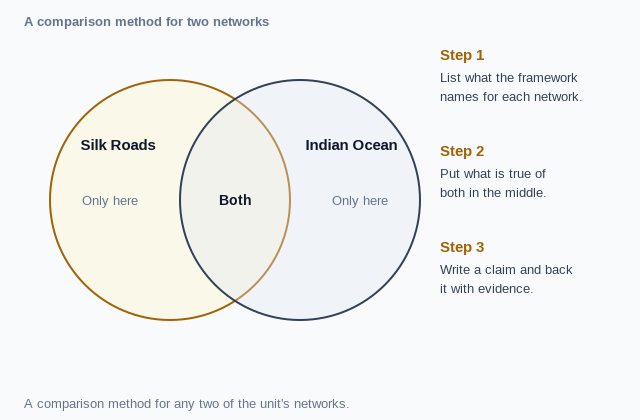 Tap to open the picture full size
Part 1 Think first What would convince you?
Commit to a guess before you read. A wrong guess now still helps the right idea stick.
Predict first
A student wants to persuade a classmate that trade networks in this period changed how much people made, not just how much they moved. What do you expect would be most convincing to bring?
In short. From c. 1200 to c. 1450, the Silk Roads, the Indian Ocean routes and the trans-Saharan network grew in a shared way, as existing routes carrying more trade farther, while each drew on its own named innovations, and changes in trade both resulted from and stimulated rising production.
- The similarity: on each network, improved practices or technologies increased the volume of trade and expanded the geographical range of existing routes.
- The differences: the framework names different innovations for each network, such as the caravanserai and forms of credit for the Silk Roads and the camel saddle and caravans for the trans-Saharan routes.
- Changes in trade networks resulted from and stimulated increasing productive capacity, and a deepening and widening of networks of human interaction contributed to cultural, technological and biological diffusion.
Part 2 Learn it Comparing the networks
2a. One pattern, different means
This lesson adds no new network. The framework says the final topic of each unit focuses on argumentation, drawing on the unit's key concepts.
Set the three trade statements side by side and one sentence repeats. On the Silk Roads (2.1 The Silk Roads), improved commercial practices led to an increased volume of trade and expanded the geographical range of existing trade routes. The Indian Ocean (2.3 Exchange in the Indian Ocean) and trans-Saharan (2.4 Trans-Saharan Trade Routes) statements say the same, naming improved transportation technologies with the practices. The Silk Roads and Indian Ocean statements both end with the growth of powerful new trading cities.
That is the strongest similarity: existing routes, more trade, wider reach.
The clearest differences are the innovations each page names. The Silk Roads page names the caravanserai, forms of credit and money economies. The Indian Ocean page names the compass, the astrolabe and larger ship designs. The trans-Saharan page gives the camel saddle and caravans as possible examples. Each list sits on one network's page; none is said to belong to that network alone.
Quick check · Multiple choice
Which claim best states a similarity among the Silk Roads, the Indian Ocean routes and the trans-Saharan network after 1200?
2b. Trade and production
The unit's review turns from routes to making things. Changes in trade networks resulted from and stimulated increasing productive capacity, how much a society could produce, with important implications for social and gender structures and environmental processes.
Resulted from and stimulated runs the link both ways: rising production helped change trade, and changes in trade pushed production further.
The unit gives specific evidence for the production half. Demand for luxury goods increased in Afro-Eurasia. Chinese, Persian, and Indian artisans and merchants expanded their production of textiles and porcelains for export; manufacture of iron and steel expanded in China. The framework does not say the iron and steel were for export.
For social and gender structures and environmental processes, this unit's statements give no details under this claim. A strong answer does not make any up. If you tie the crops and pathogens of 2.6 Environmental Consequences of Connectivity to it, that is your own connection, and you would have to argue it.
Quick check · Select all
The course claims that changes in trade networks resulted from and stimulated increasing productive capacity. Which two pieces of evidence from this unit describe productive capacity increasing? Pick two.
Select 2 answers, then check.
2c. Evidence that does two jobs
The skill here has two parts, and College Board lists both: describe specific examples of historically relevant evidence, and explain how those examples support an argument.
Take the unit's widest claim: a deepening and widening of networks of human interaction within and across regions contributed to cultural, technological, and biological diffusion within and between various societies. A sample activity for this lesson has students list evidence for the claim, refine it with a partner, and then see it used.
A worked pair, written for this page:
- Describe: "The spread of Hinduism and Buddhism into Southeast Asia is one of the framework's examples of cultural traditions that diffused."
- Explain: "That shows cultural diffusion between societies, one of the three kinds the claim names, and it came as cross-cultural interactions increased."
The first sentence alone is true but does only half the job. Evidence also has to point the same way as the claim: a true fact about something else does not support it.
Quick check · Select all
The course's review statement says a deepening and widening of networks of human interaction contributed to cultural, technological and biological diffusion. Which two pieces of evidence from this unit support that statement? Pick two.
Select 2 answers, then check.
Part 3 Watch it done Support a similarity
Watch the first steps, then take the last one yourself.
Support this claim with specific evidence and explain how the evidence supports it: "The Silk Roads and the Indian Ocean routes grew in a similar way after 1200."
Step 1 · Describe specific evidence from each network
Silk Roads: improved commercial practices led to an increased volume of trade and expanded the geographical range of existing routes. Indian Ocean: improved transportation technologies and commercial practices did the same.
Step 2 · Explain how it supports the claim
Both statements describe existing routes whose trade grew in volume and range, and both end with powerful new trading cities. The same kind of growth on both networks is what a claim of similarity needs.
Why this step?
Why use evidence from both networks?
A similarity is a claim about two things. Evidence from only one network says nothing about the other, so it cannot show that they were alike.
Your step · Decide and justify
Finish it. Which sentence supports the claim of similarity?
Which evidence supports your choice?
Part 4 Try it Does it support the claim?
A student was asked to list evidence for the claim "Changes in trade networks resulted from and stimulated increasing productive capacity." The eight items below were written for this page as the student's list. Every one is true of the unit. Decide which ones show productive capacity increasing, the half of the claim this unit gives evidence for.
Try it · Sort it
Sort each item on the student's list by whether it shows productive capacity increasing.
Shows production increasing
Does not show it
Part 5 Explain it Compare two networks
This is a self-check. Nothing you type leaves this page. Compare your answer with the model and each scoring point.
Free-response practice · Question 2 style
A partial long essay, the kind College Board's Progress Check for this unit lists: a thesis, one sentence of context and one paragraph of evidence.
After 1200, trade grew on several networks of exchange in Afro-Eurasia.
Compare the causes of the growth of trade on the Silk Roads and in the Indian Ocean in the period c. 1200 to c. 1450.
Model answer
Thesis: Trade on the Silk Roads and in the Indian Ocean grew for a similar reason, improved practices on existing routes, but different innovations encouraged each: the caravanserai and forms of credit on the Silk Roads, and the compass and larger ship designs in the Indian Ocean.
Context: Both networks belong to a wider change. Networks of human interaction were deepening and widening within and across regions, contributing to cultural, technological and biological diffusion, so the growth of these two routes was part of a world growing more connected.
On the Silk Roads, improved commercial practices increased the volume of trade and expanded the range of existing routes, and innovations in the caravanserai, forms of credit and money economies encouraged trade in luxury goods. In the Indian Ocean, improved transportation technologies and commercial practices did the same, and innovations such as the compass, the astrolabe and larger ship designs encouraged interregional trade in luxury goods there. So the comparison has two parts: the same kind of growth, encouraged by different named means.
Score your own answer. This is a self-check, not a grade. Tick each point your answer makes.
Part 6 Check yourself Three networks in one table
The table drives the first two questions. The last two come from the rest of the lesson.
A student set the unit's three trade networks side by side, using only what the framework names on each network's page.
| Network | How it grew | Innovations named on its page |
|---|---|---|
| Silk Roads | Existing routes; more trade over a wider range; new trading cities | Caravanserai, forms of credit, money economies |
| Indian Ocean | Existing routes; more trade over a wider range; new trading cities | Compass, astrolabe, larger ship designs |
| Trans-Saharan | Existing routes; more trade over a wider range | Camel saddle, caravans |
Case question 1 · Match
Compare the table's three rows. Match each entry to what it shows.
Case question 2 · Spot the error
A student wrote a comparison from the table. Which line is the first to go wrong?
The rest stand on their own and do not use the case.
Check yourself · Select all
A student claims: "The networks of exchange in this period grew with the help of different technologies." Which two pieces of evidence support that claim? Pick two.
Select 2 answers, then check.
Check yourself · Multiple choice
A student uses "Chinese, Persian and Indian artisans and merchants expanded their production of textiles and porcelains for export" as evidence that trade stimulated productive capacity. Which sentence best explains how that evidence supports the claim?
Part 7 Keep it Bring back earlier ideas
One question from the environmental lesson just before this one, and one from the trans-Saharan lesson three back.
From 2.6 Environmental Consequences of Connectivity · Select all
Which two statements about disease in Afro-Eurasia from c. 1200 to c. 1450 are accurate? Pick two.
Select 2 answers, then check.
From 2.4 Trans-Saharan Trade Routes · Select all
A student writes, "Mali expanded in West Africa," and wants to explain how that expansion affected trade. Which two additions turn the sentence into that explanation? Pick two.
Select 2 answers, then check.
In three lines
- The Silk Roads, the Indian Ocean and the trans-Saharan network were existing routes whose trade grew in volume and range.
- Each network's page names different innovations, and changes in trade both resulted from and stimulated increasing productive capacity.
- Supporting a claim means describing specific, relevant evidence and explaining how it supports the claim.
Exam strategy for this topic
- Section I Part A, Multiple Choice: 55 questions in 55 minutes.
- Section I Part B, Short Answer: 3 questions in 40 minutes.
- Section II, Document-Based Question and Long Essay: 2 questions in 100 minutes.
- This lesson's Explain it is shaped like free-response question 2, Long essay.
Before you use a fact as evidence, ask two things: does it point the same way as the claim, and can you say in one sentence how it supports it? A true fact that fails either test does not earn its place.
Questions students ask
Why does this lesson teach no new network?
College Board's framework says the final topic in each unit focuses on argumentation, so students draw on the key concepts and historical developments they studied in the unit.
Does the unit say how trade changed social and gender structures?
No. The claim about productive capacity names important implications for social and gender structures and environmental processes, but this unit's statements give no details of them, so do not make any up.
Can I use the spread of crops and the plague as evidence about productive capacity?
The framework does not offer them as evidence for that claim. If you connect them to its environmental processes, that is your own argument, and you would need to explain the link.
What does support an argument mean in a prompt?
College Board defines it as providing specific examples and explaining how they support a claim. An example without that explanation does only half the task.
Is the compass only an Indian Ocean technology?
The framework names the compass, the astrolabe and larger ship designs on its Indian Ocean page. It does not say they were used nowhere else, so say where the framework names them rather than where they belonged.
Course alignment, for teachers
AP World History: Modern topic 2.7, Unit 2: Networks of Exchange.
- Skill 6.B: Support an argument using specific and relevant evidence. - Describe specific examples of historically relevant evidence. - Explain how specific examples of historically relevant evidence support an argument.
This lesson maps all 5 essential knowledge statements of the topic, and the one learning objective with none of its own, to the part that teaches each one: 6 are checked by a scored question. The map is in the lesson file.