Unit 4 · Topic 4.1 · about 30 minutes · 7 parts · 9 scored checks, 2 of them multiple choice, plus 2 from earlier lessons
AP World History: Modern 4.1: Technological Innovations from 1450 to 1750
Unit 4: 12 to 15% of the multiple-choice section
What you'll be able to do
- Explain how cross-cultural interactions spread technology and helped change patterns of trade and travel between 1450 and 1750.
Key vocabulary
| Term | What it means | The exam trap |
|---|---|---|
| Transoceanic | Across an ocean. | A route that follows a coast is not the same as one that crosses an ocean. Read which one a choice describes. |
| Diffusion | The spread of something, such as an idea or a technology, from one place or people to others. | Spreading says where something went, not who first made it. Read what a choice claims about the origin. |
| Innovation | A new idea, method or design, or a change that improves an existing one. | An innovation can build on older knowledge. A choice that treats new as coming from nowhere may be reading too much into the word. |
| Historical context | A broader development that a specific development sits inside. | A context has to bear on the development. A true fact from the same years is not a context on that ground alone. |
| Currents | Steady flows of water moving in one direction through a sea or ocean. | Winds move air and currents move water. A choice may name only one of them. |
 Tap to open the picture full size
Part 1 Think first Before the ocean crossing
Commit to a guess before you read. A wrong guess now still helps the right idea stick.
Predict first
A crew that has always sailed within sight of a coast now plans to cross an open ocean. Which change do you expect would matter most to them?
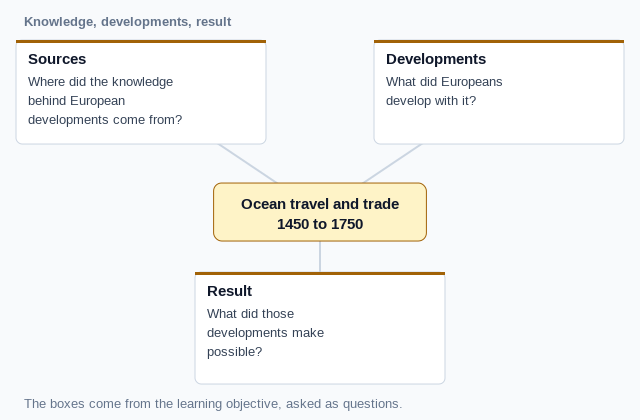
In short. From 1450 to 1750, knowledge that spread into Europe from other worlds facilitated European developments in tools, ships and the understanding of winds and currents, and those developments made travel and trade across oceans possible.
- Knowledge, scientific learning, and technology from the Classical, Islamic, and Asian worlds spread, facilitating European technological developments and innovation.
- The developments included the production of new tools, innovations in ship designs, and an improved understanding of regional wind and currents patterns.
- All of those developments made transoceanic travel and trade possible.
Part 2 Learn it Knowledge, ships and the open ocean
4.1a. Knowledge that traveled
This topic starts outside Europe. Knowledge, scientific learning, and technology from the Classical, Islamic, and Asian worlds spread, facilitating European technological developments and innovation.
Read the direction of that sentence. Knowledge moved toward Europe from three worlds the statement names, and it facilitated, or made easier, what Europeans went on to develop. The statement does not say Europeans invented nothing, and it does not say the other worlds did Europe's inventing for it. It says the spread helped.
College Board's examples of European developments influenced by these cross-cultural interactions are the lateen sail, the compass and astronomical charts. It lists them without saying which world each came from or how it reached Europe, so this lesson does not assign them either.
That is the first half of the learning objective: cross-cultural interactions resulted in the diffusion, or spread, of technology.
Quick check · Multiple choice
Which statement best describes the link this topic draws between other regions and European technology?
4.1b. Three developments and what they made possible
The second statement says what those European developments included: the production of new tools, innovations in ship designs, and an improved understanding of regional wind and currents patterns. Then it gives their result: all of which made transoceanic travel and trade possible.
Transoceanic means across an ocean. The result the statement names is travel and trade across oceans.
College Board's examples of innovations in ship design are the caravel, the carrack and the fluyt. It gives no details of how each was built or how they differed, and you can use them as examples of the category without any.
Notice the chain. The spread of knowledge facilitated the developments, and the developments made the travel and trade possible. That is the second half of the learning objective: the diffusion of technology facilitated changes in patterns of trade and travel.
Quick check · Select all
This topic's second statement ends "all of which made transoceanic travel and trade possible." Which three developments does that phrase refer to? Pick three.
Select 3 answers, then check.
4.1c. Describing a context
This topic's skill is contextualization: identify and describe a historical context for a specific development. A historical context is a broader development that the specific one sits inside. Identifying it names it. Describing it says what it was and how the specific development fits within it.
One worked through. The specific development: European use of the lateen sail. A broader development it sits inside: knowledge, scientific learning and technology from the Classical, Islamic and Asian worlds were spreading, and College Board lists the lateen sail among European developments influenced by those interactions. The description joins the two: the sail was part of a wider movement of knowledge into Europe.
A context can also come from an earlier period, as long as it bears on the development. For a ship or an instrument, that means a development in technology, knowledge or trade, not one about something unrelated.
Two things are not a context: the development restated ("the lateen sail was a European development"), and a development from the same years that has no bearing on it.
Quick check · Multiple choice
A student is describing a historical context for the caravel and the carrack, two of College Board's examples of innovations in ship design from this period. Which development from Unit 2 gives the best context?
Part 3 Watch it done Find a context for the compass
Watch the first steps, then take the last one yourself.
Describe a historical context for European use of the compass in the period c. 1450 to c. 1750.
Step 1 · Say what the development is
The compass is one of College Board's examples of a European technological development influenced by cross-cultural interactions with the Classical, Islamic and Asian worlds.
Step 2 · Look for a broader development that bears on it
Reach back to 2.3 Exchange in the Indian Ocean. Before 1450, the growth of interregional trade in luxury goods was encouraged by significant innovations in previously existing transportation and commercial technologies, including the use of the compass. So the compass was already part of a wider story of technology serving trade.
Why this step?
Why is "Europeans used the compass in this period" not a context?
It restates the development. A context has to be a broader development that the compass sits inside, such as the earlier use of the compass among the technologies that encouraged trade.
Your step · Decide and justify
Finish it. Which sentence describes a historical context for European use of the compass?
What makes your sentence a context?
Part 4 Try it Context, or not?
A class was asked: "Describe a historical context for the fluyt, one of the innovations in ship design from c. 1450 to c. 1750." Six students each wrote one sentence. The sentences were written for this page from College Board's statements. Decide which ones give a context.
Try it · Sort it
Sort each student sentence by whether it gives a historical context for the fluyt.
Gives a broader development the fluyt sits inside
Does not give a context
Part 5 Explain it Knowledge on the move
This is a self-check. Nothing you type leaves this page. Compare your answer with the model and each scoring point.
Free-response practice · Question 2 style
This is a partial long essay. Write a thesis, one sentence of context and one paragraph of evidence, not a full essay.
In the period c. 1450 to c. 1750, European sailors began to travel and trade across oceans.
Explain how cross-cultural interactions contributed to changes in European maritime travel in the period c. 1450 to c. 1750.
Model answer
Thesis: Cross-cultural interactions spread knowledge, scientific learning and technology from the Classical, Islamic and Asian worlds into Europe, and that spread facilitated the new tools, ship designs and understanding of winds and currents that made transoceanic travel and trade possible.
Context: Before 1450, improved transportation technologies and commercial practices had already increased the volume of trade on existing routes, including the Indian Ocean, so the European developments after 1450 came out of a world where technology and trade had long grown together.
European developments such as the lateen sail, the compass and astronomical charts were influenced by cross-cultural interactions with the Classical, Islamic and Asian worlds. They were part of a wider set of developments that included the production of new tools, innovations in ship designs such as the caravel and the carrack, and an improved understanding of regional wind and currents patterns. Together these made transoceanic travel and trade possible, so knowledge that came into Europe through contact with other worlds helped change where Europeans could sail and trade.
Score your own answer. This is a self-check, not a grade. Tick each point your answer makes.
Part 6 Check yourself Examples and their categories
The table drives the first two questions. The last two come from the rest of the lesson.
A student filed College Board's examples for this topic under the category each one illustrates. The table was written for this lesson from College Board's statements and examples.
| Examples | Category |
|---|---|
| Caravel, carrack, fluyt | Innovations in ship design |
| Lateen sail, compass, astronomical charts | European technological developments influenced by cross-cultural interactions with the Classical, Islamic and Asian worlds |
Case question 1 · Fill the statement
A classmate says the caravel and the fluyt have nothing to do with cross-cultural interactions, because the table files them only under ship design. Complete the reply, using both of the topic's statements.
The table's two rows are one story: the caravel and the fluyt were the European developments that knowledge from the Classical, Islamic and Asian worlds .
Case question 2 · Match
Each scene was written for this question. Match it to the development it shows.
The rest stand on their own and do not use the case.
Check yourself · Select all
Topic 4.2 says Portuguese development of maritime technology and navigational skills led to increased travel to and trade with Africa and Asia. Which two sentences from this topic describe a context for that development? Pick two.
Select 2 answers, then check.
Check yourself · Select all
In this topic's statements, what did the spread of knowledge from the Classical, Islamic and Asian worlds help bring about? Pick two.
Select 2 answers, then check.
Part 7 Keep it Bring back earlier ideas
One question from the empires lesson just before this one, and one from the lesson on how rulers legitimized power three back.
From 3.4 Comparison in Land-Based Empires · Multiple choice
A student claims: "Land empires of this period grew by similar military means." Which piece of evidence from the course best supports the claim?
From 3.2 Empires: Administration · Select all
Which two statements about how rulers legitimized their rule from 1450 to 1750 are accurate, as the course describes it? Pick two.
Select 2 answers, then check.
In three lines
- Knowledge, scientific learning and technology from the Classical, Islamic and Asian worlds spread, facilitating European technological developments.
- Those developments included new tools, innovations in ship designs and an improved understanding of regional wind and currents patterns.
- Together they made transoceanic travel and trade possible.
Exam strategy for this topic
- Section I Part A, Multiple Choice: 55 questions in 55 minutes.
- Section I Part B, Short Answer: 3 questions in 40 minutes.
- Section II, Document-Based Question and Long Essay: 2 questions in 100 minutes.
- This lesson's Explain it is shaped like free-response question 2, Long essay.
When a question asks for a context, check that your answer is wider than the development itself. Name the broader development, then add a clause that says how the specific one fits inside it.
Questions students ask
Did Europeans invent the compass and the lateen sail?
College Board does not say who first made them. It lists them as European technological developments influenced by cross-cultural interactions with the Classical, Islamic and Asian worlds.
Which world did each technology come from?
College Board does not match a technology to a world. It names the three worlds together and the examples together, so a careful answer does the same.
What is the difference between a caravel, a carrack and a fluyt?
College Board lists all three as innovations in ship design and does not describe them further. For this topic, what matters is the category they illustrate.
Was the compass new in this period?
No. In 2.3 Exchange in the Indian Ocean, the use of the compass was already among the significant innovations that encouraged interregional trade in luxury goods before 1450. In this topic it is one of the European developments influenced by cross-cultural interactions.
Why do winds and currents count as a development?
College Board lists an improved understanding of regional wind and currents patterns alongside new tools and ship designs. Knowledge counts as a development here, not only objects.
Course alignment, for teachers
AP World History: Modern topic 4.1, Unit 4: Transoceanic Interconnections.
- Skill 4.A: Identify and describe a historical context for a specific historical development or process.
This lesson maps all 2 essential knowledge statements of the topic, and the one learning objective with none of its own, to the part that teaches each one: 3 are checked by a scored question. The map is in the lesson file.