Unit 9 · Topic 9.1 · about 30 minutes · 7 parts · 10 scored checks, 2 of them multiple choice, plus 2 from earlier lessons
AP World History: Modern 9.1: Advances in Technology and Exchange After 1900
Unit 9: 8 to 10% of the multiple-choice section
What you'll be able to do
- Explain how the development of new technologies changed the world from 1900 to the present.
Key vocabulary
| Term | What it means | The exam trap |
|---|---|---|
| Problem of geographic distance | How far apart places are, and how much that stands in the way of moving people, goods and messages between them. | The phrase names a problem, not a length. Read whether a choice describes the places themselves or what the distance between them stood in the way of. |
| Productivity | This lesson's own plain meaning: how much comes out for the work and resources put in. | Productivity and production are different words. A statement can claim one, the other, or both, so read which one a choice names. |
| Material goods | Physical things that are made, such as clothing or machines. | Goods here means things produced, not a judgment that something is good for people. |
| Green Revolution | A change in farming that the topic names alongside commercial agriculture; the topic gives its effects but not its dates or places. | Revolution here names a change in farming, not a political revolution or the overthrow of a government. |
| Fertility | Here, the bearing of children: how many children women have. | A rate of fertility and the size of a population are different measures. A falling rate does not by itself mean a smaller population. |
| Reproductive practices | How people go about having children; the topic uses the phrase without detail, so this is its plain meaning. | Transformed is a strong verb. A choice that says these practices changed a little, or stayed as they were, does not match it. |
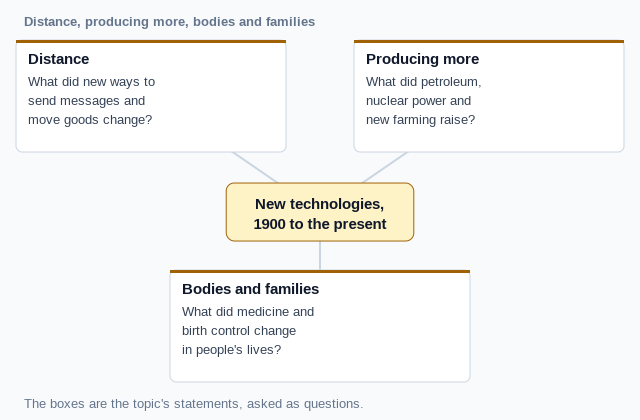 Tap to open the picture full size
Part 1 Think first Two lives, seventy years apart
Make a guess before you read. A wrong guess still helps the right idea stick.
Predict first
A woman born in 1920 and her granddaughter born in 1990 compare their lives at thirty. Which difference between them do you guess is the largest?
In short. This topic is about what new technologies changed in the world after 1900, from the problem of distance to how many children families had.
- New modes of communication and transportation reduced the problem of geographic distance.
- Energy technologies, and the Green Revolution with commercial agriculture, increased productivity; the Green Revolution and commercial agriculture also sustained the earth's growing population.
- Medical innovations increased the ability of humans to survive and live longer lives, and more effective forms of birth control contributed to declining rates of fertility in much of the world.
Part 2 Learn it What new technology changed
9.1a. The problem of distance
Start with the first group of technologies the topic names: New modes of communication, including radio communication, cellular communication, and the internet, as well as transportation, including air travel and shipping containers, reduced the problem of geographic distance.
Two kinds of technology share that one sentence. Radio, cellular communication and the internet carry messages. Air travel and shipping containers carry people and goods. The sentence gives both kinds a single effect.
Read the effect closely. What was reduced is the problem of distance. The places stayed where they were; what changed was how much the distance between them stood in the way.
Including matters as well. The five technologies are examples of each kind, not a full list.
Quick check · Multiple choice
A family in the late 20th century can phone relatives on another continent and send goods there in a shipping container. Which effect does this topic give for technologies like these?
9.1b. Producing more
Two statements in this topic are about producing more.
Energy technologies, including the use of petroleum and nuclear power, raised productivity and increased the production of material goods. That is two effects. In this lesson's own words, productivity is how much comes out for the work and resources put in, and production is how much comes out in all. The statement claims a rise in both.
The Green Revolution and commercial agriculture increased productivity and sustained the earth's growing population as it spread chemically and genetically modified forms of agriculture. Again two effects, with a third part attached: as ties them to the spread of modified forms of farming, chemical and genetic.
Neither statement names a country where these changes came first or a decade when they began, so this lesson names none either.
Quick check · Select all
Which two does this topic say energy technologies, including the use of petroleum and nuclear power, did? Pick two.
Select 2 answers, then check.
9.1c. Longer lives, smaller families
The last two statements turn to bodies and families.
Medical innovations, including vaccines and antibiotics, increased the ability of humans to survive and live longer lives. The claim is about an ability. It does not say every person lived longer, and it names no disease.
More effective forms of birth control gave women greater control over fertility, transformed reproductive practices, and contributed to declining rates of fertility in much of the world. Three effects come in a row: more control for women, a change in practices, and a part in falling fertility.
The third effect carries two qualifiers. Contributed to makes birth control one cause of the decline, and the topic names no other. In much of the world stops short of all of it.
Quick check · Multiple choice
Which choice states this topic's claim about more effective forms of birth control most accurately?
9.1d. From a list to a pattern
This topic's skill is to identify patterns among or connections between historical developments and processes. College Board defines identify as to indicate or provide information about a specified topic, without elaboration or explanation. Short is fine, but a pattern still has two parts: the developments, and what they share.
The first statement already holds one. Five technologies, from radio to shipping containers, are tied to a single effect on distance. Naming that shared effect is what turns a list of inventions into a pattern.
A pattern can also run across statements, when two of them give the same effect or effects that point the same way. Before you claim one, check each technology's own effects. A word that appears in your sentence is not shared if only one of the statements gives it.
Quick check · Select all
A student looks for a pattern: technologies that this topic links to people surviving or to a growing population. Which two fit the pattern? Pick two.
Select 2 answers, then check.
Part 3 Watch it done Finding a shared effect
Watch the first steps, then take the last one yourself.
Identify a pattern between energy technologies and the Green Revolution.
Step 1 · Lay out each one's effects
Energy technologies, including petroleum and nuclear power: two effects, from the second section. The Green Revolution and commercial agriculture: two effects as well, and a spread of modified forms of farming.
Step 2 · Look for the effect both lists give
Set the two lists side by side. Look for an effect both lists give, or two effects that point the same way. An effect that only one list gives, with nothing like it in the other, is not shared.
Why this step?
Why must the shared effect appear in both statements?
A pattern is a feature the developments have in common. If only one statement gives the effect, the sentence describes one development and borrows its effect for the other.
Your step · Decide and justify
Finish it. Which sentence identifies a pattern between the two?
What makes it a pattern?
Part 4 Try it Patterns in a memoir
A memoir written for this page (it is not a real source), by a woman looking back on her town between 1950 and 1990:
> When I was a girl, a letter to my brother across the ocean took a month to arrive. By the time my daughter moved away, we spoke on the telephone every Sunday, and the shirts she sewed in her factory went across the sea in steel boxes stacked on ships. The new seed the government brought in filled our sacks twice over, and the clinic's injections meant my grandchildren lived through the fevers that took two of my sisters. I was one of ten children. My daughter chose to have two.
A class was asked to identify a pattern among the developments in the memoir. Five students each wrote one sentence.
Try it · Sort it
Sort each student sentence by whether it identifies a pattern the topic's statements support.
Identifies a supported pattern
Does not
Part 5 Explain it How technology changed the world
This is a self-check. Nothing you type leaves this page. Compare your answer with the model and each scoring point.
Free-response practice · Question 2 style
This is a partial long essay. Write a thesis, one sentence of context and one paragraph of evidence, not a full essay.
In the period from 1900 to the present, rapid advances in science and technology led to advances in communication, transportation, industry, agriculture, and medicine.
Explain how the development of new technologies changed the world from 1900 to the present.
Model answer
Thesis: New technologies after 1900 changed the world by reducing the problem of geographic distance and raising productivity, while medicine increased people's ability to survive and live longer, and birth control contributed to smaller families in much of the world.
Context: Before 1900, steam engines and the internal combustion engine had let societies draw on the energy stored in coal and oil, a fossil fuels revolution that greatly increased the energy available to them, which I would argue means the energy technologies after 1900 built on an industrial age that had already transformed how much energy societies could use.
Radio, cellular communication and the internet, along with air travel and shipping containers, reduced the problem of geographic distance. Production changed too. Petroleum and nuclear power raised productivity and increased the production of material goods, and the Green Revolution and commercial agriculture increased productivity and sustained the earth's growing population as they spread chemically and genetically modified forms of agriculture. Vaccines and antibiotics increased the ability of humans to survive and live longer lives, and more effective forms of birth control gave women greater control over fertility and contributed to declining rates of fertility in much of the world. One pattern runs through farming and energy: both raised productivity.
Score your own answer. This is a self-check, not a grade. Tick each point your answer makes.
Part 6 Check yourself A port city's yearbook
The table drives the first two questions. The last two come from the rest of the lesson.
Four rows from the yearbook of an imagined port city, comparing 1960 with 2000. The yearbook was written for this lesson and is not real.
| Row | 1960 | 2000 |
|---|---|---|
| 1 | Most women in the city have six or more children. | Most women have two or three, and say they choose when. |
| 2 | Dockworkers carry crates onto ships one at a time. | Cranes lift sealed steel boxes straight onto ships bound for other continents. |
| 3 | Factories stop work whenever the coal runs short. | A new plant splitting atoms keeps the factories running, and each worker turns out twice as much in a day. |
| 4 | A fever kills many of the city's children each winter. | Children receive injections at school, and the winter fever rarely kills. |
Case question 1 · Fill the statement
Complete the note on the yearbook.
Row shows the kind of technology that raised productivity, and row shows the kind of change that more effective forms of birth control contributed to.
Case question 2 · Spot the error
A student wrote this summary of the yearbook. Which line goes wrong?
The rest stand on their own and do not use the case.
Check yourself · Select all
Which two does this topic say about the Green Revolution and commercial agriculture? Pick two.
Select 2 answers, then check.
Check yourself · Match
Match each scene, written for this page, to the group of technologies it belongs to.
Part 7 Keep it Bring back earlier ideas
One question from the Unit 8 review just before this lesson, and one from reactions to the century's conflicts three lessons back.
From 8.9 Causation in the Age of the Cold War and Decolonization · Multiple choice
According to the review, how far did the Cold War's effects reach?
From 8.7 Global Resistance to Established Power Structures After 1900 · Select all
This topic's first statement describes reactions to the conflict that dominated much of the 20th century. Which two does it name? Pick two.
Select 2 answers, then check.
In three lines
- New modes of communication and transportation reduced the problem of geographic distance.
- Energy technologies and the Green Revolution increased productivity, and the Green Revolution and commercial agriculture sustained the earth's growing population.
- Medical innovations increased the ability to survive, and more effective birth control contributed to declining fertility in much of the world.
Exam strategy for this topic
- Section I Part A, Multiple Choice: 55 questions in 55 minutes.
- Section I Part B, Short Answer: 3 questions in 40 minutes.
- Section II, Document-Based Question and Long Essay: 2 questions in 100 minutes.
- This lesson's Explain it is shaped like free-response question 2, Long essay.
When a long essay asks how technology changed the world after 1900, give each technology its own effect in the same sentence, then point out which effects two technologies share.
Questions students ask
Does this topic say the world got smaller?
No. It says new communication and transportation reduced the problem of geographic distance. The places stayed where they were; what eased was how much the distance stood in the way.
Which energy technologies does the topic name?
The use of petroleum and nuclear power. The word including marks them as examples, so the topic leaves room for others without naming them.
Where did the Green Revolution spread?
The statement does not say where or how far. It says the Green Revolution and commercial agriculture spread chemically and genetically modified forms of agriculture, and this lesson names no places either.
Did birth control alone cause fertility to fall?
The topic says more effective forms of birth control contributed to declining rates of fertility in much of the world. That makes it one cause, and the topic names no others.
Did these technologies make life better for everyone?
The topic gives what each technology raised or increased and does not say everyone gained. 9.2 Technological Advances and Limitations After 1900: Disease turns to diseases that persisted or emerged, and 9.3 Technological Advances: Debates About the Environment After 1900 to debates about the environment.
Course alignment, for teachers
AP World History: Modern topic 9.1, Unit 9: Globalization.
- Skill 5.A: Identify patterns among or connections between historical developments and processes.
This lesson maps all 5 essential knowledge statements of the topic, and the one learning objective with none of its own, to the part that teaches each one: 6 are checked by a scored question. The map is in the lesson file.