Unit 9 · Topic 9.6 · about 30 minutes · 7 parts · 9 scored checks, 2 of them multiple choice, plus 2 from earlier lessons
AP World History: Modern 9.6: Globalized Culture After 1900
Unit 9: 8 to 10% of the multiple-choice section
What you'll be able to do
- Explain how and why globalization changed culture over time.
Key vocabulary
| Term | What it means | The exam trap |
|---|---|---|
| Popular culture | Music, films, television, sport and other entertainment enjoyed by large numbers of people; a plain meaning, since the topic does not define it. | Popular here means widely enjoyed, not well liked by critics. A choice that ranks popular culture as better or worse art misreads the word. |
| Consumer culture | A way of life centered on buying goods and services; a plain meaning. | Consumer culture is about buying, not making. Factories moving to other countries belong to the global economy topic, not to this one. |
| Globalized society | A society shaped by close ties with the rest of the world; a plain meaning. | The phrase names an influence, not a place. A choice that treats it as one country, such as the country a brand came from, misreads it. |
| Bollywood | The name the topic gives as its example of movies in global culture. | The topic lists Bollywood by name only. A choice that says where its films were watched, or how many people saw them, claims more than the topic gives. |
 Tap to open the picture full size
Part 1 Think first Songs, films and soft drinks
Make a guess before you read. A wrong guess still helps the right idea stick.
Predict first
Think of music and films on one side, and the brands people buy on the other. After 1900, which do you guess began crossing borders on a large scale first?
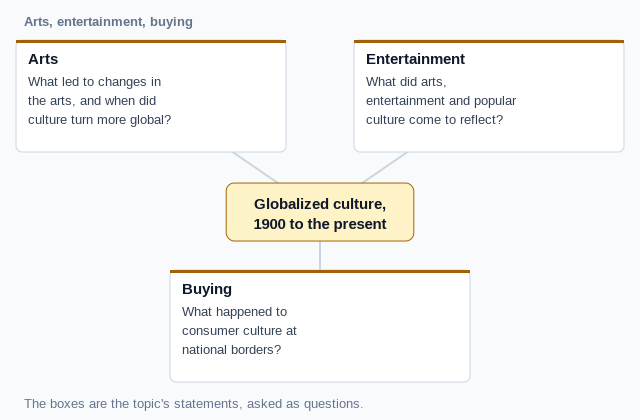
In short. This topic is about how culture changed after 1900: the arts changed with the century's politics and society, entertainment and popular culture came to reflect a globalized society, and buying crossed national borders.
- Political and social changes of the 20th century led to changes in the arts and in the second half of the century, popular and consumer culture became more global.
- Arts, entertainment, and popular culture increasingly reflected the influence of a globalized society.
- Consumer culture became globalized and transcended national borders.
Part 2 Learn it Culture in a globalized world
9.6a. The arts, and a time
The first statement is printed as one sentence with no comma in the middle: Political and social changes of the 20th century led to changes in the arts and in the second half of the century, popular and consumer culture became more global.
Read as written, it makes two claims. Led to belongs to the arts: political and social changes came first, and changes in the arts followed. Then a second clause gives a time. In the second half of the century, popular and consumer culture became more global.
Notice what the second clause leaves out. It dates the turn and gives no cause for it, and the sentence does not say which political or social changes it means. So when you write about why culture went global, the first statement only gives you the when.
The objective asks how and why globalization changed culture. The topic's statements say more about how than about why; the next section gives the closest it comes.
Quick check · Select all
Which two does this topic say about culture in the 20th century? Pick two.
Select 2 answers, then check.
9.6b. Entertainment that reflected a globalized society
The second statement names three parts of culture together: Arts, entertainment, and popular culture increasingly reflected the influence of a globalized society.
Increasingly is the word to keep. The influence grew over time, which fits the first statement's later turn. Reflected means the influence showed in them, the way a reflection shows what stands in front of it.
The topic's examples of global culture: reggae in music, Bollywood in movies, Facebook and Twitter in social media, the BBC in television, and World Cup soccer and the Olympics in sports. They are listed by name only. The topic does not say where each began or who watched it, so a claim about that needs evidence of its own.
This is the nearest the topic comes to how globalization changed culture: a globalized society left its mark on what people made and enjoyed. It does not explain why that influence grew.
Quick check · Multiple choice
Which choice best describes what this topic says about arts, entertainment, and popular culture?
9.6c. Buying across borders, and its context
The third statement is about buying: Consumer culture became globalized and transcended national borders. To transcend a border is to go past it. What people bought, and how they bought it, was no longer held inside one country.
The examples of global consumerism come in two kinds. Online commerce: Alibaba and eBay. Global brands: Toyota and Coca-Cola.
This topic's skill is to explain how a specific historical development or process is situated within a broader historical context. A single shop stocking a brand from abroad is a specific development. Consumer culture crossing national borders, in the second half of the century, is a broader one it can sit inside. The skill is the sentence that joins the two.
Quick check · Multiple choice
What does this topic say happened to consumer culture?
Part 3 Watch it done Placing one shop in its context
Watch the first steps, then take the last one yourself.
In 1985 a shop in an imagined town sells Toyota cars and Coca-Cola, two brands that come from outside the country. Explain how this development is situated within a broader historical context.
Step 1 · Name the specific development
One shop, one year, two brands from abroad.
Step 2 · Find a broader development it sits inside
Look in the statement on consumer culture, and at the timing in the first statement, for a change wider than one town. Then join the shop to it in a single sentence.
Why this step?
Why does a whole street of such shops still not count as the context?
More shops in the same town are more cases of the same thing. A context has to be wider than what it explains: here, the change across many borders that all of the shops belong to.
Your step · Decide and justify
Finish it. Which sentence situates the shop within that context?
What makes it situate the shop?
Part 4 Try it A student's diary, 2000
A diary entry written for this page (it is not a real source), by a student in an imagined city in 2000:
> Stayed up to watch a basketball game broadcast live from another country. This morning I ordered sneakers online from a seller overseas, then streamed a song a friend abroad sent me. Mom bought a car last month from a carmaker based across the ocean. My little brother watched a cartoon from overseas, dubbed into our language, and Dad had a bottle of a soft drink made by a foreign brand.
Each thing in the diary is evidence for one of the topic's statements. Decide which.
Try it · Sort it
Sort each thing in the diary by the statement it is evidence for.
Arts, entertainment, and popular culture reflecting a globalized society
Consumer culture crossing national borders
Part 5 Explain it How culture became global
This is a self-check. Nothing you type leaves this page. Compare your answer with the model and each scoring point.
Free-response practice · Question 2 style
This is a partial long essay. Write a thesis, one sentence of context and one paragraph of evidence, not a full essay.
In the period from 1900 to the present, arts, entertainment, and popular culture increasingly reflected the influence of a globalized society.
Explain how globalization changed culture in the period from 1900 to the present.
Model answer
Thesis: After 1900, and above all in the second half of the century, culture became more global, as entertainment and popular culture increasingly reflected the influence of a globalized society and consumer culture crossed national borders.
Context: New modes of communication, including radio, cellular communication and the internet, along with air travel and shipping containers, reduced the problem of geographic distance, which I would argue made it easier for a film, a broadcast or a brand from one country to reach others.
The change shows first in what people watched and heard. Reggae, Bollywood movies and BBC television carried culture across borders, and so did World Cup soccer and the Olympics, with Facebook and Twitter added in social media. Buying changed too. Consumer culture became globalized and transcended national borders, through online commerce such as Alibaba and eBay and global brands such as Toyota and Coca-Cola. The timing matters: popular and consumer culture became more global in the second half of the century. Not every cultural change came from globalization, though, because political and social changes of the 20th century led to changes in the arts.
Score your own answer. This is a self-check, not a grade. Tick each point your answer makes.
Part 6 Check yourself One port city, 1930 to 2000
The table drives the first two questions. The last two come from the rest of the lesson.
Four rows from a record of an imagined port city. The record was written for this lesson and is not real.
| Row | What is recorded | 1930 | 1960 | 2000 |
|---|---|---|---|---|
| 1 | Films from other countries shown in the city's cinemas that year | 5 | 12 | 140 |
| 2 | Shops selling brands made abroad | 2 | 6 | 310 |
| 3 | Residents who bought from a seller abroad online that year | None | None | 1 in 4 |
| 4 | Homes that watched a World Cup final on television | None | 1 in 20 | 7 in 10 |
Case question 1 · Fill the statement
Complete the note on the record.
Row shows consumer culture crossing borders with no shop involved, and row shows a sport from global culture reaching people at home.
Case question 2 · Spot the error
A student wrote this summary of the record. Which line goes wrong?
The rest stand on their own and do not use the case.
Check yourself · Select all
This topic lists Alibaba and eBay (online commerce) and Toyota and Coca-Cola (global brands) as examples of global consumerism. Based on this topic, which two pieces of evidence could best situate them in a broader context? Pick two.
Select 2 answers, then check.
Check yourself · Select all
A student argues: "Culture became more connected across the world in the 20th century." Based on this topic, which two pieces of evidence could best support the argument? Pick two.
Select 2 answers, then check.
Part 7 Keep it Bring back earlier ideas
One question from calls for reform, the lesson just before this one, and one from debates about the environment three lessons back.
From 9.5 Calls for Reform and Responses After 1900 · Multiple choice
According to this topic, what did movements throughout the world protest?
From 9.3 Technological Advances: Debates About the Environment After 1900 · Select all
Which two does this topic say about how humans competed over resources after 1900? Pick two.
Select 2 answers, then check.
In three lines
- Political and social changes of the 20th century led to changes in the arts and in the second half of the century, popular and consumer culture became more global.
- Arts, entertainment, and popular culture increasingly reflected the influence of a globalized society.
- Consumer culture became globalized and transcended national borders.
Exam strategy for this topic
- Section I Part A, Multiple Choice: 55 questions in 55 minutes.
- Section I Part B, Short Answer: 3 questions in 40 minutes.
- Section II, Document-Based Question and Long Essay: 2 questions in 100 minutes.
- This lesson's Explain it is shaped like free-response question 2, Long essay.
When a long essay asks how culture changed after 1900, pair an example of global culture, such as the Olympics, with one of global consumerism, such as eBay, and date the turn to the second half of the century.
Questions students ask
Does the topic say globalization caused the changes in the arts?
Read as written, the first statement gives political and social changes of the 20th century as what led to changes in the arts. Globalization appears in the second statement, as an influence that arts, entertainment, and popular culture increasingly reflected.
Why does the sentence about the arts read oddly?
It is printed as one sentence with no comma after arts. Read as written, led to governs the arts, and in the second half of the century begins a second clause that gives a time. That is the reading this lesson uses.
Did global culture replace local culture?
The topic does not say. Its statements describe culture becoming more global and crossing borders, and they say nothing about what happened to local traditions, so a claim either way needs its own evidence.
Are Toyota and Coca-Cola examples of culture or of the economy?
The topic lists them under global consumerism, as global brands, in a topic about culture. They are evidence that consumer culture crossed national borders.
What does the topic give as the why?
Very little. It gives political and social changes as what led to changes in the arts, and the influence of a globalized society as something culture reflected. It does not explain why that influence grew, so an argument about causes needs evidence from beyond these statements.
Course alignment, for teachers
AP World History: Modern topic 9.6, Unit 9: Globalization.
- Skill 4.B: Explain how a specific historical development or process is situated within a broader historical context.
This lesson maps all 3 essential knowledge statements of the topic, and the one learning objective with none of its own, to the part that teaches each one: 4 are checked by a scored question. The map is in the lesson file.