Unit 5 · Topic 5.2 · about 30 minutes · 7 parts · 9 scored checks, 2 of them multiple choice, plus 2 from earlier lessons
AP World History: Modern 5.2: Nationalism and Revolutions in the Period from 1750 to 1900
Unit 5: 12 to 15% of the multiple-choice section
What you'll be able to do
- Explain causes and effects of the various revolutions in the period from 1750 to 1900.
Key vocabulary
| Term | What it means | The exam trap |
|---|---|---|
| Commonality | Something people share with one another. | A sense of commonality is a feeling people hold, not an institution, so a choice that makes it a law or a government misreads it. |
| Nation-state | In the general meaning, a state whose people are thought of as sharing one national identity. | A nation-state is the state that is established, not the rebellion, so do not use the term for an uprising itself. |
| Republic | In the general meaning, a state governed without a monarch, by representatives of the people. | Republic names a form of government, so the United States is one example of it, not its definition. |
| Liberalism | In the general meaning, a set of political ideas centered on individual rights and limited government. | The statement attaches a century to it, 19th-century liberalism, so keep the label whole when you use the term. |
| Monarchist | In the general meaning, supporting or carried out by rule of a king or queen. | The statement pairs monarchist rule with imperial rule, so read both words, not just the first. |
| Unification | Joining separate parts into one whole. | Unification joins parts that were separate, so it can change a map as much as a breakaway can. |
 Tap to open the picture full size
Part 1 Think first Two documents, one seminar
Commit to a guess before you read. A wrong guess now still helps the right idea stick.
Predict first
One of College Board's sample activities sets students to discuss three documents side by side: the Declaration of Independence, the French "Declaration of the Rights of Man and of the Citizen" and Simón Bolívar's "Letter from Jamaica." Before reading any of them, what would you expect all three to share?
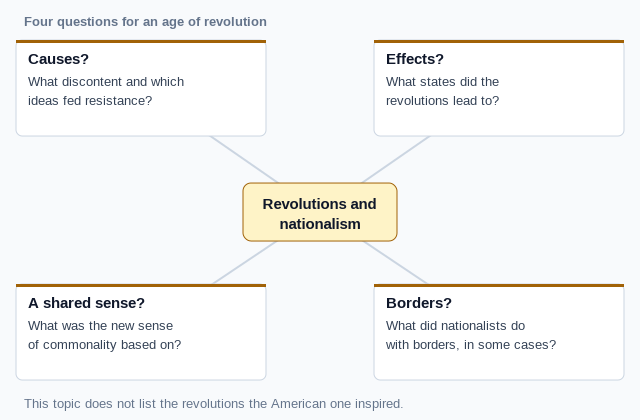
In short. From the 18th century, discontent with monarchist and imperial rule and the ideas of Enlightenment philosophers fed revolutions and rebellions that led to new nation-states, while people developed a new sense of commonality based on language, religion, social customs and territory.
- The 18th century began an intense period of revolution and rebellion against existing governments, and discontent with monarchist and imperial rule encouraged democracy and 19th-century liberalism.
- Revolutionary documents reflected Enlightenment ideas, and colonial subjects in the Americas led rebellions inspired by democratic ideals that helped independent states emerge.
- A new sense of commonality, based on language, religion, social customs and territory, was often linked with state borders, and in some cases nationalists challenged boundaries or sought unification.
Part 2 Learn it Revolutions and a new sense of nation
2a. An age of revolution begins
This topic dates the start of this unit's story to the 18th century, which marked the beginning of an intense period of revolution and rebellion against existing governments. That period led to the establishment of new nation-states around the world.
It also names a driver of new political thinking: discontent with monarchist and imperial rule, meaning unhappiness with rule by monarchs and by empires. That discontent encouraged the development of systems of government and various ideologies, and the statement names two of them:
- democracy
- 19th-century liberalism
Including marks these as examples, not a full list.
Quick check · Multiple choice
According to this topic, what encouraged the development of systems of government and ideologies such as democracy and 19th-century liberalism?
2b. Documents and rebellions in the Americas
The ideas of Enlightenment philosophers turn up in revolutionary documents. The statement names three:
- the American Declaration of Independence, during the American Revolution
- the French "Declaration of the Rights of Man and of the Citizen," during the French Revolution
- Bolívar's "Letter from Jamaica," on the eve of the Latin American revolutions
Those ideas influenced resistance to existing political authority, often in pursuit of independence and democratic ideals.
In the Americas, colonial subjects led a series of rebellions inspired by democratic ideals. The American Revolution, with its successful establishment of a republic, the United States of America, was a model and inspiration for a number of the revolutions that followed. A number, not all of them.
The result in the Americas: the American Revolution, the Haitian Revolution and the Latin American independence movements facilitated the emergence of independent states.
Quick check · Select all
Which three does this topic give as effects of the revolutions of this period? Pick three.
Select 3 answers, then check.
2c. A shared sense of nation
Alongside the revolutions, people around the world developed a new sense of commonality, a feeling of having something in common, based on four things: language, religion, social customs and territory. Governments sometimes harnessed it to foster a sense of unity.
Where did that feeling point? Newly imagined national communities often linked the new national identity with the borders of the state. And in some cases, nationalists went further: they challenged boundaries, or sought the unification of fragmented regions.
College Board's examples of calls for national unification or liberation include the German and Italian unifications, Balkan nationalisms, Ottomanism, the Propaganda Movement in the Philippines, Maori nationalism and the New Zealand wars, and the writings of Lola Rodríguez de Tió in Puerto Rico. It lists them by name and does not describe them.
Quick check · Select all
This topic says something about what some nationalists did in some cases. Which two match it? Pick two.
Select 2 answers, then check.
Part 3 Watch it done Compare two passages' main ideas
Watch the first steps, then take the last one yourself.
Two passages written for this page from this topic's statements.
Passage A: "Declarations of rights were more than paper. The Declaration of Independence and the French 'Declaration of the Rights of Man and of the Citizen' reflected the ideas of Enlightenment philosophers, and those ideas influenced resistance to existing political authority."
Passage B: "Colonial subjects in the Americas did not wait for permission. Inspired by democratic ideals, they led a series of rebellions, and the American and Haitian Revolutions and the Latin American independence movements helped independent states emerge."
Compare the passages' main ideas.
Predict first
Before the steps: do the two passages make the same argument?
Step 1 · State each main idea on its own
Passage A's point: the ideas in revolutionary documents shaped resistance to those in power. Passage B's point: colonial subjects, inspired by democratic ideals, rebelled and helped independent states emerge in the Americas.
Step 2 · Find a similarity, then a difference
Similar: both tie ideas to resistance, Enlightenment ideas in A and democratic ideals in B. Different: A is about what documents carried, across America and France; B is about who rebelled in the Americas and what came of it.
Why this step?
Why state each main idea before comparing?
A comparison sets two points side by side. Without each point stated first, it is easy to compare subjects, which can match, instead of arguments, which may not.
Your step · Decide and justify
Finish it. A student writes: "Passages A and B make the same argument, since both are about revolutions." Is that a fair comparison of their main ideas?
Why?
Part 4 Try it Two voices on the nation
Two short sources written for this page from this topic's statements, in the voices of people of the period. Neither is a real document.
Source 1, a nationalist in a divided land: "We speak one language, keep one faith and the same customs, and we live on one stretch of land. Yet separate states stand in the way, splitting us apart. Those borders must give way, so that our nation can stand united."
Source 2, an official of a government: "Our people share a language, a religion and their customs. The government will build on that shared feeling, so that the state holds its people together in unity."
Try it · Sort it
Sort each idea by which source puts it forward.
Only Source 1
Only Source 2
Both sources
Part 5 Explain it Causes and effects of revolutions, in writing
This is a self-check. Nothing you type leaves this page. Compare your answer with the model and each scoring point.
Free-response practice · Question 2 style
A short practice in the shape of the long essay question: a thesis, one sentence of context and one paragraph of evidence instead of a full essay.
Explain the causes and effects of the revolutions in the Americas in the period from 1750 to 1900.
Model answer
Thesis: Revolutions in the Americas were caused in part by democratic ideals and the ideas of Enlightenment philosophers, and they led to independent states, with the American Revolution becoming a model for a number of later revolutions.
Context: The revolutions in the Americas were part of a wider age of revolution. The 18th century marked the beginning of an intense period of revolution and rebellion against existing governments, leading to new nation-states around the world, and discontent with monarchist and imperial rule encouraged new systems of government and ideologies, including democracy.
Colonial subjects in the Americas led a series of rebellions inspired by democratic ideals. The ideas of Enlightenment philosophers, as reflected in documents such as the Declaration of Independence and Bolívar's "Letter from Jamaica," influenced resistance to existing political authority, often in pursuit of independence. As an effect, the American Revolution, the Haitian Revolution and the Latin American independence movements facilitated the emergence of independent states in the Americas. The American Revolution's successful establishment of a republic, the United States of America, then became a model and inspiration for a number of the revolutions that followed, so one revolution's effect became a cause of others.
Score your own answer. This is a self-check, not a grade. Tick each point your answer makes.
Part 6 Check yourself Three documents compared
Use the table for the first two questions. The last two cover the whole lesson.
These are the three documents in College Board's sample seminar for this topic, with what College Board says about each.
| Row | Document | When, in College Board's words |
|---|---|---|
| 1 | Declaration of Independence | during the American Revolution |
| 2 | "Declaration of the Rights of Man and of the Citizen" | during the French Revolution |
| 3 | Bolívar's "Letter from Jamaica" | on the eve of the Latin American revolutions |
Case question 1 · Fill the statement
Complete a student's comparison of the three documents.
Rows 1 and 3 belong to revolutions in , and of the three, is the one written before its revolution had begun; all three reflect the ideas of Enlightenment philosophers.
Case question 2 · Spot the error
A student wrote this paragraph from the table and the lesson. Which line is the first to go wrong?
The rest stand on their own and do not use the case.
Check yourself · Multiple choice
Two passages written for this page. Passage 1: "The ideas of Enlightenment philosophers, reflected in revolutionary documents such as the Declaration of Independence and Bolívar's 'Letter from Jamaica,' influenced resistance to existing political authority." Passage 2: "Colonial subjects in the Americas led a series of rebellions inspired by democratic ideals." Which main idea do both passages share?
Check yourself · Select all
Two passages written for this page. Passage 1: "Newly imagined national communities often linked national identity with the borders of the state." Passage 2: "Governments sometimes harnessed people's new sense of commonality to foster a sense of unity." Which two describe a difference between the passages' main ideas? Pick two.
Select 2 answers, then check.
Part 7 Keep it Bring back earlier ideas
One question from the Enlightenment lesson and one from the lesson on changing social hierarchies in Unit 4, so both come round again.
From 5.1 The Enlightenment · Multiple choice
This topic says philosophers developed new political ideas. Which ideas does it name?
From 4.7 Changing Social Hierarchies from 1450 to 1750 · Multiple choice
According to this topic, what contributed to the formation of new political and economic elites?
In three lines
- The 18th century began an intense period of revolution against existing governments, and discontent with monarchist and imperial rule encouraged democracy and 19th-century liberalism.
- Enlightenment ideas in revolutionary documents influenced resistance, and colonial subjects' rebellions in the Americas helped independent states emerge.
- A new sense of commonality, based on language, religion, social customs and territory, was often linked to state borders, and in some cases nationalists challenged them.
Exam strategy for this topic
- Section I Part A, Multiple Choice: 55 questions in 55 minutes.
- Section I Part B, Short Answer: 3 questions in 40 minutes.
- Section II, Document-Based Question and Long Essay: 2 questions in 100 minutes.
- This lesson's Explain it is shaped like free-response question 2, Long essay.
To compare two sources, write each one's main idea in a sentence of its own first. Then name one way they are alike and one way they differ, and point to the words in each source that show it.
Questions students ask
What was the Letter from Jamaica?
College Board names Bolívar's "Letter from Jamaica," written on the eve of the Latin American revolutions, as a revolutionary document that reflected the ideas of Enlightenment philosophers. It does not summarize the letter.
Where does the Haitian Revolution fit?
It is one of the three the statement names, with the American Revolution and the Latin American independence movements, as facilitating the emergence of independent states in the Americas.
Did governments create the new sense of nation?
The statement says people around the world developed it, and that governments sometimes harnessed it to foster a sense of unity. So governments used it in some cases; they are not named as its source.
What were Ottomanism and the Propaganda Movement?
College Board lists both among its examples of calls for national unification or liberation, Ottomanism with the Balkan nationalisms and the Propaganda Movement in the Philippines. It does not describe either one.
Which revolutions did the American Revolution inspire?
The statement says it was a model and inspiration for a number of the revolutions that followed, and it does not list them. Do not stretch that to every later revolution.
Course alignment, for teachers
AP World History: Modern topic 5.2, Unit 5: Revolutions.
- Skill 3.C: Compare the arguments or main ideas of two sources.
This lesson maps all 6 essential knowledge statements of the topic, and the one learning objective with none of its own, to the part that teaches each one: 7 are checked by a scored question. The map is in the lesson file.