Unit 8 · Topic 8.7 · about 30 minutes · 7 parts · 10 scored checks, 3 of them multiple choice, plus 2 from earlier lessons
AP World History: Modern 8.7: Global Resistance to Established Power Structures After 1900
Unit 8: 8 to 10% of the multiple-choice section
What you'll be able to do
- Explain various reactions to existing power structures in the period after 1900.
Key vocabulary
| Term | What it means | The exam trap |
|---|---|---|
| Nonviolence | Seeking change without using force, even when force is used against you. | Nonviolence names a method, not an aim. Read what a source says it wants as well as how it means to get it. |
| Militarized state | In the general sense of the term, a state run by its military or organized around military power. | Militarized states often intensified conflict; often is not always. Keep the qualifier when a choice turns it into a rule. |
| Military-industrial complex | The ties between a country's armed forces and the industries that supply them; one of College Board's examples, with weapons trading, of responses that intensified conflict. | It is listed with responses that intensified conflict, not with the movements that used violence against civilians. Keep it with the militaries. |
| Proliferation of conflicts | Conflicts spreading and growing in number. | Here proliferation is about conflicts multiplying, not nuclear weapons as in 8.3 Effects of the Cold War. Read what is proliferating. |
| Civilian | A person who is not a member of an armed force. | Check whom a source names as its target before you call its violence violence against civilians. |
 Tap to open the picture full size
Part 1 Think first Answering a violent century
Make a guess before you read. A wrong guess still helps the right idea stick.
Predict first
War and conflict filled much of the 20th century. How do you expect people and states mostly reacted to it?
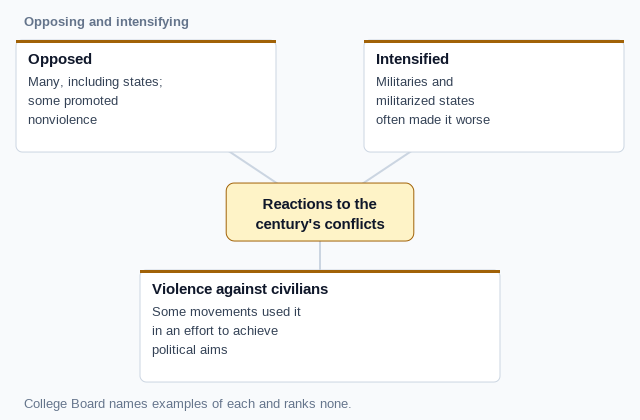
In short. Conflict dominated much of the 20th century, and people reacted to it in opposite ways: many opposed it, while some intensified it.
- Groups and individuals challenged the many wars of the century, and some, such as Mohandas Gandhi, Martin Luther King Jr., and Nelson Mandela, promoted nonviolence as a way to bring about political change.
- Militaries and militarized states often responded to the proliferation of conflicts in ways that further intensified conflict.
- Some movements used violence against civilians in an effort to achieve political aims.
Part 2 Learn it Opposing and intensifying conflict
8.7a. Two directions
The topic opens with a frame for everything after it:
Although conflict dominated much of the 20th century, many individuals and groups, including states, opposed this trend. Some individuals and groups, however, intensified the conflicts.
Although sets the opposition against the trend: conflict dominated, yet many opposed it. Including states matters, because opposition was not only the work of private people. However turns to the other direction: some intensified the conflicts.
Notice the sizes. Many opposed; some intensified. The statement does not say which mattered more. The rest of the topic fills in each direction, and causation is its reasoning process: each reaction was a response to conflict, and some made it worse.
Quick check · Select all
This topic's first statement describes reactions to the conflict that dominated much of the 20th century. Which two does it name? Pick two.
Select 2 answers, then check.
8.7b. Challenging war, practicing nonviolence
The second statement is the opposing direction:
Groups and individuals challenged the many wars of the century, and some, such as Mohandas Gandhi, Martin Luther King Jr., and Nelson Mandela, promoted the practice of nonviolence as a way to bring about political change.
It gives two actions. Groups and individuals challenged the century's wars. And some went further, promoting nonviolence, not as giving up on change but as a way to bring about political change. The three names are in the statement itself.
This topic's skill is explaining a source's point of view, purpose, historical situation, and/or audience. A leaflet calling for an unarmed march is not neutral: its purpose is to win followers to one way of seeking change, and its situation is a century in which conflict dominated.
Quick check · Multiple choice
According to this topic, what did Mohandas Gandhi, Martin Luther King Jr., and Nelson Mandela promote?
8.7c. Responses that made conflict worse
Two statements fill in the other direction.
Militaries and militarized states often responded to the proliferation of conflicts in ways that further intensified conflict. The conflicts were multiplying, and these responses made them worse. Often keeps it from being a rule. College Board's examples are Chile under Augusto Pinochet, Spain under Francisco Franco, Uganda under Idi Amin, and the buildup of the military-industrial complex and weapons trading.
Some movements used violence against civilians in an effort to achieve political aims. The targets were civilians, and the aims were political. College Board's examples are the Shining Path and Al-Qaeda.
The two differ in who acted. One is armies and states, the other movements. Both sit under the first statement's some intensified the conflicts.
Quick check · Select all
Which two statements from this topic could best support an argument that some reactions to the century's conflicts made the violence worse? Some choices are true but do not bear on the argument. Pick two.
Select 2 answers, then check.
Part 3 Watch it done Sourcing an arms advertisement
Watch the first steps, then take the last one yourself.
An advertisement written for this page (it is not a real source), printed in 1981 by an arms company in a magazine read by the officers of many countries' armies: "Our rifles have served in every war of the last ten years. Whatever your army faces next, be ready. Order now."
Explain the advertisement's purpose and how its historical situation bears on it.
Predict first
Before the steps: what does the advertisement most want from its readers?
Step 1 · Read who wrote it and for whom
An arms company wrote it, and it ran in a magazine for army officers in many countries. A seller is speaking to buyers.
Step 2 · Place it in its situation
A century in which conflict dominated and conflicts kept multiplying. The advertisement counts "every war of the last ten years" as its record. Look back at the third chunk's examples for the one that fits a company selling arms abroad.
Why this step?
Why does the situation matter to the purpose, and not just to the date?
The advertisement sells by pointing to wars, past and coming. Its purpose only makes sense in a time of many conflicts.
Your step · Decide and justify
Finish it. Which sentence explains the advertisement's purpose through its situation?
What makes that sentence explain the purpose?
Part 4 Try it Sourcing a march leader's speech
A speech written for this page (it is not a real source), given in 1963 by the leader of a movement to a meeting of its members the night before a march:
> They have guns; we have our feet and our voices. Tomorrow we march to the square. If the police beat us, we will not raise a hand, because the whole world must see who is using force.
A student wrote a paragraph sourcing the speech.
Try it · Spot the error
Which line of the student's paragraph misreads the speech?
Part 5 Explain it Two answers to force
This is a self-check. Nothing you type leaves this page. Set your answer beside the model and each scoring point.
Free-response practice · Question 1 style
A short practice in the shape of the document-based question: a thesis, one sentence of context and one paragraph that uses both documents and explains the point of view or purpose of one, instead of a full essay. Both documents are written for this page and are not real.
Document 1: the march leader's speech from Try it, 1963.
Document 2: a decree read on the radio by a general who has just seized power, 1974: "All meetings are forbidden. Newspapers will print what the army allows. Anyone who resists will be treated as an enemy of the nation."
Using both documents, explain various reactions to existing power structures in the period after 1900.
Model answer
Thesis: Reactions to power after 1900 ran in opposite directions: some movements challenged it through nonviolence as a way to bring about political change, while militarized states often answered challenges with force that intensified conflict.
Context: In World War II, the totalitarian states set out to dominate many aspects of daily life and to repress basic freedoms, during the conflicts and beyond, and both documents answer that kind of power: one defies it, one claims it.
Document 1 shows the first reaction. The leader tells members that if "the police beat us, we will not raise a hand," promoting nonviolence as the way to win change. His purpose shapes the words: speaking to his own members the night before a march, he wants them to stay unarmed "because the whole world must see who is using force," so the speech is meant to win onlookers as well. Document 2 shows the other direction. A general who has seized power forbids meetings and calls anyone who resists "an enemy of the nation," a militarized state responding in a way that makes conflict worse.
Score your own answer. This is a self-check, not a grade. Tick each point your answer makes.
Part 6 Check yourself Four voices on conflict
The table drives the first two questions. The last three come from the rest of the lesson.
Four short sources from the century after 1900. All four were written for this lesson and are not real.
| Row | Speaker | Its words |
|---|---|---|
| 1 | A state's foreign minister, at a meeting of many states | "My government will send no soldiers to this war, and it calls on every side to talk." |
| 2 | A general who has seized power, on the radio | "Strikes are banned. The army will arrest anyone who resists." |
| 3 | A message from an armed movement | "Every market in the city is a target until the government falls." |
| 4 | A leaflet from a students' group | "We will sit in the street, unarmed, until the war ends." |
Case question 1 · Sort it
Sort each row by the direction its speaker takes.
Opposes the conflict
Intensifies the conflict
Case question 2 · Fill the statement
Complete the note on rows 2 and 3.
Row 2 is a response by a , and row 3 is a movement threatening violence against .
The rest stand on their own and do not use the case.
Check yourself · Multiple choice
A radio address written for this page (it is not a real source) is given to the nation by a military ruler who has just taken power: "Our enemies are everywhere. The army will act against them without mercy until order returns." Given the speaker and the situation, which choice best explains the address's purpose?
Check yourself · Select all
Two statements written for this page (they are not real sources). Source 1, a leaflet from a protest movement: "We will march without weapons, and if we are struck, we will not strike back." Source 2, a message from another movement: "Until our demands are met, no one in the capital is safe." Which two explanations of the sources' purposes are accurate? Pick two.
Select 2 answers, then check.
Check yourself · Multiple choice
A letter written for this page (it is not a real source) is sent by a student to a newspaper: "Another war, and again our leaders send us to fight in it. I will not go, and I ask my classmates to refuse with me." Which choice best explains the letter's purpose, given its writer and audience?
Part 7 Keep it Bring back earlier ideas
One question from the lesson just before this one, and one from the spread of communism three lessons back.
A newspaper article written for this page (it is not a real source), printed in 1975 in a state that had been a colony:
> Independence cut the threads that tied the new states to their old rulers. Their people no longer go there to live, and their trade no longer passes through the old rulers' cities.
Sort each piece of evidence by how it bears on the article's argument.
From 8.6 Newly Independent States · Sort it
Sort each piece of evidence from this topic.
Refutes the article
Does not bear on it
Three short sources about movements to redistribute land. All three were written for this lesson and are not real.
| Row | Who, to whom | Its words |
|---|---|---|
| 1 | The leader of a land movement in a state in Asia, to a rally of tenant farmers | "The landlords' fields will be yours when we govern. Our party follows the teachings of socialism." |
| 2 | A newspaper owned by large landowners in a state in Latin America, to its readers | "The so-called reformers will ruin the harvests and drive the country into hunger." |
| 3 | A government official in a state in Africa, in a report to the minister who ordered the reform | "Land in the eastern province has been divided as ordered. The farmers report themselves satisfied." |
From 8.4 Spread of Communism After 1900 · Spot the error
A student wrote a paragraph using the table. Which line misreads it?
In three lines
- Although conflict dominated much of the 20th century, many individuals and groups, including states, opposed it, and some, such as Gandhi, King, and Mandela, promoted nonviolence.
- Militaries and militarized states often responded in ways that further intensified conflict.
- Some movements used violence against civilians in an effort to achieve political aims.
Exam strategy for this topic
- Section I Part A, Multiple Choice: 55 questions in 55 minutes.
- Section I Part B, Short Answer: 3 questions in 40 minutes.
- Section II, Document-Based Question and Long Essay: 2 questions in 100 minutes.
- This lesson's Explain it is shaped like free-response question 1, Document-based.
When you source a document about conflict, say which direction its author takes, opposing the conflict or intensifying it, and show how that purpose shapes one thing the document says.
Questions students ask
Who opposed the century's conflicts?
Many individuals and groups, including states. Groups and individuals challenged the many wars of the century, and some, such as Gandhi, King, and Mandela, promoted nonviolence as a way to bring about political change.
Which examples does College Board give of responses that intensified conflict?
Chile under Augusto Pinochet, Spain under Francisco Franco, Uganda under Idi Amin, and the buildup of the military-industrial complex and weapons trading.
Which movements does this topic name as using violence against civilians?
College Board's examples are the Shining Path and Al-Qaeda. The statement says some movements used violence against civilians in an effort to achieve political aims.
Did opposition or intensification matter more?
The statement does not say. It gives both directions, many who opposed and some who intensified, and ranks neither.
How is this topic's sourcing different from 8.2's?
The skill is the same one. 8.2 The Cold War used it on the Cold War's two sides; here the sources take a side on conflict itself, opposing it or making it worse.
Course alignment, for teachers
AP World History: Modern topic 8.7, Unit 8: Cold War and Decolonization.
- Skill 2.B: Explain the point of view, purpose, historical situation, and/or audience of a source.
This lesson maps all 4 essential knowledge statements of the topic, and the one learning objective with none of its own, to the part that teaches each one: 5 are checked by a scored question. The map is in the lesson file.