Unit 5 · Topic 5.10 · about 35 minutes · 7 parts · 10 scored checks, 2 of them multiple choice, plus 2 from earlier lessons
AP World History: Modern 5.10: Continuity and Change in the Industrial Age
Unit 5: 12 to 15% of the multiple-choice section
What you'll be able to do
- Explain the extent to which industrialization brought change from 1750 to 1900.
Key vocabulary
| Term | What it means | The exam trap |
|---|---|---|
| Continuity | Something that stays the same, or goes on, across a period. | Continuity is not the absence of all change, so one development can show both, and an answer can say which part is which. |
| Extent | How far or how much. | An extent question wants a degree, so an answer of only yes or only no leaves the task undone. |
| Diffusion | The spread of something from place to place or group to group. | Rise and diffusion name two things, growth and spread, so do not treat diffusion as where Enlightenment thought began. |
| Empiricist | In the word's general meaning, relying on observation and experience to understand something. | Empiricist names a method of knowing, so it says how the philosophies studied the world, not what they concluded. |
| Nation-state | In the general meaning, a state whose people are thought of as sharing one national identity. | A nation-state joins a state to a shared sense of nationhood, so an empire ruling many peoples is not one. |
 Tap to open the picture full size
Part 1 Think first How much changed?
Commit to an answer first, then see how the lesson treats it.
Predict first
Think back over the whole unit. From 1750 to 1900, how much do you think industrialization changed?
In short. Industrialization brought great change from 1750 to 1900, and the unit's review gives both the change and the small words that limit it.
- The development of industrial capitalism led to increased standards of living for some, and to continued improvement in manufacturing methods that increased the availability, affordability, and variety of consumer goods.
- Railroads, steamships, and the telegraph made exploration, development, and communication possible in interior regions globally, which led to increased trade and migration.
- Revolution and rebellion against existing governments, often preceded by Enlightenment thought, led to new nation-states, and nationalism became a major force shaping states and empires.
Part 2 Learn it The unit in review
2a. The economic statements, and whom they reached
The objective asks to what extent industrialization brought change. The review opens with its economic statements, from 5.7 Economic Developments and Innovations in the Industrial Age and 5.5 Technology of the Industrial Age.
The development of industrial capitalism led to increased standards of living for some, and to continued improvement in manufacturing methods that increased the availability, affordability, and variety of consumer goods.
Railroads, steamships, and the telegraph made exploration, development, and communication possible in interior regions globally, which led to increased trade and migration.
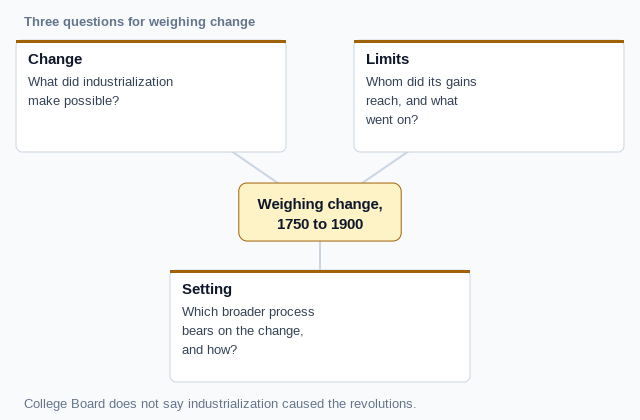
Both describe change, and small words set its extent. For some limits who gained a higher standard of living. Continued makes the improvement in manufacturing a process that kept going, not a single leap. Globally sets how far the technologies reached.
The review states no continuity of its own. For one, go back to 5.4 Industrialization Spreads in the Period from 1750 to 1900: Middle Eastern and Asian countries continued to produce manufactured goods, while their share of global manufacturing declined. A careful answer sets evidence like that against the change.
Quick check · Select all
Which two pieces of evidence from this unit could best support an argument that the changes industrialization brought had limits? Pick two.
Select 2 answers, then check.
2b. Revolution, and what came before it
The statements on revolution and ideas come from 5.1 The Enlightenment and 5.2 Nationalism and Revolutions in the Period from 1750 to 1900, and they describe change in governments and ideas.
The 18th century marked the beginning of an intense period of revolution and rebellion against existing governments, leading to the establishment of new nation-states around the world. Marked the beginning starts the period in that century. It does not close it there.
The rise and diffusion of Enlightenment thought that questioned established traditions in all areas of life often preceded revolutions and rebellions against existing governments. Preceded is an order in time, and often is not always. The statement sets the two in sequence; it does not say the thought caused each revolution.
The review does not say whether these changes came from industrialization, so an answer without evidence for a link should not claim one. They can serve as context only when an answer says how they bear on the extent of economic change. The review gives no such tie, so the writer has to make and support one; happening in the same years is not a tie.
Quick check · Multiple choice
The review says the 18th century marked the beginning of an intense period of revolution and rebellion against existing governments. Which other statement in the review describes something that often came before such revolutions?
2c. Ideas and nations
Enlightenment philosophies applied new ways of understanding and empiricist approaches to both the natural world and human relationships; they also reexamined the role that religion played in public life and emphasized the importance of reason. Philosophers developed new political ideas about the individual, natural rights, and the social contract.
Reexamined means looked at again. It does not say the philosophies removed religion from public life.
Nationalism also became a major force shaping the historical development of states and empires. A major force makes nationalism one force among others, and also sets it beside the revolutions before it.
Sorted by kind, the review holds economic statements and statements on revolution and ideas. That split is a first step in weighing the extent of change: which evidence speaks to the prompt, and which gives its setting.
Quick check · Multiple choice
A student sorts the review's statements into two categories, ideas and economy. Which statement belongs with ideas?
Part 3 Watch it done Weigh two pieces of evidence
Two steps are worked; the third is yours.
Prompt: Explain the extent to which industrialization brought change from 1750 to 1900.
Evidence A: Railroads, steamships, and the telegraph made exploration, development, and communication possible in interior regions globally, which led to increased trade and migration.
Evidence B: The development of industrial capitalism led to increased standards of living for some.
Explain how the two pieces of evidence relate to each other and to the prompt.
Predict first
Before the steps: which side of an extent argument can Evidence B support?
Step 1 · Name the reasoning process
The prompt asks about the extent of change, so the process is continuity and change. The task is to identify patterns or developments that indicate change and/or continuity, and draw conclusions in support of a claim.
Step 2 · Place each piece
Evidence A shows change: interior regions opened to exploration, development and communication, and trade and migration increased. Evidence B shows change too, a rise in standards of living, but for some limits who gained it, so it can also support a claim about limits.
Why this step?
Why not count both pieces as plain proof of great change?
Because B's own words hold a limit. Counting it only as change drops for some, and a claim about extent is exactly where that word matters.
Your step · Decide and justify
Finish it. A student writes: "Together, A and B show that industrialization opened interior regions to more trade and migration while its gains in standards of living reached only some, so the change was great but uneven." Does the sentence explain how the two pieces of evidence relate?
Why?
Part 4 Try it An editorial from 1899
An editorial written for this page, as if printed in a newspaper in 1899. It is not a real document.
"Look how far the century has carried us. Railways and the telegraph now reach far inland, and traders and settlers follow them. Yet the workshops of India still weave cloth, as they did a hundred years ago. And while some families live better than any before them, it is only some."
Try it · Fill the statement
Finish a student's reading of the editorial as a whole.
Read together, the editorial supports the claim that . A reader who used only the sentence about would reach the opposite claim, that little changed.
Part 5 Explain it How far did industry change the world?
This is a self-check. Nothing you type leaves this page. Compare your answer with the model, line by line, and with each scoring point.
Free-response practice · Question 2 style
A short practice in the shape of the long essay: a thesis, one sentence of context and one paragraph of evidence and reasoning, instead of a full essay.
Explain the extent to which industrialization brought change from 1750 to 1900.
Model answer
Thesis: Industrialization brought great change from 1750 to 1900, opening interior regions to trade and migration and making consumer goods more available and affordable, but the change had limits, since its gains in standards of living reached only some and older producers went on making goods.
Context: Industrialization did not arrive everywhere at once: as new methods of industrial production became more common in parts of northwestern Europe, they spread to other parts of Europe and the United States, Russia, and Japan, so the change began in a few places and reached others later, which already marks its reach as uneven.
Railroads, steamships, and the telegraph made exploration, development, and communication possible in interior regions globally, which led to increased trade and migration. Continued improvement in manufacturing methods increased the availability, affordability, and variety of consumer goods. Both mark a break with the past in what could be made, bought and reached. Yet the development of industrial capitalism led to increased standards of living for some, so those gains reached only some people. Middle Eastern and Asian countries also continued to produce manufactured goods even as their share of global manufacturing declined, a continuity beside the change. So the change was great in what it made possible but uneven in whom it reached, and older production carried on beside it.
Score your own answer. This is a self-check, not a grade. Tick each point your answer makes.
Part 6 Check yourself A student's evidence organizer
The first two questions use the organizer. The other three range across the lesson.
A student's organizer for the prompt in Explain it, written for this page. For this skill, College Board suggests naming the reasoning process the prompt asks for, here continuity and change, and arranging the evidence in an organizer that fits it. The student's categories come from College Board's sample activity for a neighboring skill, supporting an argument with evidence: evidence that supports radical change, evidence that the change was not as radical, and evidence that could support both. Evidence the review does not tie to industrialization supports neither position on its own; it becomes context once the answer writes how it bears on the prompt.
| Row | Evidence from the unit | Student's category |
|---|---|---|
| 1 | Railroads, steamships, and the telegraph made exploration, development, and communication possible in interior regions globally, which led to increased trade and migration. | Supports radical change |
| 2 | The development of industrial capitalism led to increased standards of living for some. | Could support both |
| 3 | While Middle Eastern and Asian countries continued to produce manufactured goods, these regions' share in global manufacturing declined. | Could support both |
| 4 | Continued improvement in manufacturing methods increased the availability, affordability, and variety of consumer goods. | Not yet sorted |
| 5 | The 18th century marked the beginning of an intense period of revolution and rebellion against existing governments, leading to new nation-states around the world. | Not yet sorted |
Case question 1 · Fill the statement
Finish the student's sorting of rows 4 and 5.
Row 4 belongs under , and row 5 belongs under .
Case question 2 · Spot the error
A student wrote this paragraph from the organizer. Which line is the first to go wrong?
The rest stand on their own and do not use the case.
Check yourself · Select all
Which two pieces of evidence from this review could best support an argument that industrialization brought great change? Pick two.
Select 2 answers, then check.
Check yourself · Select all
Which two pieces of evidence from this review show change in how states took shape? Pick two.
Select 2 answers, then check.
Check yourself · Sort it
Sort each claim by how it stands against the review's own words.
Fits the review's wording
Claims more than the review
Part 7 Keep it Bring back earlier ideas
One question from the lesson on reactions to the industrial economy and one from the lesson on society in the industrial age.
From 5.8 Reactions to the Industrial Economy from 1750 to 1900 · Multiple choice
According to this topic, what were some governments in Asia and Africa, including the Ottoman Empire and Qing China, responding to when they sought to reform and modernize their economies and militaries?
From 5.9 Society and the Industrial Age · Multiple choice
According to this topic, why did middle-class women's roles differ from those of women in working-class families?
In three lines
- Industrial capitalism raised standards of living for some, and improved manufacturing made consumer goods more available, affordable and varied.
- Railroads, steamships, and the telegraph opened interior regions globally, which led to increased trade and migration.
- Revolution, Enlightenment thought and nationalism changed governments and ideas, and the review does not say industrialization caused them, so using them as context takes a stated tie.
Exam strategy for this topic
- Section I Part A, Multiple Choice: 55 questions in 55 minutes.
- Section I Part B, Short Answer: 3 questions in 40 minutes.
- Section II, Document-Based Question and Long Essay: 2 questions in 100 minutes.
- This lesson's Explain it is shaped like free-response question 2, Long essay.
An extent claim needs both sides weighed. Name your strongest evidence of change, name a limit or a continuity, and say which weighs more and why.
Questions students ask
Why does a review of industrialization include revolutions and Enlightenment ideas?
The review gathers the unit's key concepts: its economic statements beside those on revolution and ideas. College Board does not say industrialization caused the revolutions or the ideas. An essay on industrialization can use them as context only by saying how they bear on the economic change; happening in the same years is not enough.
Does the review name any continuity?
Not directly. Its qualifiers mark limits, such as for some. For a continuity, earlier topics help, such as Middle Eastern and Asian countries continuing to produce manufactured goods in 5.4 Industrialization Spreads in the Period from 1750 to 1900.
What activity does College Board suggest for this skill?
For long essay practice, College Board suggests having students identify the historical reasoning process the prompt indicates, then develop and use a graphic organizer, such as a Venn diagram or flowchart, to arrange the evidence in a way that reflects that reasoning process. The three groups in this lesson's organizer come from its sample activity for a neighboring skill, supporting an argument with evidence: for a prompt on the extent to which European industrialization produced a radical change in the lives of Africans, students sort three to four documents in a Venn diagram into evidence that supports radical change, evidence that the change was not as radical, and evidence that could support both, and write how each piece supports the position.
What is the Great Divergence resource listed with this topic?
College Board lists a classroom resource beside this topic, a review essay titled Teaching the Great Divergence. This page does not describe what it says.
Is extent the same as cause?
No. Extent asks how much changed; cause asks why. This topic's reasoning process is continuity and change, so weigh change against what continued or stayed limited.
Course alignment, for teachers
AP World History: Modern topic 5.10, Unit 5: Revolutions.
- Skill 6.C: Use historical reasoning to explain relationships among pieces of historical evidence.
This lesson maps all 6 essential knowledge statements of the topic, and the one learning objective with none of its own, to the part that teaches each one: 7 are checked by a scored question. The map is in the lesson file.