Unit 1 · Topic 1.2 · about 30 minutes · 7 parts · 9 scored checks, 2 of them multiple choice, plus 2 from earlier lessons
AP World History: Modern 1.2: Developments in Dar al-Islam from c. 1200 to c. 1450
Unit 1: 8 to 10% of the multiple-choice section
What you'll be able to do
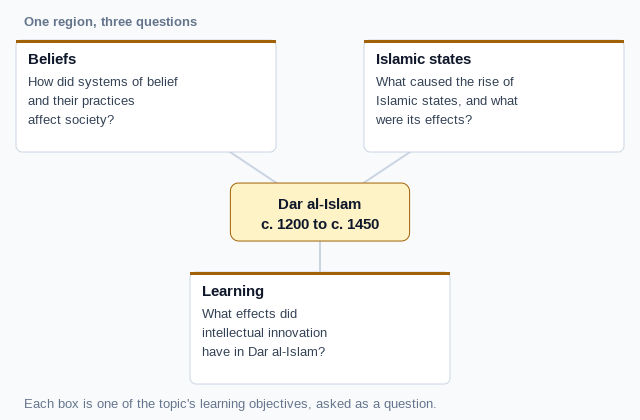
- Explain how Islam, Judaism and Christianity, with their beliefs and practices, affected societies in Africa and Asia from c. 1200 to c. 1450.
- Explain the causes and effects of the rise of new Islamic states as the Abbasid Caliphate fragmented, and how Muslim rule and Islam spread.
- Explain the effects of the intellectual innovations and transfers that Muslim states encouraged.
Key vocabulary
| Term | What it means | The exam trap |
|---|---|---|
| Dar al-Islam | An Arabic phrase meaning "the house of Islam", used for the lands where Muslims ruled. | It names a set of lands, not one state or government. A question may still ask about the states inside it. |
| Caliphate | A state led by a caliph, a ruler with both political and religious authority in Islam. | A caliph's title reaches into both government and faith. Read whether a question asks about the state or the religion. |
| Fragment | To break into pieces. | Fragmenting describes what happened to one state. What came next is a separate step, so read the stem for which one it asks. |
| Turkic peoples | Peoples who speak one of the Turkic languages. | Turkic is a word about people and language, not about religion. Keep it apart from Islam when reading a choice. |
| Sufis | Muslims who follow Sufism, a mystical practice within Islam. | Sufism is a practice inside Islam, not a separate religion. Do not count Sufis as a fourth faith. |
| Intellectual innovation | New knowledge or new work in a field of learning. | This topic uses two learning words that look alike. Decide what each one means before you sort any example. |
| Intellectual transfer | Knowledge passed from one people, place or time to another. | A transfer can involve new writing about older ideas. Ask where the ideas themselves came from. |
 Tap to open the picture full size
Part 1 Think first When a great state breaks apart
Commit to a guess before you read. A wrong guess now still helps the right idea stick.
Predict first
A large state that has ruled a wide region for centuries begins to break into pieces. What do you expect fills the space it leaves?
In short. From c. 1200 to c. 1450, the Abbasid Caliphate fragmented into new Islamic states, Muslim rule and then Islam itself spread across Afro-Eurasia, and Muslim states encouraged both new learning and the passing on of older learning.
- As the Abbasid Caliphate fragmented, new Islamic political entities emerged, such as the Seljuk Empire, the Mamluk sultanate of Egypt and the Delhi sultanates, most of them dominated by Turkic peoples.
- Military expansion carried Muslim rule to many parts of Afro-Eurasia, and Islam then spread through merchants, missionaries and Sufis, while Islam, Judaism and Christianity all continued to shape societies in Africa and Asia.
- Muslim states encouraged intellectual innovations, such as advances in mathematics, literature and medicine, and transfers, such as the preservation of Greek philosophy.
Part 2 Learn it States, faith and learning in Dar al-Islam
2a. A caliphate breaks apart
Dar al-Islam is an Arabic phrase, "the house of Islam", used for the lands where Muslims ruled. Its great state had been the Abbasid Caliphate.
In this period that caliphate fragmented, and new Islamic political entities emerged. Most of them were dominated by Turkic peoples. College Board's framework gives three examples: the Seljuk Empire, the Mamluk sultanate of Egypt and the Delhi sultanates. A sultanate is a state ruled by a sultan.
Two points follow. First, the breakup did not end Islamic rule; the states that emerged were Islamic too. Second, the people who held power in most of them were Turkic.
The framework describes these states with the three words from the Song lesson: they showed continuity, innovation and diversity. You will see the same three words used for states in South and Southeast Asia, the Americas and Africa. When the same words describe many regions, the unit is pointing at a pattern.
Quick check · Multiple choice
Which statement best describes political change as the Abbasid Caliphate fragmented?
2b. Rule spreads, then faith
One sentence carries two different processes. Muslim rule continued to expand to many parts of Afro-Eurasia (Africa, Europe and Asia taken together) because of military expansion. Islam subsequently expanded through the activities of merchants, missionaries and Sufis.
Separate them:
- Rule is about who governs a land. It spread by military expansion.
- Faith is about what people believe and practice. It spread through merchants, missionaries and Sufis, followers of Sufism, a practice within Islam.
Subsequently means afterward. The framework puts military expansion first and the spread of the faith after it.
Islam was not the only faith at work. Islam, Judaism and Christianity, with their core beliefs and practices, all continued to shape societies in Africa and Asia in this period.
Quick check · Select all
Which two statements correctly describe how Muslim rule and Islam spread in this period? Pick two.
Select 2 answers, then check.
2c. New learning and inherited learning
Muslim states and empires encouraged significant intellectual innovations and transfers. The two words name different things.
An innovation is new work. The framework's examples are advances in mathematics, such as those of Nasir al-Din al-Tusi; advances in literature, such as those of 'A'ishah al-Ba'uniyyah; and advances in medicine.
A transfer is learning passed from one people, place or time to another. The examples are the preservation of, and commentaries on, Greek moral and natural philosophy; the House of Wisdom in Abbasid Baghdad; and scholarly and cultural transfers in Muslim and Christian Spain.
To tell them apart, ask where the knowledge came from. If someone in a Muslim state produced it, it is an innovation. If it was kept, commented on or passed along from somewhere else, it is a transfer. A commentary on Greek philosophy is new writing, but its subject is older learning being carried forward.
One honest limit. The objectives also ask about effects, of the new states and of this learning. The framework's statements name what emerged and what Muslim states encouraged, not the effects, so this lesson stops where they stop.
Quick check · Select all
Muslim states encouraged intellectual innovations and transfers. Which two of these are transfers, learning passed along from another people or time? Pick two.
Select 2 answers, then check.
Part 3 Watch it done Identify and describe a cause
Watch the first steps, then take the last one yourself.
Identify and describe one cause of the spread of Islam as a faith in Afro-Eurasia in the period c. 1200 to c. 1450.
Predict first
Before the steps: which do you expect the answer will be about?
Step 1 · Read what the prompt is about
The prompt asks about Islam as a faith, not about Muslim rule. That matters, because the framework gives the two different causes.
Step 2 · Find the cause that matches
Military expansion is the cause given for the spread of Muslim rule. For the faith, the cause is the activities of merchants, missionaries and Sufis, which came after rule had expanded.
Why this step?
Why does identifying alone not finish the answer?
The prompt says identify and describe. Describing means giving the relevant characteristics: who the people were and how their activities, rather than conquest, carried the faith.
Your step · Decide and justify
Finish it. Which sentence identifies and describes a cause of the spread of Islam as a faith?
Which evidence supports your choice?
Part 4 Try it Rule or faith?
Imagine these arrivals in a new part of Afro-Eurasia. They were written for this page, not taken from a source, and each matches something the framework describes. Decide what each one spreads.
Try it · Sort it
Each card is an arrival in a new part of Afro-Eurasia. Sort it by what it spreads.
Muslim rule
Islam as a faith
Part 5 Explain it Two causes, in writing
This is a self-check. Nothing you type leaves this page. Compare your answer with the model and each scoring point.
Free-response practice · Question 2 style
A short practice in the shape of the long essay question: a thesis, one sentence of context and one paragraph of evidence instead of a full essay. Use what this lesson taught.
In the period c. 1200 to c. 1450, Muslim rule and the faith of Islam both expanded across many parts of Afro-Eurasia.
Explain one cause of the expansion of Muslim rule and one cause of the expansion of Islam as a faith in the period c. 1200 to c. 1450.
Model answer
Thesis: Muslim rule and Islam spread by different means: military expansion extended Muslim rule to many parts of Afro-Eurasia, and the faith then spread through the activities of merchants, missionaries and Sufis.
Context: This happened as the Abbasid Caliphate fragmented and new Islamic political entities emerged, such as the Seljuk Empire, the Mamluk sultanate of Egypt and the Delhi sultanates, most of them dominated by Turkic peoples.
Rule came first. Military expansion carried Muslim rule into new lands, which is a change in who governed. The faith followed: merchants, missionaries and Sufis spread Islam through their activities, which is a change in what people believed and practiced. So the two spread by different means and in sequence: conquest changed who governed, and the activities of merchants, missionaries and Sufis afterward changed what people believed.
Score your own answer. This is a self-check, not a grade. Tick each point your answer makes.
Part 6 Check yourself Learning in Muslim states
The table drives the first two questions. The last two come from the rest of the lesson.
A student listed the framework's examples of learning in Muslim states, with a note on each.
| Example | Note |
|---|---|
| Nasir al-Din al-Tusi | advances in mathematics |
| 'A'ishah al-Ba'uniyyah | advances in literature |
| Medicine | advances in the field |
| Greek moral and natural philosophy | preserved, with commentaries written on it |
| Muslim and Christian Spain | scholarly and cultural transfers |
Case question 1 · Sort it
Sort each example in the table by the kind of learning it shows.
Innovation
Transfer
Case question 2 · Spot the error
The student wrote this summary of Dar al-Islam in the period. Which line is the first to go wrong?
The rest stand on their own and do not use the case.
Check yourself · Select all
Which two statements about religion in Africa and Asia from c. 1200 to c. 1450 are accurate? Pick two.
Select 2 answers, then check.
Check yourself · Multiple choice
Which of these is an example of a new Islamic political entity that emerged as the Abbasid Caliphate fragmented?
Part 7 Keep it Bring back earlier ideas
Two questions from the Song China lesson, so its ideas come round again.
From 1.1 Developments in East Asia from c. 1200 to c. 1450 · Multiple choice
A student writes: "As the Song economy became more commercial, it stopped relying on free workers." Which correction is accurate?
From 1.1 Developments in East Asia from c. 1200 to c. 1450 · Select all
Which two statements describe Buddhism in Asia from c. 1200 to c. 1450? Pick two.
Select 2 answers, then check.
In three lines
- As the Abbasid Caliphate fragmented, new Islamic political entities emerged, most dominated by Turkic peoples.
- Military expansion carried Muslim rule across Afro-Eurasia; merchants, missionaries and Sufis then spread Islam, and Judaism and Christianity also kept shaping societies.
- Muslim states encouraged innovations, such as al-Tusi's mathematics, and transfers, such as the preservation of Greek philosophy.
Exam strategy for this topic
- Section I Part A, Multiple Choice: 55 questions in 55 minutes.
- Section I Part B, Short Answer: 3 questions in 40 minutes.
- Section II, Document-Based Question and Long Essay: 2 questions in 100 minutes.
- This lesson's Explain it is shaped like free-response question 2, Long essay.
When a question asks how Islam spread, first decide whether it means Muslim rule or the faith itself. Then match the cause to that process before you read the choices closely.
Questions students ask
Why does the framework spell it Bagdad?
College Board's framework prints Bagdad in its list of examples. This lesson uses Baghdad, the usual spelling in US English. Both name the same city.
Did Islam replace Judaism and Christianity where Muslims ruled?
The framework says Islam, Judaism and Christianity, with their core beliefs and practices, all continued to shape societies in Africa and Asia in this period.
Who were Nasir al-Din al-Tusi and 'A'ishah al-Ba'uniyyah?
The framework names them as examples of advances in mathematics and in literature. It gives no more about them here, and it calls such examples possible ones rather than required information.
What does subsequently mean in the statement about Islam's spread?
It means afterward. Military expansion carried Muslim rule first, and merchants, missionaries and Sufis spread the faith after that.
Did the breakup of the Abbasid Caliphate end Islamic rule?
No. As the caliphate fragmented, new Islamic political entities emerged, such as the Seljuk Empire, the Mamluk sultanate of Egypt and the Delhi sultanates, most of them dominated by Turkic peoples.
Course alignment, for teachers
AP World History: Modern topic 1.2, Unit 1: The Global Tapestry.
- Skill 1.A: Identify a historical concept, development, or process.
This lesson maps all 4 essential knowledge statements of the topic, and the 3 learning objectives with none of their own, to the part that teaches each one: 7 are checked by a scored question. The map is in the lesson file.