Unit 6 · Topic 6.5 · about 30 minutes · 7 parts · 9 scored checks, 2 of them multiple choice, plus 2 from earlier lessons
AP World History: Modern 6.5: Economic Imperialism from 1750 to 1900
Unit 6: 12 to 15% of the multiple-choice section
What you'll be able to do
- Explain how various economic factors contributed to the development of the global economy from 1750 to 1900.
Key vocabulary
| Term | What it means | The exam trap |
|---|---|---|
| Economic imperialism | Extending power over other lands through economic means, such as trade, investment and business. | It is a kind of imperialism, not an alternative to it. A question about economic imperialism may name a firm and no army. |
| Commodity | A raw material or farm product that is bought and sold in trade. | A commodity is a good, not a place or a trader. Read what a choice says was traded before you read where. |
| Distinct economic advantage | A clear edge over others in buying, selling or profiting. | An advantage is relative. It means one side did better than another, not that the other side earned nothing. |
| Primarily | Mainly; for the most part. | A qualifier like this keeps a claim from being total. Copy it into your answer rather than turning it into always or only. |
| Broader historical context | A development larger than a specific case, which the case belongs to. | Context is a development, not a single event. A war or a port is a case to be placed, not the context itself. |
 Tap to open the picture full size
Part 1 Think first A port built by a foreign firm
Choose before you read. The guess is yours to test, not a score.
Predict first
In the 1800s a British firm helps pay for a great new port at Buenos Aires, a city in Latin America. Could that count as imperialism?
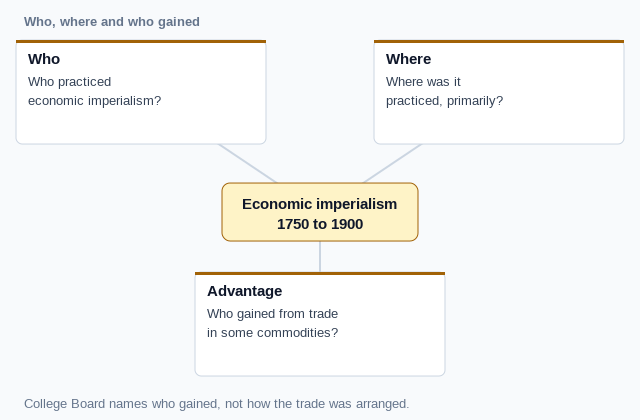
In short. From 1750 to 1900, industrialized states and businesses within those states practiced economic imperialism, primarily in Asia and Latin America, and trade in some commodities was organized to favor merchants and companies based in Europe and the U.S.
- Industrialized states and businesses within those states practiced economic imperialism primarily in Asia and Latin America.
- Trade in some commodities was organized in a way that gave merchants and companies based in Europe and the U.S. a distinct economic advantage.
- To situate a case, name the broader development it belongs to and say how the case fits inside it.
Part 2 Learn it Trade, business and advantage
6.5a. Who practiced it, and where
Imperialism did not always arrive as an army or a governor. The statement puts it plainly: industrialized states and businesses within those states practiced economic imperialism primarily in Asia and Latin America.
Two actors are named, a state and the firms inside it, and both count. Primarily marks Asia and Latin America as the main regions, not the only ones; the statement does not say where else.
College Board gives two examples. Britain and France expanded their influence in China through the Opium Wars, which is a case in Asia with states acting. The Port of Buenos Aires was built with the support of British firms, a case in Latin America with businesses acting.
The statement does not define economic imperialism or say how a firm's support turned into influence. Read the phrase as its two words suggest, imperialism carried out by economic means, and keep any claim about how it worked close to the examples.
Quick check · Multiple choice
According to this topic, where did industrialized states and businesses within those states primarily practice economic imperialism?
6.5b. Trade arranged to favor some merchants
The second statement turns from who to how. Trade in some commodities was organized in a way that gave merchants and companies based in Europe and the U.S. a distinct economic advantage.
Three words carry the weight. Some limits the claim to certain commodities. Distinct means a clear edge. Based in places the advantage with where the merchants and companies were headquartered, which is often not where the goods came from.
College Board's examples of commodities that contributed to European and American economic advantage:
| Commodity | Where it came from, and where it went | |---|---| | Opium | produced in the Middle East or South Asia, exported to China | | Cotton | grown in South Asia and Egypt, exported to Great Britain and other European countries | | Palm oil | produced in sub-Saharan Africa, exported to European countries | | Copper | extracted in Chile |
The statement says the trade was organized to give the advantage. It does not describe the terms of that trade, so a claim about prices or contracts goes past it.
Quick check · Select all
This topic says trade in some commodities was organized in a way that gave certain merchants and companies a distinct economic advantage. Which two places does it name as where those merchants and companies were based? Pick two.
Select 2 answers, then check.
6.5c. Placing a case in a wider frame
This topic's skill is contextualization: explaining how a specific historical development or process is situated within a broader historical context.
A sentence of context does two jobs. It names a development larger than the case, and it ties the case to that development. A report about a dock in Buenos Aires is the case; industrialized states and their businesses practicing economic imperialism in Latin America is a development it can sit inside.
The second job is the one students skip. "Industrial states grew more powerful" is background. It becomes context only when the sentence returns to the case and says how the dock belongs to that growth: built with a British firm's money, in one of the regions where industrialized states and their businesses primarily practiced economic imperialism.
Quick check · Multiple choice
One of College Board's examples for this topic is the construction of the Port of Buenos Aires with the support of British firms. Which development described in this topic provides the broader context for that example?
Part 3 Watch it done The Opium Wars in a wider frame
Watch the first steps, then take the last one yourself.
One of College Board's examples for this topic is Britain and France expanding their influence in China through the Opium Wars. Explain how this case is situated within a broader historical context.
Step 1 · Say what the case is
Two states, Britain and France, expanded their influence in China, and they did it through war. Both were industrialized states.
Step 2 · Look for the larger development
A context sentence needs something wider than China and wider than these two wars. This topic's first statement describes a pattern across whole regions, so ask which region China belongs to and who the statement says was active there.
Why this step?
Why is "Britain and France fought wars in China" not yet context?
It only restates the case. Context names a larger development and ties the case to it.
Your step · Decide and justify
Finish it. Which sentence situates the case within a broader historical context?
What makes that sentence context?
Part 4 Try it Context for a merchant's letter
A letter written for this page, from a British merchant in a Chinese port to his partners:
> The chests of opium from India sold within the week. We set the terms here now, and our house in London may expect a good year.
Build a context sentence for it. Choose the broader development the letter belongs to, then the detail in the letter that ties it there.
Try it · Fill the statement
Complete the context sentence for the letter.
The sale belongs to , and the letter fits inside it because .
Part 5 Explain it Trade, firms and the global economy, from documents
This is a self-check. Nothing you type leaves this page. Hold your answer up to the model and each scoring point.
Free-response practice · Question 1 style
A short practice in the shape of the document-based question: a thesis, one sentence of context and one paragraph that uses both documents and explains the point of view or audience of one, instead of a full essay. Both documents are written for this page and are not real.
Document 1: the merchant's letter from Try it.
Document 2: a report from the agent of a British building firm in Buenos Aires to the firm's directors: "The new docks are nearly finished. Our company's money built them, and our ships will be the first to use them."
Using both documents, explain how various economic factors contributed to the development of the global economy in the period from 1750 to 1900.
Model answer
Thesis: Economic factors drew distant regions into the global economy on unequal terms, as industrialized states' businesses invested and traded in Asia and Latin America, and trade in commodities such as opium was organized to favor merchants based in Europe.
Context: As states industrialized, they expanded existing overseas empires and established new colonies and transoceanic relationships, and the trading house in China and the building firm in Buenos Aires both worked inside those relationships.
Document 1 shows a commodity trade running to a European firm's advantage: opium from India sells in a Chinese port within the week, and the merchant boasts, "We set the terms here now," with the profit going to "our house in London." Document 2 shows a business from an industrialized state at work in Latin America, where a British firm's money built the new docks. The agent writes to his own directors, so he has reason to stress what the company paid for and what it will gain, "our ships will be the first to use them." Read together, the documents show economic imperialism in Asia and Latin America, the regions where industrialized states and their businesses primarily practiced it, with investment in one and commodity trade in the other tying those places to firms based in Europe.
Score your own answer. This is a self-check, not a grade. Tick each point your answer makes.
Part 6 Check yourself Five cases
The table drives the first two questions. The last two come from the rest of the lesson.
A student listed cases from College Board's examples for this topic. The table was written for this lesson.
| Row | Case |
|---|---|
| 1 | Britain and France expand their influence in China through the Opium Wars |
| 2 | British firms support the construction of the Port of Buenos Aires |
| 3 | Opium produced in South Asia is exported to China |
| 4 | Copper is extracted in Chile |
| 5 | Cotton grown in Egypt is exported to Great Britain |
Case question 1 · Sort it
Sort rows 1 to 5 by which of this topic's two statements each one is an example of.
Economic imperialism by industrialized states or their businesses
A commodity that contributed to European and American advantage
Case question 2 · Spot the error
A student wrote this summary of the table. Which line goes wrong?
The rest stand on their own and do not use the case.
Check yourself · Select all
A report written for this page is from a company based in Europe: "Our firm buys the copper at the mine, carries it in our own ships, and sets its price in our home market." Which two statements from this unit best situate the report within a broader historical context? Pick two.
Select 2 answers, then check.
Check yourself · Select all
One of College Board's examples for this topic is palm oil produced in sub-Saharan Africa and exported to European countries. A student uses it as evidence. Which two statements from this unit could the example best support? Pick two.
Select 2 answers, then check.
Part 7 Keep it Bring back earlier ideas
One question from the export economies lesson just before this one, and one from the state expansion lesson three back.
From 6.4 Global Economic Development from 1750 to 1900 · Multiple choice
According to this topic, what did the export economies that grew around the world in this period specialize in?
From 6.2 State Expansion from 1750 to 1900 · Select all
A diary entry written for this page is by a Spanish official late in this period: "Our country's influence in Asia and the Pacific is not what it was. Other states now take the lands there." Which two developments described in this topic best situate the diary entry within its broader context? Pick two.
Select 2 answers, then check.
In three lines
- Industrialized states and businesses within those states practiced economic imperialism primarily in Asia and Latin America.
- Trade in some commodities, such as opium sent to China and cotton sent to Great Britain, was organized to give merchants and companies based in Europe and the U.S. a distinct economic advantage.
- A context sentence names a broader development and ties the case to it.
Exam strategy for this topic
- Section I Part A, Multiple Choice: 55 questions in 55 minutes.
- Section I Part B, Short Answer: 3 questions in 40 minutes.
- Section II, Document-Based Question and Long Essay: 2 questions in 100 minutes.
- This lesson's Explain it is shaped like free-response question 1, Document-based.
For the context point of a document-based answer, name a development broader than the documents, such as economic imperialism in Asia and Latin America, and then say in the same sentence how the documents' case belongs to it.
Questions students ask
Did economic imperialism mean ruling a colony?
The statement does not say so. It names industrialized states and businesses within those states, and College Board's examples are wars that expanded influence in China and a port built with British firms' support.
Was economic imperialism found only in Asia and Latin America?
Primarily there, the statement says. Primarily names the main regions and leaves room for others, which it does not list.
How exactly was the trade organized to give the advantage?
College Board does not say. The statement says trade in some commodities was organized in a way that gave merchants and companies based in Europe and the U.S. a distinct economic advantage, and its examples name commodities and where they went, not the terms.
How does this topic connect to export economies?
6.4 Global Economic Development from 1750 to 1900 explains why export economies grew and what they produced. This topic asks who held the advantage in trade in some of those goods. Cotton and palm oil appear in the examples of both topics.
Is the skill here the same as in 6.4?
No. In 6.4 Global Economic Development from 1750 to 1900 you explained a source's point of view, purpose, situation or audience. Here you explain how a specific development is situated within a broader context, which a document-based answer asks for in its context point.
Course alignment, for teachers
AP World History: Modern topic 6.5, Unit 6: Consequences of Industrialization.
- Skill 4.B: Explain how a specific historical development or process is situated within a broader historical context.
This lesson maps all 2 essential knowledge statements of the topic, and the one learning objective with none of its own, to the part that teaches each one: 2 are checked by a scored question and 1 by the written response. The map is in the lesson file.