Unit 9 · Topic 9.3 · about 30 minutes · 7 parts · 10 scored checks, 2 of them multiple choice, plus 2 from earlier lessons
AP World History: Modern 9.3: Technological Advances: Debates About the Environment After 1900
Unit 9: 8 to 10% of the multiple-choice section
What you'll be able to do
- Explain the causes and effects of environmental changes in the period from 1900 to the present.
Key vocabulary
| Term | What it means | The exam trap |
|---|---|---|
| Deforestation | The loss of forests. | The word names what happened to the forests, not who cleared them. The topic ties it to human activity in general and names no one group. |
| Desertification | The spread of desert-like conditions onto land that was not desert before. | It is a process over time, not the deserts that already existed. Read whether a choice describes land changing or land as it always was. |
| Air quality | How clean or polluted the air is. | A decline in air quality means the air got worse. Decline goes with quality, not with the amount of air. |
| Greenhouse gases | Gases in the atmosphere that hold in heat; this is a plain meaning, since the topic does not define the term. | The topic pairs greenhouse gases with pollutants as one release. A choice that keeps one and drops the other changes what was released. |
| Climate change | A long-term change in the earth's climate; a plain meaning, since the topic does not define it. | Climate is weather over long stretches of time, so one hot summer is not by itself climate change. |
 Tap to open the picture full size
Part 1 Think first Two towns, one river
Make a guess before you read. A wrong guess still helps the right idea stick.
Predict first
Two farming towns have shared one river for a hundred years. Over the next fifty, both towns grow, and the river carries less water every summer. What do you guess happens between them?
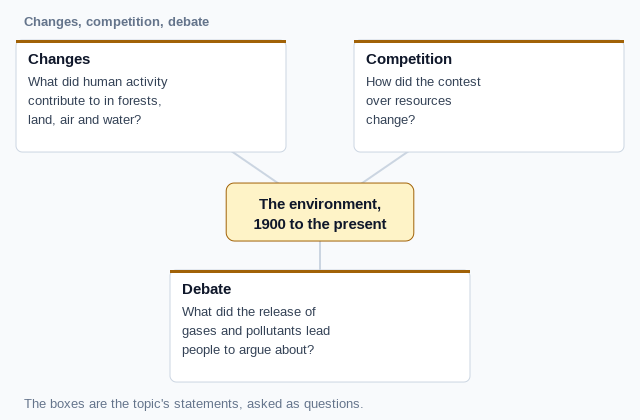
In short. This topic is about the environmental changes human activity contributed to after 1900, the competition over resources that went with them, and the debates over climate change.
- Human activity contributed to deforestation, desertification, a decline in air quality, and increased consumption of the world's supply of fresh water.
- As those changes went on, humans competed over these and other resources more intensely than ever before.
- The release of greenhouse gases and pollutants into the atmosphere contributed to debates about the nature and causes of climate change.
Part 2 Learn it Human activity and the environment
9.3a. Four changes
The topic's first statement begins with what people did to the world around them: human activity contributed to deforestation, desertification, a decline in air quality, and increased consumption of the world's supply of fresh water.
That is four changes. Forests were lost. Desert-like land spread. The air got worse. People used more of the planet's fresh water.
Contributed to makes human activity a cause of each change, not the only possible one. The statement also leaves human activity general: it names no country, industry or decade.
Quick check · Select all
Which two does this topic name as changes that human activity contributed to? Pick two.
Select 2 answers, then check.
9.3b. Competing for what was left
The same sentence goes on: As human activity contributed to those four changes, humans competed over these and other resources more intensely than ever before.
Three phrases carry the meaning.
As sets the two halves side by side in time. While the changes went on, the competition grew. The sentence does not spell out a cause, so a careful answer keeps the timing and does not invent a chain.
These and other resources means the competition reached past forests, land, air and water to resources the statement leaves unnamed.
More intensely than ever before compares the period with every earlier one. It does not say the competing started after 1900; it says it had never been so intense.
Quick check · Select all
Which two does this topic say about how humans competed over resources after 1900? Pick two.
Select 2 answers, then check.
9.3c. Gases, pollutants and a debate
The second statement is about the atmosphere: The release of greenhouse gases and pollutants into the atmosphere contributed to debates about the nature and causes of climate change.
Read what the release led to. Not a single answer, but debates, and about two things: what climate change is, its nature, and what brings it about, its causes.
The statement does not settle those debates or say who took part in them. A sentence that says the release proved what causes climate change claims more than the topic does.
This topic's reasoning process is causation. Each statement gives a cause and something it contributed to, so the order matters: the release came first, and the debates followed from it.
Quick check · Multiple choice
According to this topic, what did the release of greenhouse gases and pollutants into the atmosphere contribute to?
9.3d. Putting a dispute in its setting
This topic's skill is to explain how a specific historical development or process is situated within a broader historical context.
The two statements make good context for each other. A debate about climate change, or one country's quarrel over a river, is a specific development. Human activity changing forests, land, air and water, and the competition over resources that grew as it did, is the broader one.
A context sentence does two jobs at once. It names the wider development, and it says how the specific one fits inside it. "There was a lot of pollution in the 20th century" names something wide but ties nothing to it. "The quarrel over the river is one case of humans competing over resources more intensely than ever before" does both.
Quick check · Select all
A historian wants to situate the debates about climate change after 1900 within the broader context this topic gives: human activity changing the environment and the competition over resources that went with it. Based on this topic, which two pieces of evidence could best do that? Pick two.
Select 2 answers, then check.
Part 3 Watch it done Placing one quarrel in its context
Watch the first steps, then take the last one yourself.
In 1998 two imagined neighboring countries quarrel over a lake that shrinks a little more each year as both draw water from it. Explain how the quarrel is situated within a broader historical context.
Step 1 · Name the specific development
One quarrel, between two countries, over one lake, in 1998.
Step 2 · Find a broader development it sits inside
Look in the topic's first statement for a development wider than one lake and older than one quarrel. Then tie the quarrel to it in the same sentence.
Why this step?
Why does the context have to be wider than the quarrel?
Context explains a development by the larger process around it. Something the same size as the quarrel, such as the quarrel's own date or what each side said, tells you nothing about the setting it came out of.
Your step · Decide and justify
Finish it. Which sentence situates the quarrel within that context?
What makes it situate the quarrel?
Part 4 Try it A delegate's speech
A speech written for this page (it is not a real source), given by the delegate of an imagined country at an international meeting in 1997:
> Each year the air over our capital is thicker. Each year the sand moves farther into the fields where my grandfather grew wheat, and the forest he cut to make those fields does not come back. Upstream, our neighbors build dams, and I fear they will take the river. Some in this hall say the warming of the world is our doing; others say it is not. We came here to argue it out.
A student wrote five sentences, each meant to place the speech in a broader context.
Try it · Spot the error
Which sentence fails to situate the speech within a broader context?
Part 5 Explain it Causes and effects of environmental change
This is a self-check. Nothing you type leaves this page. Compare your answer with the model and each scoring point.
Free-response practice · Question 2 style
This is a partial long essay. Write a thesis, one sentence of context and one paragraph of evidence, not a full essay.
In the period from 1900 to the present, human activity changed forests, land, air and water.
Explain the causes and effects of environmental changes in the period from 1900 to the present.
Model answer
Thesis: Human activity after 1900 contributed to the loss of forests, the spread of desert, worse air and greater use of fresh water, and these changes came with sharper competition over resources and with debates about climate change.
Context: After 1900 the Green Revolution and commercial agriculture sustained the earth's growing population, which I would argue meant human activity worked on forests, land, air and water on behalf of more people than before.
The causes start with human activity, which contributed to deforestation, desertification, a decline in air quality, and increased consumption of the world's supply of fresh water. A second development came alongside those changes: as they went on, humans competed over these and other resources more intensely than ever before, which I would argue was in part an effect of them. A second effect came from the air. The release of greenhouse gases and pollutants into the atmosphere contributed to debates about the nature and causes of climate change, so the changes reached into argument as well as into the land.
Score your own answer. This is a self-check, not a grade. Tick each point your answer makes.
Part 6 Check yourself A river valley, 1950 and 2000
The table drives the first two questions. The last two come from the rest of the lesson.
Six rows from a record of an imagined river valley with two towns, comparing 1950 with 2000. The record was written for this lesson and is not real.
| Row | 1950 | 2000 |
|---|---|---|
| 1 | Forest covers the hills above the valley. | Most of the hills are bare; the trees were cut for farms and fuel. |
| 2 | Wheat fields reach the edge of the dry plain. | Sand covers the outer fields, and farmers have left them. |
| 3 | The two towns share the river by an old custom. | Each town posts guards at its own dam, and the custom is gone. |
| 4 | Each household draws a few buckets a day from a shallow well. | The wells are dry; each household now uses three times as much water, pumped from deep underground. |
| 5 | No record. | The valley's two newspapers argue over whether the hotter summers come from the smoke of the valley's factories. |
| 6 | The air over the towns is clear. | Smoke from new factories hangs over both towns most days. |
Case question 1 · Fill the statement
Complete the note on the record.
Row shows the kind of debate that the release of greenhouse gases and pollutants contributed to, and row shows people competing over a resource as the changes in the other rows went on.
Case question 2 · Sort it
A student made five claims about the record. Sort each by whether the record and this topic support it.
Supported
Not supported
The rest stand on their own and do not use the case.
Check yourself · Multiple choice
Which choice sorts a cause and an effect the way this topic presents them?
Check yourself · Match
Match each newspaper headline, written for this page, to the development in this topic it reports.
Part 7 Keep it Bring back earlier ideas
One question from disease after 1900, the lesson just before this one, and one from the Unit 8 review three lessons back.
From 9.2 Technological Advances and Limitations After 1900: Disease · Select all
Which two does this topic say about disease after 1900? Pick two.
Select 2 answers, then check.
From 8.9 Causation in the Age of the Cold War and Decolonization · Multiple choice
According to the review, what happened to institutions of global association during the century?
In three lines
- Human activity contributed to deforestation, desertification, a decline in air quality, and increased consumption of fresh water.
- As it did, humans competed over these and other resources more intensely than ever before.
- The release of greenhouse gases and pollutants contributed to debates about the nature and causes of climate change.
Exam strategy for this topic
- Section I Part A, Multiple Choice: 55 questions in 55 minutes.
- Section I Part B, Short Answer: 3 questions in 40 minutes.
- Section II, Document-Based Question and Long Essay: 2 questions in 100 minutes.
- This lesson's Explain it is shaped like free-response question 2, Long essay.
For a long essay on the environment after 1900, keep the topic's verbs: human activity contributed to the changes, and the release of gases contributed to debates. Each verb leaves room for other causes, so keep it in your own sentence.
Questions students ask
Does this topic say human activity caused climate change?
No. It says the release of greenhouse gases and pollutants into the atmosphere contributed to debates about the nature and causes of climate change. It does not say how those debates came out.
Which resources did humans compete over?
The statement says these and other resources: the forests, land, air and fresh water it has just named, and others it leaves unnamed.
Did competition over resources begin after 1900?
The statement says humans competed more intensely than ever before, which compares the period with earlier ones. It describes competition growing sharper, not starting.
Who took part in the debates about climate change?
The topic does not say. It names the debates and what they were about, the nature and causes of climate change, and no one who took part.
Why is contextualization this topic's skill?
The two statements fit together as setting and case. A single dispute over water or a single argument about climate is easier to explain once it sits inside the wider change human activity made to the environment.
Course alignment, for teachers
AP World History: Modern topic 9.3, Unit 9: Globalization.
- Skill 4.B: Explain how a specific historical development or process is situated within a broader historical context.
This lesson maps all 2 essential knowledge statements of the topic, and the one learning objective with none of its own, to the part that teaches each one: 3 are checked by a scored question. The map is in the lesson file.