Unit 5 · Topic 5.3 · about 30 minutes · 7 parts · 9 scored checks, 2 of them multiple choice, plus 2 from earlier lessons
AP World History: Modern 5.3: Industrial Revolution Begins
Unit 5: 12 to 15% of the multiple-choice section
What you'll be able to do
- Explain how environmental factors contributed to industrialization from 1750 to 1900.
Key vocabulary
| Term | What it means | The exam trap |
|---|---|---|
| Industrial Revolution | The broad change in how goods were produced that growing industrial production eventually resulted in. | It names a change in how goods were made, not a political revolution, so do not mix it with the revolutions of 5.2 Nationalism and Revolutions in the Period from 1750 to 1900. |
| Factory system | A way of organizing production around factories and the workers in them. | A factory is a building, but the factory system is a way of organizing work, so read it as a method, not a place. |
| Specialization of labor | Dividing work so that each worker does a narrower part of it. | It is about the work each person does, not about a region specializing in one product. |
| Urbanization | The growth of towns and cities as more people live in them. | Here it is a factor in industrial growth; in 5.9 Society and the Industrial Age rapid urbanization brings challenges of its own, so check which topic a stem draws on. |
| Capital | Wealth, such as money, that can be put to work to produce more. | Accumulation of capital means wealth built up over time, not a capital city. |
 Tap to open the picture full size
Part 1 Think first Where to build an ironworks
Commit to a guess before you read. A wrong guess now still helps the right idea stick.
Predict first
Imagine choosing a place for a large new ironworks in the late 1700s. You can pick only one advantage. Which would you want most?
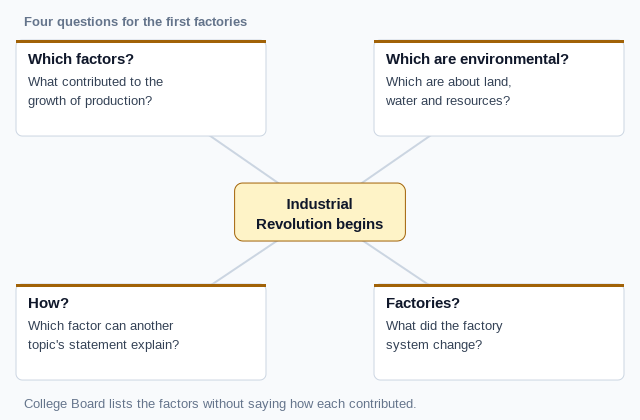
In short. A variety of factors, including waterways, the geographical distribution of coal, iron and timber, urbanization, improved agricultural productivity, legal protection of private property, access to foreign resources and accumulation of capital, contributed to the growth of industrial production that eventually resulted in the Industrial Revolution.
- The list is introduced with including, so it gives examples of the factors, not every one.
- Waterways and the geographical distribution of coal, iron and timber are the factors most plainly about land, water and resources; College Board itself does not sort the list.
- The factory system concentrated production in a single location and led to an increasing degree of specialization of labor.
Part 2 Learn it Why industry grew where it did
2a. A variety of factors
This topic does not give one cause. It says a variety of factors contributed to the growth of industrial production and eventually resulted in the Industrial Revolution, including:
- proximity to waterways; access to rivers and canals
- geographical distribution of coal, iron and timber
- urbanization
- improved agricultural productivity
- legal protection of private property
- access to foreign resources
- accumulation of capital
Read the chain in the sentence. The factors contributed to growth of industrial production, and that growth eventually resulted in the Industrial Revolution. Eventually means after some time, so the revolution is the end of a process, not the first step.
And the list opens with including, which marks examples rather than a closed set.
Quick check · Select all
Which two describe how this topic links its factors to the Industrial Revolution? Pick two.
Select 2 answers, then check.
2b. Which factors are environmental?
The objective asks about environmental factors, but the list comes unsorted. The statement never labels a factor environmental, so any sorting is your reading, and you should say why.
Two are plainly about land, water and resources: proximity to waterways and access to rivers and canals, and the geographical distribution of coal, iron and timber. Each depends on where things lie on the map.
Two are plainly not: legal protection of private property is about law, and accumulation of capital is about wealth.
The other three sit between. Urbanization, improved agricultural productivity and access to foreign resources involve people as well as land. The theme for this topic says the environment shapes societies and that growing populations in turn shape their environments, so an answer can use them, as long as it says how they bear on the environment.
Quick check · Select all
Which two factors in this topic's list could best support an argument about how environmental factors contributed to industrialization? Pick two.
Select 2 answers, then check.
2c. The factory system
A second statement turns from where industry grew to how its work was organized. The development of the factory system concentrated production in a single location and led to an increasing degree of specialization of labor.
Two changes, then:
- Where goods were made: production was concentrated, brought together in one place.
- How the work was divided: labor became more and more specialized, each worker doing a narrower part of it.
The statement says nothing about what the factory system replaced, and it does not put the factory system on the list of factors in the first chunk. It is a development of its own.
Quick check · Multiple choice
According to this topic, what did the development of the factory system do to where production happened?
Part 3 Watch it done Explain how an environmental factor contributed
Watch the first steps, then take the last one yourself.
The prompt: "Explain how environmental factors contributed to industrialization from 1750 to 1900."
A student's notes hold the list of factors from this lesson and one line from 5.5 Technology of the Industrial Age: machines, including steam engines, made it possible to take advantage of energy stored in fossil fuels, specifically coal.
Build one explaining sentence from the notes.
Predict first
Before the steps: will the list of factors on its own give the student a full explanation?
Step 1 · Pick the environmental factors
From the list, the two most plainly about land, water and resources are proximity to waterways and access to rivers and canals, and the geographical distribution of coal, iron and timber.
Step 2 · Find a link in another statement
The list says only that these factors contributed. For coal, a statement from 5.5 Technology of the Industrial Age gives something to join to it: steam engines drew on the energy stored in coal. Joining the two is the writer's own reasoning, which an essay may make: where coal was found mattered to industrial production, because the machines ran on it. Neither statement says that on its own. For waterways no statement gives a how, so an answer says only that they contributed.
Why this step?
Why not stop at "the distribution of coal contributed to industrial production"?
That repeats the list's own link without saying how. Joining the list to the steam engine line gives a how. The joining is the writer's reasoning, but each half rests on a statement, so the answer adds no fact of its own.
Your step · Decide and justify
Finish it. The student writes: "Industrial production grew where coal was found, because machines such as the steam engine drew on the energy stored in coal." Does the sentence explain how an environmental factor contributed to industrialization?
Why?
Part 4 Try it An imagined region
Six descriptions of an imagined region, written for this page. Each one shows a factor from this topic's list in a new setting.
Try it · Match
Match each description of the region to the factor it shows.
Part 5 Explain it Environmental factors, in writing
This is a self-check. Nothing you type leaves this page. Compare your answer with the model and each scoring point.
Free-response practice · Question 2 style
A short practice in the shape of the long essay question: a thesis, one sentence of context and one paragraph of evidence instead of a full essay.
Explain how environmental factors contributed to industrialization in the period from 1750 to 1900.
Model answer
Thesis: Environmental factors, especially access to rivers and canals and the geographical distribution of coal, iron and timber, contributed to the growth of industrial production, and that growth eventually resulted in the Industrial Revolution.
Context: Industrial growth took place in a world that transoceanic voyaging had already connected. The interconnection of the Eastern and Western Hemispheres had transformed trade, and European states had established new maritime empires, so access to foreign resources, one of the listed factors, reached beyond a region's own land and water.
Industrial production grew from a variety of factors, and some of them were about land, water and resources: proximity to waterways and access to rivers and canals, and the geographical distribution of coal, iron and timber. Coal mattered because machines, including steam engines, made it possible to take advantage of the energy stored in it, so places near coal could run those machines. Other factors contributed alongside these, including urbanization and improved agricultural productivity, which involve people as well as land. Together these factors fed the growth of industrial production, which eventually resulted in the Industrial Revolution.
Score your own answer. This is a self-check, not a grade. Tick each point your answer makes.
Part 6 Check yourself One town, before and after
Use the table for the first two questions. The last two cover the whole lesson.
An imagined cloth-making town, written for this page. It is not a real place. The table compares how its cloth was made before and after a factory opened.
| Question | Before the factory | After the factory |
|---|---|---|
| Where is the cloth made? | In many homes and small workshops across the district | In one large building |
| Who does which step? | One worker carries a piece of cloth through most of its steps | Each worker repeats one narrow task on every piece |
Case question 1 · Fill the statement
Complete a student's explanation of the table.
In the factory system, production is concentrated in a single location, which the table shows as , and labor grows more specialized, which it shows as .
Case question 2 · Spot the error
Another student wrote this paragraph about the table. Which line is the first to go wrong?
The rest stand on their own and do not use the case.
Check yourself · Multiple choice
A student explains: "Before factories, goods could be made in many places. The factory system brought production into one place." What does this topic's statement add that the explanation leaves out?
Check yourself · Select all
A student writes: "Industrial production grew for one reason: the coal in the ground." Which two parts of this topic's list show that the explanation is incomplete? Pick two.
Select 2 answers, then check.
Part 7 Keep it Bring back earlier ideas
One question from the lesson on revolutions and nationalism and one from the review of Unit 4, so both come round again.
From 5.2 Nationalism and Revolutions in the Period from 1750 to 1900 · Multiple choice
According to this topic, what encouraged the development of systems of government and ideologies such as democracy and 19th-century liberalism?
From 4.8 Continuity and Change from 1450 to 1750 · Multiple choice
Which of these shows an economic development leading to a change in social structure, as this unit's statements give it?
In three lines
- A variety of factors, including waterways and the geographical distribution of coal, iron and timber, contributed to industrial growth that eventually resulted in the Industrial Revolution.
- College Board does not sort the factors, so an environmental answer says why each factor it uses bears on land, water or resources.
- The factory system concentrated production in a single location and increased the specialization of labor.
Exam strategy for this topic
- Section I Part A, Multiple Choice: 55 questions in 55 minutes.
- Section I Part B, Short Answer: 3 questions in 40 minutes.
- Section II, Document-Based Question and Long Essay: 2 questions in 100 minutes.
- This lesson's Explain it is shaped like free-response question 2, Long essay.
When a prompt asks how a factor contributed, name the factor, name the outcome, and state the link in the same sentence. Where another topic supplies the link, such as steam engines and coal, use it, and where none is given, say only that the factor contributed.
Questions students ask
Which of the factors are environmental?
College Board does not say. Waterways and the geographical distribution of coal, iron and timber are the most plainly about land, water and resources; law and capital are not. Urbanization, agricultural productivity and foreign resources involve both people and land, so say why if you use them.
Where did industrial production first become common?
5.4 Industrialization Spreads in the Period from 1750 to 1900 says new methods of industrial production became more common in parts of northwestern Europe and then spread. This topic's statements do not name a place.
Does College Board say how waterways helped industry?
No. It lists proximity to waterways and access to rivers and canals as a factor that contributed, and gives no how. An answer can say they contributed without inventing a mechanism.
What did the factory system replace?
College Board does not say. Its statement gives what the factory system did: it concentrated production in a single location and led to an increasing degree of specialization of labor.
Is the steam engine part of this topic?
It is taught in 5.5 Technology of the Industrial Age, where machines including steam engines made it possible to use the energy stored in coal and oil. That link is what lets an answer here explain why the location of coal mattered.
Course alignment, for teachers
AP World History: Modern topic 5.3, Unit 5: Revolutions.
- Skill 1.B: Explain a historical concept, development, or process.
This lesson maps all 2 essential knowledge statements of the topic, and the one learning objective with none of its own, to the part that teaches each one: 3 are checked by a scored question. The map is in the lesson file.