Unit 4 · Topic 4.2 · about 30 minutes · 7 parts · 9 scored checks, 2 of them multiple choice, plus 2 from earlier lessons
AP World History: Modern 4.2: Exploration: Causes and Events from 1450 to 1750
Unit 4: 12 to 15% of the multiple-choice section
What you'll be able to do
- Describe the role states played in the growth of ocean exploration from 1450 to 1750.
- Explain the economic causes and effects of ocean exploration by the European states.
Key vocabulary
| Term | What it means | The exam trap |
|---|---|---|
| Sponsorship | Backing a venture, such as a voyage, with support or money. | The sponsor and the crew are not the same party. Read who backed a voyage and who sailed it. |
| Maritime | Having to do with the sea and sea travel. | Maritime describes the sea. A choice about overland routes is not maritime, however far it reaches. |
| Trading post | A place set up on a coast or route for trade. | A post is a place for trade, not a whole colony. Read how much land or rule a choice claims. |
| Navigational skills | The knowledge and ability to plan and follow a course at sea. | Skills belong to people and technology to tools. A statement may name both, and a choice may keep only one. |
| Subsequent | Coming after something else. | Subsequent sets an order in time, not a cause. Read whether a choice adds a cause the sentence does not give. |
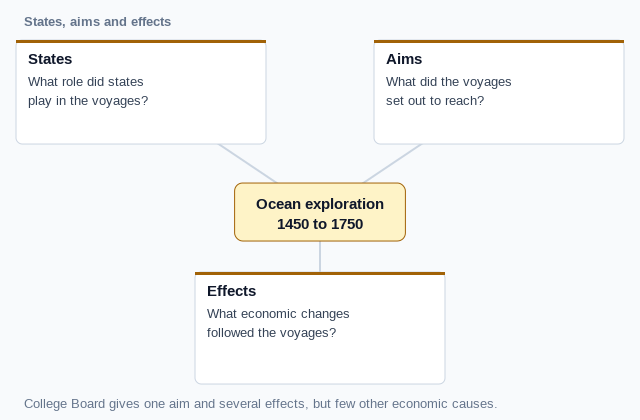 Tap to open the picture full size
Part 1 Think first Who pays for the voyage?
Commit to a guess before you read. A wrong guess now still helps the right idea stick.
Predict first
A captain has a ship that can cross an ocean, but a long voyage to unknown coasts costs far more than one merchant can risk. Who do you expect would back it?
In short. From 1450 to 1750, European states supported voyages across the oceans, and those voyages increased European travel, trade and interest in trade far beyond Europe.
- New state-supported transoceanic maritime exploration occurred in this period.
- Portuguese maritime technology and navigational skills led to increased travel to and trade with Africa and Asia and resulted in a global trading-post empire; Spanish-sponsored voyages dramatically increased European interest in transoceanic travel and trade.
- English, French and Dutch sponsorship carried Northern Atlantic crossings, often with the goal of finding alternative sailing routes to Asia.
Part 2 Learn it States and the voyages
4.2a. Exploration with a state behind it
College Board frames this topic in one sentence: new state-supported transoceanic maritime exploration occurred in this period. Read the three adjectives in order. The exploration was state-supported, it crossed oceans, and it went by sea.
The first case is Portugal. Portuguese development of maritime technology and navigational skills led to increased travel to and trade with Africa and Asia and resulted in the construction of a global trading-post empire.
That sentence has a cause and two results. The cause is a development, maritime technology and navigational skills. The results are economic: more travel and trade with Africa and Asia, and a trading-post empire that reached around the world. Keep led to and resulted in apart from a goal. A result is what happened; a goal is what someone set out to do.
Notice what the Portuguese sentence does not say. It names development, not sponsorship, so the role of the Portuguese state comes from the framing sentence, not from this one.
Quick check · Select all
Which two does this topic give as results of Portuguese maritime development, rather than goals? Pick two.
Select 2 answers, then check.
4.2b. Spain, and crossings to the north
Spain is the second case. Spanish sponsorship of the voyages of Columbus and subsequent voyages across the Atlantic and Pacific dramatically increased European interest in transoceanic travel and trade. Here the state's role is in the sentence itself: sponsorship. Subsequent means the voyages that came after Columbus's, and they crossed two oceans. The effect is on interest, and dramatically says how much.
The third case covers three states. Northern Atlantic crossings were undertaken under English, French, and Dutch sponsorship, often with the goal of finding alternative sailing routes to Asia.
This sentence gives a goal, not a result. Often matters: many of these crossings had that goal, not necessarily every one. And College Board does not say whether the crossings found such a route, so a careful answer does not say so either.
So the role College Board gives states is support and sponsorship, and its three cases name Portugal, Spain, England, France and the Dutch.
Quick check · Multiple choice
According to this topic, what did Spanish sponsorship of the voyages of Columbus and later voyages across the Atlantic and Pacific bring about?
4.2c. Causes, effects and connections
The second learning objective asks for economic causes and effects. The effects are clear in this topic: increased travel and trade with Africa and Asia, a global trading-post empire and a dramatic rise in European interest in ocean trade. Its only cause of that kind is a goal, finding other sailing routes to Asia, and College Board does not say why that route was wanted.
A later topic adds a cause. In 4.5 Maritime Empires Maintained and Developed, joint-stock companies were used by rulers and merchants to finance exploration. That is a connection between two developments: one was a way of paying for the other.
This topic's skill is making that kind of connection: explaining how one development relates to another. Name both, then name the relationship. Joint-stock companies financed exploration. Portuguese navigational skills led to more trade. A goal is what a voyage set out to find. Each verb is a different relationship, and a connection is only as strong as the link the evidence gives.
Quick check · Multiple choice
How does Topic 4.1 relate to the Portuguese voyages in this topic?
Part 3 Watch it done From Asian technology to European voyages
Watch the first steps, then take the last one yourself. This is one of College Board's sample activities: a web of causal connections between technology in Asia and European exploration.
Explain how technological developments in Asia from earlier units relate to European maritime exploration in the period c. 1450 to c. 1750.
Step 1 · Start from what earlier units give
In 2.3 Exchange in the Indian Ocean, before 1450, interregional contacts and conflicts encouraged significant technological and cultural transfers, including during Chinese maritime activity led by Ming Admiral Zheng He. That is technology moving through contact in Asia.
Step 2 · Find the link College Board states
In 4.1 Technological Innovations from 1450 to 1750, knowledge, scientific learning and technology from the Classical, Islamic and Asian worlds spread, facilitating European technological developments. Those developments made transoceanic travel and trade possible, and the voyages of this topic are that travel.
Why this step?
Why not draw an arrow straight from Zheng He's voyages to the Portuguese voyages?
College Board never links the two. The link it does give runs through the spread of knowledge in 4.1 Technological Innovations from 1450 to 1750, so the web should run through it too.
Your step · Decide and justify
Finish it. Which sentence states the connection College Board supports?
What makes your sentence a connection?
Part 4 Try it Goal or effect?
Six short scenes, written for this page from College Board's statements. Each shows something that relates to the ocean voyages of this period. Decide whether the scene shows what a voyage set out to do, or what voyages led to.
Try it · Sort it
Sort each scene by how it relates to the voyages.
A goal the voyage set out to reach
An effect the voyages led to
Part 5 Explain it What the voyages led to
This is a self-check. Nothing you type leaves this page. Compare your answer with the model and each scoring point.
Free-response practice · Question 2 style
This is a partial long essay. Write a thesis, one sentence of context and one paragraph of evidence, not a full essay.
In the period c. 1450 to c. 1750, several European states supported voyages across the oceans.
Explain the economic effects of maritime exploration by European states in the period c. 1450 to c. 1750.
Model answer
Thesis: Maritime exploration by European states expanded European trade, as Portuguese voyages increased trade with Africa and Asia and built a global trading-post empire, and Spanish-sponsored voyages dramatically increased European interest in transoceanic trade.
Context: These voyages were possible because knowledge from the Classical, Islamic and Asian worlds had spread and facilitated European developments in tools, ships and the understanding of winds and currents, which made transoceanic travel and trade possible.
Portuguese development of maritime technology and navigational skills led to increased travel to and trade with Africa and Asia, and it resulted in the construction of a global trading-post empire. Spanish sponsorship of the voyages of Columbus and of subsequent voyages across the Atlantic and Pacific dramatically increased European interest in transoceanic travel and trade. The English, French and Dutch sponsored Northern Atlantic crossings as well, often with the goal of finding alternative sailing routes to Asia, but that is a goal rather than an effect. The effects themselves were economic: more trade, an empire built on trading posts and more interest in trading across oceans.
Score your own answer. This is a self-check, not a grade. Tick each point your answer makes.
Part 6 Check yourself Three cases side by side
The table drives the first two questions. The last two come from the rest of the lesson.
A student set out the topic's three cases of exploration. The table was written for this lesson from College Board's statements.
| State or states | What College Board says they did | What it led to, or aimed at |
|---|---|---|
| Portugal | Developed maritime technology and navigational skills | Led to increased travel to and trade with Africa and Asia; resulted in a global trading-post empire |
| Spain | Sponsored the voyages of Columbus and subsequent voyages across the Atlantic and Pacific | Dramatically increased European interest in transoceanic travel and trade |
| England, France and the Dutch | Sponsored Northern Atlantic crossings | Aimed at, often: alternative sailing routes to Asia |
Case question 1 · Spot the error
A student summarized the table in five lines. Which line is the first to claim something the table does not support?
Case question 2 · Match
Each scene was written for this question, and none names a state. Match it to the part a state, or a company, played in it.
The rest stand on their own and do not use the case.
Check yourself · Select all
Which three of these match a state with what this topic says it did? Pick three.
Select 3 answers, then check.
Check yourself · Select all
This topic says Northern Atlantic crossings were undertaken under English, French, and Dutch sponsorship, often with the goal of finding alternative sailing routes to Asia. Which two statements does that sentence support? Pick two.
Select 2 answers, then check.
Part 7 Keep it Bring back earlier ideas
One question from the technology lesson just before this one, and one from the belief systems lesson in Unit 3.
From 4.1 Technological Innovations from 1450 to 1750 · Select all
This topic's second statement ends "all of which made transoceanic travel and trade possible." Which three developments does that phrase refer to? Pick three.
Select 3 answers, then check.
From 3.3 Empires: Belief Systems · Multiple choice
In one of College Board's sample activities, students read an excerpt from Martin Luther's 95 Theses after a lesson on the Protestant Reformation. Which development from the course best describes the historical situation of that source?
In three lines
- New state-supported transoceanic maritime exploration occurred in this period.
- Portuguese maritime development led to more trade with Africa and Asia and a global trading-post empire; Spanish-sponsored voyages dramatically increased European interest in ocean trade.
- English, French and Dutch sponsorship carried Northern Atlantic crossings, often aimed at alternative sailing routes to Asia.
Exam strategy for this topic
- Section I Part A, Multiple Choice: 55 questions in 55 minutes.
- Section I Part B, Short Answer: 3 questions in 40 minutes.
- Section II, Document-Based Question and Long Essay: 2 questions in 100 minutes.
- This lesson's Explain it is shaped like free-response question 2, Long essay.
When a prompt asks for effects, sort your evidence before you write. A goal, such as a route a voyage set out to find, is not an effect unless the evidence says it was reached.
Questions students ask
Did the Portuguese state sponsor its voyages?
College Board calls this period's exploration state-supported, but its Portuguese statement names the development of maritime technology and navigational skills and does not use the word sponsorship.
Did the Northern Atlantic crossings reach Asia?
College Board does not say. It gives finding alternative sailing routes to Asia as a goal the crossings often had.
Why did states want another sailing route to Asia?
College Board does not give the reason in this topic. It names the goal and stops, so an answer should not add a motive it does not state.
Who else paid for exploration besides states?
In 4.5 Maritime Empires Maintained and Developed, joint-stock companies were used by rulers and merchants to finance exploration, so merchants had a part too.
What does "global trading-post empire" mean here?
An empire built on trading posts that reached around the world. College Board gives it as a result of Portuguese maritime development, alongside increased travel to and trade with Africa and Asia.
Course alignment, for teachers
AP World History: Modern topic 4.2, Unit 4: Transoceanic Interconnections.
- Skill 5.B: Explain how a historical development or process relates to another historical development or process.
This lesson maps all 4 essential knowledge statements of the topic, and the 2 learning objectives with none of their own, to the part that teaches each one: 6 are checked by a scored question. The map is in the lesson file.