Unit 8 · Topic 8.4 · about 35 minutes · 7 parts · 10 scored checks, 3 of them multiple choice, plus 2 from earlier lessons
AP World History: Modern 8.4: Spread of Communism After 1900
Unit 8: 8 to 10% of the multiple-choice section
What you'll be able to do
- Explain the causes and consequences of China's adoption of communism.
- Explain the causes and effects of movements to redistribute economic resources.
Key vocabulary
| Term | What it means | The exam trap |
|---|---|---|
| Internal tension | Conflict inside a country, as opposed to pressure from outside it. | Internal tension is pressure from inside. Read whether a source describes trouble from inside the country or from outside it. |
| Great Leap Forward | In this topic, the means by which the government of communist China controlled the national economy. | Check when a policy began before you link it to an event. A cause cannot come after what it explains. |
| Repercussion | A result that follows from an action, often one that was not wanted. | Repercussions can be good or bad and can fall on different people. Read both what kind the statement names and on whom. |
| Redistribution | Sharing land or resources out again in a different way. | Redistribution names the movements' aim, not their politics. Keep the aim and the politics apart when a choice joins them. |
| Limit of a source | Something a source cannot show because of who made it, why, when or for whom. | A limit comes from who made a source, why, when or for whom. Name which of these you mean when you state one. |
 Tap to open the picture full size
Part 1 Think first Who gets the land?
Make a guess before you read. A wrong guess still helps the right idea stick.
Predict first
A movement in one country calls for its land and resources to be shared out differently. Would you expect movements like it in one part of the world, or in several?
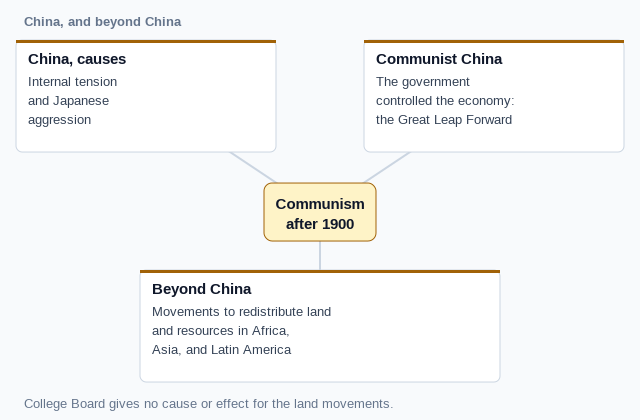
In short. Communism spread after 1900 to China, where internal tension and Japanese aggression brought the communists to power, and movements in other states sought to redistribute land and resources.
- As a result of internal tension and Japanese aggression, Chinese communists seized power, and these changes eventually led to communist revolution.
- In communist China, the government controlled the national economy through the Great Leap Forward, often implementing repressive policies, with negative repercussions for the population.
- Movements to redistribute land and resources developed within states in Africa, Asia, and Latin America, sometimes advocating communism or socialism.
Part 2 Learn it Communism in China and beyond
8.4a. Two causes of the seizure of power
The first objective asks for the causes and consequences of China's adoption of communism, and causation is this topic's reasoning process. The causes are stated as causes:
As a result of internal tension and Japanese aggression, Chinese communists seized power. These changes in China eventually led to communist revolution.
As a result of names two causes. One came from inside China, internal tension, and one from outside it, Japanese aggression. A sentence that gives only one has dropped half the statement.
The second sentence carries the story on. These changes, the seizure of power and what brought it about, eventually led to communist revolution. Eventually says the revolution came after them, not at the same moment.
Quick check · Multiple choice
According to this topic, Chinese communists seized power as a result of what?
8.4b. The Great Leap Forward
The second statement describes what the government of communist China did:
In communist China, the government controlled the national economy through the Great Leap Forward, often implementing repressive policies, with negative repercussions for the population.
Three things are in it. The government controlled the national economy; the Great Leap Forward was the means. It often implemented repressive policies. And those policies had negative repercussions, harmful results, for the population.
The statement does not use the word consequence. It describes what the government did once China was communist, so it is the evidence this topic gives for the consequences half of the objective. Keep often, and keep who bore the harm: the population.
Quick check · Multiple choice
According to this topic, what were the policies of communist China's government under the Great Leap Forward like, and what did they mean for the people?
8.4c. Movements to redistribute land and resources
The second objective looks beyond China:
Movements to redistribute land and resources developed within states in Africa, Asia, and Latin America, sometimes advocating communism or socialism.
Within states places the movements inside countries, in three regions. Sometimes is the word to protect: some of these movements advocated communism or socialism, and the statement does not say all of them did.
The objective asks for causes and effects, but the statement gives neither, so this lesson does not invent any. Your class may bring evidence for both. College Board's examples are the Communist Revolution for Vietnamese independence, Mengistu Haile Mariam in Ethiopia, land reform in Kerala and other states within India, and the White Revolution in Iran.
Quick check · Select all
Which two does this topic say about movements to redistribute land and resources? Pick two.
Select 2 answers, then check.
8.4d. What a source cannot show
This topic's skill asks you to explain why a source's point of view, purpose, historical situation or audience matters, including how these might limit the use(s) of a source. Two questions do the work: How could a historian use this source? What does it not tell you?
A limit follows from one of the four. A source written before an event cannot show how it turned out. A report written to please the people who set a target has reason to leave out failure. One person's account shows one place, not a whole population.
A limit is not the same as uselessness. A boastful report is still good evidence of what its author chose to say. Name the use, name the limit, and say which of the four the limit comes from.
Quick check · Multiple choice
A report written for this page (it is not a real source) is sent by a local official in communist China to the government during the Great Leap Forward: "Our district has met every target set for it, and the people work with joy." Which choice best explains how the report's purpose limits its use as a source?
Part 3 Watch it done A letter from a village
Watch the first steps, then take the last one yourself.
A letter written for this page (it is not a real source), sent by a farmer in communist China to a cousin during the Great Leap Forward: "We are told to work harder every month, and life in our village grows harder too."
Explain the significance of the letter's point of view, including how it limits the letter's use.
Predict first
Before the steps: what is the letter best evidence of?
Step 1 · Read the point of view
One farmer, writing privately to family. Not an official, not a reporter, and writing about one village.
Step 2 · Place it in its situation
The Great Leap Forward, when the government of communist China controlled the national economy. The letter's harder work and harder life fit what this topic says the policies brought.
Step 3 · Name a use
A historian could use it as evidence of how one farming family experienced the government's policies.
Why this step?
Why does the limit come from the point of view and not from the letter being private?
Writing privately may make the farmer more open, but it does not widen what he could see. One farmer writes about one village, so the point of view sets how far the evidence reaches.
Your step · Decide and justify
Finish it. Which sentence explains how the letter's point of view limits its use?
What makes that sentence explain the limit?
Part 4 Try it Sorting what a newspaper can show
A newspaper column written for this page (it is not a real source), printed by the Chinese communists just after they seized power, for readers in China:
> The people, worn out by quarrels at home and by the invaders' war, have turned to the Communist Party. The old rulers fought each other while the enemy burned our villages. We alone fought for the people, and the people have chosen us.
Sort each question by whether the column can answer it.
Try it · Sort it
Sort each question a historian might ask of the column.
The column can show this
The column cannot show this
Part 5 Explain it China's road to communism
This is a self-check. Nothing you type leaves this page. Set your answer beside the model and each scoring point.
Free-response practice · Question 1 style
A short practice in the shape of the document-based question: a thesis, one sentence of context and one paragraph that uses both documents and explains how the point of view or purpose of one limits its use, instead of a full essay. Both documents are written for this page and are not real.
Document 1: a pamphlet handed out by Chinese communists during the war with Japan: "The invaders burn our villages while the old government quarrels with itself. Only the party fights for the people."
Document 2: the farmer's letter from Watch it done, written during the Great Leap Forward.
Using both documents, explain the causes and consequences of China's adoption of communism.
Model answer
Thesis: Internal tension and Japanese aggression opened the way for the Chinese communists to seize power, and once China was communist, the government's control of the economy through the Great Leap Forward brought often repressive policies that harmed the population.
Context: Between the two world wars, Western and Japanese imperial states predominantly held on to their colonies and in some cases gained more territory by conquest, so the invasion Document 1 describes was part of a wider imperial expansion.
Document 1 shows both causes at once: "the invaders burn our villages" is Japanese aggression, and "the old government quarrels with itself" is internal tension. Its purpose limits it, though. A pamphlet written to win support for the party says that "only the party fights," so it cannot show on its own how the communists' rivals behaved. Document 2 shows a consequence. Under the Great Leap Forward, a farmer is "told to work harder every month" while "life in our village grows harder," which fits the negative repercussions for the population. As one farmer's letter, it speaks for one village.
Score your own answer. This is a self-check, not a grade. Tick each point your answer makes.
Part 6 Check yourself Three voices on the land
The table drives the first two questions. The last two come from the rest of the lesson.
Three short sources about movements to redistribute land. All three were written for this lesson and are not real.
| Row | Who, to whom | Its words |
|---|---|---|
| 1 | The leader of a land movement in a state in Asia, to a rally of tenant farmers | "The landlords' fields will be yours when we govern. Our party follows the teachings of socialism." |
| 2 | A newspaper owned by large landowners in a state in Latin America, to its readers | "The so-called reformers will ruin the harvests and drive the country into hunger." |
| 3 | A government official in a state in Africa, in a report to the minister who ordered the reform | "Land in the eastern province has been divided as ordered. The farmers report themselves satisfied." |
Case question 1 · Match
Match each row to the limit that its point of view, purpose or audience puts on it.
Case question 2 · Spot the error
A student wrote a paragraph using the table. Which line misreads it?
The rest stand on their own and do not use the case.
Check yourself · Select all
Which two does this topic say about China? Pick two.
Select 2 answers, then check.
Check yourself · Select all
A pamphlet written for this page (it is not a real source) is handed out by a movement to redistribute land: "The land belongs to those who work it. Join us, and the great estates will be divided among you." Given its purpose and audience, which two are uses a historian could make of the pamphlet? Pick two.
Select 2 answers, then check.
Part 7 Keep it Bring back earlier ideas
One question from the lesson just before this one, and one from the start of the unit three lessons back.
A newspaper column written for this page (it is not a real source), from a capital in Africa, 1966:
> This week's news is a map of the great powers' quarrel. In the hills to our north, rebels fight our neighbor's government with rifles one great power sends them, while the other great power arms the government. On the coast, two neighboring states that were colonies ten years ago trade shots across their border, each army trained by a different great power. And over the radio comes word that one more state has tested a nuclear bomb.
A class was asked to relate the column's news to the developments of this unit. Five students each wrote one sentence.
From 8.3 Effects of the Cold War · Sort it
Sort each student sentence by whether it explains how one development relates to another or only sets facts side by side.
Relates one development to another
Only sets facts side by side
From 8.1 Setting the Stage for the Cold War and Decolonization · Select all
This topic's statement on self-government describes a change over time. Which two choices give the two sides of that change? Pick two.
Select 2 answers, then check.
In three lines
- As a result of internal tension and Japanese aggression, Chinese communists seized power.
- In communist China, the government controlled the national economy through the Great Leap Forward, with negative repercussions for the population.
- Movements to redistribute land and resources developed within states in Africa, Asia, and Latin America, sometimes advocating communism or socialism.
Exam strategy for this topic
- Section I Part A, Multiple Choice: 55 questions in 55 minutes.
- Section I Part B, Short Answer: 3 questions in 40 minutes.
- Section II, Document-Based Question and Long Essay: 2 questions in 100 minutes.
- This lesson's Explain it is shaped like free-response question 1, Document-based.
When the prompt asks how a source's point of view or purpose limits it, name one thing the source can show, then one thing it cannot, and tie that limit to who wrote it, why, when or for whom.
Questions students ask
What caused the Chinese communists to seize power?
The statement gives two causes: internal tension, from inside China, and Japanese aggression, from outside it. It adds that these changes eventually led to communist revolution.
Was the Great Leap Forward a cause or a consequence?
It came after the communists held power: the statement places it in communist China, as the means by which the government controlled the national economy. The statement does not use the word consequence, but it describes what followed.
Did every land movement advocate communism?
No. The statement says the movements were sometimes advocating communism or socialism. Keep sometimes.
What caused the movements to redistribute land, and what did they achieve?
The statement does not say. It gives where they developed, within states in Africa, Asia, and Latin America, and what some advocated. College Board's examples include land reform in Kerala and the White Revolution in Iran; causes and effects need evidence from your class.
How is this skill different from the one in 8.2?
8.2 The Cold War asks you to explain a source's point of view, purpose, situation or audience. This topic adds why it matters, including how it limits what the source can be used to show.
Course alignment, for teachers
AP World History: Modern topic 8.4, Unit 8: Cold War and Decolonization.
- Skill 2.C: Explain the significance of a source’s point of view, purpose, historical situation, and/or audience, including how these might limit the use(s) of a source.
This lesson maps all 3 essential knowledge statements of the topic, and the 2 learning objectives with none of their own, to the part that teaches each one: 5 are checked by a scored question. The map is in the lesson file.