Unit 7 · Topic 7.2 · about 30 minutes · 7 parts · 9 scored checks, 2 of them multiple choice, plus 2 from earlier lessons
AP World History: Modern 7.2: Causes of World War I
Unit 7: 8 to 10% of the multiple-choice section
What you'll be able to do
- Explain what caused World War I and what followed from it.
Key vocabulary
| Term | What it means | The exam trap |
|---|---|---|
| Imperialist expansion | States enlarging their empires by taking control of more lands and peoples. | It names empires growing over time, not one battle between empires, so do not read it as a single event. |
| Competition for resources | Rivalry among states for raw materials and other goods they want. | Resources here are goods states want, not the soldiers or money of an army, so do not read it as an arms race. |
| Alliance system | A web of agreements by which states promise to support one another, especially in war. | The adjective in front of it describes how the system worked, so an answer that drops the adjective changes the claim. |
| Nationalism | Strong loyalty to one's own nation and its people. | Nationalism shaped revolutions and new states in earlier units too, so check which period and which war a stem is about. |
| Escalate | To grow in size or force, as when a quarrel grows into a war. | Escalating tensions is not the same as creating them, so do not read escalate as begin. |
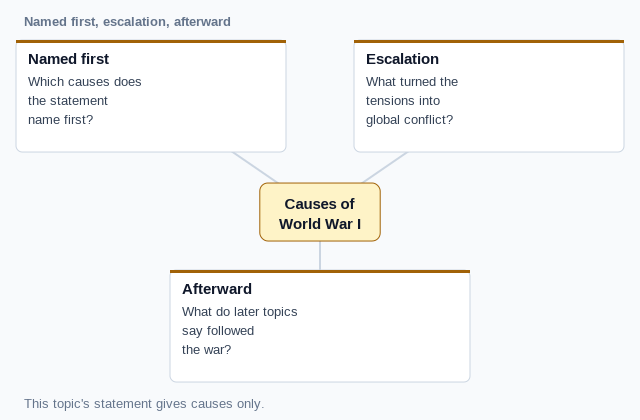 Tap to open the picture full size
Part 1 Think first A quarrel over one valley
Commit to a guess before you read. A wrong guess now still helps the right idea stick.
Predict first
Two kingdoms quarrel over a border valley. Each has signed treaties promising to fight beside its friends, and crowds in both capitals are calling for war. One morning soldiers exchange shots in the valley. What do you expect to happen next?
In short. The causes of World War I included imperialist expansion and competition for resources, and territorial and regional conflicts combined with a flawed alliance system and intense nationalism to escalate the tensions into global conflict.
- The statement has two sentences: causes named first, then three factors that combined to escalate the tensions.
- Keep the adjectives: the alliance system is flawed and the nationalism is intense.
- This topic's statement gives causes only. What followed the war comes from later topics, and calling it a consequence is a claim the writer makes.
Part 2 Learn it Two sentences, two kinds of cause
2a. The causes named first
The statement opens: the causes of World War I included imperialist expansion and competition for resources.
Imperialist expansion is states enlarging their empires. Competition for resources is rivalry among states for the goods they want.
The verb is included, so the list is open. Two causes are named here, and more follow in the next sentence, but the statement does not claim to have named every cause there was.
The statement says these were causes. It does not say how each one worked, so an answer that explains imperialist expansion or competition for resources has to bring its link from somewhere else, and say where.
Quick check · Select all
Which two does this topic name as causes of World War I, apart from the factors it says combined to escalate the tensions? Pick two.
Select 2 answers, then check.
2b. From tension to global conflict
The second sentence begins In addition and names three more factors: territorial and regional conflicts, a flawed alliance system and intense nationalism.
This time the statement also says what they did. They combined to escalate the tensions into global conflict. Escalate means to grow in size or force. So the three worked together, and what they did was turn tensions that already existed into a war across the world.
Two adjectives carry weight. The alliance system was flawed, and the nationalism was intense. An answer that writes only "alliances" or "nationalism" has quietly changed the claim.
And combined means no one of the three is given the work alone.
Quick check · Select all
Besides intense nationalism, which two does this topic name among the factors that combined to escalate the tensions into global conflict? Pick two.
Select 2 answers, then check.
2c. What followed, from later topics
The objective asks about consequences too, but this topic's statement gives only causes. Later topics say what came after the war:
- 7.4 Economy in the Interwar Period: following World War I and the onset of the Great Depression, governments began to take a more active role in economic life.
- 7.5 Unresolved Tensions After World War I: between the two world wars, Western and Japanese imperial states predominantly maintained control over colonial holdings, in some cases gaining territories through conquest or treaty settlement.
- 7.6 Causes of World War II: the causes of World War II included the unsustainable peace settlement after World War I.
- Topic 8.1: hopes for greater self-government were largely unfulfilled following World War I.
None of these is called a consequence of the war in so many words. Each comes after it. Calling one a consequence is a claim you make, so make it carefully and say which later development you mean.
Quick check · Select all
Which two statements from later topics in this unit describe what happened after World War I? Pick two.
Select 2 answers, then check.
Part 3 Watch it done Explain how one factor contributed
Watch the first steps, then take the last one yourself.
The prompt: "Explain how a flawed alliance system contributed to World War I."
A student has this lesson's statement as notes. Build the explanation in steps.
Step 1 · Find where the factor sits
The flawed alliance system is in the second sentence, one of the three factors that combined to escalate the tensions into global conflict.
Step 2 · Take the link the statement gives
For this factor the statement supplies a how: it worked with territorial and regional conflicts and intense nationalism, and together they turned existing tensions into a war across the world. The explanation can rest on that link and add nothing of its own.
Why this step?
Why not stop at "the flawed alliance system caused World War I"?
That only identifies a cause. Explaining needs the link, and the statement's link has two parts: the factor worked with others, and what they did was escalate tensions that already existed.
Your step · Decide and justify
Finish it. A second student writes: "Competition for resources turned a regional quarrel into a world war, because it dragged every state's friends into the fight." Does the explanation rest on this topic's statement?
Why?
Part 4 Try it An imagined crisis
An imagined crisis between two kingdoms, written for this page. It is not a real war. Each line of its story resembles one of this topic's causes.
Try it · Match
Match each line of the imagined crisis to the cause it most resembles.
Part 5 Explain it Causes of World War I, from documents
This is a self-check. Nothing you type leaves this page. Compare your answer with the model, line by line, and with each scoring point.
Free-response practice · Question 1 style
A short practice in the shape of the document-based question: a thesis, one sentence of context and one paragraph that uses both documents and explains the sourcing of one, instead of a full essay. Both documents are written for this page and describe the imagined crisis from Try it.
Document 1: a foreign minister's note to his king: "If we do not march when our ally marches, no state will trust our word again. We must keep the treaty, whatever the quarrel."
Document 2: a newspaper editorial in the other capital: "Our people have never bowed to theirs. Let every citizen be ready to defend the valley that is ours by right."
Using both documents and what you know from this topic, explain the causes of World War I.
Model answer
Thesis: World War I had several causes, including imperialist expansion and competition for resources, and its tensions escalated into global conflict because territorial and regional conflicts combined with a flawed alliance system and intense nationalism.
Context: Before the war, many European states used both warfare and diplomacy to expand their empires in Africa, and that expansion is part of the imperialist expansion the war's causes included.
The documents show how the escalating factors work together. Document 1 shows a flawed alliance system: the minister would go to war because an ally does, whatever the quarrel, so a small dispute can pull in states that have no part in it. His audience is his own king, and his purpose is to keep the kingdom's word, which is why he weighs trust and says nothing of whether the quarrel is just. Document 2 shows intense nationalism joined to a territorial conflict: the editorial sets one people against the other and calls the valley theirs by right. Neither document alone makes a wide war. Together they show tensions that already existed escalating as the factors combined. Competition for resources, which neither document shows, was also among the causes.
Score your own answer. This is a self-check, not a grade. Tick each point your answer makes.
Part 6 Check yourself After the war, in later topics
Use the table for the first two questions. The last two cover the whole lesson.
Each row gives a statement from a later topic, the 7.5 row shortened. Every one describes something after World War I. None of them calls itself a consequence of the war.
| Topic | What the statement says |
|---|---|
| 7.4 | Following World War I and the onset of the Great Depression, governments began to take a more active role in economic life. |
| 7.5 | Between the two world wars, Western and Japanese imperial states predominantly maintained control over colonial holdings; in some cases they gained additional territories. |
| 7.6 | The causes of World War II included the unsustainable peace settlement after World War I. |
| 8.1 | Hopes for greater self-government were largely unfulfilled following World War I. |
Case question 1 · Fill the statement
Complete a student's plan for an essay on what followed World War I.
To argue that the way the war ended helped bring on another war, I will use the row from Topic . To argue that empires did not shrink in the years after it, I will use the row from Topic .
Case question 2 · Spot the error
A student wrote this paragraph about the table. Which line is the first to go wrong?
The rest stand on their own and do not use the case.
Check yourself · Multiple choice
A short-answer question asks students to explain how one cause contributed to World War I. Which response explains, rather than only identifies, as College Board defines those verbs?
Check yourself · Multiple choice
Which of these does Topic 7.6's statement name among the causes of World War II?
Part 7 Keep it Bring back earlier ideas
One question from the last lesson and one from the lesson on migrants and receiving societies, so both come round again.
From 7.1 Shifting Power After 1900 · Select all
Which two describe the collapse of the Ottoman, Russian, and Qing empires as this topic describes it? Pick two.
Select 2 answers, then check.
From 6.7 Effects of Migration · Select all
A letter written for this page is from a woman in a village to her husband, who has migrated abroad for work: "Since you left, I run the farm and sell our crops at market myself." Which two statements best explain how the letter relates to developments in this topic? Pick two.
Select 2 answers, then check.
In three lines
- The causes of World War I included imperialist expansion and competition for resources.
- Territorial and regional conflicts combined with a flawed alliance system and intense nationalism to escalate the tensions into global conflict.
- What followed the war comes from later topics, and calling a later development a consequence is the writer's own claim.
Exam strategy for this topic
- Section I Part A, Multiple Choice: 55 questions in 55 minutes.
- Section I Part B, Short Answer: 3 questions in 40 minutes.
- Section II, Document-Based Question and Long Essay: 2 questions in 100 minutes.
- This lesson's Explain it is shaped like free-response question 1, Document-based.
When a prompt asks you to explain a cause, give the link as well as the cause. For the factors that combined to escalate the tensions the statement supplies that link; for imperialist expansion and competition for resources it does not, so say where your link comes from.
Questions students ask
Does College Board rank the causes of World War I?
No. The statement lists them in two sentences and ranks none. Weighing which mattered most is the argument Topic 7.9 asks you to make.
Why does the statement say flawed alliance system and not just alliances?
The adjective is part of the claim. It is the alliance system's flaws, working with other factors, that the statement says escalated the tensions.
Does this topic give the consequences of World War I?
No. Its statement gives causes only. Later topics, such as 7.4 Economy in the Interwar Period, 7.5 Unresolved Tensions After World War I and 7.6 Causes of World War II, describe what came after the war, and calling one a consequence is your own claim.
Is the list of causes complete?
The statement says the causes included imperialist expansion and competition for resources, then adds three factors in its second sentence. Included leaves the list open.
Where did the war's peace settlement lead?
7.6 Causes of World War II says the causes of World War II included the unsustainable peace settlement after World War I. That is the clearest later statement tying the end of one war to the next.
Course alignment, for teachers
AP World History: Modern topic 7.2, Unit 7: Global Conflict.
- Skill 1.B: Explain a historical concept, development, or process.
This lesson maps the one essential knowledge statement of the topic, and the one learning objective with none of its own, to the part that teaches each one: 2 are checked by a scored question. The map is in the lesson file.