Unit 6 · Topic 6.4 · about 30 minutes · 7 parts · 9 scored checks, 2 of them multiple choice, plus 2 from earlier lessons
AP World History: Modern 6.4: Global Economic Development from 1750 to 1900
Unit 6: 12 to 15% of the multiple-choice section
What you'll be able to do
- Explain how various environmental factors contributed to the development of the global economy from 1750 to 1900.
Key vocabulary
| Term | What it means | The exam trap |
|---|---|---|
| Export economy | An economy built around producing goods to sell to other regions. | Export names where goods go, not what kind of goods they are. Read what a choice says the economy produced. |
| Raw materials | Materials in their natural state, used to make goods. | A raw material is often traded far from where it is used. Read where a choice says the material came from and where it went. |
| Commercial extraction | Taking natural resources from the land or sea in order to sell them. | Commercial means for sale. Taking a resource only for a family's own use would not be commercial extraction. |
| Industrial crop | A crop grown to supply industry rather than to be eaten. | An industrial crop is still farmed. Read whether a choice is about what a field grows or what a factory makes. |
| Finished goods | Goods made from raw materials and ready to use or sell. | Finished and manufactured mean the same here. A harvested crop, however valuable, is not a finished good. |
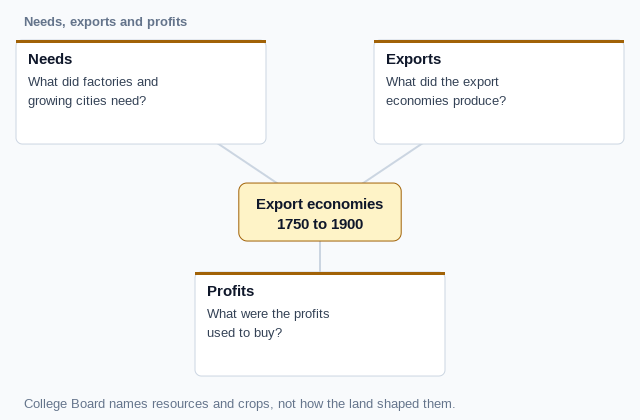 Tap to open the picture full size
Part 1 Think first Supplying the mills
Choose before you read. The guess is yours to test, not a score.
Predict first
A mill in an industrial city of the 1880s runs on cotton and rubber grown and gathered thousands of miles away. How do you expect the regions that supplied it were changing?
In short. From 1750 to 1900, factories' need for raw materials and growing cities' need for food led export economies to grow around the world, specializing in natural resources, food and industrial crops.
- The need for raw materials for factories and increased food supplies for growing urban populations led to the growth of export economies.
- Those economies specialized in commercial extraction of natural resources and the production of food and industrial crops.
- The profits from these raw materials were used to purchase finished goods.
Part 2 Learn it Export economies
6.4a. What the export economies produced
Across the period, some regions came to live by selling what their land and waters yielded. The statement calls them export economies around the world that specialized in commercial extraction of natural resources and the production of food and industrial crops.
Commercial means for sale. Extraction is taking a resource from the land. Industrial crops are grown to supply industry rather than to be eaten.
College Board's examples of resource export economies: cotton production in Egypt, rubber extraction in the Amazon and the Congo basin, the palm oil trade in West Africa, the guano industries in Peru and Chile, meat from Argentina and Uruguay, and diamonds from Africa. They are examples, not a complete list, and College Board does not sort each one into extraction, food or industrial crop. This lesson sorts five of them by the example's own wording (production, extraction) or by what the product plainly is (meat is food; guano and diamonds are neither planted nor raised), and leaves palm oil unsorted.
Quick check · Multiple choice
According to this topic, what did the export economies that grew around the world in this period specialize in?
6.4b. Why they grew, and where the profits went
The statement opens with two causes. The need for raw materials for factories and increased food supplies for the growing population in urban centers led to the growth of export economies. One need came from industry, the other from the growing population of the cities.
It closes with where the money went. The profits from these raw materials were used to purchase finished goods. Read the two ends together: resources and crops were sold, and the profits from them bought finished goods.
The learning objective calls these factors environmental. The statement itself names natural resources, food and crops, all things taken from or grown on land and sea. It does not name a climate, a soil or any other feature of the land, so an argument about environmental factors rests on those products.
Quick check · Select all
Which two statements could best support an argument that environmental factors contributed to the development of the global economy in this period? Pick two.
Select 2 answers, then check.
6.4c. Four questions to ask of a source
This topic's skill is explaining a source's point of view, purpose, historical situation or audience. Each is a separate question.
| Ask | It means | |---|---| | Point of view | Where does the author stand? | | Purpose | What was the source made to do? | | Historical situation | What circumstances did it come from? | | Audience | Who was it made for? |
Explaining goes one step past naming. "The author is a rancher" names a point of view; "a rancher who sells abroad has reason to praise distant markets" explains it. Purpose and situation are the two most often confused: purpose is what the source tries to do, and situation is the larger world it was made in, such as the growth of export economies.
Quick check · Select all
A pamphlet written for this page is printed in a forest region and sent to investors in an industrial country: "The rubber of our forests waits for your factories." Which two statements best explain the pamphlet's audience and purpose? Pick two.
Select 2 answers, then check.
Part 3 Watch it done The situation of a guano notice
Watch the first steps, then take the last one yourself.
A notice written for this page is printed by a trading firm on the coast of Peru: "Guano from our coast, shipped by the ton to buyers overseas." Explain the historical situation of the notice.
Step 1 · Say what the source is
A firm in Peru advertises guano for buyers overseas. The guano industries in Peru and Chile are one of College Board's examples of resource export economies.
Step 2 · Look for the circumstances it came from
In this period, the need for raw materials for factories and increased food supplies for growing cities led to the growth of export economies that specialized in commercial extraction of natural resources. The notice was printed inside that growth.
Why this step?
Why is "the firm wants to sell guano" not the historical situation?
That is what the notice tries to do, its purpose. The situation is the larger world it was made in.
Your step · Decide and justify
Finish it. Which sentence explains the notice's historical situation?
What makes that sentence the situation?
Part 4 Try it Four questions, one letter
A letter written for this page, from the manager of a palm oil trading house on the West African coast to the company's owners in Europe:
> The coast's oil fills our ships faster than ever. Send more casks, and more cloth to pay the traders who bring the oil down to us.
Each sentence below answers one of the four sourcing questions about the letter.
Try it · Match
Match each sourcing question to the sentence that answers it for this letter.
Part 5 Explain it Land, trade and the global economy, from documents
This is a self-check. Nothing you type leaves this page. Hold your answer up to the model and each scoring point.
Free-response practice · Question 1 style
A short practice in the shape of the document-based question: a thesis, one sentence of context and one paragraph that uses both documents and explains the point of view or audience of one, instead of a full essay. Both documents are written for this page and are not real.
Document 1: the palm oil letter from Try it.
Document 2: a report from an official in Egypt to his government: "More of the valley's fields are sown with cotton each year, for the mills abroad pay well for it."
Using both documents, explain how various environmental factors contributed to the development of the global economy in the period from 1750 to 1900.
Model answer
Thesis: The products of land and water, palm oil and crops such as cotton, drew regions into the global economy, as factories' need for raw materials and cities' need for food led export economies to grow around them.
Context: In this period the development of industrial capitalism brought continued improvement in manufacturing methods that increased the availability, affordability and variety of consumer goods, and those factories needed supplies.
Document 2 shows a region turning its land toward an industrial crop: each year more of the valley is sown with cotton because "the mills abroad pay well." The official writes to his own government, so the report frames the change as a matter of fields and earnings, the things a government tracks. Document 1 shows a resource export drawn into trade: palm oil from West Africa fills the company's ships "faster than ever." In both documents, what the land yielded became what the region sold, and the mills' demand drew it abroad.
Score your own answer. This is a self-check, not a grade. Tick each point your answer makes.
Part 6 Check yourself Six exports
The table drives the first two questions. The last two come from the rest of the lesson.
A student listed exports from College Board's examples for this topic. The table was written for this lesson.
| Row | Export | From |
|---|---|---|
| 1 | Cotton | Egypt |
| 2 | Rubber extraction | The Amazon and the Congo basin |
| 3 | Guano | Peru and Chile |
| 4 | Meat | Argentina and Uruguay |
| 5 | Diamonds | Africa |
Case question 1 · Sort it
Sort each export by what its export economy specialized in.
Commercial extraction of natural resources
Production of food or industrial crops
Case question 2 · Fill the statement
Rows 1 and 4 answer different needs. Complete the sentence.
Row 4's meat answered the need of the , while row 1's cotton answered the need of .
The rest stand on their own and do not use the case.
Check yourself · Multiple choice
A letter written for this page is from a cotton grower to a merchant in an industrial country: "Our harvest is ready for your mills. Send payment soon, for we wish to buy your cloth and your machines." Which choice best explains the letter's purpose?
Check yourself · Select all
A newspaper notice written for this page is printed in a large industrial city: "Fresh meat arrives each week by ship from across the ocean." Which two statements best explain the historical situation of the notice? Pick two.
Select 2 answers, then check.
Part 7 Keep it Bring back earlier ideas
One question from the resistance lesson just before this one, and one from the rationales lesson three back.
From 6.3 Indigenous Responses to State Expansion from 1750 to 1900 · Multiple choice
According to this topic, which developments contributed to anticolonial movements?
From 6.1 Rationales for Imperialism from 1750 to 1900 · Select all
Which two of these does this topic's statement name among the ideologies used to justify imperialism? Pick two.
Select 2 answers, then check.
In three lines
- Factories' need for raw materials and growing cities' need for food led export economies to grow around the world.
- They specialized in commercial extraction of natural resources and the production of food and industrial crops, such as Egypt's cotton and Peru's guano.
- The profits from these raw materials were used to purchase finished goods.
Exam strategy for this topic
- Section I Part A, Multiple Choice: 55 questions in 55 minutes.
- Section I Part B, Short Answer: 3 questions in 40 minutes.
- Section II, Document-Based Question and Long Essay: 2 questions in 100 minutes.
- This lesson's Explain it is shaped like free-response question 1, Document-based.
When a question asks about a source's historical situation, give the broader circumstances it came from, such as the growth of export economies, not what the source was trying to do. Keep purpose and situation as two separate answers.
Questions students ask
What makes these factors environmental?
The learning objective calls them environmental. The statement names natural resources, food and industrial crops, which come from land and sea; it does not name a climate, a soil or any other feature of the land.
Is palm oil a crop or an extracted resource?
College Board lists the palm oil trade in West Africa as an example of a resource export economy without saying which kind, so this lesson does not sort it.
Are College Board's examples the only export economies?
No. They are illustrative examples. The statement says export economies grew around the world.
How is this topic different from economic imperialism?
This topic covers what export economies produced and why they grew. 6.5 Economic Imperialism from 1750 to 1900 turns to economic imperialism and to trade organized to the advantage of merchants and companies based in Europe and the U.S.
Is the skill here the same as in 6.3?
Close. Here you explain a source's point of view, purpose, situation or audience. In 6.3 Indigenous Responses to State Expansion from 1750 to 1900 you also explained their significance, including how they limit a source's use.
Course alignment, for teachers
AP World History: Modern topic 6.4, Unit 6: Consequences of Industrialization.
- Skill 2.B: Explain the point of view, purpose, historical situation, and/or audience of a source.
This lesson maps the one essential knowledge statement of the topic, and the one learning objective with none of its own, to the part that teaches each one: 1 is checked by a scored question and 1 by the written response. The map is in the lesson file.