Unit 9 · Topic 9.7 · about 30 minutes · 7 parts · 9 scored checks, 2 of them multiple choice, plus 2 from earlier lessons
AP World History: Modern 9.7: Resistance to Globalization After 1900
Unit 9: 8 to 10% of the multiple-choice section
What you'll be able to do
- Explain the various responses to increasing globalization from 1900 to present.
Key vocabulary
| Term | What it means | The exam trap |
|---|---|---|
| Globalization | The growing ties among the world's economies, cultures and peoples; a plain meaning, since the topic does not define it. | Globalization names a process, not an organization. The IMF and the World Bank appear in the topic, but neither one is globalization itself. |
| Activism | Organized public action meant to bring about change. | Activism names a way of acting, not an aim. The topic does not say what the activists against the IMF and the World Bank wanted. |
| Locally developed | Made within the country or community that uses it; a plain meaning. | Locally developed says where something was made, not who owned it or who joined it. |
| Audience | The people a source was made for. | The audience is who the author had in mind, not everyone who read the source later. |
 Tap to open the picture full size
Part 1 Think first Closer ties, and a reply
Make a guess before you read. A wrong guess still helps the right idea stick.
Predict first
A country's economy becomes tied more closely to the rest of the world. Which reply from its people do you guess is more likely?
In short. This topic is about how people answered globalization as it rose after 1900: in more than one way, from activism against international institutions to building their own social media.
- Responses to rising cultural and economic globalization took a variety of forms.
- The topic's examples are anti-IMF and anti-World Bank activism, and the advent of locally developed social media, such as Weibo in China.
- A source left by one response shows that side's case, and its point of view, purpose and audience limit what else it can show.
Part 2 Learn it Answering globalization
9.7a. One claim about many responses
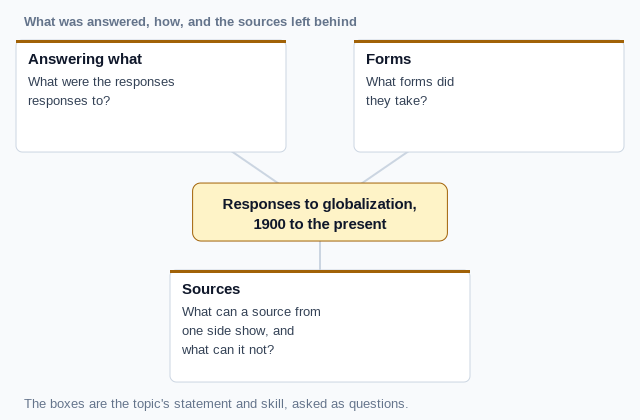
This topic has a single statement: Responses to rising cultural and economic globalization took a variety of forms.
Read it in parts. Rising says the globalization being answered was growing. Cultural and economic names two kinds of it, so a response could be to the spread of culture, of trade and money, or of both. A variety of forms is the claim itself: the responses were not all of one kind.
The title calls the topic resistance, but the statement says responses. That word is wider. A response can push back against something, and it can also be an answer that builds something of its own.
That is nearly all the statement says. It does not say who responded, where, when within the period, or why, and this lesson does not fill those gaps from memory.
Quick check · Select all
This topic's statement names what the responses were responses to. Which two? Pick two.
Select 2 answers, then check.
9.7b. Two forms the topic names
The topic gives two examples, both listed as responses to economic globalization.
The first is anti-IMF and anti-World Bank activism: people acting in public against two international institutions. The second is the advent of locally developed social media, with Weibo in China as the case. That one is not a protest. It is something made at home.
Set side by side, the two show what variety can mean: one form pushes against an institution, and the other builds something of its own. The topic stops there. It does not describe what the IMF or the World Bank did, why activists opposed them, or why Weibo was built.
One more pairing is open to you. 9.6 Globalized Culture After 1900 lists Facebook and Twitter among its examples of global culture. Read beside this topic's Weibo, the two lists can be used to argue that social media appears both in global culture and in the responses to it. That is an argument, not a claim the topic makes.
Quick check · Multiple choice
Which choice best describes this topic's claim about responses to rising cultural and economic globalization?
9.7c. Sources from one side
Responses leave sources: a flyer for a march, a post on a new site, a speech at its launch. Each comes from someone who took a side.
This topic's skill is to explain the significance of a source's point of view, purpose, historical situation, and/or audience, including how these might limit the use(s) of a source.
Take a flyer handed out at a march. Its purpose is to bring more people to the next one. That makes it strong evidence of how the marchers made their case, and weak evidence of whether the case was right or how many people agreed. The purpose narrows the flyer's use; it does not cancel it.
The useful sentence has two halves: what the source can show, and what its point of view, purpose or audience keeps it from showing.
Quick check · Multiple choice
A flyer written for this page (it is not a real source) is handed out at a protest against the World Bank: "Decisions about our economy are made far away, by people we never chose. Join us." Which choice best explains how the flyer's purpose limits its use as a source?
Part 3 Watch it done Weighing a newsletter
Watch the first steps, then take the last one yourself.
A newsletter written for this page (it is not a real source), sent in 2001 by an imagined farmers' group to its own members: "Last month forty of us stood outside the World Bank's meeting. We went because decisions about our rivers should be made by the people who live beside them."
Explain how the newsletter's audience might limit its use as a source.
Step 1 · Name the audience and the purpose
The audience is the group's own members. The purpose is to report the march and say why it mattered, to people who already belong.
Step 2 · Ask what that audience lets the source show
Writing to its own members, the group has reason to speak for itself. Then ask whose views a newsletter for insiders cannot speak for.
Why this step?
Why name a use before you name the limit?
A limit is always a limit on some use. Naming what the source can show first keeps the limit from swallowing the whole source.
Your step · Decide and justify
Finish it. Which sentence explains how the audience limits the newsletter's use?
What makes that the right limit?
Part 4 Try it Four sources on one new site
Four sources written for this page (none of them is real), all about a locally developed social media site that opened in an imagined country in 2009:
- The founder's speech to investors, 2010: "Ten million people joined us in our first year, and every one of them chose a site built here over the foreign giants."
- A foreign social media company's report to its shareholders, 2010: "In that country our growth has slowed since a local site opened."
- A teacher's letter to a friend, 2011: "I use the new site every day, but it is full of rumors."
- A newspaper's count, 2011: "The site now has eight million active members."
Try it · Match
Match each question a historian might ask to the source best placed to answer it.
Part 5 Explain it Many answers to globalization
This is a self-check. Nothing you type leaves this page. Compare your answer with the model and each scoring point.
Free-response practice · Question 2 style
This is a partial long essay. Write a thesis, one sentence of context and one paragraph of evidence, not a full essay.
In the period from 1900 to the present, responses to rising cultural and economic globalization took a variety of forms.
Explain the various responses to increasing globalization from 1900 to the present.
Model answer
Thesis: As globalization rose after 1900, people answered it in more than one way, some by acting in public against international institutions and others by building something of their own at home.
Context: In the late 20th century, in a trend accelerated by the end of the Cold War, many governments encouraged free-market economic policies and promoted economic liberalization, which I would argue was part of the rising economic globalization that these responses answered.
One form was activism. Anti-IMF and anti-World Bank activism is an example of a response to economic globalization in which people pushed back against two international institutions. Another form built something instead: the advent of locally developed social media, such as Weibo in China, is also listed as a response to economic globalization. I would also count the movements that protested the inequality of the environmental and economic consequences of global integration as a response. These examples show variety in kind, protest beside building. They do not show why each group responded as it did, and that would need evidence of its own.
Score your own answer. This is a self-check, not a grade. Tick each point your answer makes.
Part 6 Check yourself One country's responses, 1999 to 2015
The table drives the first two questions. The last two come from the rest of the lesson.
Four rows from a record of an imagined country. The record was written for this lesson and is not real.
| Row | What is recorded | When |
|---|---|---|
| 1 | Students and farmers march outside a World Bank meeting in the capital | 1999 |
| 2 | Union members hold a hunger strike outside the IMF's office | 2003 |
| 3 | A social media site made by the country's own programmers opens | 2009 |
| 4 | Accounts open on the site in row 3: 40 million | 2015 |
Case question 1 · Fill the statement
Complete the note on the record.
Row records a response whose form differs from row 1's, and row records the same form as row 1, aimed at the other institution the topic names.
Case question 2 · Sort it
Sort each claim a student made about the record by whether the record supports it.
The record supports it
The record cannot show it
The rest stand on their own and do not use the case.
Check yourself · Select all
A post written for this page (it is not a real source) appears on a locally developed social media site: "Why should we hand our conversations to foreign companies? Our own site understands us." Given the writer's point of view and purpose, which two are uses a historian could make of the post? Pick two.
Select 2 answers, then check.
Check yourself · Select all
A student argues: "Responses to globalization after 1900 took more than one form." Based on this unit, which two pieces of evidence could best support the argument? Pick two.
Select 2 answers, then check.
Part 7 Keep it Bring back earlier ideas
One question from globalized culture, the lesson just before this one, and one from the global economy three lessons back.
From 9.6 Globalized Culture After 1900 · Multiple choice
What does this topic say happened to consumer culture?
From 9.4 Economics in the Global Age · Select all
Which two does this topic say about the economy in the late 20th century? Pick two.
Select 2 answers, then check.
In three lines
- Responses to rising cultural and economic globalization took a variety of forms.
- Anti-IMF and anti-World Bank activism and locally developed social media, such as Weibo in China, are two different forms.
- A source from one side shows that side's case; its point of view, purpose and audience limit what else it can show.
Exam strategy for this topic
- Section I Part A, Multiple Choice: 55 questions in 55 minutes.
- Section I Part B, Short Answer: 3 questions in 40 minutes.
- Section II, Document-Based Question and Long Essay: 2 questions in 100 minutes.
- This lesson's Explain it is shaped like free-response question 2, Long essay.
When a long essay asks about responses to globalization, name two different forms, such as anti-World Bank activism and Weibo in China, and say how they differ instead of treating every response as protest.
Questions students ask
Why is the topic called resistance when its statement says responses?
The title says resistance, and the statement says responses that took a variety of forms. One of the topic's examples protests and the other builds, so this lesson uses the statement's wider word.
What did the IMF and the World Bank do that activists opposed?
The topic does not say. It names anti-IMF and anti-World Bank activism as an example and gives no account of either institution or of the activists' aims, so a claim about that needs other evidence.
Was Weibo built to resist Facebook and Twitter?
The topic files Weibo in China under responses to economic globalization, and Topic 9.6 lists Facebook and Twitter under global culture. Read side by side, the lists can be used to argue that social media sits on both sides, but neither topic says Weibo was built against them.
Does the topic give an example of a response to cultural globalization?
Its statement names cultural and economic globalization, but both of its examples are listed under economic globalization. Evidence of a response to cultural globalization would have to come from your class or your reading.
When did these responses happen?
The objective covers 1900 to the present, and the statement says the globalization was rising. The topic dates no response, so this lesson's sources and record give their own years and are labeled as written for the page.
Course alignment, for teachers
AP World History: Modern topic 9.7, Unit 9: Globalization.
- Skill 2.C: Explain the significance of a source’s point of view, purpose, historical situation, and/or audience, including how these might limit the use(s) of a source.
This lesson maps the one essential knowledge statement of the topic, and the one learning objective with none of its own, to the part that teaches each one: 2 are checked by a scored question. The map is in the lesson file.