Unit 6 · Topic 6.7 · about 30 minutes · 7 parts · 9 scored checks, 2 of them multiple choice, plus 2 from earlier lessons
AP World History: Modern 6.7: Effects of Migration
Unit 6: 12 to 15% of the multiple-choice section
What you'll be able to do
- Explain how and why new patterns of migration affected society from 1750 to 1900.
Key vocabulary
| Term | What it means | The exam trap |
|---|---|---|
| Home society | The society a migrant came from. | A migrant who returns is back in the home society; the term does not change with the journey. |
| Receiving society | The society migrants moved into. | One country can be a home society for some migrants and a receiving society for others. |
| Ethnic enclave | A community where people of one ethnic group live together inside a larger society. | An enclave sits inside a larger society; it is not a separate country. |
| Prejudice | A judgment against people formed in advance, here because of their ethnicity or race. | The statement speaks of various degrees of prejudice, so treat it as a range rather than one fixed thing. |
| Regulate | To control by rules or law. | The statement says states attempted to regulate the flow of people. It does not say they succeeded. |
 Tap to open the picture full size
Part 1 Think first The village they left
Choose before you read. The guess is yours to test, not a score.
Predict first
Many of a village's young men sail away to work in another country. What do you expect changes most in the village they leave behind?
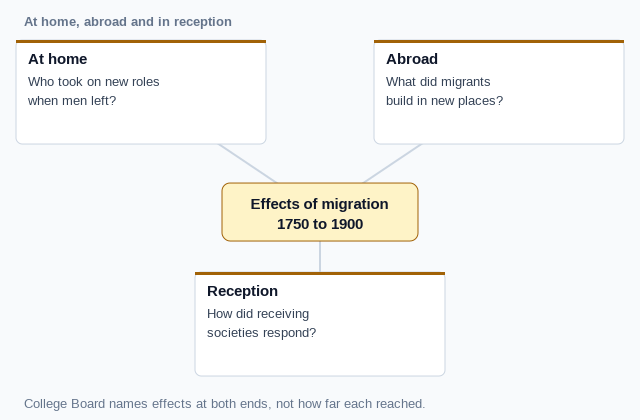
In short. From 1750 to 1900, migration changed society at both ends of the journey: women took on new roles at home, migrants built enclaves abroad, and receiving societies did not always embrace them.
- Migrants tended to be male, leaving women to take on new roles in the home society that had been formerly occupied by men.
- Migrants often created ethnic enclaves in different parts of the world that helped transplant their culture into new environments.
- Receiving societies did not always embrace immigrants, as seen in various degrees of ethnic and racial prejudice and in the ways states attempted to regulate the increased flow of people across their borders.
Part 2 Learn it Effects at both ends
6.7a. The societies migrants left
Begin where the journey began. Migrants tended to be male, leaving women to take on new roles in the home society that had been formerly occupied by men.
The sentence joins two developments. Who migrated is a pattern of migration; women's new roles are a change in society. Leaving is the link: because men tended to go, women took up what the men had done.
Tended to be describes a pattern, not a rule. Women migrated too, and a claim that every migrant was a man goes past the statement. Notice also where the effect falls: in the home society, the one the migrants left, not the one they reached.
College Board names no particular role. Running a farm or a shop, or sitting where a husband had sat, are the kinds of change a document might show, and the statement's wording is what ties them to migration.
Quick check · Select all
A letter written for this page is from a woman in a village to her husband, who has migrated abroad for work: "Since you left, I run the farm and sell our crops at market myself." Which two statements best explain how the letter relates to developments in this topic? Pick two.
Select 2 answers, then check.
6.7b. Enclaves in new lands
At the other end of the journey, migrants often created ethnic enclaves in different parts of the world that helped transplant their culture into new environments.
An ethnic enclave is a community of one ethnic group living together inside a larger society. Transplant is a gardener's word: the culture was dug up in one place and set down to grow in another, with its language, food, faith and festivals.
Often means many migrants did this, not all. The statement says who built the enclaves, the migrants themselves.
College Board's examples are wide: Chinese in Southeast Asia, the Caribbean, South America and North America; Indians in East and Southern Africa, the Caribbean and Southeast Asia; Irish in North America; and Italians in North and South America.
Quick check · Select all
Which two statements describe ethnic enclaves as this topic presents them? Pick two.
Select 2 answers, then check.
6.7c. How receiving societies responded
The last statement turns to the welcome migrants met. Receiving societies did not always embrace immigrants, as seen in the various degrees of ethnic and racial prejudice and the ways states attempted to regulate the increased flow of people across their borders.
Each phrase limits the claim. Not always leaves room for societies that did embrace newcomers. Various degrees says prejudice ran from mild to severe. Attempted says states tried to regulate the flow; it does not say they succeeded.
Two kinds of evidence are named. Prejudice can show up in daily life, in who is served in a shop or who may join a guild. Regulation is the work of a state, in laws on who may enter. College Board's examples of regulation are the Chinese Exclusion Act and the White Australia policy; it does not describe their terms.
Quick check · Multiple choice
A law written for this page limits how many people from abroad may enter a country each year. Which development described in this topic does the law best illustrate?
Part 3 Watch it done Tying a new role to who migrated
Watch the first steps, then take the last one yourself.
A letter written for this page, from a woman in a hill village to a cousin: "Since half the men of our village sailed for the Americas, I sit on the council and sign the contracts for our olive press." Explain how the change the letter describes relates to patterns of migration.
Step 1 · Name the change
The writer now sits on the village council and signs the contracts for the press, work she does in the village she never left.
Step 2 · Find what it is an effect of
Ask who left the village and who stayed. The letter says half the men sailed away. The change has to be tied to that pattern of who migrated, and placed in the society where it happened.
Why this step?
Why does it matter where the change happened?
The writer's new role is in the village the men left. An effect in the home society is a different development from an effect in the place migrants reached.
Your step · Decide and justify
Finish it. Which sentence explains how the change relates to patterns of migration?
What makes that sentence the connection?
Part 4 Try it Two letters, three effects
Two letters written for this page. The first is from a woman in a village to her brother, who has gone to work in a port city across the ocean; the second is his reply.
> Since you and the other men left, I keep the accounts of the shop, as Father did. The council has asked two wives whose husbands are abroad to sit in their places.
> Our street here has a priest, a baker and a band from our own province, and on feast days you would think you were home. But some landlords will not rent to people from our country, and a new law lets the ships land only so many of us each year.
Each change in the letters relates to one development from this topic.
Try it · Sort it
Sort each change from the letters by the development it relates to.
Women taking on roles formerly held by men
Migrants' culture carried abroad in an enclave
A receiving society not always embracing immigrants
Part 5 Explain it Both ends of the journey, from documents
This is a self-check. Nothing you type leaves this page. Hold your answer up to the model and each scoring point.
Free-response practice · Question 1 style
A short practice in the shape of the document-based question: a thesis, one sentence of context and one paragraph that uses both documents and explains the point of view or purpose of one, instead of a full essay. Both documents are written for this page and are not real.
Document 1: the two letters from Try it.
Document 2: an editorial in a newspaper of a country that receives many migrants: "The newcomers keep to their own streets and their own tongue. Parliament must limit how many may land."
Using both documents, explain how and why new patterns of migration affected society in the period from 1750 to 1900.
Model answer
Thesis: New patterns of migration changed society at both ends of the journey: because migrants tended to be male, women took on new roles at home, while abroad migrants built enclaves that carried their culture and met prejudice and attempts at regulation in the societies that received them.
Context: The rapid urbanization that accompanied global capitalism at times brought cities challenges such as housing shortages, and both documents show migrants arriving in such growing cities, the brother on his street in a port city and the newcomers on the streets the editorial complains of.
In Document 1, the sister keeps the shop's accounts "as Father did," and wives sit on the council in their absent husbands' places, roles in the home society formerly held by men. Her brother's street, with a priest, a baker and a band from home, is an enclave that transplanted their culture. Document 2 describes the same kind of street from outside, as newcomers who "keep to their own streets and their own tongue," and calls for Parliament to limit landings, a state's attempt to regulate the flow of people. The editorial's purpose is to press lawmakers, so it presents the enclave as a refusal to fit in, where the brother presents it as home. Together the documents show a receiving society that did not always embrace immigrants.
Score your own answer. This is a self-check, not a grade. Tick each point your answer makes.
Part 6 Check yourself Enclaves and laws
The table drives the first two questions. The last two come from the rest of the lesson.
A student listed College Board's examples for this topic in rows 1 to 6 and added row 7 from a reading. The table was written for this lesson, and row 7 is invented.
| Row | Example |
|---|---|
| 1 | Chinese in Southeast Asia, the Caribbean, South America and North America |
| 2 | Indians in East and Southern Africa, the Caribbean and Southeast Asia |
| 3 | Irish in North America |
| 4 | Italians in North and South America |
| 5 | The Chinese Exclusion Act |
| 6 | The White Australia policy |
| 7 | An Italian quarter of a South American port city, with its own newspapers and festivals |
Case question 1 · Spot the error
A student wrote this summary of rows 1 to 6. Which line goes wrong?
Case question 2 · Fill the statement
Use rows 4, 6 and 7 to complete the sentences.
Row 7 is an , like those of row 4, and its newspapers and festivals show . Row 6 shows another side of migration: a receiving society that .
The rest stand on their own and do not use the case.
Check yourself · Multiple choice
A letter written for this page is from a migrant in a receiving society: "Here some people will not rent us rooms, and some shout at us in the street because of where we come from." Which development described in this topic does the letter best illustrate?
Check yourself · Select all
A letter written for this page is from a migrant: "In our quarter of the city we speak our own language, keep our own festivals and cook the food of home." Which two statements from this topic and Topic 6.6 best explain how the letter relates to patterns of migration? Pick two.
Select 2 answers, then check.
Part 7 Keep it Bring back earlier ideas
One question from the causes of migration lesson just before this one, and one from the export economies lesson three back.
From 6.6 Causes of Migration in an Interconnected World · Multiple choice
Which of these does this topic name as a form of coerced or semicoerced labor migration?
From 6.4 Global Economic Development from 1750 to 1900 · Select all
A newspaper notice written for this page is printed in a large industrial city: "Fresh meat arrives each week by ship from across the ocean." Which two statements best explain the historical situation of the notice? Pick two.
Select 2 answers, then check.
In three lines
- Migrants tended to be male, leaving women to take on new roles in the home society that men had formerly held.
- Migrants often created ethnic enclaves that helped transplant their culture into new environments.
- Receiving societies did not always embrace immigrants, as seen in degrees of prejudice and in states' attempts to regulate the flow of people.
Exam strategy for this topic
- Section I Part A, Multiple Choice: 55 questions in 55 minutes.
- Section I Part B, Short Answer: 3 questions in 40 minutes.
- Section II, Document-Based Question and Long Essay: 2 questions in 100 minutes.
- This lesson's Explain it is shaped like free-response question 1, Document-based.
When you explain an effect of migration, say which society felt it, the home society or the receiving one, and tie it to the pattern that caused it, such as men tending to be the ones who left.
Questions students ask
Did migrants always leave women behind?
Migrants tended to be male, which is a pattern, not a rule. College Board does not say how many women migrated or how many stayed.
Which new roles did women take on?
College Board says only roles in the home society that had been formerly occupied by men. It names no particular role, so the council seats and the shop's accounts in this lesson's letters are written for the page.
What were the Chinese Exclusion Act and the White Australia policy?
College Board lists them as examples of the regulation of immigrants, the ways states attempted to regulate the increased flow of people across their borders. It does not describe their terms, so this lesson does not either.
Did receiving societies reject immigrants?
Not as a rule. The statement says they did not always embrace immigrants, as seen in various degrees of ethnic and racial prejudice and in states' attempts at regulation.
How does this topic connect to 6.6?
6.6 Causes of Migration in an Interconnected World asks what caused migration, from changes in population to the search for work. This topic follows the effects of that migration on the societies migrants left and the ones they reached.
Course alignment, for teachers
AP World History: Modern topic 6.7, Unit 6: Consequences of Industrialization.
- Skill 5.B: Explain how a historical development or process relates to another historical development or process.
This lesson maps all 3 essential knowledge statements of the topic, and the one learning objective with none of its own, to the part that teaches each one: 4 are checked by a scored question. The map is in the lesson file.