Unit 9 · Topic 9.4 · about 30 minutes · 7 parts · 10 scored checks, 2 of them multiple choice, plus 2 from earlier lessons
AP World History: Modern 9.4: Economics in the Global Age
Unit 9: 8 to 10% of the multiple-choice section
What you'll be able to do
- Explain the continuities and changes in the global economy from 1900 to the present.
Key vocabulary
| Term | What it means | The exam trap |
|---|---|---|
| Free-market economic policies | Policies that leave prices, production and trade more to buyers and sellers than to the government; a plain meaning, since the topic does not define the term. | Free describes the market, not the goods. It does not mean things given away at no cost. |
| Economic liberalization | Loosening government rules on trade and business; a plain meaning. | Liberalization here is economic. Do not read it as the political liberalism of earlier units or as a party's name. |
| Knowledge economy | An economy built largely on information and ideas rather than on factory goods; a plain meaning. | It describes how a region's economy works, not how much schooling its people had. |
| Multinational corporation | A company that operates in more than one country. | Multinational describes where a company does business, not who owns it or where it began. |
| Regional trade agreement | An agreement on trade among countries in one part of the world. | An agreement sets rules among the countries that sign it. Read whether a choice describes an agreement, a company or an organization. |
 Tap to open the picture full size
Part 1 Think first What changed most?
Make a guess before you read. A wrong guess still helps the right idea stick.
Predict first
Think about the world economy in 1970 and in 2000. Which of these do you guess changed the most in those thirty years?
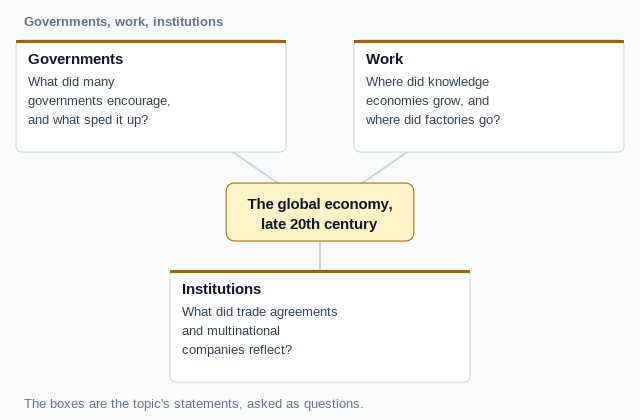
In short. This topic is about how the world economy changed in the late 20th century: what governments encouraged, where different kinds of work were done, and what new institutions and companies reflected.
- In a trend accelerated by the end of the Cold War, many governments encouraged free-market economic policies and promoted economic liberalization in the late 20th century.
- Revolutions in information and communications technology led to the growth of knowledge economies in some regions, while industrial production and manufacturing were increasingly situated in Asia and Latin America.
- Changing economic institutions, multinational corporations, and regional trade agreements reflected the spread of principles and practices associated with free-market economics throughout the world.
Part 2 Learn it The economy in the global age
9.4a. Governments and the free market
The topic's first statement is about what governments did: In a trend accelerated by the end of the Cold War, many governments encouraged free-market economic policies and promoted economic liberalization in the late 20th century.
Three limits sit in it. Many governments, not all. Accelerated by the end of the Cold War, so the trend was already under way and the Cold War's end sped it up. And the late 20th century, not the whole period.
The topic's examples are the United States under Ronald Reagan, Britain under Margaret Thatcher, China under Deng Xiaoping and Chile under Augusto Pinochet.
The objective asks for continuity and change across the century. Here is a change you can argue from two topics, as your own argument: following World War I and the onset of the Great Depression, governments began to take a more active role in economic life (7.4 Economy in the Interwar Period), and in the late 20th century many encouraged free-market policies instead.
Quick check · Select all
Which two does this topic say about free-market economic policies in the late 20th century? Pick two.
Select 2 answers, then check.
9.4b. Where the work was done
The second statement moves from governments to work: In the late 20th century, revolutions in information and communications technology led to the growth of knowledge economies in some regions, while industrial production and manufacturing were increasingly situated in Asia and Latin America.
The first half has a cause and a result. The revolutions in information and communications technology led to knowledge economies, and only in some regions. The topic's examples are Finland, Japan and the U.S.
The second half is a change in place. Manufacturing went on, but it was increasingly situated in Asia, with Vietnam and Bangladesh as examples, and in Latin America, with Mexico and Honduras.
While sets the two halves side by side. The statement does not say one caused the other.
Quick check · Select all
Which two does this topic say about the economy in the late 20th century? Pick two.
Select 2 answers, then check.
9.4c. Institutions, companies and agreements
The third statement ties three kinds of thing to one idea: Changing economic institutions, multinational corporations, and regional trade agreements reflected the spread of principles and practices associated with free-market economics throughout the world.
The topic's examples are the World Trade Organization (WTO), the North American Free Trade Agreement (NAFTA) and the Association of Southeast Asian Nations (ASEAN), and three multinational corporations: Nestlé, Nissan and Mahindra and Mahindra.
The verb is reflected. These institutions show the spread of free-market principles and practices, the way a mirror shows a face. The statement does not say they started the spread.
Quick check · Multiple choice
This topic names the WTO, NAFTA and ASEAN, and the companies Nestlé and Nissan, among its examples. What does this topic say institutions, companies and agreements like these reflected?
9.4d. What a source's purpose allows
This topic's skill is to explain the significance of a source's point of view, purpose, historical situation, and/or audience, including how these might limit the use(s) of a source.
A source's purpose is what its author wanted it to do. Purpose gives an author reasons to stress some things and pass over others, so it changes what the source can show.
A limit is not the same as uselessness. A company's leaflet promising jobs is good evidence of what the company promised, and weak evidence of what happened after. The useful sentence names the purpose, then says which use it limits and which it leaves standing.
College Board's sample activity for this topic does exactly this with a real speech: students fact-check the claims Margaret Thatcher made about Pinochet at the Conservative Party Conference in 1999, rate their accuracy and write a brief report.
Quick check · Multiple choice
A leaflet written for this page (it is not a real source) is printed by a multinational corporation for the people of a town where it plans to open a factory: "Our new factory will bring jobs and skills to your town, and our products will reach buyers around the world." Which choice best explains how the leaflet's purpose limits its use as a source?
Part 3 Watch it done Weighing a minister's speech
Watch the first steps, then take the last one yourself.
A speech written for this page (it is not a real source), given on national radio in 1992 by the economics minister of an imagined country: "The state will sell its factories, open our ports to foreign companies, and let prices find their own level. In five years every family will feel the gain." Explain how the speech's purpose limits its use as a source.
Step 1 · Name who is speaking, to whom, and why
A government minister, speaking to the whole country on the radio, announcing a policy of economic liberalization the government has chosen.
Step 2 · Ask what that purpose gives the speaker reason to do
A minister announcing his own government's policy wants listeners to support it. Think about which parts of the policy such a speaker has reason to stress, and what a promise about the next five years can and cannot show.
Why this step?
Why look at purpose before deciding what the speech is good for?
Purpose decides what the speaker had reason to say. Once you know it, you can tell which claims are evidence of the government's plans and hopes and which would need other sources to check.
Your step · Decide and justify
Finish it. Which sentence explains how the speech's purpose limits its use?
What makes it explain the limit?
Part 4 Try it Four sources on one factory
Four sources written for this page (none is real) about a clothing factory that a foreign company opened in an imagined country in 1996:
- Source A. The company's report to its shareholders, 1997: "Our new plant has cut our costs by a third."
- Source B. The newsletter of the workers' union at the plant, 1997: "Twelve-hour shifts, and the company calls it opportunity."
- Source C. A speech by the country's trade minister at the plant's opening, 1996: "Foreign companies are our road to prosperity."
- Source D. The private diary of a machinist at the plant, 1997: "My wage feeds my mother and sisters. My back aches every night."
Try it · Match
Match each source to the way its purpose or audience limits its use.
Part 5 Explain it The global economy across the century
This is a self-check. Nothing you type leaves this page. Set your answer beside the model and each scoring point.
Free-response practice · Question 2 style
This is a partial long essay. Write a thesis, one sentence of context and one paragraph of evidence, not a full essay.
In the late 20th century, many governments encouraged free-market economic policies and promoted economic liberalization.
Explain the continuities and changes in the global economy from 1900 to the present.
Model answer
Thesis: Across the century the global economy changed in what many governments wanted from markets, moving from a more active government role after the Great Depression toward free-market policies late in the century, while manufacturing continued but was increasingly situated in Asia and Latin America.
Context: After World War II, governments in newly independent states often took on a strong role in guiding economic life to promote development, which I would argue makes the free-market turn of the late 20th century a change from the path many such states had taken.
The change starts early in the century. Following World War I and the onset of the Great Depression, governments began to take a more active role in economic life. In the late 20th century, in a trend accelerated by the end of the Cold War, many governments encouraged free-market policies instead, among them the United States under Ronald Reagan and Chile under Augusto Pinochet. New institutions and agreements, such as the WTO and NAFTA, and multinational corporations such as Nissan reflected the spread of free-market practices. I would argue the continuity is in production: industrial production and manufacturing went on, but were increasingly situated in places such as Vietnam and Mexico. Knowledge economies, meanwhile, grew in some regions, such as Finland, a further change.
Score your own answer. This is a self-check, not a grade. Tick each point your answer makes.
Part 6 Check yourself One country's economy, 1975 and 2000
The table drives the first two questions. The last two come from the rest of the lesson.
Four rows from a report on an imagined country, comparing 1975 with 2000. The report was written for this lesson and is not real.
| Row | What is measured | 1975 | 2000 |
|---|---|---|---|
| 1 | Companies owned by the government | Thirty, among them the railways and the telephone company | Three; the rest were sold to private buyers |
| 2 | Clothing sold in the country | Mostly sewn in the country's own mills | Mostly sewn in Asia and Latin America |
| 3 | Workers in factories | Four in every ten workers | Fewer than two in every ten |
| 4 | Workers in software, research and design | Very few | Nearly one in five |
Case question 1 · Fill the statement
Complete the note on the report.
The rise in row fits the growth of a knowledge economy, and the change in row fits a government promoting economic liberalization.
Case question 2 · Spot the error
A student wrote this summary of the report. Which line goes wrong?
The rest stand on their own and do not use the case.
Check yourself · Select all
A student argues: "The role governments took in economic life changed during the 20th century." Based on this topic and Topic 7.4, which two pieces of evidence could best support the argument? Pick two.
Select 2 answers, then check.
Check yourself · Decide and justify
College Board's sample activity gives students the "Pinochet's Achievements" section of Margaret Thatcher's speech on Pinochet at the Conservative Party Conference (1999). Is the speech, on its own, good evidence that its claims about Pinochet are accurate?
Why?
Part 7 Keep it Bring back earlier ideas
One question from the environment, the lesson just before this one, and one from new technologies three lessons back.
From 9.3 Technological Advances: Debates About the Environment After 1900 · Multiple choice
According to this topic, what did the release of greenhouse gases and pollutants into the atmosphere contribute to?
From 9.1 Advances in Technology and Exchange After 1900 · Select all
Which two does this topic say energy technologies, including the use of petroleum and nuclear power, did? Pick two.
Select 2 answers, then check.
In three lines
- In a trend accelerated by the end of the Cold War, many governments encouraged free-market policies in the late 20th century.
- Knowledge economies grew in some regions, while manufacturing was increasingly situated in Asia and Latin America.
- Economic institutions, multinational corporations and regional trade agreements reflected the spread of free-market practices.
Exam strategy for this topic
- Section I Part A, Multiple Choice: 55 questions in 55 minutes.
- Section I Part B, Short Answer: 3 questions in 40 minutes.
- Section II, Document-Based Question and Long Essay: 2 questions in 100 minutes.
- This lesson's Explain it is shaped like free-response question 2, Long essay.
For a long essay on the economy after 1900, set the government role after the Great Depression beside the free-market policies of the late 20th century, and you have a change with two ends to compare.
Questions students ask
Which governments does the topic give as examples of the free-market turn?
The United States under Ronald Reagan, Britain under Margaret Thatcher, China under Deng Xiaoping and Chile under Augusto Pinochet.
Did the end of the Cold War start the free-market trend?
The statement says the trend was accelerated by the end of the Cold War, so it was already under way and the Cold War's end sped it up. The topic does not say when it began.
Did manufacturing leave the knowledge economies completely?
The statement says industrial production and manufacturing were increasingly situated in Asia and Latin America. Increasingly describes a shift, and the topic gives no figures for how far it went.
Did trade agreements cause the spread of free-market economics?
The statement says economic institutions, multinational corporations and regional trade agreements reflected that spread. It does not say they caused it.
What does the Thatcher activity ask students to do?
College Board's sample activity gives students the "Pinochet's Achievements" section of Margaret Thatcher's 1999 speech on Pinochet at the Conservative Party Conference. Students fact-check each claim, rate the speech's accuracy and write a brief report justifying their rating.
Course alignment, for teachers
AP World History: Modern topic 9.4, Unit 9: Globalization.
- Skill 2.C: Explain the significance of a source’s point of view, purpose, historical situation, and/or audience, including how these might limit the use(s) of a source.
This lesson maps all 3 essential knowledge statements of the topic, and the one learning objective with none of its own, to the part that teaches each one: 4 are checked by a scored question. The map is in the lesson file.