Unit 4 · Topic 4.5 · about 30 minutes · 7 parts · 9 scored checks, 2 of them multiple choice, plus 2 from earlier lessons
AP World History: Modern 4.5: Maritime Empires Maintained and Developed
Unit 4: 12 to 15% of the multiple-choice section
What you'll be able to do
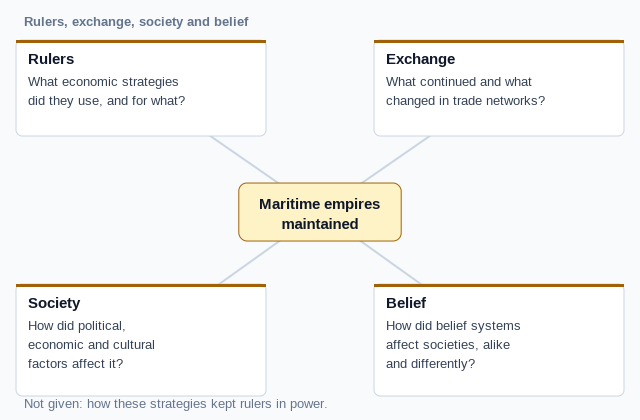
- Explain how rulers employed economic strategies to consolidate and maintain power throughout the period from 1450 to 1750.
- Explain the continuities and changes in networks of exchange from 1450 to 1750.
- Explain how political, economic, and cultural factors affected society from 1450 to 1750.
- Explain the similarities and differences in how various belief systems affected societies from 1450 to 1750.
Key vocabulary
| Term | What it means | The exam trap |
|---|---|---|
| Mercantilist | Following mercantilism, a set of policies by which a state manages trade for its own gain. | In this topic mercantilist policies belong to European rulers. A choice that hands them to Asian merchants or regional markets has moved them. |
| Joint-stock company | A business owned by many investors who each hold shares. | A joint-stock company is a business, not a state. Read whether a choice has the company itself or the rulers who used it doing the acting. |
| Chartered monopoly company | A company given sole rights to a trade by an official grant. | Monopoly means sole rights. Do not mix these companies up with the many merchants of Afro-Eurasia's regional markets. |
| Demographic | Having to do with the size and makeup of a population. | A demographic change is a change in population, not in belief. A choice about religion is describing a different kind of change. |
| Cultural synthesis | A new mix formed from different cultures. | Cultural synthesis is about cultures and peoples mixing; syncretic is the word for blended beliefs. Read whether a choice is about culture or about religion. |
| Syncretic | Blending elements of different beliefs or practices. | Syncretic beliefs are one outcome the topic gives "in some cases". A choice that drops the qualifier claims more than the statement does. |
 Tap to open the picture full size
Part 1 Think first Following the silver
Commit to a guess before you read. A wrong guess now still helps the right idea stick.
Predict first
Large amounts of silver are mined in Spain's colonies in the Americas in this period. Where do you expect much of that silver ended up?
In short. Rulers used mercantilism and joint-stock companies to build and compete, silver and the Atlantic system moved goods and people on a new scale, and the trade reshaped society and belief.
- Mercantilist policies helped European rulers expand and control their economies and claim overseas territories, joint-stock companies financed exploration and competition, and economic disputes led to rivalries and conflict between states.
- Chartered monopoly companies and the global flow of silver, especially from Spanish colonies, carried a new global circulation of goods, while regional markets in Afro-Eurasia continued to flourish and peasant and artisan labor intensified in many regions.
- The Atlantic trading system moved goods, wealth and labor, including enslaved persons, and mixed cultures and peoples; in some cases the new interactions spread existing religions, fed religious conflict and produced syncretic beliefs.
Part 2 Learn it Running and paying for empires
4.5a. Rulers, companies and rivals
Rulers had economic tools. Mercantilist policies and practices were used by European rulers to expand and control their economies and claim overseas territories. In the word's general meaning, mercantilism is a set of policies by which a state manages trade for its own gain; this topic does not define it further. The topic gives what rulers used these tools for, not how the tools kept them in power, so an answer about rulers' economic strategies should rest on expanding and controlling economies, claiming territory and competing.
A business form grew out of those ideas. Joint-stock companies, influenced by these mercantilist principles, were used by rulers and merchants to finance exploration and were used by rulers to compete against one another in global trade. Both rulers and merchants used the companies to pay for voyages; the competing was the rulers' use.
Competition could turn to conflict. Economic disputes led to rivalries and conflict between states. College Board's examples of competition over trade routes are the Muslim-European rivalry in the Indian Ocean and the Moroccan conflict with the Songhai Empire.
Quick check · Select all
This topic says joint-stock companies were influenced by mercantilist principles. Which two uses does it give for them? Pick two.
Select 2 answers, then check.
4.5b. Silver, goods and work
The new global circulation of goods was facilitated by chartered European monopoly companies and the global flow of silver, especially from Spanish colonies in the Americas, which was used to purchase Asian goods for the Atlantic markets and satisfy Chinese demand for silver. Old trade did not vanish: regional markets continued to flourish in Afro-Eurasia by using established commercial practices and new transoceanic and regional shipping services developed by European merchants.
The Atlantic had its own system. The Atlantic trading system involved the movement of goods, wealth, and labor, including enslaved persons.
And work at home grew. Peasant and artisan labor continued and intensified in many regions as the demand for food and consumer goods increased. The examples: wool and linen in Western Europe, cotton in India, silk in China.
This topic's skill is naming a source's claim: the point it asks you to accept. Find the sentence the others support, then describe it in your own words without adding to it or dropping its limits.
Quick check · Select all
Which two statements about labor match this topic? Pick two.
Select 2 answers, then check.
4.5c. Society and belief
The trade reached into families. Some notable gender and family restructuring occurred, including demographic changes in Africa that resulted from the trade of enslaved persons. Demographic means the size and makeup of a population. The statement says some and notable; it does not say how families changed.
It mixed peoples. The Atlantic trading system involved the movement of labor, including enslaved persons, and the mixing of African, American, and European cultures and peoples, with all parties contributing to this cultural synthesis.
And it reached belief. In some cases, the increase and intensification of interactions between newly connected hemispheres expanded the reach and furthered development of existing religions, and contributed to religious conflicts and the development of syncretic belief systems and practices. Three different outcomes sit in that sentence, and in some cases governs all of them. A syncretic belief blends traditions.
Quick check · Select all
Which three of these does this topic name as changes in society or belief in this period? Pick three.
Select 3 answers, then check.
Part 3 Watch it done Naming a claim
Watch the first steps, then take the last one yourself.
A passage written for this page reads: "European ships did not end the older trade of Afro-Eurasia. Its regional markets kept flourishing, relying on commercial practices merchants had long used, and they also put to work the new shipping services European merchants developed." Identify and describe the passage's claim.
Step 1 · Find the point the rest supports
The second sentence gives details about the markets: what they relied on and what they used. The first sentence is what those details are there to prove.
Step 2 · Describe it without adding or dropping
The first sentence says the older trade went on. It does not say European ships had no effect: the second sentence has the markets using the new shipping.
Why this step?
Why is "the new shipping services European merchants developed" not the claim?
It is a detail inside the support. The passage uses it to show how the older markets kept going, so it serves the claim rather than being the claim.
Your step · Decide and justify
Finish it. Which describes the passage's claim?
Why is that the claim?
Part 4 Try it Describing a claim fairly
A passage written for this page from the topic's statements:
> "Contact between the hemispheres changed more than trade. In some cases it carried existing religions to new places and helped them develop, in others it fed religious conflict, and in others it gave rise to syncretic beliefs and practices."
Each card describes the passage's claim. Sort it by whether it describes the claim accurately.
Try it · Sort it
Sort each description of the passage's claim: accurate, or not accurate.
Describes the claim accurately
Does not describe the claim accurately
Part 5 Explain it What was new in the networks, and what was not
This is a self-check. Nothing you type leaves this page. Compare your answer with the model and each scoring point.
Free-response practice · Question 2 style
This is a partial long essay. Write a thesis, one sentence of context and one paragraph of evidence, not a full essay.
In the period c. 1450 to c. 1750, trade linked more regions of the world than before.
Explain the continuities and changes in networks of exchange in the period c. 1450 to c. 1750.
Model answer
Thesis: Networks of exchange changed as a new global circulation of goods, carried by monopoly companies, silver and the Atlantic trading system, took shape, while regional markets in Afro-Eurasia continued to flourish on established commercial practices.
Context: In this period new state-supported transoceanic maritime exploration connected distant regions by sea, and the networks of exchange grew within that more connected world.
The main change was a new global circulation of goods, facilitated by chartered European monopoly companies and by silver, especially from Spanish colonies in the Americas, which bought Asian goods for the Atlantic markets and satisfied Chinese demand for silver. Part of that circulation ran through the Atlantic trading system, which involved the movement of goods, wealth and labor, including enslaved persons. The continuity was in Afro-Eurasia: regional markets went on flourishing by using established commercial practices, and they added new transoceanic and regional shipping services developed by European merchants. So the networks grew to a global scale without ending the regional trade that came before them.
Score your own answer. This is a self-check, not a grade. Tick each point your answer makes.
Part 6 Check yourself Tools, systems and markets
The table drives the first two questions. The last two come from the rest of the lesson.
A student set out four parts of this topic's economy in a table. It was written for this lesson, and it gives who or what was involved and what they used, not what came of it.
| Row | Who or what | What it used or moved |
|---|---|---|
| 1 | European rulers | Mercantilist policies and practices |
| 2 | Rulers and merchants | Joint-stock companies |
| 3 | The Atlantic trading system | Goods, wealth and labor, including enslaved persons |
| 4 | Regional markets in Afro-Eurasia | Established commercial practices and new shipping services |
Case question 1 · Fill the statement
A classmate calls row 3 a purely economic system. Complete the reply about what the movement of enslaved persons and the mixing of peoples did to society.
Row 3 reached society too: demographic changes in Africa the trade of enslaved persons, and in the mixing of African, American and European cultures and peoples, contributed to the cultural synthesis.
Case question 2 · Spot the error
A student wrote five lines about the table. Which line is the first that the lesson contradicts?
The rest stand on their own and do not use the case.
Check yourself · Multiple choice
A passage written for this page reads: "Silver helped create a new global circulation of goods. Flowing especially from Spanish colonies in the Americas, it bought Asian goods for Atlantic markets and met Chinese demand for silver." What is the passage's claim?
Check yourself · Multiple choice
According to this topic's statement on rivalries, what led to rivalries and conflict between states from 1450 to 1750?
Part 7 Keep it Bring back earlier ideas
One question from the maritime empires lesson just before this one, and one from the technology lesson that opens the unit.
From 4.4 Maritime Empires Established · Multiple choice
Which labor system does this topic describe as already existing, rather than newly introduced, in the colonial economies of the Americas?
From 4.1 Technological Innovations from 1450 to 1750 · Multiple choice
A student is describing a historical context for the caravel and the carrack, two of College Board's examples of innovations in ship design from this period. Which development from Unit 2 gives the best context?
In three lines
- European rulers used mercantilist policies and joint-stock companies, and economic disputes led to rivalries and conflict between states.
- Silver and monopoly companies carried a new global circulation of goods, while regional markets flourished and peasant and artisan labor intensified.
- The Atlantic trading system moved goods, wealth and labor and mixed peoples, and in some cases contact spread religions, fed conflict and blended beliefs.
Exam strategy for this topic
- Section I Part A, Multiple Choice: 55 questions in 55 minutes.
- Section I Part B, Short Answer: 3 questions in 40 minutes.
- Section II, Document-Based Question and Long Essay: 2 questions in 100 minutes.
- This lesson's Explain it is shaped like free-response question 2, Long essay.
When a question asks for a source's claim, look for the sentence the others support, then check each choice for what it adds or drops. A choice that loses the source's limits, such as "in some cases", misdescribes the claim even if it sounds close.
Questions students ask
What is mercantilism, as this topic uses it?
The topic gives it through what it did: mercantilist policies and practices were used by European rulers to expand and control their economies and claim overseas territories. It does not set out the theory further. The one-line definition in this lesson is the general meaning of the word, not College Board's.
Why did so much silver go to China?
The topic says silver, especially from Spanish colonies in the Americas, was used to satisfy Chinese demand for silver and to purchase Asian goods for the Atlantic markets. It does not say why China wanted silver.
Which conflicts show economic rivalry between states?
College Board's examples of competition over trade routes are the Muslim-European rivalry in the Indian Ocean and the Moroccan conflict with the Songhai Empire.
Where did peasant and artisan labor intensify?
In many regions, as demand for food and consumer goods increased. The examples are wool and linen in Western Europe, cotton in India and silk in China.
Did contact replace the existing religions?
No. In some cases it expanded the reach and furthered the development of existing religions, and it also contributed to religious conflicts and to syncretic belief systems and practices.
Course alignment, for teachers
AP World History: Modern topic 4.5, Unit 4: Transoceanic Interconnections.
- Skill 3.A: Identify and describe a claim and/or argument in a text-based or non-text-based source.
This lesson maps all 8 essential knowledge statements of the topic, and the 4 learning objectives with none of their own, to the part that teaches each one: 12 are checked by a scored question. The map is in the lesson file.