Unit 6 · Topic 6.8 · about 30 minutes · 7 parts · 9 scored checks, 2 of them multiple choice, plus 2 from earlier lessons
AP World History: Modern 6.8: Causation in the Imperial Age
Unit 6: 12 to 15% of the multiple-choice section
What you'll be able to do
- Explain the relative significance of the effects of imperialism from 1750 to 1900.
Key vocabulary
| Term | What it means | The exam trap |
|---|---|---|
| Relative significance | How much something mattered compared with other things. | The measure is part of the argument: say what you ranked by, such as the amount of change, and expect others to rank differently. |
| Corroborate | To show that evidence agrees with a claim. | Corroborating evidence supports a claim; it does not prove the claim for every case. |
| Qualify | To keep a claim but limit it, so it says less and holds up better. | Qualifying is not rejecting a claim. |
| Modify | To change a claim's point because evidence shows part of it is wrong. | A modified claim is a new claim, not the old one with a limit added. |
| Nation-state | A state whose people are thought of as sharing one national identity. | Not every state is a nation-state; the idea is a people who share a national identity within the state's borders. |
| Transoceanic | Crossing an ocean. | The review uses it for both empires and relationships, not only for voyages. |
 Tap to open the picture full size
Part 1 Think first Ranking the effects
Choose before you read. The guess is yours to test, not a score.
Predict first
Imperialism from 1750 to 1900 had many effects. If you had to rank them from most significant to least, what would you rank them by?
In short. This topic reviews the unit's four statements on industry, empire, revolution and migration, and asks which effects of imperialism from 1750 to 1900 mattered most and how evidence tests an answer.
- As states industrialized, they also expanded existing overseas empires and established new colonies and transoceanic relationships, while industrial capitalism led to increased standards of living for some.
- The 18th century marked the beginning of an intense period of revolution and rebellion, and as a result of transoceanic empires and a global capitalist economy, migration patterns changed dramatically.
- A ranking of the effects of imperialism is an argument, and evidence can corroborate, qualify or modify it.
Part 2 Learn it The unit in four statements
6.8a. Industry, goods and empire
This last topic reviews the unit through four statements. Begin with industry. The development of industrial capitalism led to increased standards of living for some, and to continued improvement in manufacturing methods that increased the availability, affordability, and variety of consumer goods.
Two words carry the weight. For some limits who gained: standards of living rose for some people, and the statement does not say for whom or how many. Continued says the improvement in manufacturing kept going rather than happening once, so goods kept getting easier to find, cheaper and more varied.
The second statement ties industry to empire. As states industrialized, they also expanded existing overseas empires and established new colonies and transoceanic relationships. Also joins two developments in the same states: the states that industrialized were the ones that expanded. Existing and new both count, since some empires grew while new colonies were founded. 6.1 Rationales for Imperialism from 1750 to 1900 to 6.5 Economic Imperialism from 1750 to 1900 show how and why, from the reasons states gave for empire to the economic imperialism that industrialized states and businesses within them practiced.
Quick check · Select all
Which two statements from this unit could best support an argument that industrialization and imperialism were connected in this period? Pick two.
Select 2 answers, then check.
6.8b. Revolution and migration
The third statement turns to governments. The 18th century marked the beginning of an intense period of revolution and rebellion against existing governments, leading to the establishment of new nation-states around the world.
Beginning of places the start in the 18th century and leaves the period running after it. Intense says the revolutions and rebellions were many and strong, and leading to names a result, new nation-states. 6.3 Indigenous Responses to State Expansion from 1750 to 1900 adds that increasing discontent with imperial rule led to rebellions, and that anti-imperial resistance took various forms.
The fourth statement is the one that names an effect of empire in so many words. As a result of the emergence of transoceanic empires and a global capitalist economy, migration patterns changed dramatically, and the numbers of migrants increased significantly. As a result of makes the change in migration an effect of empire and the economy together. Dramatically is about patterns, where and how people moved; significantly is about how many moved. 6.6 Causes of Migration in an Interconnected World gives the causes and 6.7 Effects of Migration the effects.
Quick check · Select all
A student argues that the period from 1750 to 1900 brought little challenge to existing governments. Which two statements from this unit could best be used to modify the argument? Pick two.
Select 2 answers, then check.
6.8c. Weighing effects, testing claims
The objective asks for the relative significance of the effects of imperialism, so an answer compares. Listing effects is a start; saying which mattered most, and by what measure, is the argument. College Board's sample activity for this topic gives one measure: rank the effects by the amount of change each caused, then circle the most important changes and revise the ranking.
A ranking is a claim, and this topic's skill is the one that tests claims: corroborate, qualify, or modify an argument using diverse and alternative evidence. College Board gives the three verbs without defining them; this lesson uses them this way.
- To corroborate is to show that evidence agrees with a claim as it stands.
- To qualify is to keep the claim but limit it, to some people, places or times.
- To modify is to change the claim's point, because evidence shows that part of it is wrong.
Diverse and alternative evidence means more than one kind of source, including some that cuts against a first answer. A claim that has met such evidence and been qualified says less, and holds up better.
Quick check · Multiple choice
A student argues: "Industrial capitalism raised everyone's standard of living in this period." Which statement from this unit's key concepts could best be used to qualify the argument, that is, to limit it rather than support it?
Part 3 Watch it done Running the ranking activity
Watch the first steps, then take the last one yourself.
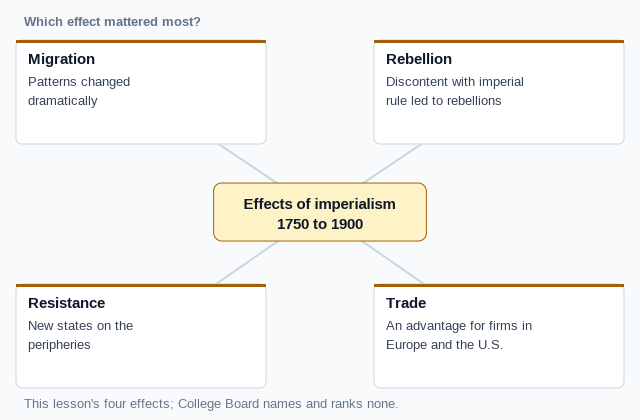
College Board's sample activity for this topic, run on four effects this lesson chose from the unit; the activity itself names none. A student group lists each effect and what changed under it.
- Migration: migrants relocated to cities, adding to global urbanization; women took on new roles at home; migrants created ethnic enclaves; states attempted to regulate the flow of people.
- Rebellion: increasing discontent with imperial rule led to rebellions, some influenced by religious ideas.
- Resistance: direct resistance within empires, and new states on the peripheries.
- Trade: trade in some commodities gave merchants and companies based in Europe and the U.S. a distinct economic advantage.
Rank the effects, then complete the activity's frame: "While imperialism in the 19th century had many effects, including ___, the most significant was ___ because ___."
Step 1 · Rank by the amount of change
Read each column for how much changed. Migration's changes reach both the societies migrants left and the ones they reached, and they touch whole cities as well as who ran a farm at home. Trade changed who profited from some commodities. A first ranking puts migration first.
Step 2 · Circle and revise
The activity asks the group to circle the three changes they judge most important and revise. Suppose they circle women's new roles, the growth of cities and new states on the peripheries. Two of the three most important changes are migration's, so it keeps first place, and resistance moves up past trade.
Why this step?
Why revise after the first ranking?
A long column can hold small changes. Circling the most important changes weighs them, so the ranking rests on how much changed, not on how many lines a column has.
Your step · Decide and justify
Finish it. Which completion of the frame argues the relative significance of the effects?
What makes that completion an argument about relative significance?
Part 4 Try it Evidence against a ranking
A claim and five pieces of evidence, all written for this page and not real.
> Claim. The change in migration was the most significant effect of imperialism throughout 1750 to 1900, because it reached every part of the world.
> A. A port city's census: 40,000 people in 1840 and 130,000 in 1890, most of the newcomers born abroad. > > B. A traveler's account, 1885: in every land he crossed, on four continents, villages had sent men abroad and cities had filled with newcomers. > > C. A survey of a large inland region in 1895: no family there had sent a member abroad, and no newcomers had arrived. > > D. A study of the period's ocean crossings: almost all came after 1840, and from 1750 to 1840 migration patterns barely changed. > > E. A historian's study of many colonies: in most of them, trade on prices set by European firms changed more households than migration did.
Use this lesson's working meanings of the three moves. Evidence corroborates if it agrees with the claim as written. It qualifies if the ranking survives but the claim must be limited to some places, people or times. It modifies if it shows the ranking itself, which effect was most significant, is wrong.
Try it · Sort it
Sort each piece of evidence by what it does to the claim.
Corroborates: the claim can stand as written
Qualifies: keep the ranking, add a limit
Modifies: the ranking itself must change
Part 5 Explain it Weighing two effects, from documents
This is a self-check. Nothing you type leaves this page. Hold your answer up to the model and each scoring point.
Free-response practice · Question 1 style
A short practice in the shape of the document-based question: a thesis, one sentence of context and one paragraph that uses both documents and explains the purpose of one, instead of a full essay. Both documents are written for this page and are not real.
Document 1: a report from a European trading company to its shareholders, 1885: "We buy the colony's palm oil at prices our agents fix and sell it in Europe for three times as much. No local merchant can match our ships or our credit."
Document 2: a letter from a migrant in a port city to his sister at home, 1890: "The city has doubled since I came, and on our street every voice is from home. You write that you now run the mill our uncle ran; there is no one else left to run it."
Using both documents, explain the relative significance of the effects of imperialism in the period from 1750 to 1900.
Model answer
Thesis: Of the effects of imperialism from 1750 to 1900, the change in migration was the most significant, because it reshaped societies at both ends of the journey, though for merchants in the colonies the trade advantage of European firms may have been the greater change.
Context: Railroads, steamships, and the telegraph made exploration, development, and communication possible in interior regions globally, which led to increased trade and migration, the two effects these documents weigh against each other.
Document 1 shows the trade effect: the company buys palm oil "at prices our agents fix" and says "no local merchant can match our ships or our credit," a distinct economic advantage for a company based in Europe. Document 2 shows migration changing two places at once. The city "has doubled," and the migrant's street, where "every voice is from home," is an ethnic enclave, while at home his sister now runs the mill their uncle ran, a new role in the society migrants left. Trade changed who profited from one commodity; migration changed where people lived and what they did at both ends, so it ranks higher. Document 1's purpose is to assure shareholders of profit, so it may overstate the company's hold on the trade, a limit on how far it can carry the case for trade.
Score your own answer. This is a self-check, not a grade. Tick each point your answer makes.
Part 6 Check yourself Evidence for a review
The table drives the first two questions. The last two come from the rest of the lesson.
A student gathered five pieces of evidence for a review of the unit. The table was written for this lesson, and every row is invented.
| Row | Evidence |
|---|---|
| 1 | A timeline: one revolution in 1789, five more in the next forty years, and new states still forming in the 1890s |
| 2 | A factory town's pay books, 1850: skilled machinists' wages doubled since 1820, while handloom weavers' wages fell by half |
| 3 | A draper's price list: cotton cloth in 1880 at a quarter of its 1820 price, in ten patterns instead of two |
| 4 | A port's arrivals from abroad: 2,000 a year in 1820, 60,000 a year in 1890 |
| 5 | A state that opened its first railway and factories in the 1870s, then took its first overseas colony in the 1890s |
Case question 1 · Spot the error
A student wrote this summary of the table. Which line goes wrong?
Case question 2 · Match
Match each row to the words of the review statement it best bears out.
The rest stand on their own and do not use the case.
Check yourself · Multiple choice
Which statement from this unit's key concepts describes a change in consumer goods?
Check yourself · Select all
A student claims that empire and expansion in this period changed where people lived. Which two statements from this unit could best corroborate the claim? Pick two.
Select 2 answers, then check.
Part 7 Keep it Bring back earlier ideas
One question from the effects of migration lesson, behind this unit's fourth review statement, and one from the economic imperialism lesson, behind its trade and empire.
From 6.7 Effects of Migration · Select all
Which two statements describe ethnic enclaves as this topic presents them? Pick two.
Select 2 answers, then check.
From 6.5 Economic Imperialism from 1750 to 1900 · Select all
A report written for this page is from a company based in Europe: "Our firm buys the copper at the mine, carries it in our own ships, and sets its price in our home market." Which two statements from this unit best situate the report within a broader historical context? Pick two.
Select 2 answers, then check.
In three lines
- Four review statements: higher living standards for some, industrializing states that also expanded empires, the beginning of an age of revolution, and a dramatic change in migration.
- Relative significance means comparing effects by a measure, such as the amount of change each caused.
- Corroborating evidence agrees with a claim, qualifying evidence limits it, and modifying evidence changes its point.
Exam strategy for this topic
- Section I Part A, Multiple Choice: 55 questions in 55 minutes.
- Section I Part B, Short Answer: 3 questions in 40 minutes.
- Section II, Document-Based Question and Long Essay: 2 questions in 100 minutes.
- This lesson's Explain it is shaped like free-response question 1, Document-based.
When an essay asks for relative significance, name in the thesis the effect you rank first, give the measure you ranked by, and add one limit the evidence shows, so the claim is qualified rather than absolute.
Questions students ask
Does College Board say which effect of imperialism mattered most?
No. The objective asks you to explain relative significance, and the sample activity has you rank the effects by the amount of change each caused. The ranking is your argument, and the one in this lesson is one that evidence can support, not the only one.
Does College Board call all four effects in this lesson effects of imperialism?
Only migration, in so many words: migration patterns changed as a result of the emergence of transoceanic empires and a global capitalist economy. This lesson reads rebellion and resistance from 6.3 Indigenous Responses to State Expansion from 1750 to 1900 and the trade advantage from 6.5 Economic Imperialism from 1750 to 1900 as effects too, and an essay that does the same should say why.
Why does a review of imperialism include industry and revolution?
The review lists four statements for the whole unit, not only for empire. The statements on industrial capitalism and on the period of revolution also appear in Unit 5, and the one on empire ties industry to imperialism: as states industrialized, they also expanded.
What is the difference between qualifying and modifying an argument?
Qualifying keeps the claim and limits it to some people, places or times. Modifying changes the claim's point, because evidence shows part of it is wrong, such as which effect ranks first.
Will multiple-choice questions test this topic's skill?
College Board says no multiple-choice questions explicitly assess the argumentation skill; the document-based question and the long essay question do. The questions here practice the reasoning those essays ask for.
How does this topic connect to Unit 7?
7.1 Shifting Power After 1900 opens the 20th century, when the West dominated the global political order at its beginning, but both land-based and maritime empires gave way to new states by its end.
Course alignment, for teachers
AP World History: Modern topic 6.8, Unit 6: Consequences of Industrialization.
- Skill 6.D: Corroborate, qualify, or modify an argument using diverse and alternative evidence in order to develop a complex argument.
This lesson maps all 4 essential knowledge statements of the topic, and the one learning objective with none of its own, to the part that teaches each one: 5 are checked by a scored question. The map is in the lesson file.