Unit 2 · Topic 2.4 · about 30 minutes · 7 parts · 9 scored checks, 2 of them multiple choice, plus 2 from earlier lessons
AP World History: Modern 2.4: Trans-Saharan Trade Routes
Unit 2: 8 to 10% of the multiple-choice section
What you'll be able to do
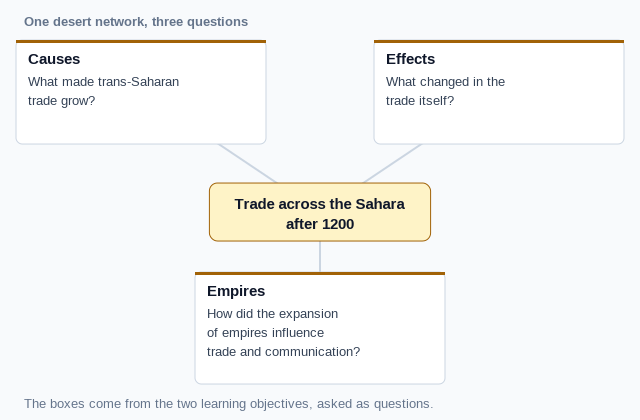
- Explain what caused trans-Saharan trade to grow, and what that growth led to.
- Explain how the expansion of empires, such as Mali, influenced trade and communication over time.
Key vocabulary
| Term | What it means | The exam trap |
|---|---|---|
| Trans-Saharan | Across the Sahara, the great desert of northern Africa. | The word names a direction of travel, not a people or a state. Read what a choice says crossed the desert. |
| Transportation technology | A tool or method for moving people and goods. | Moving goods and paying for them are different jobs. Read which one a choice describes. |
| Volume of trade | How much is traded. | How much was traded and how far it reached are two measures. A choice may give only one of them. |
| Geographical range | How far something reaches across the land or sea. | Range describes reach, not amount. Check which measure a question asks about. |
| Facilitate | To make something easier. | Read what was made easier, and for whom, before you accept a choice that uses this word. |
 Tap to open the picture full size
Part 1 Think first Across the desert
Commit to a guess before you read. A wrong guess now still helps the right idea stick.
Predict first
Merchants want to move more goods across the Sahara, a desert crossed by trade for a long time. Which change do you expect would help them most?
In short. After 1200, the existing trans-Saharan trade network carried more trade over a wider range, encouraged by innovations in older transportation technologies and by the expansion of empires such as Mali.
- Improved transportation technologies and commercial practices led to an increased volume of trade and expanded the geographical range of existing trade routes, including the trans-Saharan trade network.
- The growth of interregional trade was encouraged by innovations in existing transportation technologies, such as the camel saddle and caravans.
- The expansion of empires, including Mali in West Africa, facilitated Afro-Eurasian trade and communication as new people were drawn into the economies and trade networks.
Part 2 Learn it Trade across the Sahara
2a. An older network, carrying more
The trans-Saharan trade network, the routes across the Sahara, was not new after 1200. It is one of the existing trade routes the framework names, with the Silk Roads and the Indian Ocean.
What changed was scale. Improved transportation technologies and commercial practices led to an increased volume of trade and expanded the geographical range of the network. More goods crossed, and the trade reached farther.
This is the third time you have met nearly the same sentence. The Silk Roads statement names commercial practices; the Indian Ocean and trans-Saharan statements name transportation technologies as well. Seeing one sentence fit three networks is a connection you can use later in the unit.
One honest limit. The learning objective also asks what this growth led to. The framework names no effect of it beyond more trade over a wider range, and its Mali statement runs the other way, from an empire to trade. So this lesson does not offer an effect the framework does not give.
Quick check · Multiple choice
Which statement best explains why trade on the trans-Saharan network grew after 1200?
2b. Saddles and caravans
Which technologies? The framework's statement is general: the growth of interregional trade was encouraged by innovations in existing transportation technologies. Its possible examples, listed on the trans-Saharan page as technologies encouraging interregional trade, are the camel saddle and caravans.
Two words in that statement do the work. Existing means these were not first inventions; they were older technologies, improved. Encouraged is the link to trade: the innovations encouraged the growth of interregional trade.
What the framework does not give is the mechanics. It does not say how a better saddle or a better caravan changed a crossing, and this lesson does not invent an answer. When you explain, use the link it does give: innovations in existing transportation technologies encouraged the growth of interregional trade.
Quick check · Select all
Which two are transportation technologies whose innovation encouraged the growth of trans-Saharan trade? Pick two.
Select 2 answers, then check.
2c. Mali's expansion and the people it drew in
Empires mattered here too. The expansion of empires, including Mali in West Africa, facilitated Afro-Eurasian trade and communication as new people were drawn into the economies and trade networks.
That sentence explains as well as names. It gives a development (Mali expanded), an effect (trade and communication were facilitated, or made easier) and the how that joins them: new people were drawn into the economies and trade networks.
That is what the task verb explain asks for. College Board defines it as providing information about how or why a relationship, process, pattern, position, situation or outcome occurs, using evidence and/or reasoning. "Mali was an empire in West Africa" identifies. Adding how its expansion affected trade explains.
Compare 2.2 The Mongol Empire and the Making of the Modern World: there, new people were drawn into their conquerors' economies. The Mali statement says the economies and trade networks.
Quick check · Select all
A student writes, "Mali expanded in West Africa," and wants to explain how that expansion affected trade. Which two additions turn the sentence into that explanation? Pick two.
Select 2 answers, then check.
Part 3 Watch it done Explain a cause, not just name it
Watch the first steps, then take the last one yourself.
Explain one reason trade across the Sahara grew in the period c. 1200 to c. 1450.
Step 1 · Say what grew
The volume of trade on the existing trans-Saharan network increased, and its geographical range expanded. An explanation has to account for that growth.
Step 2 · Find a cause and its link
One cause is innovation in existing transportation technologies, such as the camel saddle and caravans. The link the framework gives is that such innovations encouraged the growth of interregional trade.
Why this step?
Why is "the camel saddle was a transportation technology" not an explanation?
It names the cause and stops. Explain asks how or why something occurs, so the sentence has to join the cause to the growth: innovations in that technology encouraged interregional trade.
Your step · Decide and justify
Finish it. Which sentence explains a reason trans-Saharan trade grew?
What makes your sentence an explanation?
Part 4 Try it Explains, or not?
Six sentences from imaginary students, each answering "Explain why trade across the Sahara grew from c. 1200 to c. 1450." They were written for this page. Decide which ones explain.
Try it · Sort it
Sort each student sentence by whether it explains why trans-Saharan trade grew.
Gives a cause and its link to the growth
Does not explain
Part 5 Explain it An empire and its trade
This is a self-check. Nothing you type leaves this page. Compare your answer with the model and each scoring point.
Free-response practice · Question 2 style
This is a partial long essay. Write a thesis, one sentence of context and one paragraph of evidence, not a full essay.
In the period c. 1200 to c. 1450, Mali expanded in West Africa.
Explain how the expansion of Mali affected trade and communication in the period c. 1200 to c. 1450.
Model answer
Thesis: Mali's expansion facilitated trade and communication by drawing new people into the economies and trade networks, while improved technologies and practices widened the trans-Saharan network.
Context: Trade was growing on other networks too. In the same years, improved practices and technologies increased trade on other existing routes, including the Silk Roads and the Indian Ocean, so Mali expanded while exchange across Afro-Eurasia was widening.
Improved transportation technologies and commercial practices increased the volume of trade on the existing trans-Saharan network and expanded its geographical range. As Mali expanded in West Africa, new people were drawn into the economies and trade networks. That is how the expansion bore on trade: people who had not been part of the networks became part of them, which facilitated Afro-Eurasian trade and communication.
Score your own answer. This is a self-check, not a grade. Tick each point your answer makes.
Part 6 Check yourself Three causes and their links
The table drives the first two questions. The last two come from the rest of the lesson.
A student set out the causes of the growth of trans-Saharan trade, with the link the framework gives for each. The table was written for this lesson from the framework's statements.
| Cause | The link to trade |
|---|---|
| Improved transportation technologies and commercial practices | Led to an increased volume of trade and expanded the geographical range of the existing network |
| Innovations in existing transportation technologies, such as the camel saddle and caravans | Encouraged the growth of interregional trade |
| The expansion of empires, including Mali in West Africa | Facilitated Afro-Eurasian trade and communication as new people were drawn into the economies and trade networks |
Case question 1 · Match
Each scene was written for this question. Match it to the cause in the table that it shows.
Case question 2 · Fill the statement
A classmate objects: caravans and the camel saddle were already in use, so they cannot explain why trade across the Sahara grew in this period. Complete the student's reply from the table.
The table's cause is not the caravans themselves but in those existing technologies, which encouraged trade to grow on an network.
The rest stand on their own and do not use the case.
Check yourself · Multiple choice
Which pairing puts a cause and its effect in the right order for trans-Saharan trade in this period?
Check yourself · Select all
A student is writing an explanation of the growth of trans-Saharan trade from c. 1200 to c. 1450. Which three of these belong in it? Pick three.
Select 3 answers, then check.
Part 7 Keep it Bring back earlier ideas
One question from the Indian Ocean lesson just before this one, and one from the Silk Roads lesson three back.
From 2.3 Exchange in the Indian Ocean · Multiple choice
Which statement best describes a connection between the Indian Ocean trading network and states in this period?
From 2.1 The Silk Roads · Select all
Improved commercial practices changed trade on the Silk Roads. Which two were results of those improved practices? Pick two.
Select 2 answers, then check.
In three lines
- Improved transportation technologies and commercial practices increased the volume of trade on the existing trans-Saharan network and expanded its range.
- Innovations in existing transportation technologies, such as the camel saddle and caravans, encouraged the growth of interregional trade.
- Mali's expansion in West Africa facilitated trade and communication as new people were drawn into the economies and trade networks.
Exam strategy for this topic
- Section I Part A, Multiple Choice: 55 questions in 55 minutes.
- Section I Part B, Short Answer: 3 questions in 40 minutes.
- Section II, Document-Based Question and Long Essay: 2 questions in 100 minutes.
- This lesson's Explain it is shaped like free-response question 2, Long essay.
When a prompt says explain, check each sentence you plan for a link. If it names a cause and stops, add how or why that cause bears on the development before you move on.
Questions students ask
Was trade across the Sahara new after 1200?
No. College Board's framework calls the trans-Saharan trade network one of the existing trade routes whose volume of trade and geographical range expanded.
Why does the framework count caravans as a technology?
It lists the camel saddle and caravans together as possible examples of technologies encouraging interregional trade, so on that page both count as technologies.
Does the framework say how the camel saddle helped trade?
No. It says innovations in existing transportation technologies encouraged the growth of interregional trade, and gives the camel saddle as an example. It does not describe how the saddle changed a crossing.
Does the Mali statement say Mali conquered the people it drew into trade?
It does not. The Mongol statement says new people were drawn into their conquerors' economies, but the Mali statement says only that new people were drawn into the economies and trade networks.
What did the growth of trans-Saharan trade lead to?
The framework does not say. It names more trade over a wider range on the existing network and gives no further effect of that growth, so this lesson adds none.
Course alignment, for teachers
AP World History: Modern topic 2.4, Unit 2: Networks of Exchange.
- Skill 1.B: Explain a historical concept, development, or process.
This lesson maps all 3 essential knowledge statements of the topic, and the 2 learning objectives with none of their own, to the part that teaches each one: 5 are checked by a scored question. The map is in the lesson file.