Unit 2 · Topic 2.3 · about 30 minutes · 7 parts · 9 scored checks, 2 of them multiple choice, plus 2 from earlier lessons
AP World History: Modern 2.3: Exchange in the Indian Ocean
Unit 2: 8 to 10% of the multiple-choice section
What you'll be able to do
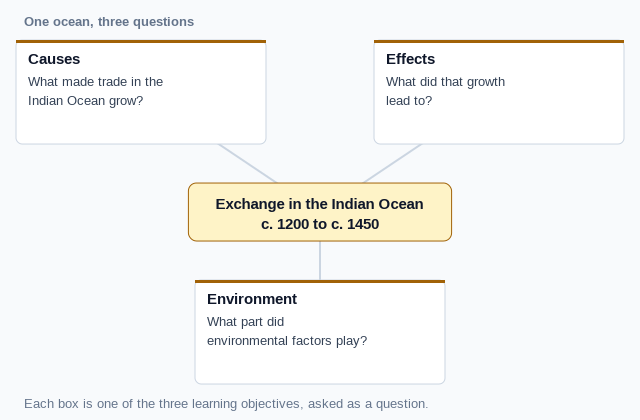
- Explain what caused networks of exchange such as the Indian Ocean routes to grow after 1200.
- Explain what the growth of networks of exchange such as the Indian Ocean routes led to after 1200.
- Explain the part environmental factors played in the development of networks of exchange from c. 1200 to c. 1450.
Key vocabulary
| Term | What it means | The exam trap |
|---|---|---|
| Monsoon winds | Seasonal winds over the Indian Ocean whose direction changes with the time of year. | A wind is part of the natural environment. Keep it apart from the tools sailors used when a question asks about one. |
| Compass | An instrument whose needle shows direction. | Read whether a stem asks about a tool, a route or a place before you use it. |
| Astrolabe | An instrument for finding position from the height of the sun or stars. | Instruments and ships can appear in the same list. Read the whole list a choice gives. |
| Diasporic community | A community of people living away from their homeland, such as merchants settled in a foreign port. | A community and a state can share a place on a map. Read which one a question asks about. |
| Indigenous culture | The culture of the people who belong to a place. | Two cultures meet in these questions. Keep track of which one a choice is describing. |
| City-state | A city that governs itself and the land around it as an independent state. | A city-state is a kind of state. Read whether a choice is about a state or about the people living in it. |
| Maritime | Having to do with the sea or travel by sea. | Maritime activity can carry trade, people or knowledge. Read which a choice says it carried. |
 Tap to open the picture full size
Part 1 Think first Strangers in port
Commit to a guess before you read. A wrong guess now still helps the right idea stick.
Predict first
Merchants from a land far across the sea settle in a port city and stay for years, raising families there. What do you expect happens to the culture of the city and to the culture of the merchants?
In short. After 1200, trade in the Indian Ocean grew in volume and reach, helped by innovations such as the compass and larger ship designs and by knowledge of the monsoon winds, and it fostered states and diasporic communities around the ocean.
- Improved transportation technologies and commercial practices expanded existing trade routes, including the Indian Ocean, and innovations including the compass, the astrolabe and larger ship designs encouraged interregional trade in luxury goods.
- The expansion and intensification of long-distance trade routes often depended on environmental knowledge, including advanced knowledge of the monsoon winds.
- The network fostered the growth of states, merchants set up diasporic communities where cultures influenced each other, and transfers took place during Chinese maritime activity led by Ming Admiral Zheng He.
Part 2 Learn it Trade across an ocean
2a. Ships, instruments and winds
The Indian Ocean routes, like the Silk Roads in 2.1 The Silk Roads, were existing trade routes. Improved transportation technologies and commercial practices increased the volume of trade on them and expanded their geographical range.
On the same page, the framework names the technologies: significant innovations in previously existing transportation and commercial technologies, including the use of the compass, the astrolabe, and larger ship designs, encouraged the growth of interregional trade in luxury goods. A compass shows direction; an astrolabe is an instrument for finding position from the sun or stars.
One more cause comes from the environment. The expansion and intensification of long-distance trade routes often depended on environmental knowledge, including advanced knowledge of the monsoon winds. Monsoons are seasonal winds. Intensification means growing busier.
That statement is about long-distance trade routes in general, and it keeps a qualifier: often depended. The framework prints it on its Indian Ocean page, but it does not say knowledge of the winds mattered on no other route.
Quick check · Select all
Which three of these were technologies or knowledge that the growth of Indian Ocean trade drew on? Pick three.
Select 3 answers, then check.
2b. What the trade built
Growing trade changed the places around the ocean. As on the Silk Roads, it promoted the growth of powerful new trading cities.
It also did something to governments: the Indian Ocean trading network fostered the growth of states. To foster is to help something grow. The framework's possible examples are the city-states of the Swahili Coast, Gujarat and the Sultanate of Malacca.
Read the direction of that sentence. The network fostered the states; the statement does not say the states built the network or shut others out of it. It also says nothing about how each state grew, so a claim about the details of Gujarat's or Malacca's government needs evidence from beyond this lesson.
Quick check · Multiple choice
Which statement best describes a connection between the Indian Ocean trading network and states in this period?
2c. Merchants abroad, and an admiral's voyages
Trade moved people as well as goods. In key places along important trade routes, merchants set up diasporic communities. A diaspora is a community living away from its homeland. In those communities, merchants introduced their own cultural traditions into the indigenous cultures, and, in turn, indigenous cultures influenced merchant cultures. Indigenous means belonging to a place: the local people.
Influence ran both ways. The possible examples are Arab and Persian communities in East Africa, Chinese merchant communities in Southeast Asia and Malay communities in the Indian Ocean basin.
Transfers also came with states. Interregional contacts and conflicts between states and empires encouraged significant technological and cultural transfers, including during Chinese maritime activity led by Ming Admiral Zheng He. Maritime means at sea. If that sentence sounds familiar, it should: 2.2 The Mongol Empire and the Making of the Modern World has nearly the same one, ending "including the Mongols".
Quick check · Select all
Merchants set up diasporic communities in key places along Indian Ocean trade routes. Which two statements describe what happened to culture there? Pick two.
Select 2 answers, then check.
Part 3 Watch it done Connect the environment to trade
Watch the first steps, then take the last one yourself.
Identify a connection between the natural environment and the growth of long-distance trade in this period, and state it as the framework does.
Step 1 · Find the statement that links them
One statement joins the two: the expansion and intensification of long-distance trade routes often depended on environmental knowledge, including advanced knowledge of the monsoon winds. The environment enters through knowledge of it.
Step 2 · Read the qualifiers
Two words limit the claim. Often means the dependence was common, not universal. Including makes the monsoon winds one kind of environmental knowledge, not the only kind.
Why this step?
Why keep the word often in your own sentence?
Without it, the sentence says long-distance trade always depended on such knowledge, which claims more than the framework does. A connection is only as strong as the evidence for it.
Your step · Decide and justify
Finish it. Which sentence states the connection the way the framework does?
Which evidence supports your choice?
Part 4 Try it Scenes from a port
Four scenes from an imagined port on the Indian Ocean. They were written for this page, not taken from a source, and each matches something College Board's framework describes. Match each scene to the development it shows.
Try it · Match
Match each scene from the port to the development it shows.
Part 5 Explain it Two causes, one ocean
This is a self-check. Nothing you type leaves this page. Compare your answer with the model and each scoring point.
Free-response practice · Question 2 style
Write a short version of a long essay answer: one thesis, one sentence of context and one paragraph of evidence.
After 1200, trade across the Indian Ocean grew in volume and reached farther.
Explain how environmental knowledge and transportation technologies contributed to the growth of Indian Ocean trade in the period c. 1200 to c. 1450.
Model answer
Thesis: Indian Ocean trade grew because it drew on knowledge of the environment, including the monsoon winds, and on innovations in older transportation technologies such as the compass and larger ship designs.
Context: Exchange was widening across Afro-Eurasia in the same years. The expansion of empires, including the Mongols, facilitated Afro-Eurasian trade and communication, so the growth of trade across the Indian Ocean belonged to a wider growth of exchange across Afro-Eurasia.
The expansion and intensification of long-distance trade routes often depended on environmental knowledge, including advanced knowledge of the monsoon winds. At the same time, significant innovations in previously existing technologies, including the compass, the astrolabe and larger ship designs, encouraged interregional trade in luxury goods. Each cause bore on trade in its own way: routes often depended on what sailors knew of the winds, and innovations in the tools they sailed with encouraged trade. So the growth often rested on what was known of the winds as well as on what ships carried and steered by.
Score your own answer. This is a self-check, not a grade. Tick each point your answer makes.
Part 6 Check yourself Notes on a port
The notes drive the first two questions. The last two come from the rest of the lesson.
A student wrote these notes on an imagined port of the Indian Ocean. The port is invented for this lesson, and every note is built from the framework's statements.
| Topic | Note |
|---|---|
| Ships | Larger ship designs, steered with the compass and the astrolabe |
| Sailing season | Planned with knowledge of the monsoon winds |
| Merchants | Arab and Persian merchants have set up a community in the city |
| Culture | The merchants' traditions and local traditions influence each other |
| Government | The ruler's state has grown with the trade through the port |
Case question 1 · Spot the error
The student turned the notes into a paragraph. Which line is the first to go wrong?
Case question 2 · Fill the statement
The notes do not say which of them are causes of the port's trade and which are effects. Complete the student's sentence using the framework.
The ships and the sailing season are of the port's trade, while the merchants' community and the ruler's growing state are of it.
The rest stand on their own and do not use the case.
Check yourself · Multiple choice
Two statements in the course are nearly the same sentence: interregional contacts and conflicts between states and empires encouraged significant technological and cultural transfers. One adds "including the Mongols". The other adds "including during Chinese maritime activity led by Ming Admiral Zheng He". What connection does this show?
Check yourself · Select all
Which two statements describe a pattern that trade on the Silk Roads and in the Indian Ocean shared after 1200? Pick two.
Select 2 answers, then check.
Part 7 Keep it Bring back earlier ideas
One question from the Mongol lesson just before this one, and one from South and Southeast Asia in Unit 1, a region this lesson's trade reached.
From 2.2 The Mongol Empire and the Making of the Modern World · Select all
Which two statements describe how the expansion of empires, including the Mongols, affected Afro-Eurasia? Pick two.
Select 2 answers, then check.
From 1.3 Developments in South and Southeast Asia from c. 1200 to c. 1450 · Multiple choice
Which statement best describes religion in South and Southeast Asia from c. 1200 to c. 1450?
In three lines
- Improved transportation technologies and commercial practices expanded existing routes, including the Indian Ocean, and innovations such as the compass and larger ship designs encouraged trade in luxury goods.
- Long-distance trade routes often depended on environmental knowledge, including advanced knowledge of the monsoon winds.
- The network fostered states, merchants set up diasporic communities where influence ran both ways, and transfers came with Zheng He's maritime activity.
Exam strategy for this topic
- Section I Part A, Multiple Choice: 55 questions in 55 minutes.
- Section I Part B, Short Answer: 3 questions in 40 minutes.
- Section II, Document-Based Question and Long Essay: 2 questions in 100 minutes.
- This lesson's Explain it is shaped like free-response question 2, Long essay.
When a statement carries a qualifier such as often, including or in turn, keep it in your answer. A choice that drops the qualifier usually claims more than the framework does, so read for it before you read for content.
Questions students ask
Were the compass and the astrolabe new inventions in this period?
The framework calls them innovations in previously existing transportation and commercial technologies, so they were improvements on tools that already existed, not first inventions.
Did knowledge of the monsoon winds matter only in the Indian Ocean?
The framework's statement is about long-distance trade routes in general, and it says their expansion often depended on environmental knowledge, including knowledge of the monsoon winds. It sits on the Indian Ocean page and names no other route.
Who was Zheng He?
The framework calls him a Ming Admiral who led Chinese maritime activity, and it names that activity as a time when contacts and conflicts encouraged technological and cultural transfers. It says no more about him.
Did merchant cultures replace local cultures in the port cities?
No. Merchants introduced their own traditions into the indigenous cultures, and in turn indigenous cultures influenced merchant cultures, so influence ran both ways.
Course alignment, for teachers
AP World History: Modern topic 2.3, Unit 2: Networks of Exchange.
- Skill 5.A: Identify patterns among or connections between historical developments and processes.
This lesson maps all 6 essential knowledge statements of the topic, and the 3 learning objectives with none of their own, to the part that teaches each one: 9 are checked by a scored question. The map is in the lesson file.