Unit 8 · Topic 8.1 · about 30 minutes · 7 parts · 9 scored checks, 2 of them multiple choice, plus 2 from earlier lessons
AP World History: Modern 8.1: Setting the Stage for the Cold War and Decolonization
Unit 8: 8 to 10% of the multiple-choice section
What you'll be able to do
- Explain the historical context of the Cold War after 1945.
Key vocabulary
| Term | What it means | The exam trap |
|---|---|---|
| Self-government | Rule of a people by leaders of its own rather than by an outside power. | Greater self-government is a matter of degree. A source can ask for more of it without asking for full independence. |
| Anti-imperialist sentiment | Feeling against empires and imperial rule. | Sentiment is a feeling people held, not an event or an army. Read whether a choice describes what people felt or what they did. |
| Dissolution | Breaking up, so that a whole no longer exists as one. | Dissolution names the breakup itself. On its own it says nothing about what drove the breakup, so look for the cause in its own words. |
| Restructuring of states | Changing how states are organized; the topic gives the phrase without detail, so this is its general meaning. | The statement pairs it with the dissolution of empires as a second result. A choice may give one result and leave out the other, so read for both. |
| Global balance of power | How power is spread among the world's states. | Balance here means how power is spread, not an even share. A shifted balance can leave power more uneven than before. |
 Tap to open the picture full size
Part 1 Think first Which war broke the empires?
Make a guess before you read. A wrong guess still helps the right idea stick.
Predict first
Two world wars ended in 1918 and 1945. Many people living under empires hoped to govern themselves after each one. After which war do you expect those hopes did better?
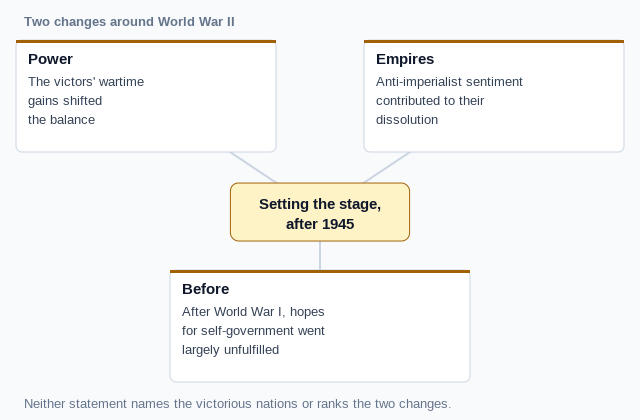
In short. This topic sets the stage for the Cold War and decolonization with two changes around World War II: one in who held power among states, and one in the fate of empires.
- Technological and economic gains experienced during World War II by the victorious nations shifted the global balance of power.
- Hopes for greater self-government were largely unfulfilled following World War I.
- In the years following World War II, increasing anti-imperialist sentiment contributed to the dissolution of empires and the restructuring of states.
Part 2 Learn it Two changes around World War II
8.1a. Two wars, two outcomes for empire
This topic's first statement sets the two wars side by side: Hopes for greater self-government were largely unfulfilled following World War I; however, in the years following World War II, increasing anti-imperialist sentiment contributed to the dissolution of empires and the restructuring of states.
However marks a change over time, and continuity and change is the reasoning process this topic is built on.
Before the turn, after the first war, hopes went largely unfulfilled. Largely leaves room for some hopes being met; the statement names none, so this page names none.
After the turn, in the years after the second war, rising feeling against empire contributed to their breakup. Contributed makes it one cause among others, and the statement names no others.
Two results follow, and they are not the same thing: empires dissolved, and states were restructured. 8.5 Decolonization After 1900 turns to how peoples pursued independence, and 8.6 Newly Independent States to the states that followed.
Quick check · Select all
This topic's statement on self-government describes a change over time. Which two choices give the two sides of that change? Pick two.
Select 2 answers, then check.
8.1b. What the winners gained
The second statement is about power among states: Technological and economic gains experienced during World War II by the victorious nations shifted the global balance of power.
Read it as a chain with three links. The gains came during the war. They belonged to the victorious nations, the side that won. Their result was a shift in the global balance of power, how power was spread among the world's states.
The statement does not list the victorious nations or say what each one gained. It gives the direction of the chain and no more: gains in the war, then a changed balance.
Set the two statements together and both changes sit at the second world war, not the first. The gains came during it, and the breakup of empires came in the years after it.
Quick check · Multiple choice
According to this topic, what shifted the global balance of power?
8.1c. The stage for the rest of the unit
This topic's skill is explaining how a specific historical development is situated within a broader historical context. The two statements are that context for the unit.
For the Cold War, 8.2 The Cold War gives the tie in its first line: the global balance of economic and political power shifted during and after World War II and rapidly evolved into the Cold War. It names the two states that came out on top: the democracy of the United States and the authoritarian communist Soviet Union emerged as superpowers. The Cold War sits inside the shift this topic describes.
For decolonization, the context is the first statement's second half. One colony winning its independence after 1945 is a single case inside the larger dissolution of empires.
A context does its work only when the sentence says how the broader development bears on the specific one. "World War II ended in 1945, and the Cold War came next" puts two events in order and ties nothing.
Quick check · Select all
An editorial written for this page (it is not a real source) appears in 1946: "The war has left two nations stronger than all the rest, and the old order will not return." Which two statements from this unit best situate the editorial within its broader historical context? Pick two.
Select 2 answers, then check.
Part 3 Watch it done Placing the Cold War in its setting
Watch the first steps, then take the last one yourself.
Explain how the Cold War is situated within a broader historical context.
Predict first
Before the steps: which would you reach for as the Cold War's broader context?
Step 1 · Name the specific development
The Cold War. 8.2 The Cold War describes it as ideological conflict and a power struggle between capitalism and communism, with the United States and the Soviet Union as the superpowers.
Step 2 · Find a broader development it sits inside
Look for something wider than the rivalry and older than it. This topic's second statement fits: during World War II the victorious nations made technological and economic gains, and those gains shifted the global balance of power.
Why this step?
Why is the shift in the balance of power broader than the Cold War?
It is a change in how power was spread across the whole world, begun during the war, and the Cold War is one rivalry that came out of it. A context has to be wider than what it explains.
Your step · Decide and justify
Finish it. Which sentence situates the Cold War within that broader context?
What makes it situate the Cold War?
Part 4 Try it Context for a colony's address
An address written for this page (it is not a real source), as if given on the radio in a colony in 1947 by the leader of a nationalist party:
> After the last war we asked for a greater share in governing ourselves, and we were told to wait. We waited. Now the war is over again, and from one end of the world to the other, peoples are turning against empire. We will not be told to wait a second time.
A class was asked to place the address in a broader historical context. Six students each wrote one sentence.
Try it · Sort it
Sort each student sentence by whether it places the address inside a broader development and ties it there.
Places the address in a broader development
Does not give a context
Part 5 Explain it The postwar setting, from two documents
This is a self-check. Nothing you type leaves this page. Set your answer beside the model and each scoring point.
Free-response practice · Question 1 style
A short practice in the shape of the document-based question: a thesis, one sentence of context and one paragraph that uses both documents and explains the purpose or audience of one, instead of a full essay. Both documents are written for this page and are not real.
Document 1: a report from an economist to a government's cabinet, 1946: "The nations that won this war leave it with new weapons, new machines and larger industries than they had in 1939. Power among nations will not be shared out as it was before the war."
Document 2: the radio address from Try it, given by the leader of a nationalist party in a colony, 1947.
Using both documents, explain the historical context of the Cold War after 1945.
Model answer
Thesis: The Cold War took shape in a world that World War II had remade, because the victors' wartime gains shifted the global balance of power, while rising feeling against empire was contributing to the breakup of the empires that had ruled much of that world.
Context: The West dominated the global political order at the start of the 20th century, but by the century's end both land-based and maritime empires had given way to new states, and Document 2 shows that older order losing its hold after 1945.
Document 1 shows the shift in power. The economist says the winners leave the war with "new weapons, new machines and larger industries," the technological and economic gains that shifted the global balance of power, and expects power to be shared out differently than before. That shifted balance rapidly evolved into the Cold War between the United States and the Soviet Union. Document 2 shows the other half of the setting. The speaker remembers being told to wait after the last war, when hopes for greater self-government went largely unfulfilled, and now hears peoples "turning against empire," the anti-imperialist sentiment that contributed to the dissolution of empires. A party leader speaking on the radio to the colony is out to rally listeners, so the address has reason to make the turn against empire sound worldwide and certain. It shows the mood the party wanted more surely than how far that feeling had spread.
Score your own answer. This is a self-check, not a grade. Tick each point your answer makes.
Part 6 Check yourself Four voices, 1920 to 1948
The table drives the first two questions. The last two come from the rest of the lesson.
Four short sources from before and after World War II. All four were written for this lesson and are not real.
| Row | Year and source | Its words |
|---|---|---|
| 1 | 1920, a petition from a colony's council to the imperial government | "We ask for a greater voice in the laws that govern us." A note at the foot reads: refused. |
| 2 | 1944, a factory manager's letter, in a nation that would win the war | "We now build in a month what took us a year before the war." |
| 3 | 1946, a diplomat's note to a foreign ministry | "Two states now stand above all others, and every other government must reckon with them." |
| 4 | 1948, a nationalist newspaper in a colony | "One empire after another is breaking apart, and our own turn is coming." |
Case question 1 · Fill the statement
Complete the note on the table.
Row records the kind of gains that shifted the global balance of power, and row shows the kind of hope that went largely unfulfilled.
Case question 2 · Spot the error
A student wrote this summary of the table. Which line goes wrong?
The rest stand on their own and do not use the case.
Check yourself · Multiple choice
A student writes: "In the years after World War II, colonies became independent of the empires that had ruled them." Which statement from this topic places that development within a broader context of the same years?
Check yourself · Select all
Which two developments does this topic place during or after World War II, rather than after World War I? Pick two.
Select 2 answers, then check.
Part 7 Keep it Bring back earlier ideas
One question from the Unit 7 review just before this lesson, and one from how World War II was fought three lessons back.
From 7.9 Causation in Global Conflict · Multiple choice
According to the review, peoples and states around the world challenged the existing political and social order in varying ways. What did those challenges lead to?
From 7.7 Conducting World War II · Multiple choice
A claim written for this page: "New weapons played no part in the rise of casualties in World War II." Which statement from this topic most directly refutes the claim?
In three lines
- Hopes for greater self-government were largely unfulfilled following World War I.
- In the years after World War II, increasing anti-imperialist sentiment contributed to the dissolution of empires and the restructuring of states.
- Gains made during World War II by the victorious nations shifted the global balance of power, the setting the Cold War grew out of.
Exam strategy for this topic
- Section I Part A, Multiple Choice: 55 questions in 55 minutes.
- Section I Part B, Short Answer: 3 questions in 40 minutes.
- Section II, Document-Based Question and Long Essay: 2 questions in 100 minutes.
- This lesson's Explain it is shaped like free-response question 1, Document-based.
For a context question on the Cold War, name the change in power that World War II left behind, then say in the same sentence how the rivalry grew out of it.
Questions students ask
Which nations were the victorious nations?
This topic's statement does not list them. 8.2 The Cold War names the two states that emerged as superpowers: the democracy of the United States and the authoritarian communist Soviet Union.
Did any hopes for self-government come true after World War I?
The statement says the hopes were largely unfulfilled. Largely leaves room for some, but it names none, so this lesson names none either.
Was anti-imperialist sentiment the reason empires ended?
The statement says it contributed to the dissolution of empires, so it was one cause among others. The topic names no others; 8.5 Decolonization After 1900 turns to how peoples pursued independence.
What is the cartoon in this topic's sample activity?
College Board's sample activity for this topic displays Paul Plaschke's cartoon of the Yalta Conference (1945) and asks students to predict how it might provide context for the unit. The debrief discusses how the events of World War II provide essential context for understanding the Cold War.
Why does a topic about context come before the Cold War itself?
A development is easier to explain once you know what it grew out of. This topic gives the shift in power and the breakup of empires first, so 8.2 The Cold War to 8.8 End of the Cold War can tie each later development to them.
Course alignment, for teachers
AP World History: Modern topic 8.1, Unit 8: Cold War and Decolonization.
- Skill 4.B: Explain how a specific historical development or process is situated within a broader historical context.
This lesson maps all 2 essential knowledge statements of the topic, and the one learning objective with none of its own, to the part that teaches each one: 3 are checked by a scored question. The map is in the lesson file.