Unit 8 · Topic 8.6 · about 35 minutes · 7 parts · 10 scored checks, 2 of them multiple choice, plus 2 from earlier lessons
AP World History: Modern 8.6: Newly Independent States
Unit 8: 8 to 10% of the multiple-choice section
What you'll be able to do
- Explain how political changes in the period from c. 1900 to the present led to territorial, demographic, and nationalist developments.
- Explain the economic changes and continuities resulting from the process of decolonization.
Key vocabulary
| Term | What it means | The exam trap |
|---|---|---|
| Metropole | The former colonizing country; the statement defines it in its own brackets. | The metropole is the old ruling country, not the former colony. Read which way a source says people moved before you use the word. |
| Population displacement | People forced from the places where they lived. | Displacement came in some cases, not with every redrawn border. A choice that makes it the rule has dropped in some cases. |
| Partition of India | One of the two cases the statement names in which redrawn boundaries led to displacement and/or resettlements. | The Partition is a named case of displacement, not an example of governments guiding economic life. Keep it with the borders statement. |
| Development | In this topic, the aim of governments that guided economic life: growth and modernization of the economy. | Development is what the governments sought, not proof they achieved it. The statement gives the aim, not the result. |
| Modify | To change part of an argument because evidence contradicts that part, while the rest stands. | Modifying is not refuting. If evidence leaves part of an argument standing, the move is modify, and the answer names the part that changes. |
 Tap to open the picture full size
Part 1 Think first After the flag comes down
Make a guess before you read. A wrong guess still helps the right idea stick.
Predict first
An empire withdraws from a colony, and a new state raises its own flag. Do you expect the ties between the new state and its old ruler to end, or to go on in some form?
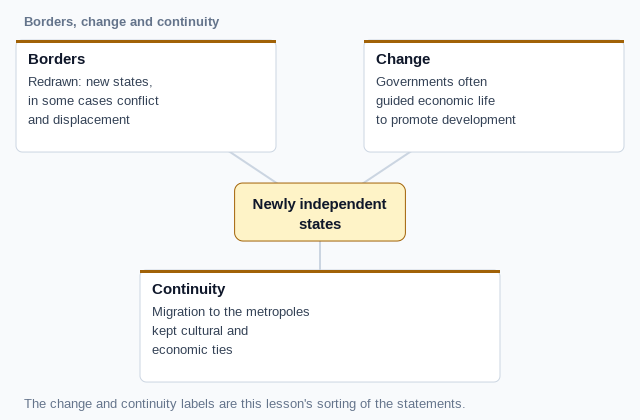
In short. When colonial authorities withdrew, redrawn borders made new states, and those states kept some old ties while changing how their economies were run.
- The redrawing of political boundaries led to new states and, in some cases, to conflict and population displacement and/or resettlements.
- In newly independent states after World War II, governments often took on a strong role in guiding economic life to promote development.
- Migration of former colonial subjects to the metropoles maintained cultural and economic ties even after the dissolution of empires.
Part 2 Learn it New borders, new states, old ties
8.6a. Redrawn borders make new states
The first statement is a short chain:
The redrawing of political boundaries after the withdrawal of former colonial authorities led to the creation of new states.
Read it in order. Colonial authorities withdrew. Political boundaries were redrawn. The redrawing led to new states. College Board's examples of states created this way are Israel, Cambodia, and Pakistan.
The first objective asks how political changes led to territorial, demographic, and nationalist developments. Redrawn borders and new states are the territorial part. The next chunk adds what the redrawing sometimes did to people, the demographic part. The statements in this topic name no nationalist development; 8.5 Decolonization After 1900 has the movements.
Quick check · Multiple choice
According to this topic, what did the redrawing of political boundaries after the withdrawal of former colonial authorities lead to?
8.6b. Conflict, displacement, and weighing a claim
The second statement carries the chain further:
The redrawing of political boundaries in some cases led to conflict as well as population displacement and/or resettlements, including those related to the Partition of India and the creation of the state of Israel.
In some cases keeps it from being a rule. And/or allows displacement, resettlement, or both. The two named cases are the Partition of India and the creation of the state of Israel.
This topic's skill is explaining how evidence supports, modifies, or refutes an argument. These are this lesson's working meanings. Evidence supports an argument when it agrees with it. It modifies an argument when it contradicts one part, so that part has to change and the rest stands. It refutes an argument when it contradicts the argument's core. A claim that new borders made new states peacefully is modified by this statement: the new states stand, the word peacefully does not.
Quick check · Select all
A claim written for this page: "The redrawing of political boundaries after colonial rule ended created new states peacefully." Which two pieces of evidence from this topic could best be used to modify the claim, that is, to change part of it rather than support it? Pick two.
Select 2 answers, then check.
8.6c. Governments guide economic life
The second objective asks for economic changes and continuities resulting from decolonization, and continuity and change is this topic's reasoning process. The third statement is about the new states' governments:
In newly independent states after World War II, governments often took on a strong role in guiding economic life to promote development.
Three words do the work. Often: many governments did, not every one. Guiding: the government steered economic life. To promote development: that was the aim.
College Board's examples are Gamal Abdel Nasser's promotion of economic development in Egypt, Indira Gandhi's economic policies in India, Julius Nyerere's modernization in Tanzania, and Sirimavo Bandaranaike's economic policies in Sri Lanka. A new government taking charge of economic life is a change that came with independence; this lesson sorts it as the change.
Quick check · Spot the error
A student summed up this chunk. Which line misreads it?
8.6d. Migration keeps old ties
The last statement is about people who moved:
The migration of former colonial subjects to imperial metropoles (the former colonizing country), usually in the major cities, maintained cultural and economic ties between the colony and the metropole even after the dissolution of empires.
A metropole is the former colonizing country; the statement defines it in its own brackets. The migrants usually settled in the major cities. Their migration maintained ties, cultural and economic, even after the empires dissolved.
So this is a continuity: something that went on across the end of empire. College Board's examples are South Asians to Britain, Algerians to France, and Filipinos to the United States.
Quick check · Multiple choice
A claim written for this page: "Once empires dissolved, the ties between former colonies and the former colonizing countries came to an end." Which evidence from this topic most directly refutes the claim?
Part 3 Watch it done Weighing one example
Watch the first steps, then take the last one yourself.
A passage written for this page (it is not a real source), from a historian: "Independence changed who ran the economy. In many new states, it was now the government that drew up the plans for the country's growth."
Explain how one of this topic's examples bears on the passage's argument.
Predict first
Before the steps: an example that agrees with an argument does what to it?
Step 1 · Name the argument
The passage argues for a change: after independence, the government in many new states drew up the plans for growth. Many is its own limit; it does not claim every state.
Step 2 · Choose the evidence
Julius Nyerere's modernization in Tanzania is one of this topic's examples. Find which statement it sits under in the third chunk before you judge it.
Why this step?
Why ask whether the evidence agrees with all of the argument or only part of it?
Evidence that agrees with the argument supports it. Evidence that contradicts one part modifies it, because that part has to change. Evidence that contradicts its core refutes it. Which of the three you name depends on where the evidence meets the argument.
Your step · Decide and justify
Finish it. Which sentence explains how the example bears on the passage?
What makes that sentence explain it?
Part 4 Try it Weighing a newspaper's claim
A newspaper article written for this page (it is not a real source), printed in 1975 in a state that had been a colony:
> Independence cut the threads that tied the new states to their old rulers. Their people no longer go there to live, and their trade no longer passes through the old rulers' cities.
Sort each piece of evidence by how it bears on the article's argument.
Try it · Sort it
Sort each piece of evidence from this topic.
Refutes the article
Does not bear on it
Part 5 Explain it What changed and what lasted
This is a self-check. Nothing you type leaves this page. Set your answer beside the model and each scoring point.
Free-response practice · Question 1 style
A short practice in the shape of the document-based question: a thesis, one sentence of context and one paragraph that uses both documents and explains the purpose or audience of one, instead of a full essay. Both documents are written for this page and are not real.
Document 1: the planning minister of a newly independent state, speaking to the state's new parliament, 1964: "The state will build the roads, the dams and the mills that no private company would build for us. This plan is how we will develop."
Document 2: a letter from a man who moved from a former colony to the capital of the country that once ruled it, to his family at home, 1968: "I send money home every month. The shop where I work sells cloth from our own country, and half our customers are from home."
Using both documents, explain the economic changes and continuities resulting from the process of decolonization.
Model answer
Thesis: Decolonization brought an economic change, as governments of the new states often took a strong role in guiding economic life, while migration to the former colonizing countries kept economic ties with them going.
Context: Earlier migrants had often created ethnic enclaves that helped transplant their culture into new environments, so the migrant in Document 2 followed an older pattern of moving abroad while holding on to home.
Document 1 shows the change. The minister says "the state will build the roads, the dams and the mills" and calls the plan "how we will develop," a government guiding economic life to promote development. His audience matters: speaking to a new parliament that must back the plan, he presents state building as the only way, since "no private company would build for us." Document 2 shows the continuity. A former colonial subject living in the old ruling country's capital sends "money home every month" and sells "cloth from our own country," so migration kept economic ties between the former colony and the metropole after the empire ended.
Score your own answer. This is a self-check, not a grade. Tick each point your answer makes.
Part 6 Check yourself Four scenes after independence
The table drives the first two questions. The last two come from the rest of the lesson.
Four short scenes from former colonies and their old rulers. All four were written for this lesson and are not real places.
| Row | Where | What happened |
|---|---|---|
| 1 | A former colony in Asia | As the colonial officials leave, a commission draws a new border, and a state that did not exist before holds its first election. |
| 2 | The same state, the following year | Fighting breaks out along the new border, and families on both sides leave their homes to cross it. |
| 3 | A newly independent state in Africa | The government's five-year plan pays for dams and steel mills, and its ministers set the price of grain. |
| 4 | The capital of a former colonizing country | A street of shops run by people from a former colony sells its goods, and its banks send money back there. |
Case question 1 · Fill the statement
Complete the note on rows 2 and 4.
Row 2 shows , and row 4 shows .
Case question 2 · Spot the error
A student wrote on change and continuity in the table. Which line misreads it?
The rest stand on their own and do not use the case.
Check yourself · Select all
Which two describe an economic change or continuity that this topic ties to decolonization? Pick two.
Select 2 answers, then check.
Check yourself · Select all
A passage written for this page (it is not a real source): "The end of empires redrew the map. Where colonial authorities withdrew, borders were drawn again, and states that had not existed before took their place." Which two pieces of evidence from this unit, outside the passage, could best support its argument? Pick two.
Select 2 answers, then check.
Part 7 Keep it Bring back earlier ideas
One question from the lesson just before this one, and one from the Cold War's effects three lessons back.
Two short speeches written for this page (they are not real sources):
> Speech A, the leader of a party in a colony in Asia, to a crowd in the colony's capital, 1946: "We do not ask the governor to leave tomorrow. We ask for a parliament of our own, inside the empire, to make our own laws."
> Speech B, the leader of a movement in a state in Africa a few years after independence, 1967: "The empire drew the lines that bound our region to this state. We did not choose them, and we ask to govern our own affairs."
Relate each speech to a development in this topic.
From 8.5 Decolonization After 1900 · Fill the statement
Complete the note on the two speeches.
Speech A seeks for its colony, and Speech B challenges .
Four short reports from the Cold War. All four were written for this lesson and are not real.
| Row | Year and place | The report |
|---|---|---|
| 1 | 1952, Europe | "Seven governments have signed a treaty, each pledged to come to the others' aid if one is attacked." |
| 2 | 1960, Asia | "A third state has now tested an atomic bomb, and two more are said to be close behind." |
| 3 | 1977, Africa | "Two armed movements fight for control of a country that left colonial rule two years ago. Each is armed by a different great power." |
| 4 | 1984, Latin America | "Troops of two neighboring states clash at the border again. One army is trained by one superpower, the other by its rival." |
From 8.3 Effects of the Cold War · Spot the error
A student compared rows 3 and 4. Which line misreads the table?
In three lines
- The redrawing of political boundaries after colonial authorities withdrew led to new states and, in some cases, to conflict and displacement.
- Governments in newly independent states often took on a strong role in guiding economic life to promote development.
- Migration to the metropoles maintained cultural and economic ties even after the dissolution of empires.
Exam strategy for this topic
- Section I Part A, Multiple Choice: 55 questions in 55 minutes.
- Section I Part B, Short Answer: 3 questions in 40 minutes.
- Section II, Document-Based Question and Long Essay: 2 questions in 100 minutes.
- This lesson's Explain it is shaped like free-response question 1, Document-based.
When you use evidence on an argument, say which move it makes, supports, modifies or refutes, and for modify, name the part of the argument that has to change.
Questions students ask
Which new states does this topic name?
College Board's examples of states created by the redrawing of political boundaries are Israel, Cambodia, and Pakistan. The redrawing came after the withdrawal of former colonial authorities.
Did every redrawn border lead to conflict?
No. The statement says in some cases, and names the Partition of India and the creation of the state of Israel as cases of displacement and/or resettlement.
What is a metropole?
The former colonizing country. Migrants from the former colonies usually settled in its major cities, and their migration maintained cultural and economic ties after empires dissolved.
Which is the change and which is the continuity?
This lesson sorts governments guiding economic life as a change that came with independence, and migration's ties as a continuity across the end of empire. The statements give the developments; the sorting is the lesson's.
What is the difference between modifying and refuting an argument?
Modifying changes part of an argument and leaves the rest standing. Refuting contradicts its core. A claim that new borders made new states peacefully is modified, not refuted, by the cases of conflict.
Did the governments' plans work?
The statement does not say. It gives the role governments took and their aim, to promote development, and names four leaders as examples.
Course alignment, for teachers
AP World History: Modern topic 8.6, Unit 8: Cold War and Decolonization.
- Skill 3.D: Explain how claims or evidence support, modify, or refute a source’s argument.
This lesson maps all 4 essential knowledge statements of the topic, and the 2 learning objectives with none of their own, to the part that teaches each one: 6 are checked by a scored question. The map is in the lesson file.