Unit 4 · Topic 4.4 · about 30 minutes · 7 parts · 9 scored checks, 2 of them multiple choice, plus 2 from earlier lessons
AP World History: Modern 4.4: Maritime Empires Established
Unit 4: 12 to 15% of the multiple-choice section
What you'll be able to do
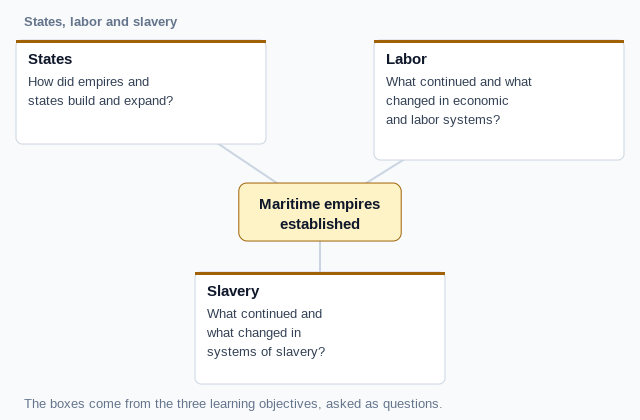
- Explain the process of state building and expansion among various empires and states in the period from 1450 to 1750.
- Explain the continuities and changes in economic systems and labor systems from 1450 to 1750.
- Explain changes and continuities in systems of slavery in the period from 1450 to 1750.
Key vocabulary
| Term | What it means | The exam trap |
|---|---|---|
| Maritime empire | An empire whose lands are linked and reached by sea. | A maritime empire could still hold land overseas. Do not rule out a choice only because it mentions colonies or territory on land. |
| Trading post | A place set up on a coast or route for trade. | A trading post is a place of trade, not a whole colony. Read whether a choice says Europeans ruled a region or traded at a post in it. |
| Isolationist | Keeping a country apart from contact with others. | An isolationist policy limits contact; it does not end a state's existence or its own trade. Read what a choice says the state kept apart from. |
| Intra-Asian trade | Trade between places within Asia. | Intra means within. A choice about trade between Asia and Europe is describing something else. |
| Chattel slavery | Slavery in which enslaved people are treated as property that can be owned, bought and sold. | Chattel slavery is a different thing from household enslavement in Africa. Read which place and which form a choice describes. |
| Mit'a, encomienda and hacienda | Names of labor systems in the colonial Americas. College Board names them without describing how they worked. | A choice may describe how one of them worked. The topic gives no such detail, so do not pick a choice for a detail you cannot find in the statement. |
 Tap to open the picture full size
Part 1 Think first A new post on a distant coast
Commit to a guess before you read. A wrong guess now still helps the right idea stick.
Predict first
A European state opens a trading post on a coast far from home, where powerful states and experienced merchants already trade. How do you expect the states and merchants already there to respond?
In short. European states built new empires by sea, states and merchants in Africa and Asia met the new trade in different ways, and labor in this period mixed old systems with new ones.
- Driven largely by political, religious and economic rivalries, European states established new maritime empires, and their new trading posts in Africa and Asia proved profitable for the rulers and merchants involved.
- Some Asian states adopted restrictive or isolationist trade policies, some African states grew in influence through trade, and existing Indian Ocean networks continued to flourish despite some disruption.
- Colonial economies in the Americas used existing labor systems and introduced new ones, enslavement in Africa continued in its traditional forms, and plantation growth increased the demand for enslaved labor in the Americas.
Part 2 Learn it Empires, trade and labor
4.4a. Empires by sea
Exploration in 4.2 Exploration: Causes and Events from 1450 to 1750 became empire. Driven largely by political, religious, and economic rivalries, European states established new maritime empires, including the Portuguese, Spanish, Dutch, French, and British. A maritime empire is one held together by the sea. Notice largely: rivalries were the main driver College Board gives, and the word leaves room for others it does not name.
The same states built outposts. Europeans established new trading posts in Africa and Asia, which proved profitable for the rulers and merchants involved in new global trade networks. Profitable for whom matters: the statement names rulers and merchants.
This topic's skill is identifying a source's historical situation, the setting it was produced in. Ask when and where the source was written, then find the larger development of that time and place that it belongs to. A development can be true of the period and still belong to another place, so let the source's own details decide.
Quick check · Select all
This topic says European states established new maritime empires. Which two statements match what it says about them? Pick two.
Select 2 answers, then check.
4.4b. Africa and Asia in the new trade
States in Africa and Asia did not answer the newcomers in one way.
Some held back. Some Asian states sought to limit the disruptive economic and cultural effects of European-dominated long-distance trade by adopting restrictive or isolationist trade policies. College Board's examples are Ming China and Tokugawa Japan. It does not describe the policies further.
Some grew. The expansion of maritime trading networks fostered the growth of states in Africa, including the Asante and the Kingdom of the Kongo, whose participation in trading networks led to an increase in their influence.
And an older network went on. Despite some disruption and restructuring due to the arrival of Portuguese, Spanish, and Dutch merchants, existing trade networks in the Indian Ocean continued to flourish and included intra-Asian trade and Asian merchants. The examples of those merchants are Swahili Arabs, Omanis, Gujaratis and Javanese. The sentence holds a change, some disruption and restructuring, inside a continuity.
Quick check · Select all
Which two describe how states in Africa and Asia took part in or responded to the new maritime trade, as this topic gives it? Pick two.
Select 2 answers, then check.
4.4c. Labor and slavery, old and new
In the Americas, newly developed colonial economies largely depended on agriculture, utilized existing labor systems, including the Incan mit'a, and introduced new labor systems including chattel slavery, indentured servitude, and encomienda and hacienda systems. That one sentence holds a continuity (existing systems) and a change (new ones). College Board names these systems without describing how each worked.
In Africa, slavery went on as before: enslavement in Africa continued in its traditional forms, including incorporation of enslaved persons into households and the export of enslaved persons to the Mediterranean and the Indian Ocean regions.
And in the Americas a new demand grew. The growth of the plantation economy increased the demand for enslaved labor in the Americas, leading to significant demographic, social, and cultural changes. The statement gives the chain, plantations to demand to change, but it does not list what the changes were.
Quick check · Multiple choice
Which labor system does this topic describe as already existing, rather than newly introduced, in the colonial economies of the Americas?
Part 3 Watch it done Placing a letter
Watch the first steps, then take the last one yourself.
A source described for this page: a letter written in the 1600s by a trader in a port on the East African coast. It complains that Portuguese ships have changed which goods reach the port and on what terms, but it adds that ships of Gujarati and Omani merchants still arrive each season. Identify the letter's historical situation.
Step 1 · When and where
The 1600s, on the East African coast, a shore of the Indian Ocean. The writer is a trader, so the letter is about commerce.
Step 2 · What the letter shows
Two things at once: the Portuguese arrival has changed some terms of trade, and Asian merchants from Gujarat and Oman go on trading there.
Why this step?
Why is the statement on Ming China and Tokugawa Japan the wrong setting for this letter?
That statement is about Asian states that restricted trade to limit its disruptive effects. This letter is about a port where trade went on, so it belongs with a development about the Indian Ocean network itself.
Your step · Decide and justify
Finish it. Which best describes the letter's historical situation?
Why does that describe it?
Part 4 Try it Where each source belongs
Four sources, each described for this page and none of them real. Read when, where and by whom each was produced, then match it to the development it was written within.
Try it · Match
Match each source to its historical situation.
Part 5 Explain it Old and new labor in the Americas
This is a self-check. Nothing you type leaves this page. Compare your answer with the model and each scoring point.
Free-response practice · Question 2 style
This is a partial long essay. Write a thesis, one sentence of context and one paragraph of evidence, not a full essay.
In the period c. 1450 to c. 1750, new colonial economies developed in the Americas.
Explain the continuities and changes in labor systems in the Americas in the period c. 1450 to c. 1750.
Model answer
Thesis: Labor in the colonial Americas combined continuity and change: colonial economies kept existing systems such as the Incan mit'a, while they introduced new ones, from chattel slavery to the encomienda, and the growth of plantations raised the demand for enslaved labor.
Context: In this period European states, driven largely by political, religious and economic rivalries, established new maritime empires, among them the Portuguese and Spanish. The colonial economies of the Americas grew up inside those empires, in places such as the Spanish colonies there.
The new colonial economies largely depended on agriculture. As a continuity, they utilized existing labor systems, including the Incan mit'a. As a change, they introduced new labor systems, including chattel slavery, indentured servitude, and the encomienda and hacienda systems. The growth of the plantation economy then increased the demand for enslaved labor in the Americas, leading to significant demographic, social and cultural changes. So older ways of organizing work carried on beside new systems, and the plantation economy pushed the new demand for enslaved labor further.
Score your own answer. This is a self-check, not a grade. Tick each point your answer makes.
Part 6 Check yourself Who took part, and how
The table drives the first two questions. The last two come from the rest of the lesson.
A student listed the groups and practices this topic names. The table was written for this lesson. It gives names and places only, not what each did or whether it was new.
| Row | Group | Where |
|---|---|---|
| 1 | Portuguese, Spanish, Dutch, French and British | Europe, with posts in Africa and Asia |
| 2 | The Asante and the Kingdom of the Kongo | Africa |
| 3 | Ming China and Tokugawa Japan | East Asia |
| 4 | Swahili Arabs, Omanis, Gujaratis and Javanese | The Indian Ocean |
| 5 | Enslaved persons kept in households, or exported to the Mediterranean and Indian Ocean regions | Africa |
Case question 1 · Fill the statement
A classmate says rows 2 and 3 show states in Africa and Asia doing the same thing with the new trade. Complete the reply, using what the lesson says about each row.
The two rows point opposite ways: the states in row 3 sought to the effects of European-dominated trade, while the states in row 2 gained influence by in trading networks.
Case question 2 · Spot the error
A student wrote five lines about the table's rows. Which line is the first that the lesson contradicts?
The rest stand on their own and do not use the case.
Check yourself · Multiple choice
A historian reads a report written by a European merchant at a new trading post in Asia, addressed to the rulers who backed the post. Which development from this topic best places the report in its historical situation?
Check yourself · Select all
Which two describe a continuity, not a change, in this period, as this topic gives it? Pick two.
Select 2 answers, then check.
Part 7 Keep it Bring back earlier ideas
One question from the Columbian Exchange lesson just before this one, and one from the exploration lesson two back.
From 4.3 Columbian Exchange · Select all
Which two statements about cash crops match this topic? Pick two.
Select 2 answers, then check.
From 4.2 Exploration: Causes and Events from 1450 to 1750 · Select all
Which two does this topic give as results of Portuguese maritime development, rather than goals? Pick two.
Select 2 answers, then check.
In three lines
- Driven largely by rivalries, European states established new maritime empires and profitable trading posts in Africa and Asia.
- Some Asian states restricted trade, the Asante and the Kongo grew through it, and Indian Ocean networks continued to flourish despite some disruption.
- Colonial labor in the Americas joined existing systems to new ones, African enslavement kept its traditional forms, and plantations raised the demand for enslaved labor.
Exam strategy for this topic
- Section I Part A, Multiple Choice: 55 questions in 55 minutes.
- Section I Part B, Short Answer: 3 questions in 40 minutes.
- Section II, Document-Based Question and Long Essay: 2 questions in 100 minutes.
- This lesson's Explain it is shaped like free-response question 2, Long essay.
When a question asks for a source's historical situation, write down when and where the source was produced before you read the choices. The right choice is a development of that time and place, not just one that is true of the period.
Questions students ask
Why did European states build maritime empires?
College Board says they were driven largely by political, religious and economic rivalries. It does not rank the three, and largely leaves room for other drivers.
Which Asian states restricted trade?
The examples are Ming China and Tokugawa Japan. The statement says some Asian states adopted restrictive or isolationist trade policies to limit the disruptive effects of European-dominated trade, and it does not describe the policies further.
Did European merchants take over the Indian Ocean?
No. Their arrival brought some disruption and restructuring, but existing networks continued to flourish and included intra-Asian trade and Asian merchants such as Swahili Arabs, Omanis, Gujaratis and Javanese.
How did the mit'a or the encomienda work?
This topic does not say. It names the mit'a as an existing Incan system that colonial economies utilized, and encomienda and hacienda among the systems they introduced.
What changed for slavery in this period, and what did not?
Enslavement in Africa continued in its traditional forms, including incorporation into households and export to the Mediterranean and Indian Ocean regions. In the Americas, chattel slavery was introduced, and the growth of the plantation economy increased the demand for enslaved labor.
Course alignment, for teachers
AP World History: Modern topic 4.4, Unit 4: Transoceanic Interconnections.
- Skill 2.A: Identify a source’s point of view, purpose, historical situation, and/or audience.
This lesson maps all 7 essential knowledge statements of the topic, and the 3 learning objectives with none of their own, to the part that teaches each one: 10 are checked by a scored question. The map is in the lesson file.